
The adoption of Bluetooth Core 7.0 in November 2026 introduces HDT with physical layer data rates of up to 7.5 Mbps, compared with the previous Bluetooth LE maximum of 2 Mbps. The new specification establishes a foundation for high-resolution and lossless audio, spatial computing, connected devices and industrial applications. Semiconductor suppliers are responding with new Bluetooth chipsets, wireless microcontrollers, integrated connectivity platforms and licensable IP. Some solutions are commercially available, while others remain in development or are progressing towards commercialisation. This WiFi NOW tracker identifies the leading suppliers and their products, focusing on four technologies:
- LE Audio: Next-generation Bluetooth audio using LC3 and isochronous communications.
- Auracast: Broadcast audio enabling compatible devices to receive shared audio streams.
- Channel Sounding: Secure distance measurement using Bluetooth 6.x technology.
- High Data Throughput (HDT): Bluetooth Core 7.0 technology supporting PHY rates of up to 7.5 Mbps.
The tracker also covers conventional Bluetooth LE and ultra-low-power wireless solutions. All capabilities are assessed against publicly available manufacturer documentation. Support for a particular Bluetooth Core version does not automatically establish support for every optional feature. Technical reference: Bluetooth Core 7.0 Feature Overview – Bluetooth SIG
2. Global Bluetooth silicon suppliers
Qualcomm
Qualcomm supplies Bluetooth audio and wireless connectivity platforms for mobile devices, earbuds, headphones and integrated wireless systems. The QCC5181 supports LE Audio and Auracast alongside Snapdragon Sound technologies. Qualcomm’s FastConnect 8800 integrates Wi-Fi 8, Bluetooth, UWB and Thread, with announced support for Bluetooth Channel Sounding and HDT. Products: QCC5181, FastConnect 8800. Technology coverage: LE Audio, Auracast, Channel Sounding, HDT.
MediaTek
MediaTek provides Bluetooth connectivity across smartphones, multimedia devices and integrated wireless platforms. The Dimensity 9200 supports LE Audio and Auracast. The Filogic 380 combines Wi-Fi 7 with Bluetooth connectivity and includes manufacturer-described HDT support. Conformance of that earlier HDT implementation with the final Bluetooth Core 7.0 specification remains unverified. Products: Dimensity 9200, Filogic 380. Technology coverage: LE Audio, Auracast, Bluetooth LE, manufacturer-described HDT.
Silicon Labs
Silicon Labs develops Bluetooth LE SoCs and modules for connected devices, industrial applications and low-power IoT. Its EFR32BG24 and BG24L platforms support Channel Sounding development, while the BG2B extends the company’s portfolio of ranging-capable Bluetooth devices. Silicon Labs provides development kits, SDK support and a distance estimation algorithm. Products: EFR32BG24, EFR32BG24L, EFR32BG2B. Technology coverage: Bluetooth LE, Channel Sounding, low-power IoT. Technical reference: Silicon Labs Channel Sounding.
Synaptics
Synaptics supplies wireless connectivity platforms for intelligent edge devices, embedded systems, and IoT. The SYN4390 combines Wi-Fi 7, Bluetooth 6.0, and IEEE 802.15.4 connectivity. Its published product brief explicitly confirms LE Audio and Bluetooth Channel Sounding distance measurement. The broader portfolio includes the SYN4384, SYN43711, SYN43756(E) and SYN43016. Products: SYN4390, SYN4384, SYN43711, SYN43756(E). Technology coverage: LE Audio, Channel Sounding, integrated wireless connectivity.
NXP Semiconductors
NXP Semiconductors provides Bluetooth audio and wireless microcontroller solutions for consumer, industrial, automotive and secure access applications. The NXH3675 is an active Bluetooth 5.3 LE Audio-certified chipset supporting Auracast, including transmitter and receiver applications. It also supports LC3, LC3plus and multi-stream audio. NXP’s MCX W72 and MCX W70 wireless MCU families address Bluetooth Channel Sounding and secure ranging. Products: NXH3675, MCX W72, MCX W70. Technology coverage: LE Audio, Auracast, Channel Sounding, Bluetooth LE.
STMicroelectronics
STMicroelectronics develops Bluetooth LE wireless microcontrollers and embedded connectivity platforms. Its STM32WBA5x family supports LE Audio and Auracast, including software development for embedded audio applications. The STM32WBA6 supports Bluetooth LE 6.0 but does not support Channel Sounding because the required hardware is absent. ST has indicated that future devices will incorporate the feature. Products: STM32WBA55, STM32WBA6, STM32WB0. Technology coverage: LE Audio, Auracast, Bluetooth LE, embedded wireless connectivity. Technical reference: STMicroelectronics Channel Sounding clarification.
CEVA
CEVA provides licensable Bluetooth IP for integration into third-party semiconductor products. Its Ceva-Waves platform supports LE Audio, Auracast, Channel Sounding and HDT up to 7.5 Mbps. CEVA has disclosed more than ten HDT IP licensees, including for Actions Technology’s ATS296X audio chipset family. Products: Ceva-Waves Bluetooth IP. Technology coverage: LE Audio, Auracast, Channel Sounding, HDT.
Nordic Semiconductor
Nordic Semiconductor develops low-power wireless SoCs for IoT, wearables, audio and connected devices. The nRF5340 Audio platform supports LE Audio and Auracast, while the nRF54 family provides Channel Sounding capabilities. Nordic demonstrated prototype HDT silicon in October 2026 and is developing an HDT-capable SoC. Products: nRF5340 Audio, nRF54L, HDT prototype. Technology coverage: LE Audio, Auracast, Channel Sounding, HDT development. Technical reference: Nordic demonstrates HDT in silicon.
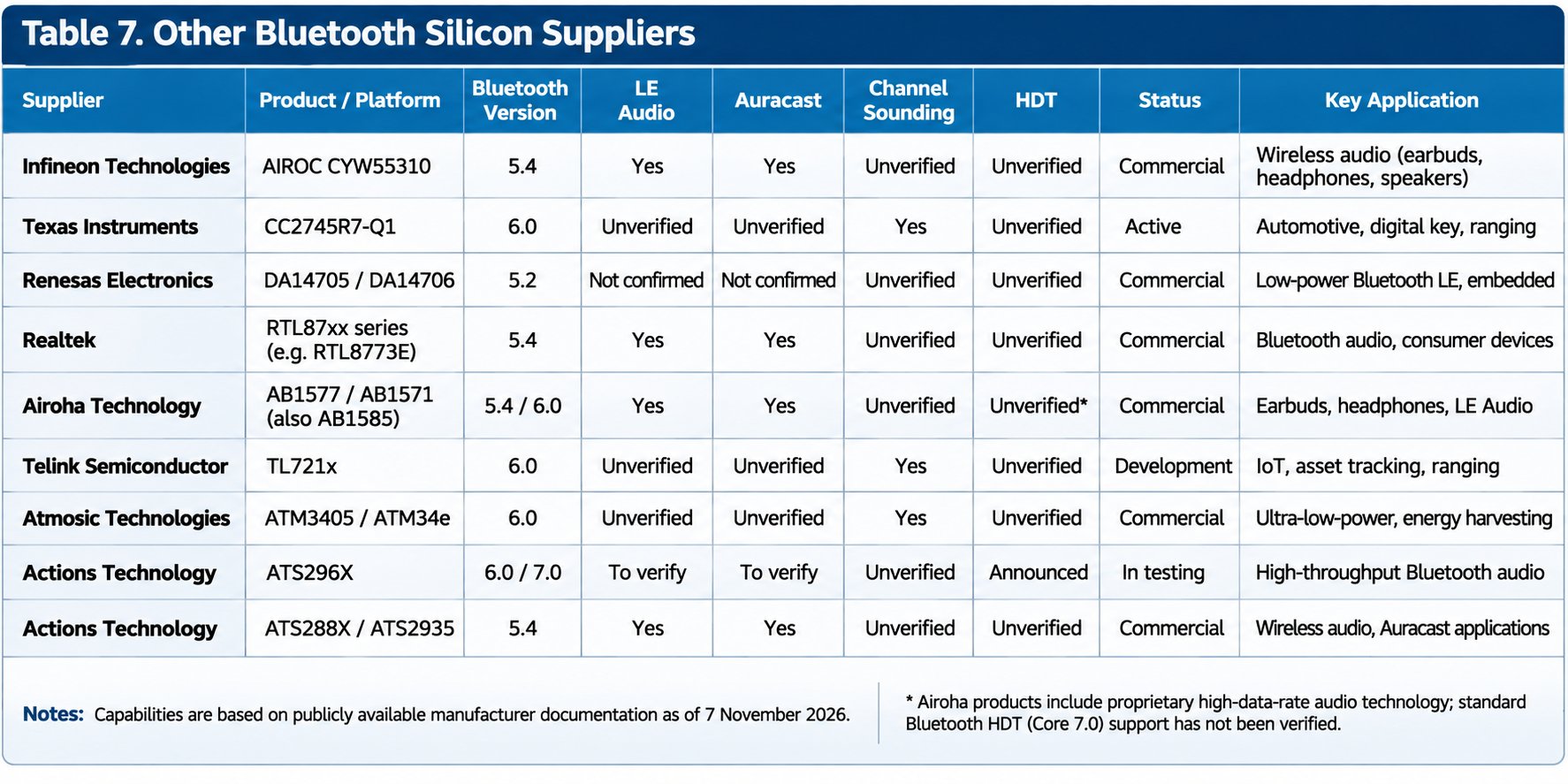
3. Bluetooth silicon technology comparison
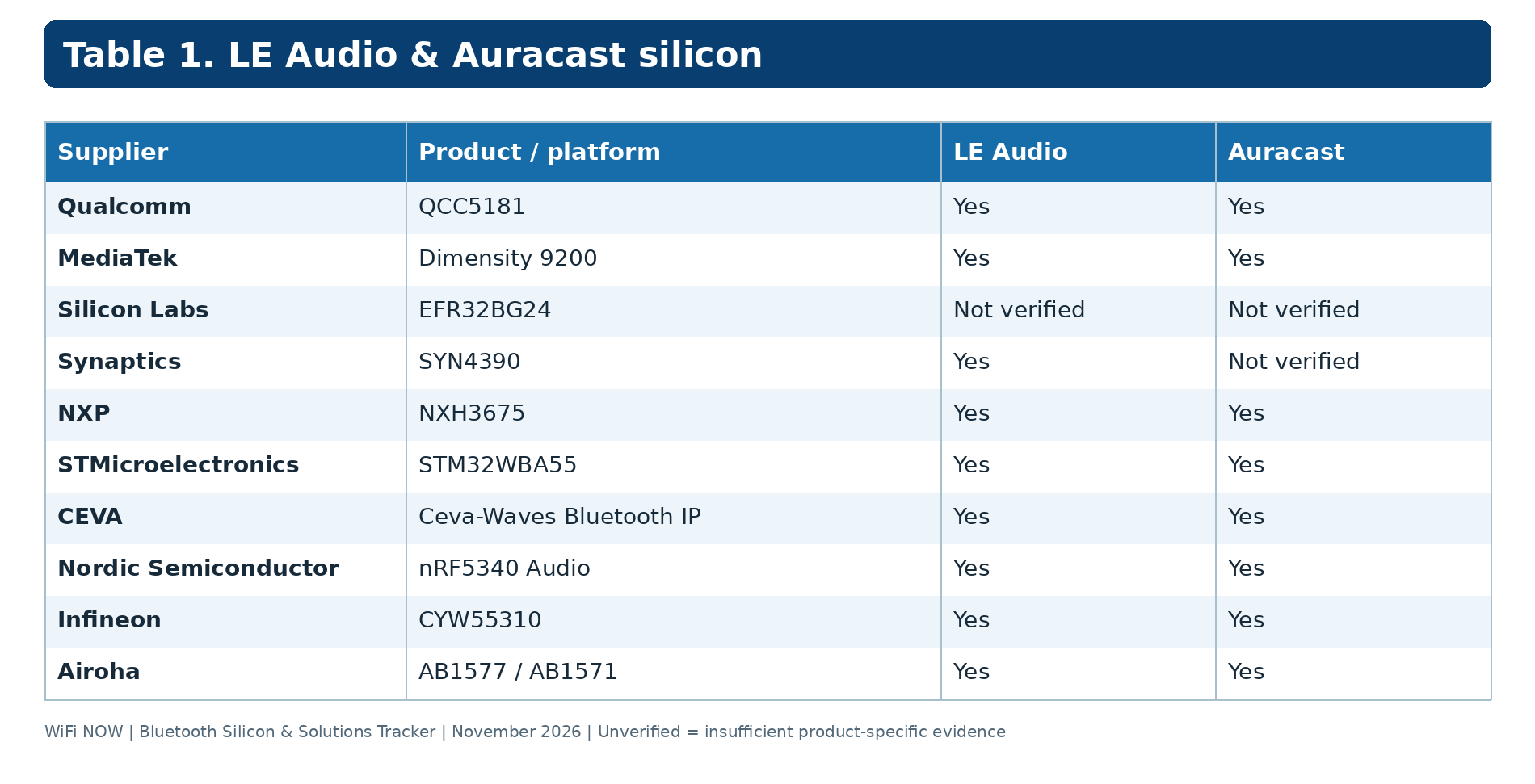
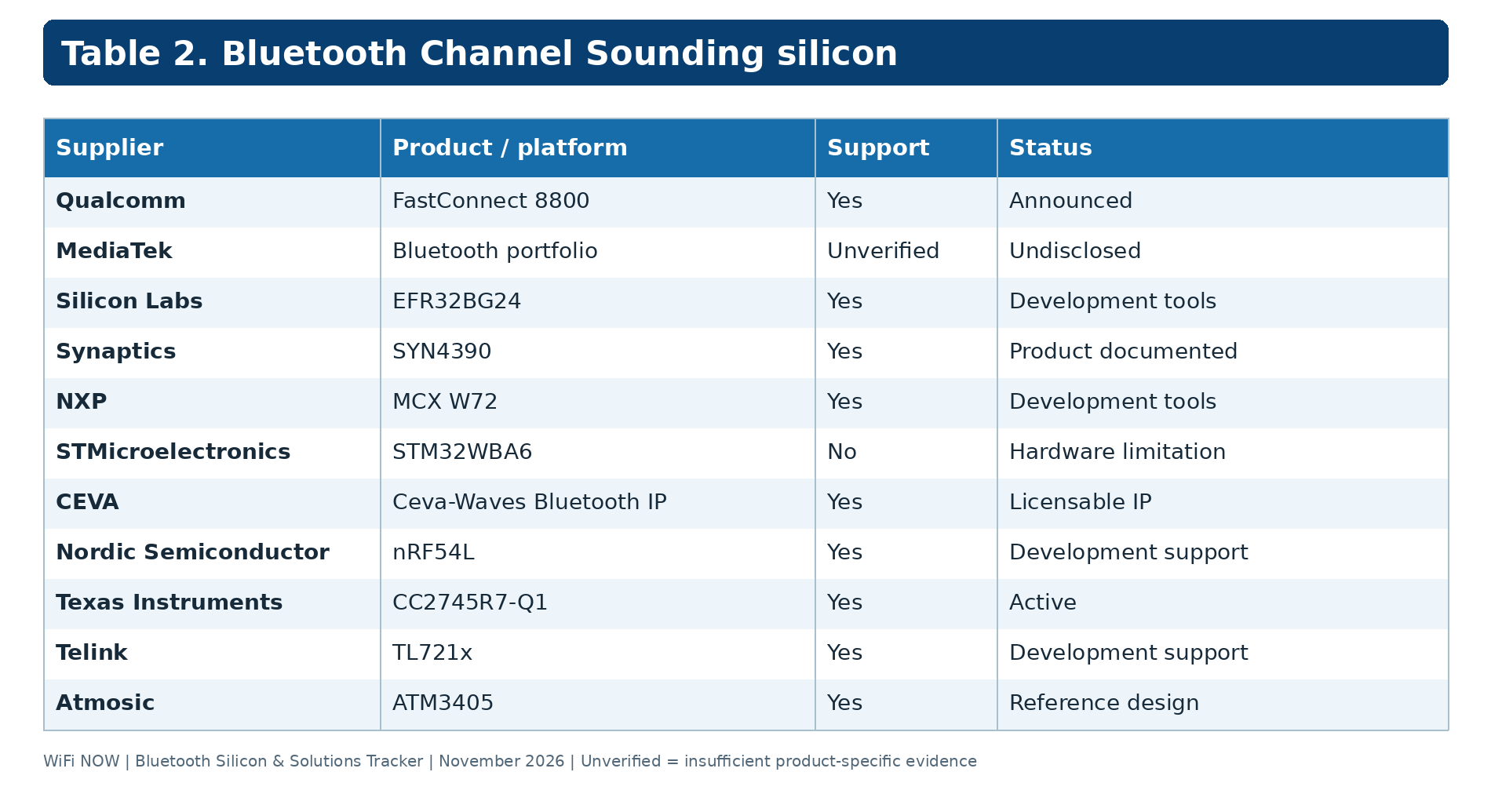
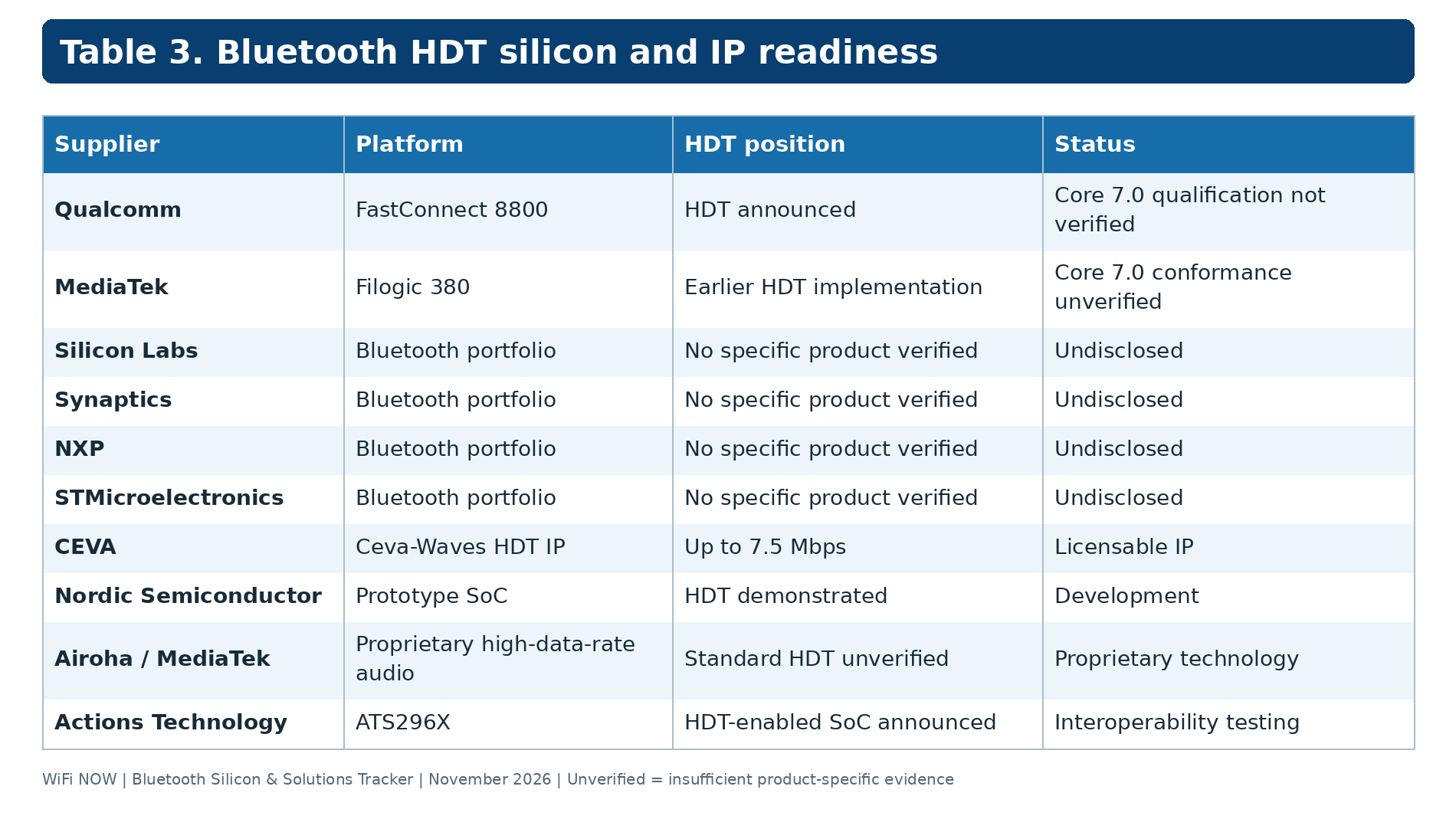
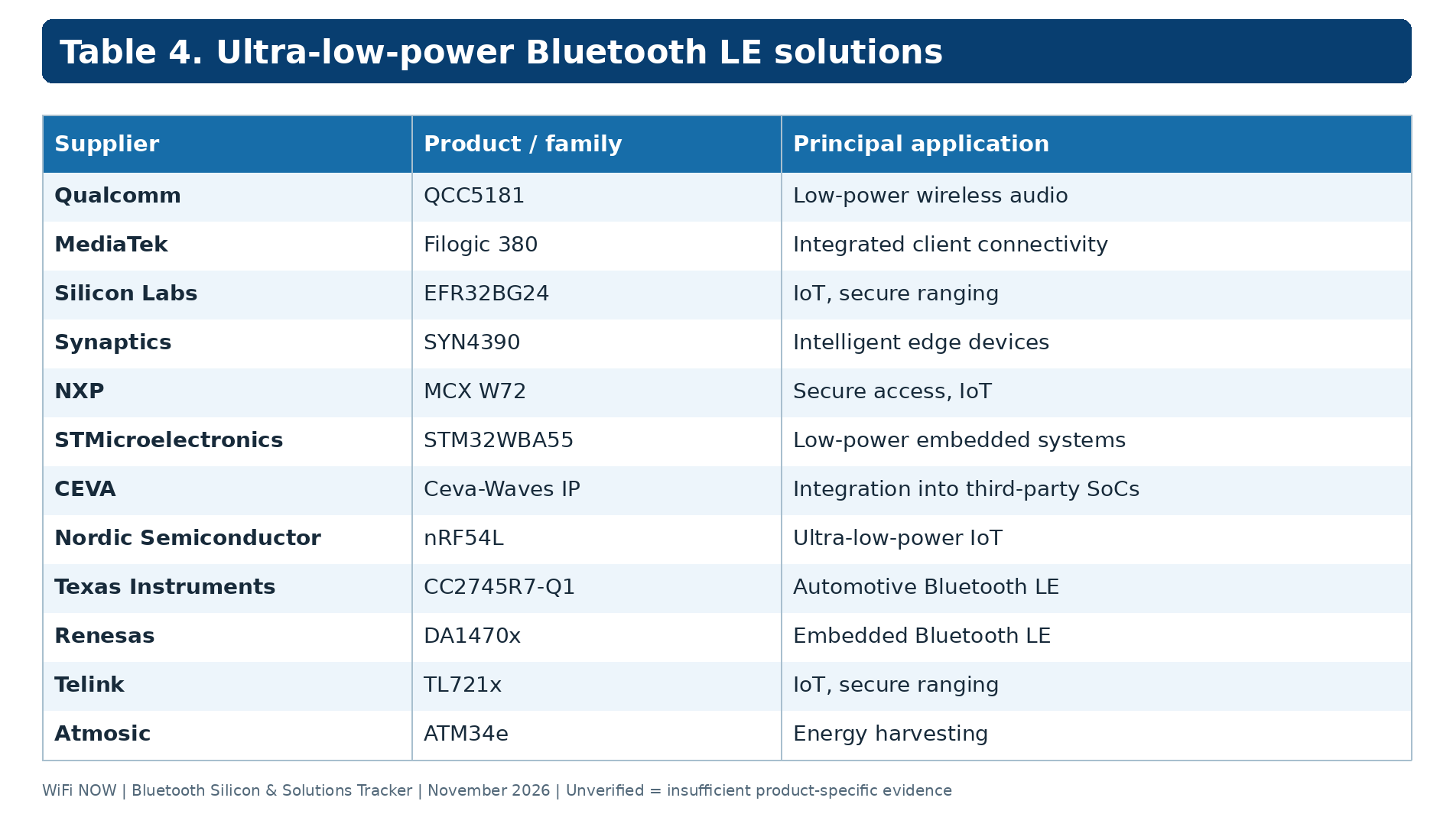
The following tables compare documented product capabilities. Features without sufficient product-specific evidence are marked as unverified.
4. Bluetooth HDT: The next generation
Bluetooth HDT introduces a new physical layer supporting substantially higher data rates while retaining the Bluetooth LE architecture. The Bluetooth Core 7.0 specification defines five HDT operating modes:
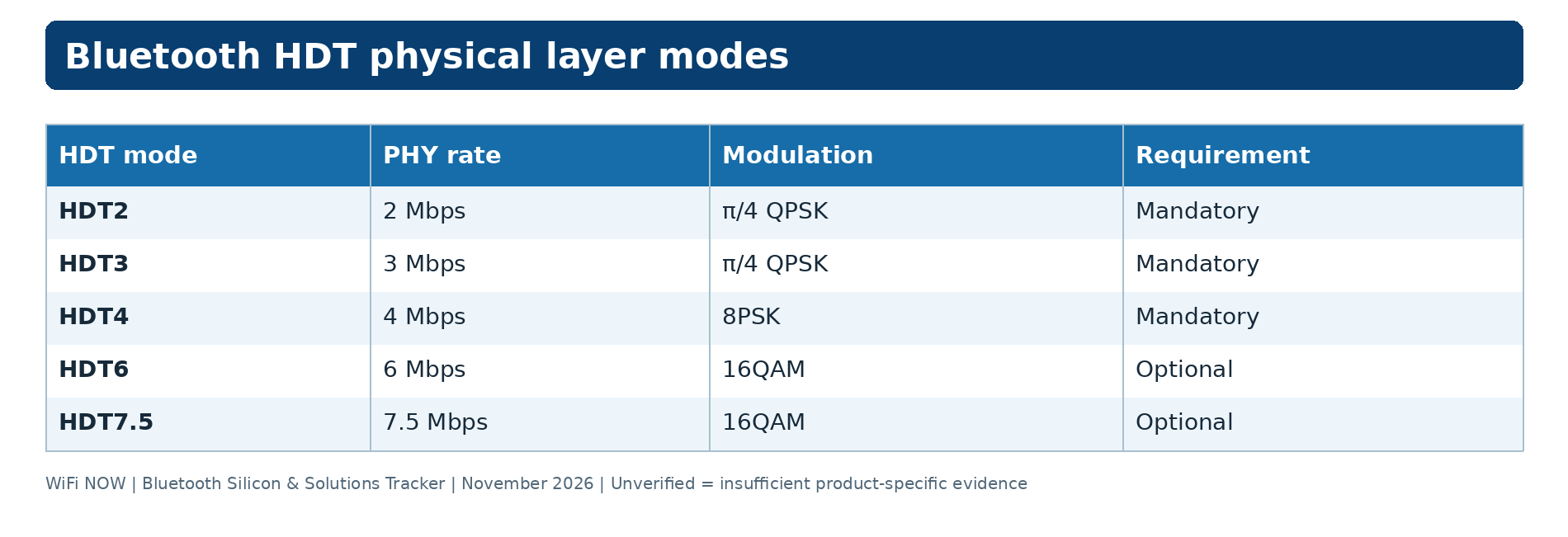
HDT7.5 requires HDT6 support. These figures represent PHY bit rates, not application throughput.
The Bluetooth SIG expects HDT to support standardised high-resolution and lossless wireless audio, with further applications in spatial computing, connected devices and industrial systems.
Semiconductor development is already under way. Qualcomm has announced HDT in FastConnect 8800, CEVA provides licensable HDT IP, Actions Technology has announced its ATS296X chipset family, and Nordic Semiconductor has demonstrated prototype silicon. Commercial availability and interoperability will depend on the release of compatible hardware, software stacks, qualification support and finished products.Technical reference: Bluetooth Core 7.0 Feature Overview.
5. Master Bluetooth Silicon & Solutions Tracker
This consolidated matrix summarises the principal products and documented capabilities [click on image to enlarge].
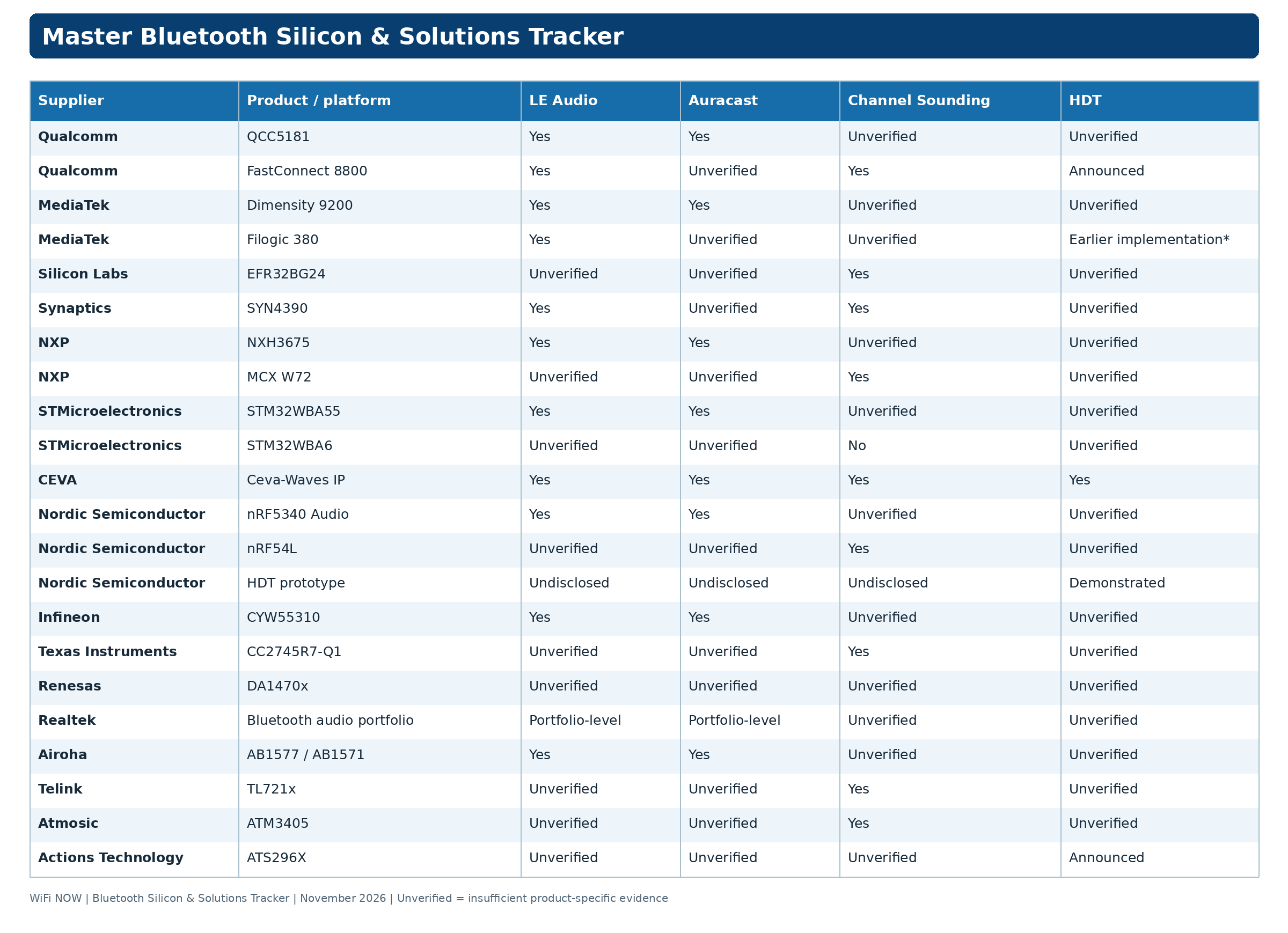
MediaTek’s earlier HDT implementation has not been verified against the final Bluetooth Core 7.0 specification.
Product references are provided in the preceding technology tables.
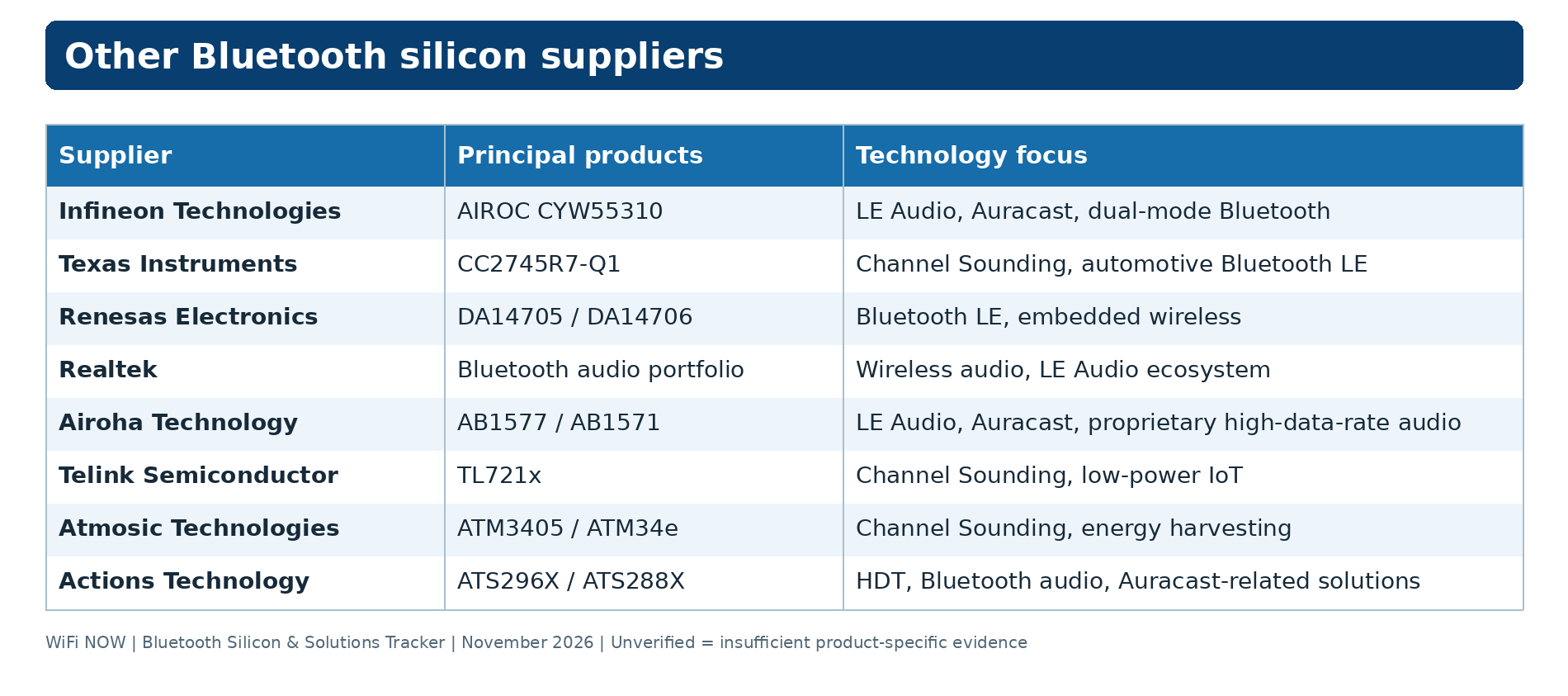
6. Tracker methodology and updates
The WiFi NOW Bluetooth Silicon & Solutions Tracker is based on publicly available manufacturer documentation, product specifications, official announcements and Bluetooth qualification information. Products are assessed according to documented capabilities and commercial readiness. The tracker distinguishes between commercially available silicon, development platforms, announced products, licensable IP and prototype technologies.
An unverified entry indicates that sufficient public evidence has not been established. It does not necessarily mean that the feature is unsupported. Bluetooth qualification of a controller or chipset does not automatically establish qualification or interoperability of every finished product using that silicon. The tracker will be updated as suppliers introduce new Bluetooth products, publish technical documentation and announce support for emerging specifications.
Download all tracker information in Excel format
First edition: November 2026
Last reviewed: 7 November 2026
Next scheduled review: February 2027
Disclaimer: This tracker is based on publicly available manufacturer information as of November 2026. Product specifications, feature support and commercial availability may change. WiFi NOW makes reasonable efforts to ensure accuracy but cannot guarantee the completeness or correctness of all information. Unverified features should not be interpreted as unsupported.