By Claus Hetting, WiFi NOW CEO & Chairman
UWB in ACTION – Europe’s first open UWB congress co-produced by WiFi NOW and Pinpoint – was held in Chemnitz, Germany, on October 29, 2026. This is a summary of the proceedings. View videos of all the presentations on-demand here and consult the event’s full program here.
Executive Summary
UWB has moved past proving the technology and into the adoption phase. The message from UWB in ACTION 2026, October 29 – the first UWB-focused event in Europe, hosted by Wi-Fi NOW and Pinpoint – was that the main barriers for adoption are now related to business issues and no longer technical. Speakers from ABI Research, Qorvo/Skyworks, STMicroelectronics, NXP, HPE, Deutsche Bahn, SICK, Flowcate and Infineon all made the same case. Standards (FiRa and omlox) are in place, UWB is going into Wi-Fi access points, and IEEE 802.15.4ab is about to expand the market considerably.
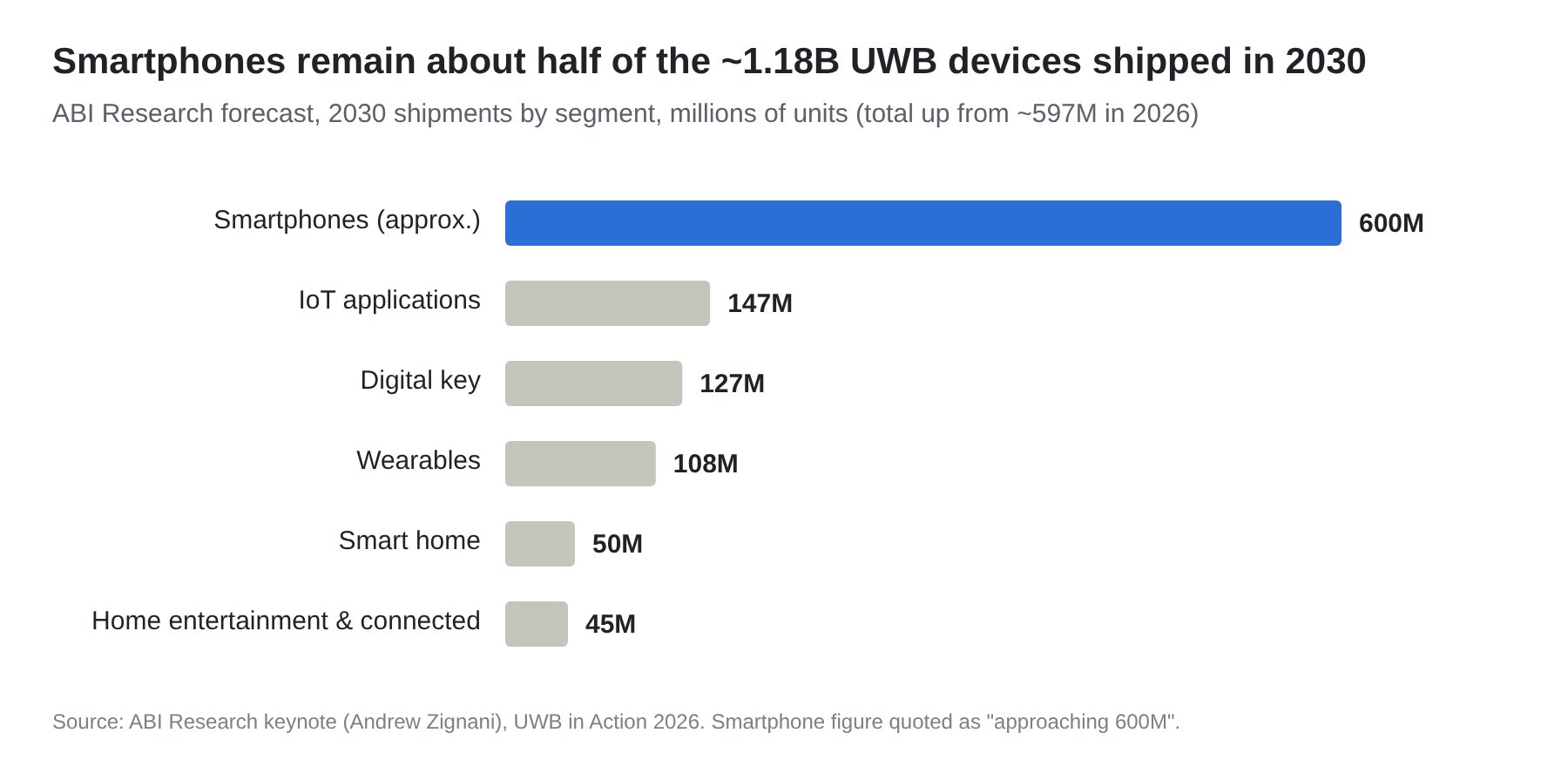
ABI Research forecasts total UWB device shipments rising from about 597 million in 2026 to nearly 1.18 billion in 2030. UWB is also moving beyond digital car keys to become a broader platform covering ranging, positioning, radar sensing and low-latency data. On the industrial side, the day was about cost and scale. Putting UWB into enterprise Wi-Fi APs (“one network, no overlays”) was presented as the main way to cut the cabling and installation cost that has held back RTLS.
The next growth area is physical AI. Robots, AMRs, drones and humanoids need trusted, low-latency position data that vision alone can’t provide. Qorvo argued that a location fix is only worth acting on if it comes with a confidence level. Flowcate and NXP described UWB as part of the shared spatial layer for robots working alongside people. Deutsche Bahn gave the most concrete public-sector example: a successful UWB indoor-navigation proof of concept at a German station that met a sub-1-metre accuracy requirement for blind and partially sighted travellers.
The panel said three things still have to happen: Educating the market, finishing 802.15.4ab at the protocol and application layers (estimated at “another couple of years”), and working out backward compatibility with RTLS systems already installed.
Key Themes
Five themes came up across nearly every session:
- From digital key to a multi-function platform. UWB now does four jobs: secure ranging and proximity, high-accuracy positioning and RTLS, radar sensing (presence, occupancy, vital signs, child presence detection; Infineon demonstrated presence sensing as a low-cost alternative to PIR), and low-latency data for audio, XR and peripherals. Vendors and OEMs increasingly combine these on one chip to get more return from the same hardware (ABI, NXP, HPE)
- 802.15.4ab is the next big step. ST put the link-budget gain at about 20–30 dB over 15.4z, giving ranges of several hundred metres comparable to long-range Bluetooth. Even one MMS (multi-millisecond) frame adds about 20 dB, enough to remove anchor-geometry limits in RTLS. It also fixes the “don’t put your phone in your back pocket” problem with car keys and standardises radar sensing.
- Infrastructure, not overlays. UWB is moving into enterprise Wi-Fi APs (HPE AP47, with NXP and Qorvo chips). AP spacing of about 40 m matches what 15.4ab can reach. SICK showed a mixed deployment of about 800 anchors, roughly 380 of them HPE APs, that cuts total cost of ownership by reducing dedicated cabling. ABI expects UWB-enabled enterprise APs to grow at a 35% CAGR from 2025 to 2030.
- Standards make scale possible. Almost every speaker cited FiRa (mobile-centric, commercial) and omlox (infrastructure-centric, industrial) and said the two can coexist on one installation. HPE says it is the only vendor compliant with both. The omlox Hub API makes applications independent of the underlying technology, which also eases migration to future chip generations.
- Physical AI needs trusted location. Robots, AMRs, drones and humanoids need self-positioning, peer-to-peer ranging, collision avoidance and safety zones. Vision alone is too slow or fails when it loses sight of its surroundings. Qorvo’s “trust contract” says location data is only actionable when it carries quality evidence and comes with defined fallback rules.
Session Summaries
ABI Research: the UWB market outlook
– by Andrew Zignani, Senior Research Director, Strategic TechnologiesUWB is heading for a billion-unit ecosystem, with shipments roughly doubling between 2026 and 2030. Growth is driven by 802.15.4ab, new suppliers (notably from Asia-Pacific) and OEMs combining several UWB functions in one device.
- Smartphones: penetration rises from 27% (2025) to more than 52% (2030), approaching 600 million units. Adoption spreads from flagships into the upper mid-range through UWB/Bluetooth/Wi-Fi combo chips. Memory shortages and price rises may weigh on volumes in the near term.
- Automotive: more than 53% of new vehicles (about 57 million) will have UWB by 2030, each with 6–8 anchors. Combining digital key with radar child presence detection helps OEMs meet NCAP requirements and remove redundant parts. New areas include EV charging and wireless battery management.
- IoT: UWB-enabled enterprise APs grow at a 35% CAGR (2025–30), RTLS deployments at 21%, asset tags and infrastructure at 44%, and commercial building access (driven by Aliro) at 70%.
- Watch points: competition from Bluetooth Channel Sounding in consumer devices, and near-term weakness in the smartphone market.
- Recommendations: mature the standards and align the industry consortia, secure consistent regulation (citing recent FCC progress), build solutions tailored to each application, push combo ICs and edge AI, and educate the market on where UWB clearly beats Wi-Fi and Bluetooth.
STMicroelectronics: Why 802.15.4ab matters
– with Rias Al-kadi, General Manager, Ranging & Connectivity Division (name as given in the transcript)
According to ST, 15.4ab solves the current problem, link budget, just as 15.4z solved synchronisation and accuracy for mobile. The speaker traced the standard from 15.4a (non-coherent impulse radio) through 15.4z (coherent, secure, mobile-ready) to 15.4ab, which adds about 20–30 dB of link budget.
- One car OEM’s adverts tell drivers not to keep their phone key in a back pocket. 15.4ab removes the body-blocking problem behind that advice.
- In industrial RTLS, most of the cost is engineering, wiring and IT, not hardware. Longer range removes the anchor-geometry bottleneck, and one MMS frame alone gives about 20 dB.
- ST agreed with HPE that the Wi-Fi AP is the natural host for UWB, because 15.4ab range now matches typical AP spacing of about 40 m.
- Addressable space: about 7 billion m² industrial, compared with about 140 billion m² residential and 33 billion m² commercial.
Qorvo (now part of Skyworks): Trusted decisions in the physical world
– with Alexis Bizalion, Director of Product MarketingA location is only useful if it is reliable enough to trigger an action. Qorvo proposed a “trust contract”: the application sets the requirements (identity, freshness, certainty), the location service provides evidence (position, uncertainty, system state), and the workflow decides whether to act or fall back.
- Example: a pallet sits at Dock A while SAP assigns it to Dock B. Spotting the mismatch matters only if the system can act on it. With 95% confidence a robot carries on; at 45% it may stop unnecessarily.
- Location value falls into three buckets: save money (less searching, better asset use), make money (steady throughput, work-in-progress priority) and protect workers (safety zones, collision detection).
- Bizalion compared this to Wi-Fi quality of service: each application should declare the location quality it needs. UWB’s 500 MHz bandwidth and roughly 2 ns pulses give first-path and multipath diagnostics that help judge reliability.
- He said trust depends on three parties: the UWB subsystem provider, the RTLS solution provider, and the integrator and customer, who set the rules.
- Skyworks context: about $7.7B revenue, 8,000 engineers, 12,000 patents. Its UWB focus is industrial and enterprise (AP RTLS, omlox/FiRa tags) and automotive (CCC/ICCE digital key, in-cabin sensing).
NXP: from precise location to intelligent motion
– with Olivier Thivolet, Segment Lead Mobile Robotics, UWB & Radar
NXP’s four-year push into industrial IoT was driven by customers. The next frontier is robotics, where UWB acts as a small, low-power, secure sensor.
• Segments: factory automation (asset and people tracking, collision avoidance, access), healthcare (asset tracking, hands-free access, contactless vital-sign monitoring by radar), energy (automatic mapping of large solar farms) and smart buildings (occupancy, automatic device mapping).
• Four standards-based modes in the Wi-Fi AP: FiRa TWR for automatic AP location, DL-TDoA for privacy-preserving phone navigation, FiRa/omlox UL-TDoA for about 10 cm asset tracking, and radar for occupancy and people counting.
• Robotics uses: self-positioning when vision fails, coordination between robots (“10 robots in a room starts to be a problem”), precise drone landing (one customer delivers medicines to windows), drone swarms, indoor–outdoor transitions, secure pallet hand-offs, and safe human–robot collaboration.
• Scaling: FiRa and omlox can run on the same site. Scale depends on partners: system integrators, platform vendors, RTLS vendors, module makers and distribution.
HPE: building the self-driving enterprise with UWB
–with Anilash Azeez, Senior Product Manager (HPE, formerly Juniper Mist)UWB is becoming part of operational infrastructure: one network, no overlays. HPE said it is the only vendor compliant with both FiRa and omlox, and it uses its AP47 (Wi-Fi 7 + BLE + UWB) for four use cases.
• AP auto-placement by two-way ranging: mean accuracy about 0.5 m in more than 95% of cases, best with APs up to 25 m apart, and no Wi-Fi downtime during placement.
• UL-TDoA asset tracking, DL-TDoA wayfinding, and radar presence detection. The 16-antenna virtual BLE array also gives 8 UWB beams.
• Customers: a car maker aiming to go from about 7,000 cars a month to a million a year, a Bay Area university using radar to manage seat bookings, and a Georgia hospital building a “future hospital” around UWB.
• Data delivery: webhooks, cloud or MQTT for low latency, with an SDK available. HPE takes part in IEEE work but not in CCC. It noted that transmit-power limits still differ between the FCC and Europe.
Deutsche Bahn: Indoor navigation at the station – with Steven Karch (name as given in the transcript)
DB replaced scattered, unstructured proofs of concept with three focused use cases: navigation for operations staff and contractors, asset tracking (scissor lifts, cleaning machines and checks that cleaning was done), and indoor navigation for travellers and retail.
• The hardest requirement is accessibility. Navigation for blind and partially sighted travellers must be accurate to under 1 m so nobody is guided off a platform edge. Wi-Fi, Bluetooth and geomagnetic positioning could not achieve this in a changing station; UWB did.
• The proof of concept, at the first German station to test UWB, was described as successful. Next comes certification so the technology can be rolled out to other stations. Attendees visited the site that afternoon.
SICK: Industrial RTLS on omlox – with Eric Mademann, Managing Director, ZIGPOS (part of SICK)
SICK concentrates on infrastructure (“satellites”) and its location engine, not tags. It expects forklift and equipment makers to build omlox tags into their products.
• Target industries: automotive, electronics and semiconductors, and logistics, wherever material moves without conveyor belts. Customers usually start with asset tracking and then add process tracking, zone events, navigation and analytics.
• Architecture: UL-TDoA, an omlox-certified engine that runs on Kubernetes, OpenShift or on-premises, and integration with any omlox hub (SICK’s own, Flowcate’s or a custom one).
• Cutting cost of ownership: cabling, not hardware, is the main cost. SICK says it was the first omlox system to accept third-party satellites. HPE AP47s now run alongside SICK satellites, for example about 380 APs among about 800 anchors at one customer.
• SICK puts its effort into omlox and relies on partners for FiRa.
Flowcate: ground truth for physical AI – with Dr. Matthias Jöst, CEO Flowcate; Committee Chair, omlox
Physical AI is arriving on the shop floor and getting crowded, and robot systems still work in proprietary silos. Flowcate presented omlox plus UWB as the vendor-neutral spatial layer that connects them.
• Market signals: more than 90,000 humanoid robots deployed in 2026 (IFR), more than 250 humanoid start-ups, more than $20B invested this year, about 35% order growth at Geek+ (H1 2026), and more than 300 picks per hour in live operation (Sereact, LogiMAT 2026).
• omlox: launched in 2018 by TRUMPF, Siemens, Deutsche Telekom, SICK, Pepperl+Fuchs and Flowcate, and hosted by PROFIBUS & PROFINET International (1,800+ members, 24 regional associations). It covers more than 350 use cases, and its data model has been adopted into other industrial standards.
• Where vision falls short: self-positioning, machine-to-machine communication, docking, gripping and tool changes. Regulation (EU Machinery Regulation 2023/1230, IEC 61508, ISO 13849) makes safety mandatory.
• SafeInLoc case study (with Fraunhofer IOSB-INA, SmartFactoryOWL, 1,200 m² test site): omlox hub, UWB and cameras combined for software-defined safety zones and real-time collision-course detection.
Infineon: UWB beyond secure ranging – with Björn Scharfen (name as given in the transcript), Ecosystem & Partner Management
Infineon’s message was that UWB is the only proven secure ranging technology, and that the same chip can also do radar presence sensing. That makes UWB worth its bill-of-materials cost in smart-home devices, where makers otherwise add PIR sensors for occupancy.
• How it works: the chip transmits and measures reflections. A person changes the reflection pattern compared with an empty room, which is enough to switch lighting or HVAC.
• Five sensing challenges: detecting micro-motion (a still occupant shouldn’t have the lights switched off), room coverage, TX/RX isolation (spillover hiding weak reflections), avoiding false alarms through post-processing and antenna design, and fitting the overall system’s power and latency limits.
• Silicon: Infineon’s latest UWB SoC combines ranging with radar sensing, driven by automotive in-cabin demand. It is very low power for battery devices and has separate TX and RX paths to reduce spillover. It builds on the acquisition of 3db Access (Switzerland), whose IP is in many car key fobs. The chip supports channel 12, but Infineon advocates protecting channel 9.
• Demos: an office presence sensor detected an untagged person up to 4.8 m away, including while sitting still. In a benchmark against 60 GHz radar, PIR and the UWB sensor (with a fisheye camera as ground truth), UWB came out behind 60 GHz radar but well ahead of PIR, which Infineon called “good enough for most smart home” use at much lower cost. An in-cabin video (TSL111A) showed a baby’s breathing detected in the rear seat with an adult present and after the adult left, in line with NCAP child-presence requirements.
• Ask to the industry: share use cases, especially RTLS and total-cost-of-ownership needs. Infineon also uses UWB tracking in its own manufacturing. Sample kits are limited for now, with more coming, and its application lab is open for joint testing in target enclosures.
Q&A Panel: UWB for industry, its challenges & opportunities – with Panellists: Matthias Jöst (Flowcate/omlox), Alexis Bizalion (Qorvo/Skyworks), Eric Mademann (SICK). Moderated by Claus Hetting of WiFi NOW, with closing remarks from Marko Rössler (Pinpoint).
The panel agreed that the technology is proven and that the challenge is now adoption. The momentum has grown noticeably since the WiFi NOW UWB summit in Mountain View in April 2026.
• Inflection point: Bizalion called 2026 “the year of indoor navigation” and the year 15.4ab arrives. Apple and Android support for indoor navigation means about 1.5–2 billion capable devices are in use. Being able to try UWB navigation on your own phone at the venue was a first for many attendees.
• Still scaling RTLS. Mademann said the industry is still scaling basic RTLS before sensing takes off. UWB is still sold project by project through feasibility studies and proofs of concept. Wi-Fi is a given in every new building; UWB infrastructure is “still in discussion”. The moderator expects UWB to be part of nearly all Wi-Fi infrastructure within a few years.
• Biggest gap: education. Jöst said enterprises don’t yet know that standardised, non-proprietary solutions exist. The panel agreed that even many wireless and Wi-Fi professionals don’t know what UWB is.
• 15.4ab timeline. The physical layer (IEEE) is done and chips and dev kits are available. The protocol layer (FiRa, omlox, CCC) is about halfway, and full applications are “another couple of years” away. Mademann pointed out that the standard isn’t formally released yet, and that backward compatibility with large installed RTLS systems is “not an easy discussion”. Jöst said the omlox Hub API keeps the application layer unchanged during migration.
• Consumer adoption. UWB is still concentrated in the large ecosystems (Apple, Samsung, Google). Smaller brands haven’t arrived yet. Jöst expects large venues to go first, because heavy data traffic drives AP upgrades, followed by retail competing with online shopping.
• Fragmentation. Compared with Wi-Fi’s simple IEEE-plus-Wi-Fi Alliance model, UWB involves more bodies (FiRa, omlox, CCC). Panellists said there is a lot of joint work between them, so it isn’t seriously fragmented.
• Closing analogy (Marko): NFC took about 10 years and needed Apple’s backing to reach mass adoption, starting in Japan. UWB may follow a similar path that differs by region, depending on how well it is built into smartphones.
Market Data
ABI Research expects UWB shipments to roughly double, from about 597 million devices in 2026 to nearly 1.18 billion in 2030. Smartphones remain the anchor, but IoT, digital key and wearables together add almost 400 million units.
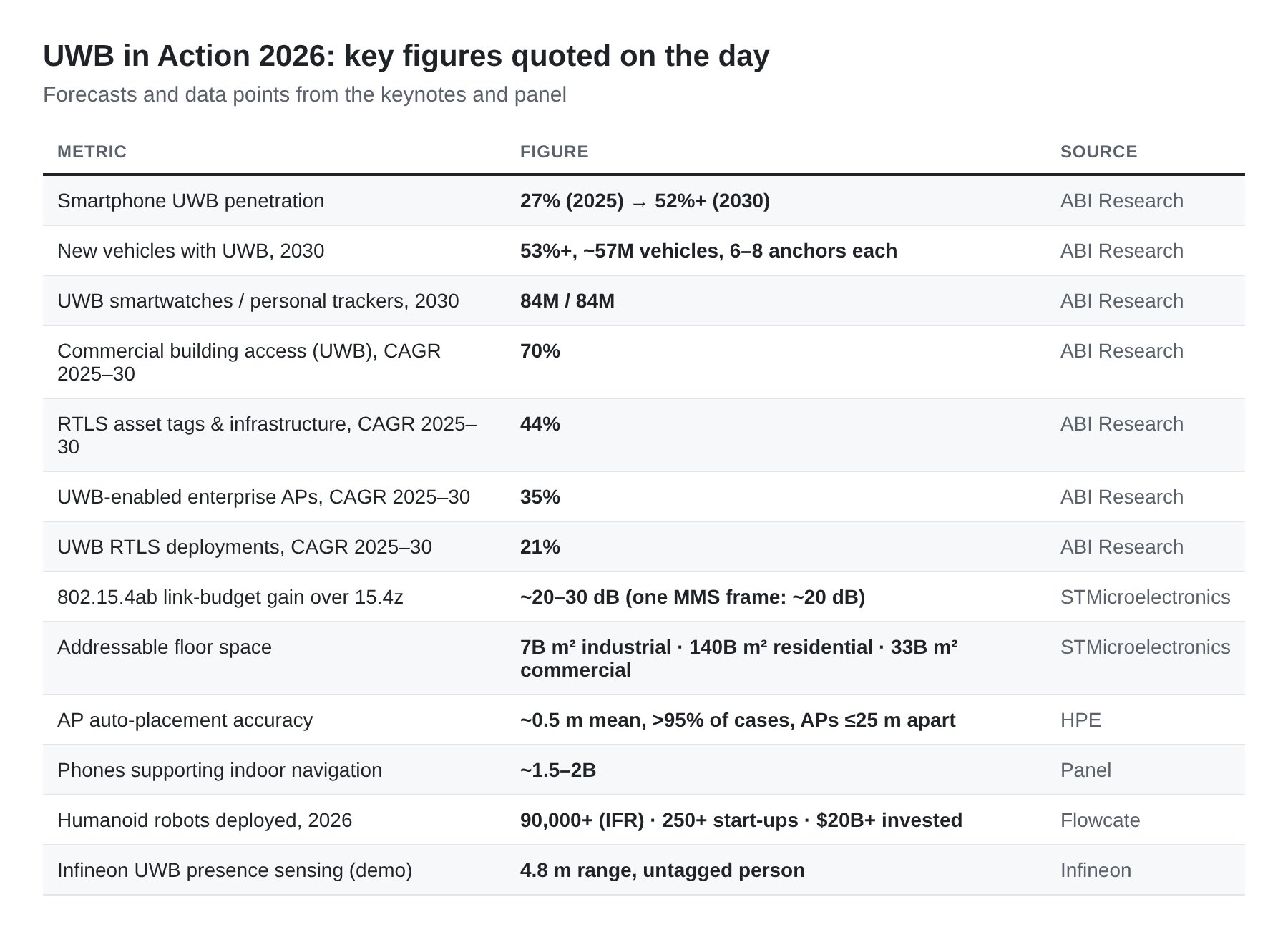
Other figures quoted on the day:
Outlook
Over the next two to three years, UWB’s position will depend less on chip performance and more on deployment economics, how complete the standards are, and whether buyers know UWB exists. Speakers agreed on the following:
- Infrastructure vendors are the lever for scale. If UWB ships in standard enterprise APs, the business case changes from “should we install RTLS?” to “should we turn it on?”
- Chip and module vendors have 15.4ab parts ready. The next step is getting FiRa, omlox and CCC specifications, interoperability testing and regulation (including differences between FCC and EU transmit power) in place to match.
- RTLS and software providers gain from layers that don’t depend on a particular technology (omlox Hub). They should plan migration paths for existing 15.4z installations.
- End users in manufacturing, logistics, healthcare, transport and buildings can now buy standardised, multi-vendor systems. Safety-critical and accessibility uses (robot collision avoidance, navigation for blind travellers) need defined location-quality requirements and certification, as Deutsche Bahn is now pursuing.
- Physical AI is the longer-term growth story. UWB is positioned as a complement to vision for robot self-positioning, coordination and safety, not a replacement.