
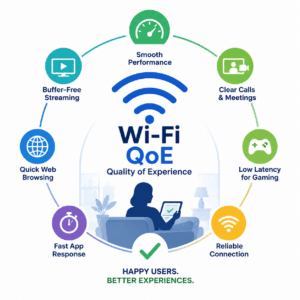
What is home Wi-Fi QoE and why is it important?
Over the past decade, delivering the right home Wi-Fi QoE has become the dominant challenge for vendors and home broadband service providers alike. Here’s what it means.
In-depth guides on Wi-Fi technologies and standards.
Over the past decade, delivering the right home Wi-Fi QoE has become the dominant challenge for vendors and home broadband service providers alike. Here’s what it means.

Netduma puts intelligence directly on the home gateway to continuously measure what is happening, identify the root cause of problems, and in many cases fix issues locally and automatically. Here’s a summary of WiFi NOW’s recent Tech Watch interview with Netduma.
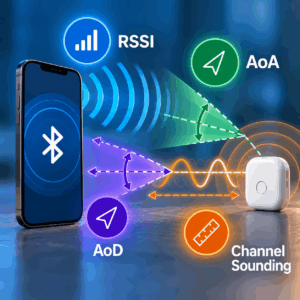
Bluetooth has been able to determine whether another device is nearby for many years. What it has historically struggled to do is determine precisely how far away that device actually is. Bluetooth Channel Sounding changes this. Introduced with Bluetooth Core 6.0, Channel Sounding adds a standardised mechanism for secure, fine ranging between two Bluetooth Low Energy devices.
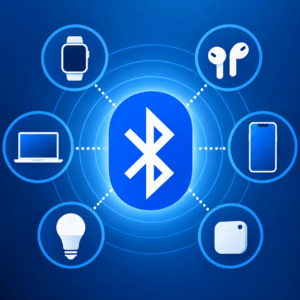
Bluetooth Low Energy has evolved from a low-power companion to Bluetooth Classic into the foundation for many of Bluetooth’s most important new capabilities. Understanding its radio architecture, protocol stack and communication models explains why Bluetooth is now expanding into positioning, audio, IoT, higher-performance applications and entirely new device categories.

IEEE 802.15.4ab is the next major evolution of Ultra-Wideband technology. The emerging standard expands UWB beyond the precise ranging applications for which it is best known today, introducing substantially more feature-rich radio technology designed for a much wider selection of use cases.
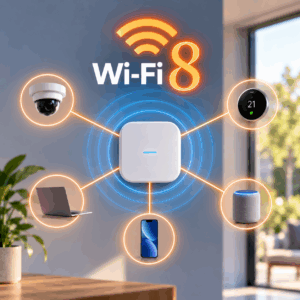
The real significance of Wi-Fi 8 will ultimately depend on how these technologies are implemented and deployed in real networks. Wi-Fi 8 is unlikely to arrive as a single capability that suddenly transforms every network.
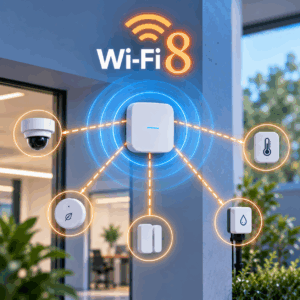
When a radio link is weak, Wi-Fi 8 addresses this part of the reliability problem with Enhanced Long Range (ELR) – a dedicated transmission mode designed to make communication more robust when signal levels are low.

IEEE 802.11bn introduces a new seamless-roaming framework designed to make transitions between access points more reliable. The objective is to prepare the transition and preserve more of the connection state and data flow while the device moves.
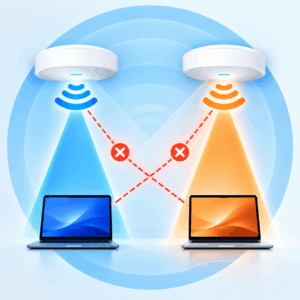
Co-BF allows cooperating access points to coordinate simultaneous transmissions so that each AP can serve its intended client while reducing the interference it causes to clients being served by another AP. The objective is to shape transmissions with awareness of the wider multi-AP network.
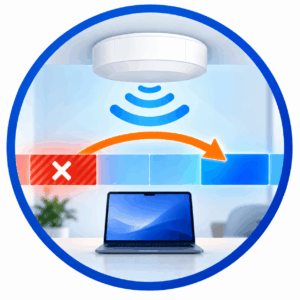
Wi-Fi 8 introduces Non-Primary Channel Access (NPCA) to give compatible devices another way to access the medium in such circumstances. Wi-Fi 8 devices may be able to switch to another designated primary channel within the AP’s operating bandwidth and contend for access there.
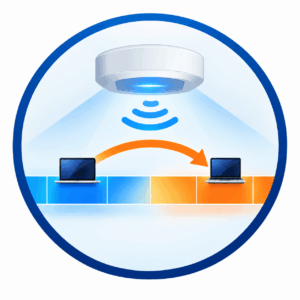
DSO allows the AP to make subband allocation decisions dynamically. This matters because Wi-Fi traffic is inherently variable. A laptop may suddenly begin downloading a large file while another device has almost nothing to send. Greater flexibility in frequency allocation gives the AP another way to respond to changing traffic conditions.
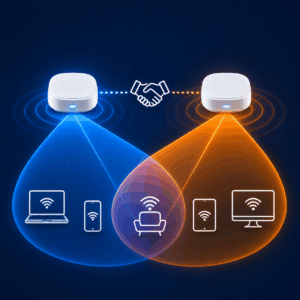
As Wi-Fi deployments become denser, the amount of time spent waiting can increasingly limit network performance. IEEE 802.11bn – the technical basis for Wi-Fi 8 – addresses this problem with Coordinated Spatial Reuse (Co-SR): A Multi-AP mechanism designed to allow two access points to transmit at the same time.
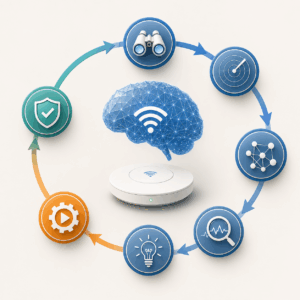
Collecting network data is only the beginning. The real value of AI Operations emerges when platforms can identify problems, determine their likely causes, recommend corrective action, and – in carefully controlled cases – resolve issues automatically.

AI can only improve enterprise Wi‑Fi operations if it understands what is happening across the network. That requires far more than collecting access point statistics. Effective AI Ops depends on a continuous, contextualised stream of data spanning infrastructure, clients, applications, and the wider wired network.

Enterprise Wi-Fi networks have become extraordinarily good at generating data. Access points, controllers, switches, clients, applications, authentication systems, and cloud management platforms continuously produce telemetry describing almost every aspect of network behaviour. The challenge is no longer collecting the data. The challenge is working out what it means – and turning it into action.
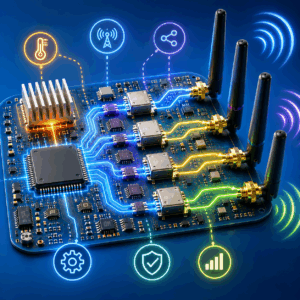
Wi-Fi APs increasingly need to support many frequency bands, multiple spatial streams, wide channels, high-order modulation, simultaneous transmissions, Bluetooth and sometimes cellular radios – all within tight constraints on size, cost and power consumption.Meanwhile, the RF chain needs to preserve extremely demanding signal quality from the Wi-Fi chipset all the way to the antenna. This makes RF front-end integration one of the less visible – but increasingly important.
Free members get access to premium resources.
Create your free WiFi NOW account to unlock reports, guides, presentations, videos and more.
It's free and takes less than a minute.

