WiFI NOW’s TAKE: Over the past decade, delivering the right home Wi-Fi QoE has become the dominant challenge for vendors and home broadband service providers alike. A massive increase in the number of connected devices within the home as well as the number of applications running concurrently has made home Wi-Fi QoE difficult to achieve and – at the same time – essential for the success of a large part of the ecosystem. Getting a strong broadband signal to a house using fibre, cable, or 5G FWA is usually technically easier than making sure that the Wi-Fi service delivers excellent QoE under all conditions and in all parts of the home. As a result, a varied ecosystem of suppliers are today addressing this challenge in a variety of ways. Post updated October 8, 2026.
What is Quality of Experience (QoE)?
As Wi-Fi networks increasingly support essential home broadband applications, cloud services, video conferencing, video streaming, gaming, and IoT devices, network operators are looking beyond traditional performance metrics to understand how users actually experience connectivity.
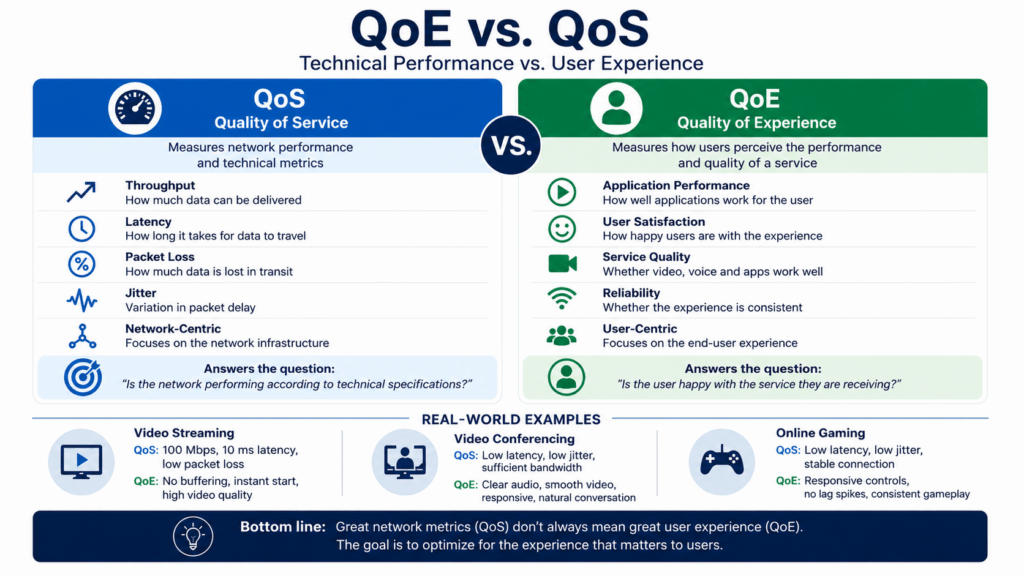
This is where Quality of Experience (QoE) becomes important. QoE is a measure of how users perceive the performance, reliability, and overall quality of a digital service, application, or network. Unlike traditional network metrics, QoE focuses on the end-user experience rather than the technical operation of the network itself. Ultimately, QoE answers a simple question: Is the user satisfied with the service they are receiving?
QoE vs. QoS
QoE is often confused with Quality of Service (QoS), but the two concepts are different. QoS measures technical network performance using metrics such as throughput, latency, jitter, and packet loss. QoE focuses on how those network conditions affect the user’s actual experience. For example, a network may deliver excellent throughput and low latency, but users may still experience poor video quality due to application issues, device limitations, or network congestion elsewhere in the service path. While QoS measures network performance, QoE measures the outcome.
Role of AI in home Wi-Fi QoE
Although solutions for boosting home Wi-Fi QoE have been around for longer that the current AI boom, most current QoE solution providers use AI extensively. Many vendors apply AI methods for (non-real-time) cloud-based Wi-Fi management following the collection of data from – sometimes – millions of homes. Home Wi-Fi QoE can also be achieved with AI at the edge (on the gateway). The latter solutions are less common today but on the rise. Benefits include privacy and faster processing.
Why QoE Matters
For many organisations (including service providers), delivering a positive user experience is more important than achieving a specific throughput target or latency threshold. A home broadband subscriber cares whether Netflix streams smoothly. An enterprise employee cares whether Microsoft Teams calls remain clear and uninterrupted. A gamer cares whether gameplay feels responsive and consistent. In all cases, users evaluate the service based on their experience – not on the network statistics operating behind the scenes. As a result, home broadband service providers, enterprises, and managed Wi-Fi operators increasingly use QoE metrics to understand and improve customer satisfaction, increase loyalty, avoid churn, and so on.
STANDARDS: In general there are no (IEEE or other) standards for measuring QoE. However, the Wi-Fi Alliance‘s ‘Wi-Fi Data Elements’ a standardised set of the most important key performance indicators for Wi-Fi network health, such as how many devices are on the network, use of bandwidth, signal strength measurements, and free airtime. Some vendors have successfully used this data set to guide network management decisions for better service quality and QoE.
Common QoE Indicators
QoE can be evaluated using a variety of measurements, including: Video buffering frequency, video startup delay, voice and video call quality, application response times, web page load times, session success rates, connection reliability, user satisfaction scores, Mean Opinion Score (MOS) for voice services. State-of-the-art network management platforms often combine multiple indicators to estimate overall user experience. Some vendors will measure QoE as part of their home broadband solution but the combination of parameters used for the assessment are usually proprietary and could even be patented.
QoE in Wi-Fi Networks
Wi-Fi performance has a direct impact on application experience. As networks become more complex – with multiple access points, many dozens of connected devices, and increasingly demanding applications – understanding QoE becomes critical. Common Wi-Fi-related factors affecting QoE include: Coverage quality, interference, network congestion, roaming performance, latency and jitter, device capability differences, and backhaul limitations. Some Wi-Fi management platforms now include QoE analytics that correlate network performance data with application behaviour and user experience.
The Evolution Toward Experience-Based Networking
Historically, network operations teams focused primarily on technical performance metrics. Today, many organisations are shifting toward experience-based networking, where success is measured by the quality of application and user experiences. This trend is driving investment in AI-powered analytics, service assurance platforms, application visibility tools, and automated network optimisation solutions. The goal is to ensure that users consistently receive the experience they expect.
Key Takeaway: Quality of Experience (QoE) is a user-centric measure of how well applications and services perform from the perspective of the end user. While traditional network metrics remain important, QoE provides a more complete understanding of whether networks are successfully delivering the experiences that users require and/or expect. As Wi-Fi continues to become the primary platform for connectivity in homes, enterprises, and public venues, QoE is emerging as one of the most important indicators of network success. QoE is currently particularly important in for home broadband services since these are the most challenging to deliver cost-efficiently while ensuring customer loyalty and subscriber churn.