
By Claus Hetting, WiFi NOW CEO & Chairman
Industrial enterprises increasingly depend on multiple wireless technologies to connect mobile workers, machines, and operational systems. But moving between Wi-Fi, public and private 5G, and satellite networks can interrupt applications and create costly operational delays. SPARRO has developed an intelligent network control platform called ARC (Adaptive Route Control) designed to eliminate these disruptions by dynamically steering traffic between available networks. In a recent WiFi NOW Tech Watch interview, SPARRO VP & GM Jason Wickam explains the technology, its industrial applications, and the company’s plans for AI-driven network automation.
The challenge: Multiple networks, but no seamless connectivity
Modern industrial enterprises typically operate across several wireless networks. Wi-Fi provides high-capacity connectivity inside factories, warehouses, offices, and distribution centres. Public and private cellular networks extend coverage into outdoor areas, while satellite services can connect remote locations beyond conventional terrestrial coverage. Although these networks may overlap geographically, moving between them is not necessarily seamless.
A warehouse worker carrying a mobile scanner might move from indoor Wi-Fi coverage into an outdoor loading area served by public cellular. A forklift operator might repeatedly cross the boundary between a factory’s Wi-Fi network and an external logistics yard. Field technicians may transition between private cellular, public mobile networks, and satellite connections.
In each case, devices may remain attached to a deteriorating network even when a better alternative is available. The resulting delays can interrupt enterprise applications, force users to reconnect manually, and reduce operational efficiency. SPARRO VP & GM Jason Wickam says the problem is particularly acute in what he calls the uncarpeted enterprise: Manufacturing, logistics, warehousing, transportation, utilities, and other operational environments where continuous connectivity supports day-to-day business execution.
ARC: An intelligent control layer across wireless networks
SPARRO’s solution is called ARC, short for Adaptive Route Control, a software-as-a-service platform designed to monitor available access networks and dynamically steer traffic between them. Rather than replacing existing wireless infrastructure, ARC operates as an intelligent control layer across the networks already available to an enterprise. The architecture consists of two principal functions:
1. Real-time network monitoring
ARC continuously monitors the health and performance of available connections, including Wi-Fi, public and private cellular, and other supported network technologies. The monitoring layer evaluates network performance and provides the information needed to determine whether a device should remain on its current connection or move to an alternative.
2. Policy-based traffic steering
Above the monitoring function sits a traffic steering layer that uses network performance indicators and enterprise-defined policies to select the appropriate connection.
Traffic can be redirected according to application requirements, connection quality, and operational priorities. For example, an enterprise might prioritise low latency for a critical industrial application while directing less time-sensitive traffic over a lower-cost network. The objective is to make transitions between access networks effectively invisible to applications and end users.
Jason Wickam explains in the interview that ARC is designed to perform these transitions in milliseconds rather than requiring devices to wait for conventional operating-system reconnection procedures.
From minutes to milliseconds: The operational impact
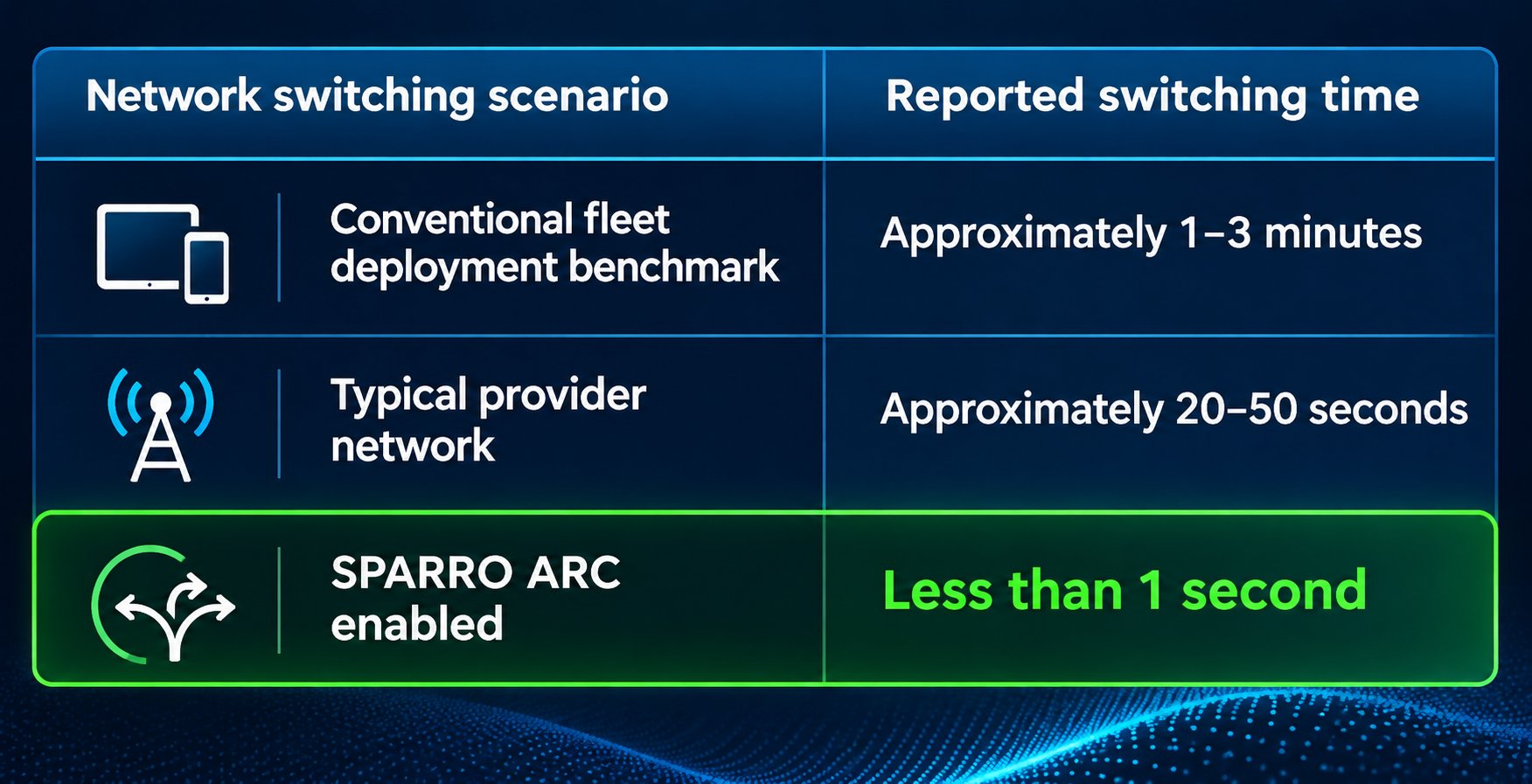
One of SPARRO’s central claims concerns the time required for devices to switch between networks. During the Tech Watch interview, Jason Wickam described testing conducted with a large enterprise fleet customer employing more than 30,000 workers. According to SPARRO, the customer’s devices experienced an average switching delay of approximately 180 seconds when transitioning between Wi-Fi and public cellular networks.
With ARC enabled, SPARRO reports that switching could be completed in milliseconds. The company’s presentation illustrates the performance difference:
The implications extend beyond connectivity performance: In large industrial operations, devices are often used continuously by hourly employees performing time-sensitive tasks. Repeated reconnection delays can accumulate across thousands of workers and devices, creating measurable productivity losses.
SPARRO estimates that reducing these delays could recover as much as USD 32.4 million annually in its illustrated 30,000-device fleet scenario. The figure is a company-provided estimate rather than a verified customer saving, but it illustrates how relatively short network interruptions can translate into significant operational costs at scale.
Industrial use case: Connecting the factory floor with the outdoor logistics yard
Jason Wickam describes a recent customer engagement involving a major US manufacturer of commercial truck trailers: The manufacturer operates approximately two million square feet of covered production facilities, alongside extensive outdoor storage areas for raw materials.
Employees use forklifts, tablets, and barcode scanners to track and transport materials between the outdoor yards and indoor production facilities. The outdoor environment is served by public cellular connectivity, while the factory interior uses corporate Wi-Fi.
Each transition between these networks created interruptions in application performance. According to Wickam, the manufacturer had experienced the problem for approximately four years. Following a trial of ARC lasting roughly ten business days, the company requested a statement of work and contract through a SPARRO value-added reseller.
The deployment example illustrates a recurring challenge in industrial networking: The problem is not necessarily inadequate wireless coverage, but the inability to maintain application continuity when moving between otherwise functional networks. ARC is designed to address this challenge without requiring enterprises to standardise on a single radio access technology.
Beyond connectivity: Application-aware routing and cost optimisation
ARC’s functionality extends beyond selecting the connection with the strongest signal. Jason Wickam says the platform supports application-specific routing policies, local traffic breakout, and least-cost routing. These capabilities allow enterprises to make different connectivity decisions depending on the requirements of individual applications.
For example: A vehicle-mounted camera system may continuously generate large volumes of video data. Some information may need to be transmitted immediately over a cellular connection, while other recordings can be stored locally and uploaded later over a less expensive Wi-Fi network. ARC can apply routing policies to distinguish between these traffic types.
The platform also supports local breakout, allowing selected application traffic to avoid unnecessary routing through SPARRO’s servers when latency or jitter requirements make a more direct path preferable. This creates opportunities to manage both network performance and connectivity expenditure. For enterprises operating thousands of devices, the ability to reduce unnecessary cellular or satellite data consumption can contribute to lower operating costs.
Applications across industrial and operational environments
SPARRO identifies several sectors where dynamic traffic steering can support mobile enterprise operations:
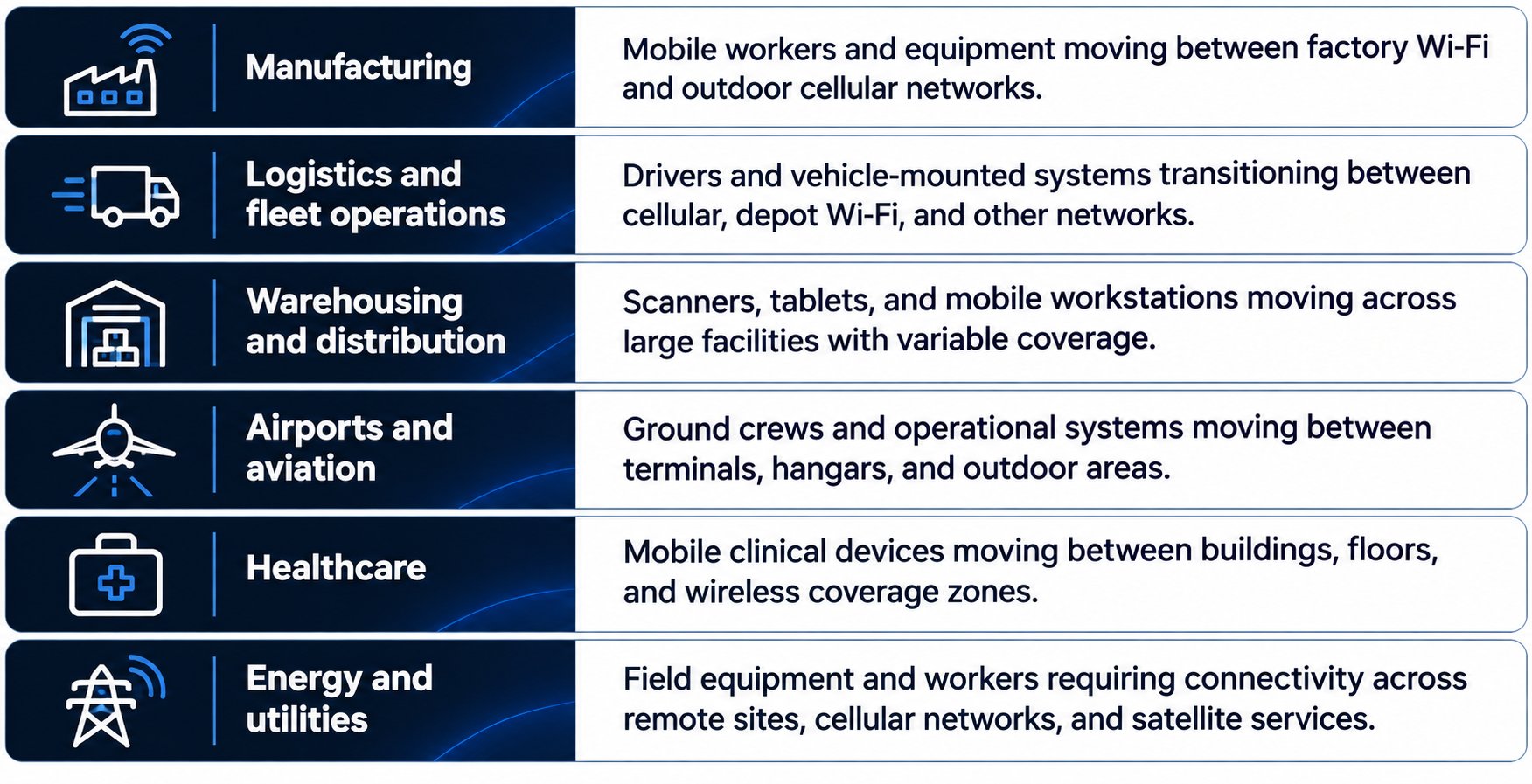
The underlying requirement is similar across these environments: Applications must remain available even when the most suitable network changes. The platform is intended to work across multiple device categories, including smartphones, tablets, handheld scanners, mobile computers, printers, and specialised industrial equipment, subject to compatible device and network configurations.
The next phase: AI-driven and autonomous network operations
SPARRO is also developing AI capabilities intended to extend ARC beyond reactive traffic steering. Jason Wickam says the company’s development roadmap includes predictive network intelligence, automated self-healing, and more advanced operational dashboards.
The objective is to anticipate connectivity degradation before it affects application performance and proactively redirect traffic towards a better-performing network.
SPARRO is also working on interfaces that allow different enterprise stakeholders to interact with network intelligence according to their roles. For example: A business executive might use a natural-language interface to request operational performance information, while an IT administrator could access more granular technical diagnostics and configuration options.
Jason Wickam indicated that the company was targeting further development of these capabilities over the following six to twelve months. The roadmap also includes expanded support for additional access technologies, including satellite, CBRS, and future radio access networks. These are planned enhancements rather than capabilities that should all be assumed to be commercially available today.
Towards a network of networks
Wireless convergence is increasingly relevant to enterprises deploying combinations of Wi-Fi, private 5G, public cellular, and satellite connectivity. Each technology offers different advantages in coverage, capacity, mobility, latency, and operating cost. The challenge is coordinating them so that enterprise applications can use the most appropriate connection without interruption.
SPARRO’s ARC approaches this challenge through a software-based monitoring and traffic steering layer rather than through changes to the underlying radio technologies. For industrial enterprises, the potential benefits include fewer application interruptions, improved workforce productivity, more predictable mobile operations, and better control of connectivity expenditure.
As enterprise IT and operational technology environments continue to converge, software-defined coordination across heterogeneous wireless networks offers another approach to improving connectivity reliability.
Watch the full WiFi NOW Tech Watch interview with Jason Wickam, VP & GM of SPARRO, to learn more about ARC, its industrial applications, and the company’s plans for AI-driven wireless convergence.
WiFi NOW’s Take: The convergence of Wi-Fi, cellular, and satellite connectivity has been discussed for years, but seamless operation across these technologies remains a challenge. SPARRO’s ARC addresses this problem through intelligent software-based traffic steering, allowing enterprises to make better use of existing wireless infrastructure. The benefits extend beyond uninterrupted connectivity to improved productivity, application performance, and reduced operating costs. As industrial IT and OT increasingly converge, solutions such as ARC provide a practical approach to creating unified, reliable wireless services across factories, logistics operations, and other mission-critical environments.
About SPARRO: SPARRO is a business spun off from hospitality & MDU service provider WorldVue, focused on enterprise connectivity software and intelligent network control. Its ARC platform is designed to coordinate connectivity across heterogeneous access networks.
/Claus.