

Beamforming has been part of Wi-Fi for years. An access point can use multiple antennas to shape a transmission so that more useful signal energy reaches the intended client. But conventional beamforming has an important limitation: An AP primarily optimizes its transmission for its own clients. In a dense network, that transmission can still create interference for clients connected to another nearby AP.
Wi-Fi 8 introduces Coordinated Beamforming (Co-BF) to address this problem. Co-BF allows cooperating access points to coordinate simultaneous transmissions so that each AP can serve its intended client while reducing the interference it causes to clients being served by another AP. The objective is not simply to create stronger beams. It is to shape transmissions with awareness of the wider multi-AP network.
The interference problem
Consider two nearby access points, each serving a client: AP 1 transmits to Client A while AP 2 transmits to Client B. Even if both APs use conventional beamforming, some of the energy transmitted by AP 1 may reach Client B as interference. The same can happen in the opposite direction. This can limit how effectively the two APs can transmit at the same time.
One solution is to separate transmissions in time or reduce transmit power. But Wi-Fi 8 introduces another possibility: Coordinate the spatial characteristics of the transmissions themselves.
Shaping the interference
With Coordinated Beamforming, cooperating APs obtain information about the radio channels not only to their own intended clients, but also about relevant paths to clients associated with another AP. This cross-BSS channel information allows the APs to calculate how their transmissions should be shaped. In simplified form, see the image below.
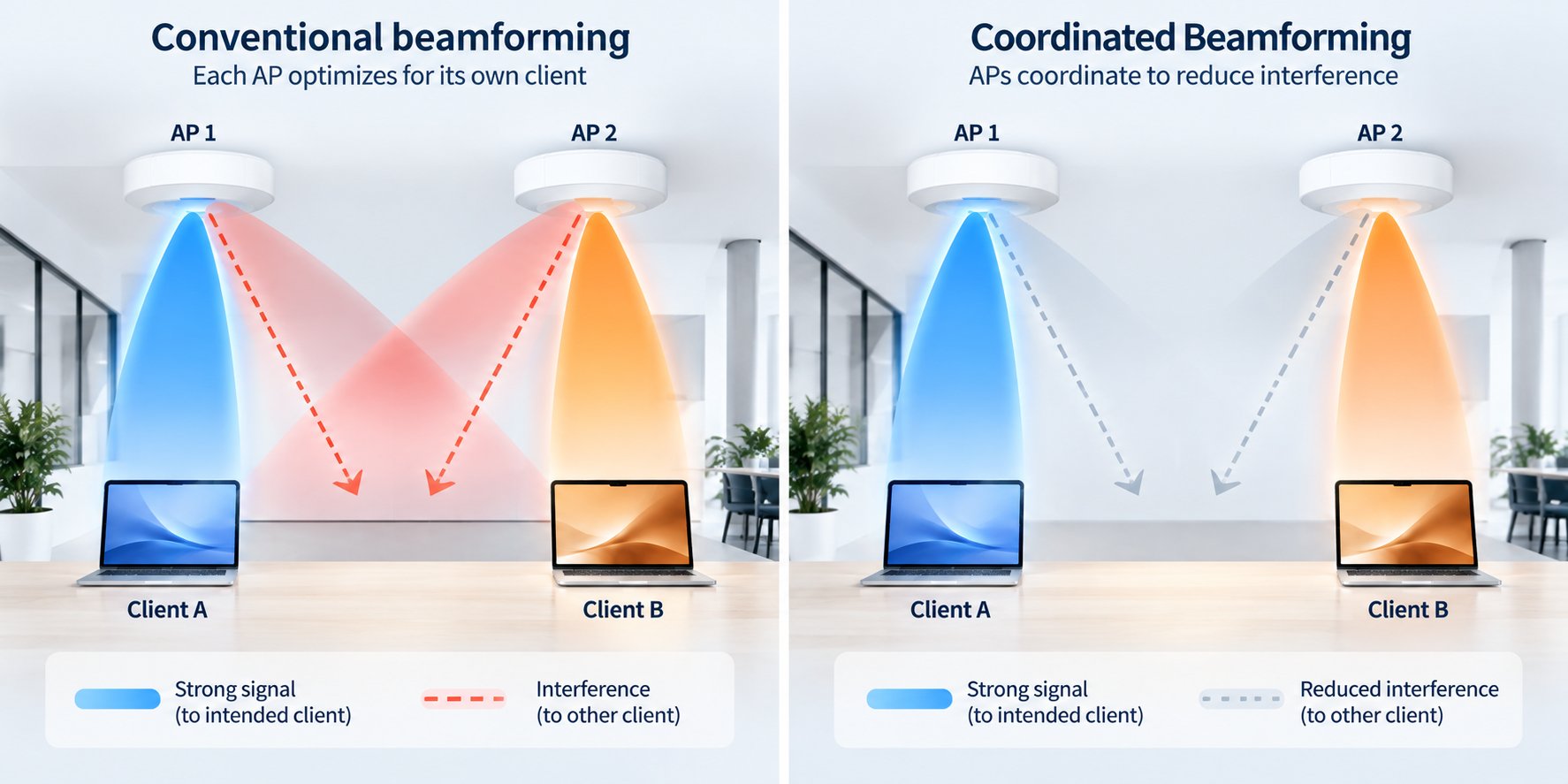
The APs can therefore direct useful signal energy toward their intended recipients while creating reduced-energy regions, or spatial nulls, toward unintended recipients. This can make simultaneous transmissions that would otherwise interfere with one another more practical.
The importance of channel information
To reduce interference toward another AP’s client, an AP needs to understand how its own transmission would be received by that client. This makes channel state information (CSI) an important part of Coordinated Beamforming.
Wi-Fi 8 includes procedures allowing cooperating APs to obtain the channel information needed for Co-BF. In effect, the network needs information about both the desired and interfering radio paths before it can determine how the simultaneous transmissions should be shaped. The detailed procedures are complex, but the principle is straightforward: The better the network understands the radio environment between participating APs and clients, the more intelligently it can shape its transmissions.
Coordination requires more than beamforming
Co-BF also requires coordination between the participating APs. The APs must establish the appropriate Multi-AP Coordination relationship, exchange information, obtain the necessary channel measurements and coordinate the resulting transmissions.
Synchronisation is also important because the coordinated transmissions originate from separate APs with independent radios. This makes Co-BF considerably more sophisticated than conventional beamforming performed independently by individual access points.
It also creates overhead. Sounding, information exchange, synchronisation, and coordination all consume resources, so Co-BF will not necessarily be advantageous for every transmission. The benefit depends on whether the improvement from coordinated simultaneous transmission outweighs the cost of establishing and maintaining that coordination.
What clients gain
For the client, the main potential benefit of Co-BF is not necessarily a stronger Wi-Fi signal. It is less interference from other access points transmitting at the same time. When Co-BF works effectively, this can potentially result in:
- Higher useful throughput in interference-limited situations
- Fewer transmissions disrupted by neighbouring APs
- Fewer retransmissions
- More consistent performance in dense networks
The greatest benefits are therefore likely to occur in environments where multiple nearby APs would otherwise create substantial interference for one another’s clients.
Coordinated Beamforming versus Coordinated Spatial Reuse
Coordinated Beamforming and Coordinated Spatial Reuse both aim to make simultaneous transmissions from multiple APs more effective, but they approach the interference problem differently.
Coordinated Spatial Reuse primarily uses coordinated transmit-power control to allow two APs to share a transmission opportunity while keeping interference within acceptable limits. Coordinated Beamforming uses channel information and spatial processing to shape transmissions so that useful energy is directed toward intended clients while interference toward unintended clients is reduced.
A useful shorthand is: Co-SR controls how strongly APs transmit. Co-BF controls how their transmitted energy is spatially shaped. The two mechanisms illustrate different ways in which Wi-Fi 8 can move beyond independent AP operation toward coordinated multi-AP networking.
Where Co-BF could matter most
Coordinated Beamforming is particularly relevant to dense, managed multi-AP environments where several access points frequently operate within interference range of one another. Potential environments include:
- Enterprise offices and campuses
- Hotels and conference facilities
- Stadiums and large public venues
- Dense managed residential deployments
- Other high-density managed Wi-Fi networks
Co-BF should not be interpreted as a mechanism by which arbitrary neighbouring Wi-Fi 8 routers will automatically coordinate their transmissions. The APs need the capabilities, information exchange and coordination required to participate in the procedure. This makes managed networks a particularly natural environment for the technology.
Key takeaways:
- Beamforming itself is not new to Wi-Fi; coordination between APs is the important Wi-Fi 8 development.
- Co-BF allows cooperating APs to coordinate simultaneous transmissions while reducing interference toward unintended clients.
- Cross-BSS channel information enables APs to take clients associated with another AP into account when shaping transmissions.
- Spatial nulls or reduced-energy regions can help protect those unintended recipients.
- Co-BF requires sounding, information exchange, synchronization and Multi-AP Coordination between participating APs.
- The main potential client benefit is reduced interference and more consistent performance during simultaneous multi-AP transmissions.
Co-BF is particularly relevant to dense, managed multi-AP networks.
WiFi NOW Perspective: Beamforming traditionally allows an access point to ask: How should I transmit to my client? Coordinated Beamforming adds another question: How can I transmit to my client without unnecessarily interfering with yours? That difference captures much of the architectural direction of Wi-Fi 8.
The network is no longer optimizing every transmission purely from the perspective of an individual access point. Instead, cooperating APs can increasingly take the wider radio environment – including clients belonging to another BSS – into account. Coordinated Beamforming is therefore another example of the broader Wi-Fi 8 transition from independently optimized links toward increasingly coordinated wireless networks.