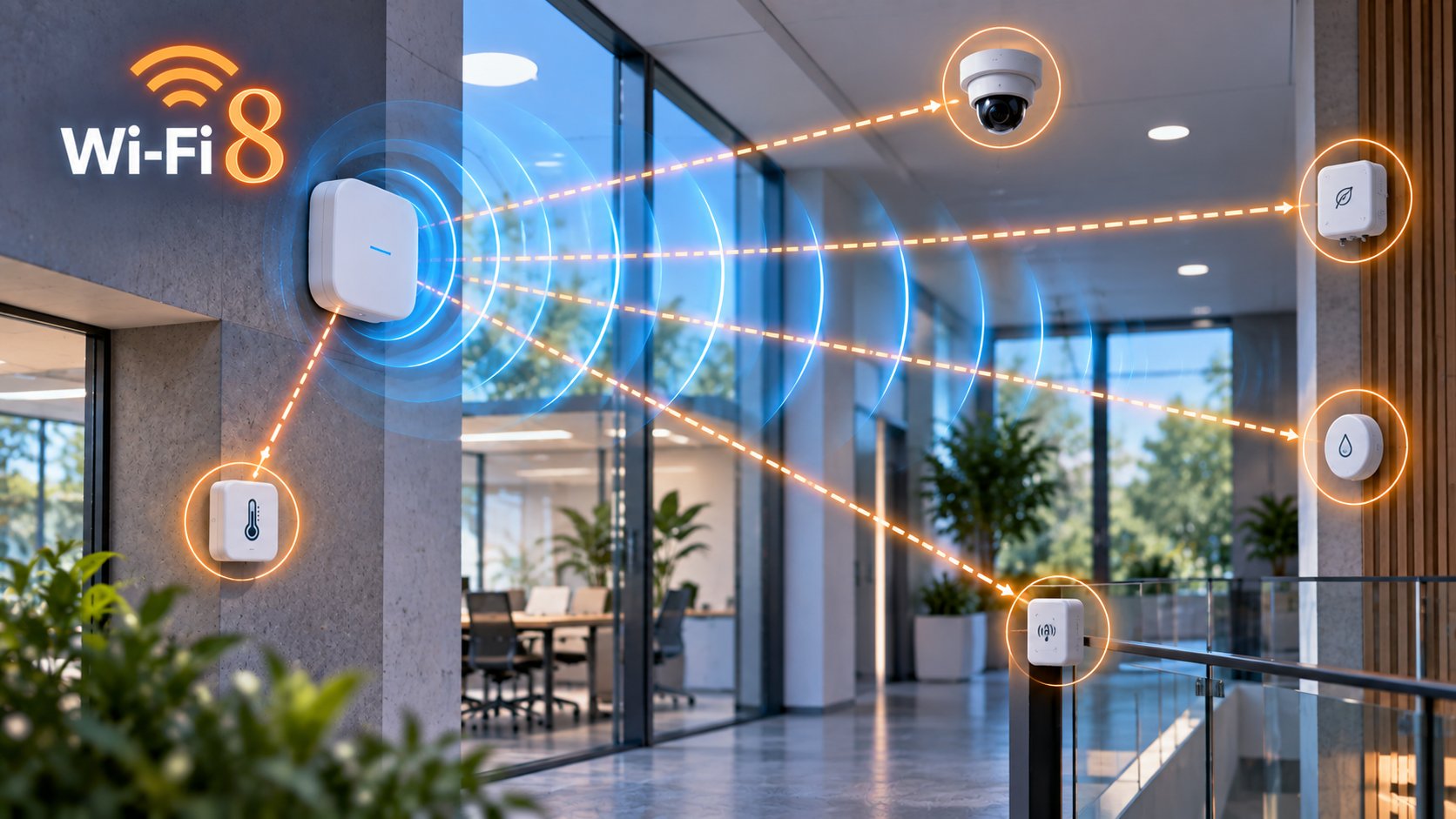

Much of the Wi-Fi 8 story is about making networks work better together. Multi-AP Coordination allows access points to cooperate. Coordinated Spatial Reuse and Coordinated Beamforming address interference. Dynamic Subband Operation and Non-Primary Channel Access make spectrum use more flexible. Seamless roaming aims to maintain connectivity as devices move.
But sometimes the problem is much simpler: The radio link itself is weak. A client may be far from its access point, separated by several walls, located at the edge of a coverage area, or simply operating under difficult radio conditions. Wi-Fi 8 addresses this part of the reliability problem with Enhanced Long Range (ELR) – a dedicated transmission mode designed to make communication more robust when signal levels are low.
The objective isn’t simply to make Wi-Fi travel farther. It is to keep useful communication working under conditions where a conventional transmission may become unreliable.
The coverage-edge problem
Wi-Fi performance normally deteriorates as radio conditions become more difficult. As signal-to-noise ratio falls, devices use increasingly robust modulation and coding. Data rates decrease, transmissions take longer, and packet errors and retransmissions can become more likely.
Eventually, a device may still technically be connected to Wi-Fi while the connection has become too unreliable for the application using it. This creates an important distinction between coverage and useful coverage. For Ultra High Reliability, simply detecting an access point isn’t enough. The connection needs to remain useful when radio conditions become difficult.
A dedicated mode for difficult links
Wi-Fi 8 introduces an Enhanced Long Range PPDU specifically designed for robust communication under these conditions. ELR deliberately operates using only 20 MHz of spectrum rather than attempting to maintain operation across the much wider channels associated with high Wi-Fi data rates.
That reflects a fundamental trade-off: When the radio link becomes difficult, reliability can be more valuable than bandwidth. Instead of trying to deliver maximum throughput, ELR uses a narrow transmission and robust signalling techniques to increase the probability that the receiver can successfully detect and decode the transmission. The target minimum data rate for ELR is at least 1.5 Mbps – a clear indication that the technology is intended to preserve useful connectivity rather than deliver headline speeds.
Making weak transmissions easier to receive
ELR includes several PHY techniques specifically designed to improve robustness. Important parts of the packet preamble are transmitted with 3 dB of power boosting, helping a receiver detect the transmission and estimate the radio channel when signal conditions are poor.
ELR also uses a dedicated packet structure and robust signalling designed for operation at low signal levels. The detailed PHY mechanisms are complex, but their collective purpose is straightforward: Make a weak Wi-Fi transmission easier for the receiver to detect, understand, and successfully decode.
This is fundamentally different from simply increasing channel width or using a higher modulation order to achieve more throughput. ELR deliberately moves in the opposite direction when necessary: Use less spectrum and more robust transmission techniques to keep the connection working.
More precise modulation and coding
Wi-Fi 8 also expands the range of modulation and coding options available to the radio. An MCS – or Modulation and Coding Scheme – determines how data is represented over the radio link and how much error-correction coding is applied. Higher-throughput MCSs generally carry more data but require better radio conditions, while more robust MCSs trade throughput for a greater probability of successful reception. IEEE 802.11bn introduces four new intermediate modulation-and-coding combinations:
- QPSK with a 2/3 coding rate
- 16-QAM with a 2/3 coding rate
- 16-QAM with a 5/6 coding rate
- 256-QAM with a 2/3 coding rate
These additions fill gaps between existing MCS levels. The objective is not primarily to increase maximum Wi-Fi speed. Instead, the additional choices allow the link-adaptation algorithm to select a transmission mode that more closely matches current radio conditions.
For example, where previous Wi-Fi implementations might need to jump directly from one QPSK coding rate to another, Wi-Fi 8 can add an intermediate operating point: QPSK 1/2 → QPSK 2/3 → QPSK 3/4
This gives the radio a more finely graduated set of choices. If conditions deteriorate gradually, the network no longer needs to make as large a jump between some existing MCS levels. A new intermediate MCS may provide enough additional robustness without forcing the link to fall back to a significantly lower data rate.
This can potentially help improve throughput consistency and reduce failed transmissions as radio conditions change. Enhanced Long Range also includes dedicated ELR MCS operation for its robust 20 MHz transmission mode. Together with ELR’s specialised PPDU format, robust signalling and preamble boosting, these modulation-and-coding options form part of Wi-Fi 8’s effort to keep difficult links usable rather than simply maximise peak throughput.
The uplink matters too
Wireless range is sometimes imagined as a question of how far an access point can transmit. But Wi-Fi is a two-way communication system. A powerful access point with good antennas may be able to reach a distant client, but the client must also be able to transmit successfully back to the AP. A phone, sensor, or other small device may have a more limited power budget and antenna system.
The uplink can therefore become the limiting part of a long or difficult Wi-Fi connection. This is an important part of the ELR design. Wi-Fi 8 supports ELR uplink operation in the 2.4 GHz, 5 GHz, and 6 GHz bands, helping APs receive transmissions from compatible clients operating under difficult link conditions. ELR downlink operation is defined for 2.4 GHz.
The asymmetric design highlights an important point: ELR isn’t simply about making the access point’s signal travel farther. It is also about making weak client transmissions more reliably receivable at the AP.
Why 2.4 GHz still matters
The inclusion of 2.4 GHz is particularly relevant to long-range communication. Lower-frequency 2.4 GHz signals generally experience less propagation loss than 5 GHz and 6 GHz signals under comparable conditions, making the band useful for maintaining connectivity over longer distances and through obstacles.
Wi-Fi 8’s ELR operation can use these propagation characteristics while adding a transmission mode specifically designed for difficult links. This does not mean Wi-Fi 8 suddenly turns 2.4 GHz into a new long-range wireless technology. Regulatory power limits, interference, antenna design, client capabilities, and the physical environment continue to determine real-world coverage. Instead, ELR is intended to make better use of the radio link that is available.
What clients gain
For compatible devices operating under difficult signal conditions, ELR can potentially provide:
- More dependable connectivity toward the edge of coverage
- Greater resilience when signal levels are low
- Fewer failed transmissions and retransmissions
- Better uplink reliability from power-constrained clients
- More consistent performance as radio conditions deteriorate
- A larger area over which Wi-Fi remains useful for lower-data-rate applications
The new intermediate MCS options can also help the radio adapt more gradually as conditions change, rather than falling back between relatively widely spaced modulation-and-coding choices.
The overall trade-off remains speed: ELR is not intended to deliver multi-gigabit connectivity at long range. Its purpose is almost the opposite: When maintaining a high data rate becomes unrealistic, preserve a lower-rate connection that continues to work reliably. For many applications, that can be considerably more valuable.
Where ELR could matter
ELR could be useful wherever Wi-Fi devices need to remain connected under difficult radio conditions. In homes, this could include devices at the edge of AP or mesh coverage. In enterprises, it could improve connectivity in difficult coverage areas or help mobile devices maintain useful links as signal conditions change. Warehouses, industrial facilities, campuses, outdoor areas, and other large environments could also benefit where reliable low-rate connectivity is more important than maximum throughput.
The technology may be particularly relevant to devices such as sensors and other connected equipment that exchange relatively small amounts of data but need dependable connectivity. Actual benefits will depend on device support, frequency band, regulatory limits, network design, interference, antenna performance, and the physical environment.
Enhanced Long Range is not simply ‘more range’
The name Enhanced Long Range makes it tempting to describe ELR as a technology for extending Wi-Fi coverage. That is directionally correct, but it can also be misleading. ELR does not change the fundamental physics of radio propagation, nor does it guarantee that every Wi-Fi 8 network will cover a particular percentage more area.
A more useful way to understand the technology is through the concept of usable coverage. The question isn’t simply: How far can the Wi-Fi signal be detected? But instead: How far can the connection remain sufficiently reliable to be useful? ELR is designed to improve the answer to the second question.
Another dimension of Ultra High Reliability
Most of the Wi-Fi 8 technologies discussed in this guide improve reliability by changing how the network operates. Coordinated APs manage interference. DSO and NPCA provide more flexible use of spectrum. Seamless roaming helps maintain traffic as devices move between access points.
ELR addresses reliability from another direction: Making the individual radio link more robust when signal conditions deteriorate. The new MCS options add another layer to this effort by giving Wi-Fi 8 a finer set of transmission choices as radio conditions change. These approaches are complementary.
A highly coordinated network still needs reliable radio links. Likewise, a robust radio link cannot by itself solve congestion, interference, or mobility. Together, these mechanisms illustrate how broad the Ultra High Reliability objective really is.
Key takeaways
- Enhanced Long Range (ELR) is designed to keep Wi-Fi working under difficult signal conditions.
- ELR prioritises reliability over speed, using robust 20 MHz transmissions.
- New Wi-Fi 8 MCS options provide more precise link adaptation as radio conditions change.
- ELR addresses the uplink as well as the downlink, recognising that weak client transmissions can limit coverage.
- The goal is not simply longer range, but more usable and reliable coverage.
WiFi NOW Perspective: For years, successive Wi-Fi generations have been associated primarily with faster speeds. Enhanced Long Range – together with Wi-Fi 8’s expanded MCS options – illustrates why this generation is different. When conditions become difficult, the most useful innovation may not be another increase in peak data rate. It may be the ability to select a more appropriate transmission mode, sacrifice bandwidth where necessary, and keep the connection working.
That is a fundamentally reliability-driven design choice. The traditional question has been: How fast can Wi-Fi go? Wi-Fi 8 adds another: How difficult can radio conditions become before useful Wi-Fi stops working? Extending that boundary is an important part of the Wi-Fi 8 transition from maximizing theoretical performance toward delivering more dependable wireless connectivity.