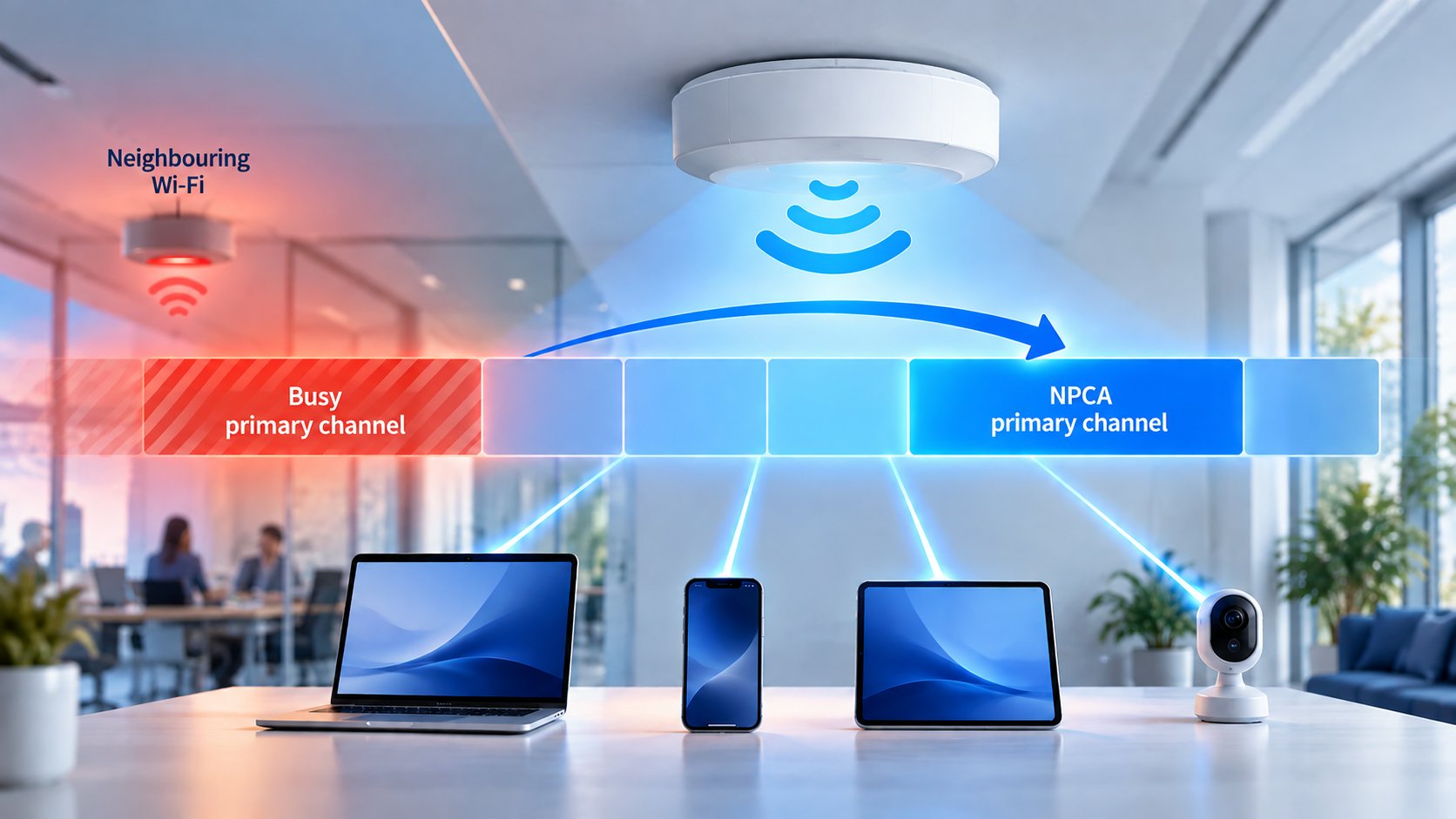

Wi-Fi networks have traditionally depended heavily on one particularly important piece of spectrum: The primary channel. An access point may operate across 80 MHz, 160 MHz, or even 320 MHz of spectrum, but channel access is anchored to its primary channel. This can create an awkward situation in dense Wi-Fi environments: Activity from a neighbouring network may occupy the part of the spectrum containing the primary channel while other spectrum within the AP’s wider operating channel remains available.
Wi-Fi 8 introduces Non-Primary Channel Access (NPCA) to give compatible devices another way to access the medium in such circumstances. The principle is straightforward: If overlapping network activity prevents normal access through the primary channel, compatible Wi-Fi 8 devices may be able to switch to another designated primary channel within the AP’s operating bandwidth and contend for access there instead.
The primary-channel problem
Every Wi-Fi BSS has a primary channel. Even when an AP uses a much wider channel, the primary channel plays a central role in channel access and communication between the AP and its clients. Normally this works well. But consider a wide-channel AP operating in a dense environment with several neighbouring Wi-Fi networks.
Activity from another BSS may occupy spectrum overlapping the AP’s primary channel. The AP and its clients must respect that transmission even if another portion of their own wider operating channel is not occupied by the neighbouring transmission. The result can be an inefficient situation: Some spectrum is available, but the network’s normal route to accessing it is temporarily constrained.
Creating another route to the spectrum
NPCA addresses this by introducing the concept of an NPCA Primary Channel. A compatible AP can announce an NPCA Primary Channel located elsewhere within its BSS operating bandwidth. Under defined conditions, NPCA-capable devices can switch from the normal BSS primary channel to this alternative primary channel and perform channel access there.
In simplified form see the image below.
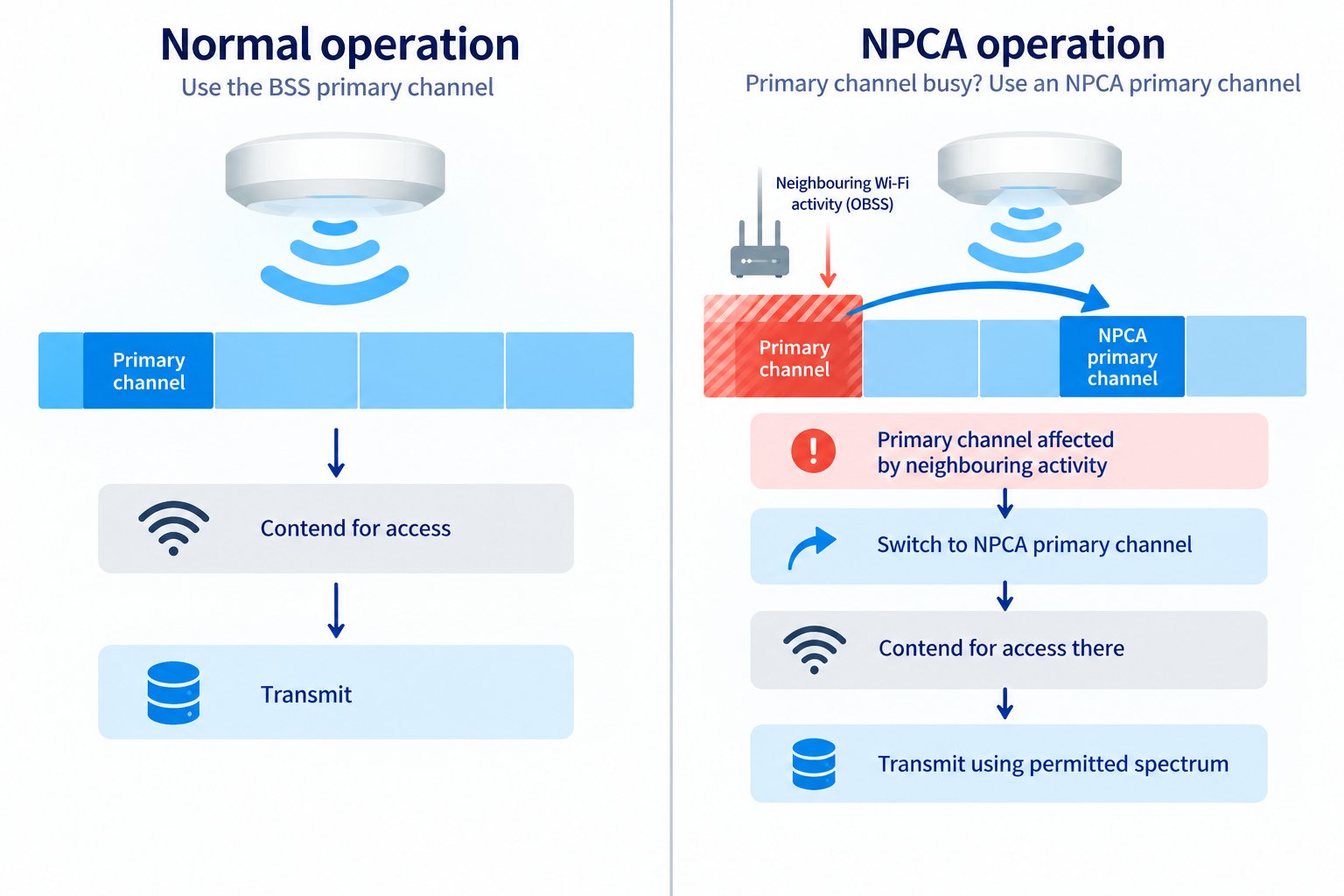
The important point is that NPCA does not eliminate Wi-Fi’s contention-based access mechanism. It provides another location from which compatible devices can contend for access when specified conditions make normal primary-channel access difficult.
NPCA does not mean ignoring interference
NPCA should not be interpreted as permission for a Wi-Fi 8 device simply to transmit elsewhere whenever its primary channel appears busy. The mechanism includes rules governing when devices may switch, how they access the alternative channel, and which spectrum can subsequently be used.
In particular, an NPCA transmission must take account of the overlapping-BSS activity that triggered the switch. The objective is not to transmit over the neighbouring network but to exploit other spectrum within the AP’s operating bandwidth when the conditions permit. NPCA is therefore better understood as an alternative channel-access procedure, not an interference-avoidance shortcut.
What clients gain
For a compatible client, the potential benefit is straightforward: A busy primary channel does not necessarily mean that the client must wait until normal channel access becomes available again. If NPCA conditions are satisfied, the client may be able to switch with the AP to the NPCA Primary Channel and gain another opportunity to access the medium.
In busy environments, this can potentially reduce unnecessary waiting and improve the consistency of network performance. As with Dynamic Subband Operation, however, the client must support the feature. An AP cannot simply move an arbitrary legacy client into NPCA operation.
NPCA and DSO solve different problems
NPCA and Dynamic Subband Operation both make Wi-Fi’s use of wide channels more flexible, but they solve different constraints. DSO asks: Where within the AP’s wider channel can this narrower-bandwidth client be served? NPCA asks: If normal access through the primary channel is constrained, can compatible devices access the medium through another designated channel instead?
DSO therefore provides greater flexibility in where a client can operate within a wide channel, while NPCA provides greater flexibility in how the network gains access to available spectrum. Together, they illustrate an important direction in Wi-Fi 8: making the spectrum already available to a Wi-Fi network more usable rather than simply increasing channel width.
Where NPCA could matter most
NPCA is particularly relevant to environments where overlapping Wi-Fi networks frequently compete for the same spectrum. These could include:
- Dense apartment buildings
- High-density enterprise networks
- Hotels and hospitality venues
- Public Wi-Fi deployments
- Other environments with substantial overlapping-BSS activity
The actual benefit will depend on channel configuration, neighbouring traffic, device support, switching behaviour and the amount of usable spectrum available outside the interfering transmission.
Key takeaways
- Wi-Fi channel access has traditionally been anchored to the BSS primary channel.
- Activity from neighbouring Wi-Fi networks can constrain normal channel access even when other spectrum within a wide operating channel is available.
- NPCA allows compatible Wi-Fi 8 devices, under defined conditions, to switch to an announced NPCA Primary Channel within the BSS operating bandwidth.
- Devices still contend for access; NPCA does not bypass Wi-Fi’s channel-access rules.
- NPCA operation must avoid spectrum occupied by the overlapping transmission that triggered the switch.
- Both the AP and participating clients need appropriate NPCA support.
- DSO changes where a client can be served; NPCA provides an alternative way to gain access to available spectrum.
WiFi NOW Perspective: For years, wider Wi-Fi channels have delivered greater potential capacity – but using that capacity efficiently becomes increasingly difficult as networks become denser. NPCA represents an important change in approach.
Instead of assuming that access to a wide channel must always remain tied to the same primary channel, Wi-Fi 8 introduces a controlled mechanism for compatible devices to use an alternative access point within that spectrum. Combined with Dynamic Subband Operation and coordinated spectrum reuse, NPCA reinforces one of the central ideas behind Wi-Fi 8: Better Wi-Fi increasingly depends not simply on having more spectrum, but on using the available spectrum more intelligently.