
By Claus Hetting, WiFi NOW CEO & Chairman
AI-powered network management is rapidly becoming a standard feature of enterprise networking platforms. Nearly every major vendor now offers some combination of machine learning, automated troubleshooting, predictive analytics, and natural-language interfaces. But are these capabilities becoming interchangeable, or do meaningful differences remain? The emergence of agentic AI is raising the stakes as vendors compete to deliver increasingly autonomous network operations.
AI Ops is becoming a standard requirement
Not long ago, AI-driven network management was a distinguishing feature offered by a relatively small number of enterprise networking vendors. Today, AI Ops has become a central element of product development and marketing across much of the industry.
Most leading enterprise Wi-Fi platforms now incorporate capabilities such as anomaly detection, automated root-cause analysis, performance optimisation, and AI-assisted troubleshooting. Increasingly, administrators can also interact with network management systems using natural language rather than navigating complex dashboards and diagnostic tools. These developments are changing enterprise expectations. Network operators increasingly expect management platforms to identify problems automatically, correlate information across different network elements, and provide actionable recommendations.
As a result, simply offering AI-assisted operations is becoming less of a differentiator. The more relevant questions concern how well these capabilities work, how deeply they are integrated into the network architecture, and how much operational responsibility can safely be delegated to AI.
Where the differences really lie
Despite similarities in product descriptions, AI Ops implementations can differ considerably in their underlying architecture, data collection capabilities, intelligence, and degree of automation. One fundamental distinction concerns the quality and completeness of the data available to the AI system.
As discussed in Part Two of this series, AI Ops depends on continuous access to reliable telemetry covering network infrastructure, connected devices, applications, and user experiences. Platforms with access to extensive, high-quality operational data may be better positioned to identify subtle performance problems, correlate events, and distinguish between symptoms and underlying causes.
However, collecting large quantities of data does not automatically produce better AI. The ability to interpret data in context, identify meaningful relationships, and recommend appropriate actions is equally important. Another differentiator is the breadth of visibility. Some AI Ops implementations focus primarily on wireless infrastructure, while others extend across wired LANs, WANs, security systems, and application performance.
This broader perspective can help distinguish between problems originating in the Wi-Fi network and those caused by other parts of the infrastructure. For example, a poor video conferencing experience may result from RF interference, excessive airtime utilisation, authentication delays, a congested WAN connection, or problems with the application itself. An AI Ops system capable of correlating information across these domains may identify the cause more efficiently than one operating with limited visibility.
From AI assistance to agentic AI
The emergence of agentic AI is introducing another level of differentiation. Traditional AI Ops systems generally analyse network conditions, identify potential problems, and recommend corrective actions. Network administrators remain responsible for deciding whether and how to implement those recommendations.
Agentic AI extends this model by introducing software agents capable of planning and executing multi-step operational tasks. Rather than simply identifying a problem, an AI agent may investigate the issue, gather additional information, determine an appropriate response, and initiate corrective action within predefined operational boundaries. The distinction is not necessarily between manual and fully autonomous operations. Several intermediate levels are possible.
At one level, AI systems provide information and recommendations. At another, they prepare remediation workflows for human approval. More advanced implementations can execute selected tasks automatically, while escalating higher-risk decisions to network administrators. The degree of autonomy therefore becomes an important consideration when comparing AI Ops platforms.
Different approaches are emerging
Several major enterprise networking vendors are developing AI Ops platforms that illustrate these differences. HPE Juniper Networking has developed its Mist AI architecture and Marvis virtual network assistant around continuous telemetry, service-level experience monitoring, automated root-cause analysis, and self-driving network capabilities.
Marvis supports both assisted troubleshooting and selected automated remediation actions while Cisco is expanding AI-driven operations through its networking and observability portfolio. Cisco’s AI Canvas initiative brings together operational information, specialised agents, and human administrators in a shared environment for investigation and remediation.
Extreme Networks is advancing an agentic AI approach through Extreme Platform ONE and Extreme Agent ONE. Its Coworker implementation provides proactive, context-aware operational assistance, while its Operator architecture is designed to extend autonomous execution within defined governance boundaries.
RUCKUS Networks combines AI-driven network assurance with increasingly automated network optimisation through its RUCKUS AI and RUCKUS One platforms. Its IntentAI framework allows administrators to define operational objectives that guide automated RF management, performance optimisation, and energy-saving functions. RUCKUS is also introducing agentic capabilities through its Digital System Engineer (DSE), which enables conversational interaction with network management systems. The company’s Agentic Operations roadmap extends towards autonomous troubleshooting and remediation under defined operational policies and human oversight.
These examples illustrate different approaches to combining AI reasoning, network context, operational workflows, and automation. They do not – by themselves – establish which implementation delivers better results in a particular enterprise environment. The distinction between commercially available capabilities, newly introduced features, and longer-term product roadmaps is also essential when evaluating vendor claims.
The challenge of measuring AI Ops performance
Comparing AI Ops implementations is more complicated than comparing conventional networking equipment.Access points can be evaluated using measurable parameters such as throughput, latency, coverage, and interference tolerance.
AI Ops platforms introduce additional variables related to operational effectiveness. For example, how accurately does a platform identify the root cause of a problem? How frequently does it generate false alarms? How much administrator time does it save? And how reliably does it resolve issues without introducing new ones? A system that identifies more anomalies is not necessarily better if it overwhelms administrators with low-value notifications.
Similarly, a system that automatically implements corrective actions is not necessarily more effective if those actions are inappropriate or create unexpected consequences elsewhere in the network. The effectiveness of AI Ops must therefore be evaluated in terms of operational outcomes rather than the number of AI features offered. Relevant performance indicators include mean time to resolution (MTTR), incident frequency, administrator workload, user experience, and the percentage of issues resolved without manual intervention.
These measurements also require context. Results depend on network complexity, deployment architecture, operational policies, and the types of problems encountered.
Comparing AI Ops implementations
The following framework identifies areas where enterprise AI Ops platforms may differ:
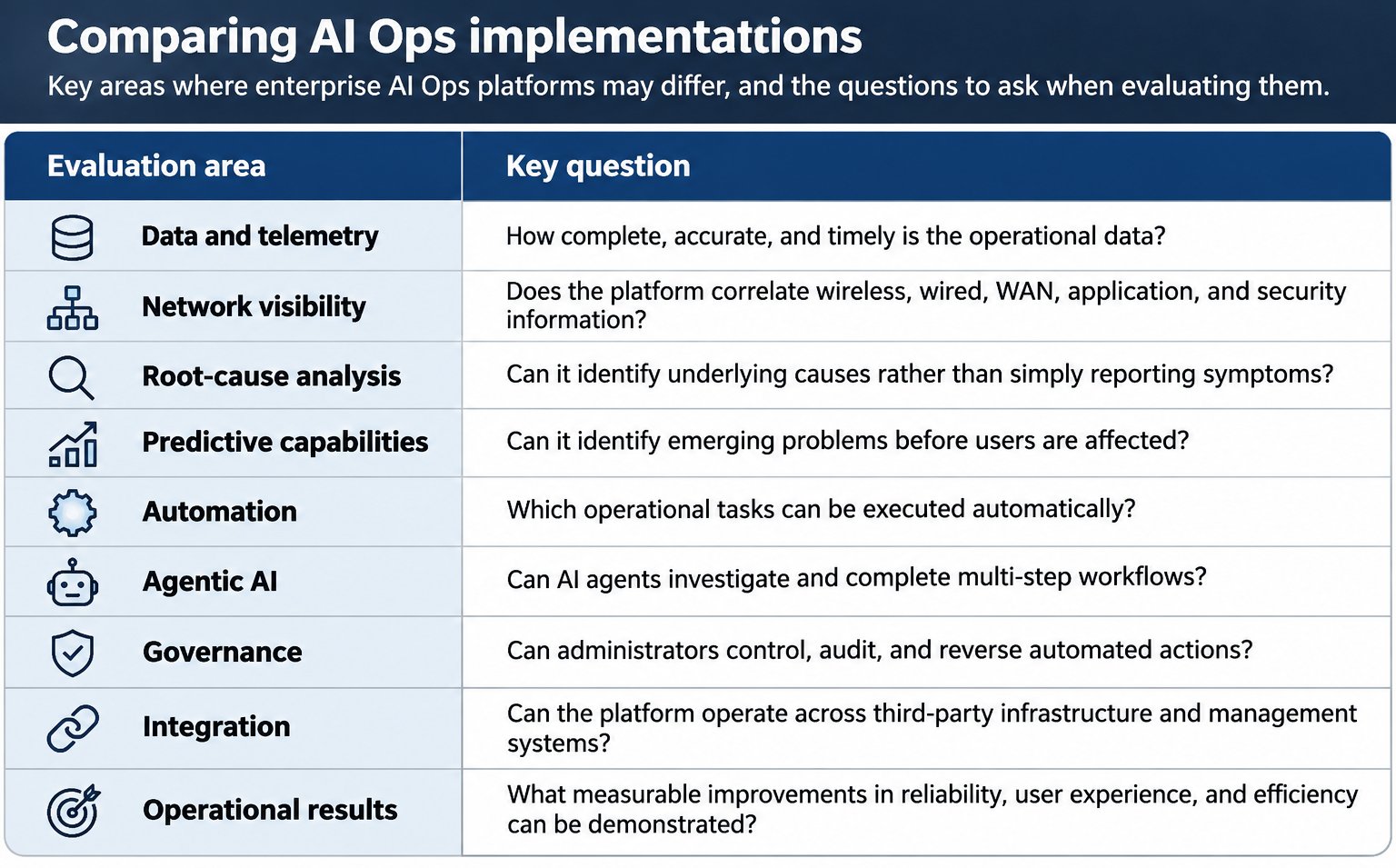
No single criterion determines the overall effectiveness of an AI Ops platform. Different enterprise environments may prioritise different capabilities. A large distributed retail network, for example, may place particular emphasis on proactive troubleshooting and automated remediation across thousands of locations. A hospital or industrial facility may place greater emphasis on predictable performance, operational safeguards, and strict control over configuration changes.
Will AI Ops eventually become a commodity?
The history of enterprise networking suggests that many capabilities initially regarded as differentiators eventually become standard product features. AI-assisted monitoring, anomaly detection, and conversational interfaces may follow a similar trajectory. However, the underlying intelligence and operational effectiveness of AI Ops platforms may remain differentiated for longer.
Vendors are investing in proprietary telemetry architectures, AI models, knowledge graphs, operational datasets, and automation frameworks. The resulting systems may differ in their ability to understand network conditions, interpret complex events, and implement reliable corrective actions. There is also the question of learning and improvement over time.
AI Ops platforms may benefit from accumulating operational experience across large numbers of deployments, provided that data quality, privacy, and security requirements are maintained. This could create advantages for vendors with extensive installed bases and mature AI operations architectures. Equally, open interfaces, standardised telemetry, and advances in general-purpose AI could reduce some of these advantages by making sophisticated capabilities available to a wider range of suppliers. The competitive landscape is therefore unlikely to remain static.
The next phase: Autonomous network operations
The longer-term direction of enterprise AI Ops is towards networks capable of managing an increasing proportion of their own operational requirements. This does not necessarily imply networks operating without human supervision. Instead, it suggests a gradual redistribution of operational responsibilities between administrators and AI systems.
Routine diagnostic and remediation tasks may increasingly be handled automatically, while administrators concentrate on policy, architecture, security, and higher-level operational decisions. For enterprises, the challenge will be determining which tasks can safely be automated and which should remain subject to human approval.
For vendors, the challenge will be demonstrating that increasingly sophisticated AI systems deliver measurable improvements in network reliability, operational efficiency, and user experience. AI Ops may be becoming table stakes as a product category, but meaningful differentiation remains in how effectively these systems translate network intelligence into operational results.
As agentic AI develops, the competitive focus is likely to shift further from identifying problems towards resolving them reliably, with appropriate safeguards and progressively less manual intervention. In Part Five of this series, we examine the enterprise AI Ops ecosystem, mapping leading vendors, platforms, and solutions, and comparing their approaches to AI-driven network operations.
/Claus.