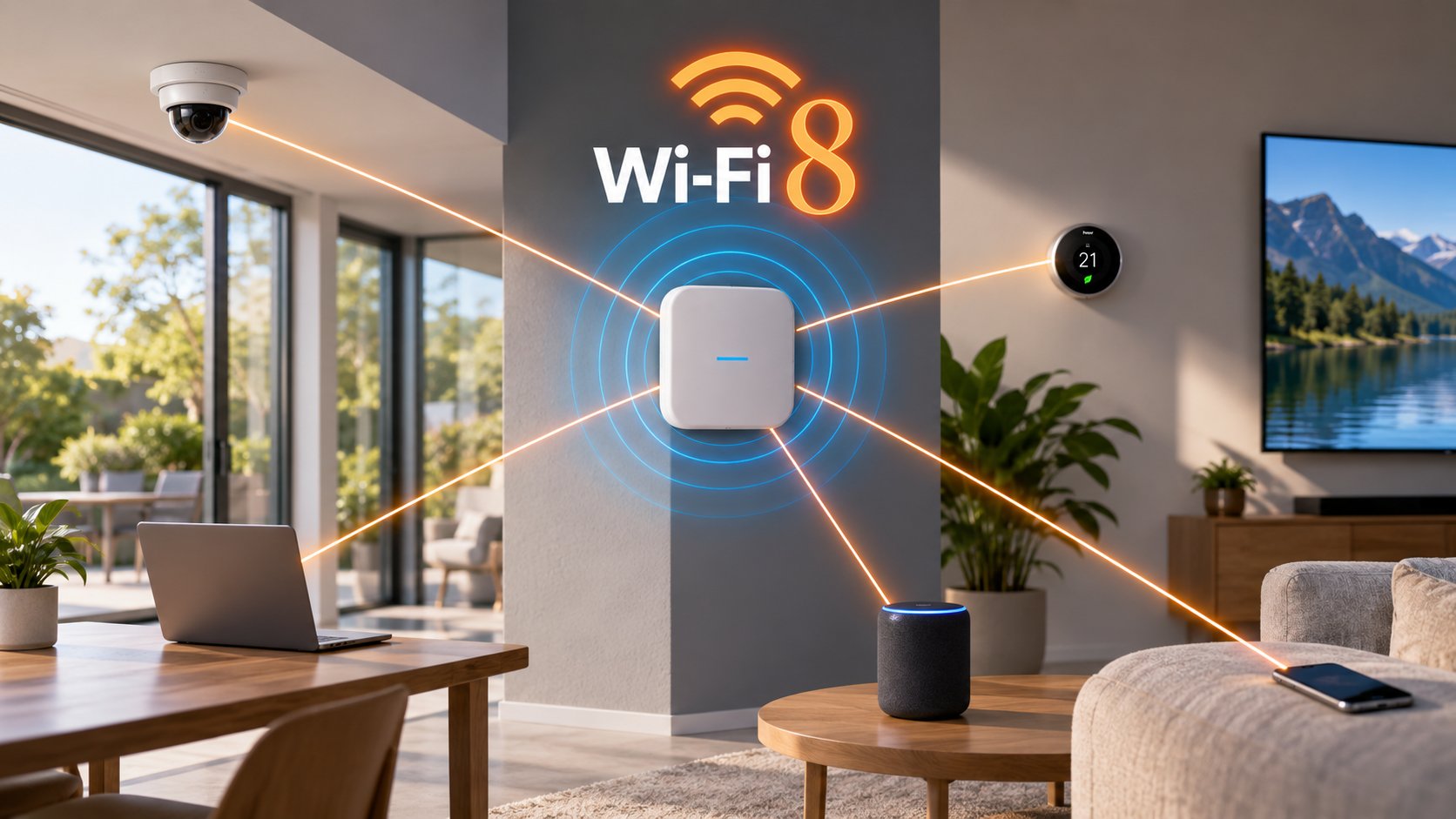

Wi-Fi 8 introduces an unusually broad collection of technologies aimed at making wireless connectivity more dependable. Multi-AP Coordination allows access points to cooperate. Coordinated Spatial Reuse and Coordinated Beamforming address interference. Dynamic Subband Operation and Non-Primary Channel Access make spectrum use more flexible. Seamless roaming targets better mobility, while Enhanced Long Range aims to preserve useful connectivity under difficult radio conditions.
But the real significance of Wi-Fi 8 will ultimately depend on something else: How these technologies are implemented and deployed in real networks. Wi-Fi 8 is unlikely to arrive as a single capability that suddenly transforms every network. Different features require different combinations of AP support, client support, network architecture, software, and coordination. The transition will therefore be gradual. What is already becoming clear, however, is the direction of travel: Wi-Fi is becoming a more coordinated and increasingly intelligent networking system.
Wi-Fi 8 builds on Wi-Fi 7
Wi-Fi 8 is an evolution rather than a clean break with previous generations. IEEE 802.11bn builds on capabilities introduced by Wi-Fi 7 and earlier standards, including OFDMA, beamforming, Multi-Link Operation, wide channels, advanced modulation, and increasingly sophisticated scheduling. This matters for deployment. Backward compatibility remains fundamental, meaning Wi-Fi 8 networks will operate for years in environments containing Wi-Fi 7, Wi-Fi 6, and older clients.
The benefits will therefore appear progressively as more APs and clients support the new capabilities.
Not every feature requires the same deployment
The technologies covered in this guide have different requirements. Some primarily improve the operation of the radio link. Enhanced Long Range and the new MCS options are examples. Others require support from both the AP and client. Dynamic Subband Operation, Non-Primary Channel Access, and seamless roaming depend on compatible devices participating in the new procedures.
Multi-AP technologies introduce another level of complexity. Coordinated Beamforming and Coordinated Spatial Reuse require APs to exchange information and coordinate transmissions. Their benefits therefore depend not simply on having Wi-Fi 8 radios, but on having APs capable of participating in a coordinated network architecture. This distinction will matter when evaluating Wi-Fi 8 products. A Wi-Fi 8 logo alone won’t necessarily tell a network operator which UHR capabilities have been implemented, how they are managed, or how effectively they work together.
Managed networks may benefit first
Many of Wi-Fi 8’s most interesting capabilities are particularly well suited to networks in which multiple APs are under common management. Enterprise Wi-Fi is an obvious example. Enterprise networks already use centralised or cloud-based systems to manage radio resources, client connections, channel selection, power levels, roaming, and network performance. Wi-Fi 8 adds new mechanisms through which APs can coordinate radio behaviour more closely.
Managed residential Wi-Fi represents another important opportunity. Service-provider-managed gateways and mesh systems increasingly consist of several APs operating as one network. These environments provide a natural foundation for coordination because the APs already belong to the same administrative domain.
The same principle applies to managed Wi-Fi in hospitality, education, public venues, MDUs, industrial environments, and other multi-AP deployments. By contrast, independent neighbouring APs operated by different owners should not be assumed to coordinate simply because they support Wi-Fi 8.
Client adoption will take time
AP infrastructure is only half of the Wi-Fi ecosystem. Many Wi-Fi 8 capabilities also depend on support in phones, laptops, IoT devices, and other clients. Those devices will enter the installed base gradually through normal replacement cycles.
This creates an important reality for early Wi-Fi 8 deployments: Networks will be heterogeneous. A Wi-Fi 8 AP may simultaneously serve new UHR-capable clients and large numbers of legacy devices. The value of individual Wi-Fi 8 features will therefore depend partly on how much benefit infrastructure can deliver in mixed-client environments and how gracefully new capabilities can coexist with older devices. For operators, migration strategy may ultimately matter almost as much as peak technical capability.
Coordination creates a new implementation challenge
Wi-Fi has historically been remarkably successful partly because of its distributed architecture. Devices listen to the channel, compete for access, and operate with relatively limited knowledge of what neighbouring networks are doing. Wi-Fi 8 doesn’t abandon that model.
But it increasingly supplements it with explicit coordination. APs may need to exchange more information about radio conditions, clients, interference, timing, and transmission opportunities. Coordination decisions also need to be made quickly enough to remain useful as traffic and radio conditions change. The quality of the algorithms controlling these mechanisms may therefore become an important differentiator. Two Wi-Fi 8 networks supporting the same underlying IEEE capabilities may not necessarily deliver identical real-world results.
AI could become an important layer above Wi-Fi 8
IEEE 802.11bn defines radio and MAC mechanisms. It doesn’t prescribe an AI system for operating the network. But Wi-Fi 8 creates an increasingly rich set of controls that network-management software can use.
A network may have choices about which AP should serve a client, when APs should coordinate, how spectrum should be used, which transmission parameters should be selected, and when a client should prepare to move to another AP. Making those decisions requires information about the network and its changing radio environment.
This creates a natural opportunity for increasingly sophisticated optimisation algorithms – including machine learning and AI – to operate above the standards-defined mechanisms. The standard provides the tools. Network intelligence can increasingly determine when and how those tools should be used. AI isn’t therefore a Wi-Fi 8 feature defined by IEEE 802.11bn – but Wi-Fi 8 could provide a much richer platform for intelligent network optimisation.
Certification will turn standards into products
IEEE defines the underlying 802.11 technical standard, but commercial interoperability depends heavily on the broader Wi-Fi ecosystem. The Wi-Fi Alliance traditionally converts new IEEE capabilities into certification programmes and interoperability requirements.
Those programmes determine which capabilities become part of certified generations of Wi-Fi products and how they are tested across vendors. The eventual commercial definition of Wi-Fi CERTIFIED 8 therefore won’t necessarily correspond one-for-one with every capability developed within IEEE 802.11bn. Some features may become certification requirements. Others may be optional or introduced progressively as the ecosystem develops. For buyers and network operators, the details of certification will therefore be important when Wi-Fi 8 reaches commercial deployment.
The transition has already begun
The Wi-Fi 8 ecosystem is developing before completion of the final IEEE 802.11bn standard. As with previous Wi-Fi generations, chipset vendors, equipment manufacturers, test companies, and other ecosystem participants can begin engineering against sufficiently mature draft specifications.
Early Wi-Fi 8 silicon and products may therefore appear while IEEE work is still progressing toward final publication. This isn’t unusual. Previous Wi-Fi generations have followed similar development cycles, with commercial ecosystem activity overlapping the final stages of standards development. What matters is that specifications, interoperability testing, certification, and implementations converge as the technology matures.
An operator-focused Wi-Fi 8 deployment roadmap
For broadband operators, Wi-Fi 8 deployment is likely to be an evolution rather than a single upgrade event. Gateways, extenders, client devices, cloud management platforms, and support systems will all move at different speeds. A practical deployment path could therefore develop in several stages – with operator benefits increasing as more of the Wi-Fi 8 ecosystem comes into place.
Stage 1: Prepare the platform
Before large-scale Wi-Fi 8 deployment, operators can prepare the network architecture that will eventually make use of the new capabilities. This includes improving home-network telemetry, developing cloud-based visibility and analytics, and ensuring future gateways and mesh architectures have the processing and radio capabilities needed for increasingly sophisticated Wi-Fi management. The objective is to create the management and data foundation needed for increasingly coordinated Wi-Fi.
Operator outcome: Better visibility into subscriber Wi-Fi performance and a stronger foundation for remote troubleshooting and optimisation. Better network intelligence can potentially reduce unnecessary support calls, escalations, and truck rolls even before the full benefits of Wi-Fi 8 become available.
Stage 2: Introduce Wi-Fi 8 gateways and APs
Operators can begin introducing Wi-Fi 8-capable gateways, extenders, and mesh APs through normal equipment refresh cycles and, potentially, premium broadband offerings. Early deployments will inevitably serve predominantly legacy clients, so initial benefits may come from improved radio and platform capabilities alongside Wi-Fi 8 features that can provide value in mixed-client environments. Backward compatibility will remain essential.
Operator outcome: A gradual migration without requiring a costly mass replacement of customer equipment. Wi-Fi 8 can also provide a new premium CPE proposition while preparing the installed base for more advanced UHR capabilities.
Stage 3: Activate client-dependent UHR features
As Wi-Fi 8 clients become more common, operators can begin taking greater advantage of features requiring support at both ends of the connection. Dynamic Subband Operation, Non-Primary Channel Access, Enhanced Long Range, and new mobility mechanisms are examples where compatible clients become important to unlocking the full benefit.
The proportion of Wi-Fi 8 clients in each home could therefore become an important indicator of when particular capabilities begin delivering meaningful benefits.
Operator outcome: More consistent subscriber experience as compatible devices gain access to better spectrum utilisation, mobility, and weak-signal operation. The potential business result is fewer Wi-Fi-related complaints and greater ability to deliver the broadband performance customers expect throughout the home.
Stage 4: Exploit coordinated multi-AP Wi-Fi
For operators supplying both gateways and mesh extenders, Multi-AP Coordination could represent one of Wi-Fi 8’s most strategically important opportunities. Instead of treating each AP largely as an independent radio, operator-managed Wi-Fi could increasingly coordinate transmissions, interference management, mobility, and spectrum use across the home.
This is where Wi-Fi 8 begins to move beyond upgrading individual access points toward improving the behaviour of the whole home network.
Operator outcome: Better performance and consistency across multi-AP homes, particularly in difficult radio environments. More effective use of existing gateways and extenders could also help operators solve some coverage and performance problems through optimisation rather than simply adding more hardware.
Stage 5: Add increasingly intelligent optimisation
The longer-term opportunity is to combine Wi-Fi 8’s radio and MAC capabilities with the data already available to operator cloud platforms. Network intelligence could determine which Wi-Fi 8 mechanisms should be used, for which clients, under which radio conditions, and at what time.
AI and machine learning could play an increasing role here – not as part of IEEE 802.11bn itself, but as an optimisation layer controlling standards-based capabilities. The result could be a feedback loop in which the network measures conditions, identifies a problem, selects an appropriate Wi-Fi 8 mechanism, observes the result, and continually adjusts its behaviour.
Operator outcome: A shift from reactive Wi-Fi support toward proactive and increasingly autonomous network management. The strategic opportunity is lower operating cost, fewer customer-impacting Wi-Fi problems, better quality of experience, and greater differentiation of the operator’s managed Wi-Fi service.
For operators, this progression may ultimately be more important than any individual Wi-Fi 8 feature. The long-term opportunity isn’t simply to deploy faster gateways. It is to evolve managed Wi-Fi from a largely reactive connectivity service into an increasingly coordinated, measurable, and optimised wireless system.
From faster links to better networks
Across the chapters of this guide, a pattern emerges. Wi-Fi 8 still improves the radio link. Enhanced Long Range and new MCS options demonstrate that PHY innovation remains important. But many of the most consequential changes occur elsewhere.
APs can coordinate transmissions. Spectrum can be used more flexibly. Clients can potentially maintain better continuity while moving. Networks can manage interference rather than simply reacting to it. The emphasis therefore moves increasingly from optimizing an individual transmission toward optimizing the behaviour of the network as a whole.
This doesn’t mean peak performance no longer matters. It means peak performance alone is becoming an incomplete measure of Wi-Fi quality. Latency, packet loss, mobility, interference resilience, consistency, and usable coverage increasingly matter alongside throughput.
Key takeaways
- Wi-Fi 8 deployment will be a gradual evolution, not a single upgrade event.
- Many benefits will grow as Wi-Fi 8 AP and client adoption increases.
- Managed multi-AP networks provide a natural environment for Wi-Fi 8 coordination.
- Operators can progress from platform preparation to coordinated and increasingly intelligent Wi-Fi management.
- The larger shift is from faster individual links toward more dependable networks and better user experience.
WiFi NOW Perspective: Wi-Fi 8 may ultimately be remembered less for a new headline speed than for a change in architecture. The extraordinary success of Wi-Fi has been built on distributed access to shared spectrum. That principle remains intact. But as networks become denser and applications more demanding, purely independent radio operation increasingly reaches practical limits. IEEE 802.11bn responds by giving Wi-Fi networks more ways to coordinate APs, manage spectrum, protect traffic during mobility, and maintain difficult links.
That doesn’t suddenly turn Wi-Fi into a centrally scheduled wireless system. Nor will every Wi-Fi 8 network use every available mechanism. The change is subtler – and potentially more important. Wi-Fi is evolving from a collection of increasingly powerful individual links toward an increasingly coordinated wireless network.
For broadband operators, that evolution could also change the nature of managed Wi-Fi itself: from supplying connectivity and reacting when it fails toward continuously measuring, coordinating, and optimising the subscriber’s wireless experience. Ultra High Reliability is the objective. Coordination, smarter spectrum use, better mobility, more robust links, and increasingly intelligent management are the tools for getting there. That is the architectural – and potentially operational – story of Wi-Fi 8.