
Wi-Fi channels have become dramatically wider. Wi-Fi 5 made 80 MHz channels commonplace, while Wi-Fi 6E expanded Wi-Fi into the 6 GHz band. Then Wi-Fi 7 introduced channels as wide as 320 MHz. But there is a catch: A Wi-Fi access point may support a much wider channel than many of the devices connected to it.
A 320 MHz-capable access point, for example, may serve smartphones, laptops, televisions, cameras and other devices supporting only 80 MHz or 160 MHz operation. IEEE 802.11bn – the technical basis for Wi-Fi 8 – addresses this mismatch with Dynamic Subband Operation, or DSO. DSO allows an access point to temporarily move compatible clients to different portions of its operating bandwidth.
The wide-channel problem
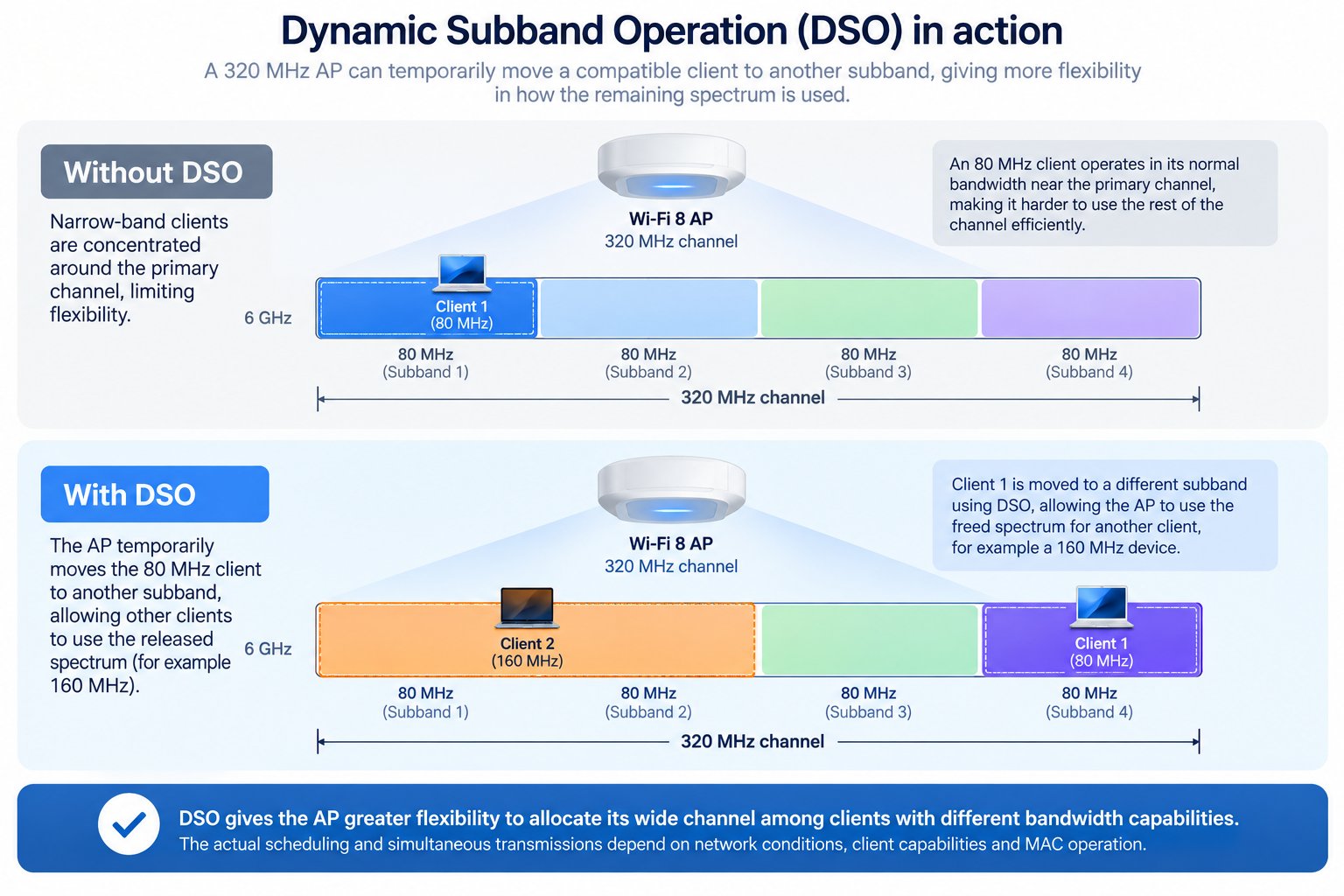
Consider a Wi-Fi 8 access point operating across 320 MHz and serving several clients supporting only 80 MHz operation: Under conventional operation, those clients normally operate within bandwidth that includes the BSS primary channel. This can limit the AP’s ability to schedule those clients elsewhere within its much wider operating channel.
The result can be an unusual situation: The AP has spectrum available but limited flexibility in where it can serve a particular client. Dynamic Subband Operation is designed to change that.
Moving clients within the channel
DSO allows a compatible client to be temporarily allocated frequency resources outside its current operating bandwidth but still inside the AP’s wider operating bandwidth.
Imagine a 320 MHz AP serving an 80 MHz client: 80 MHz | 80 MHz | 80 MHz | 80 MHz. The client’s normal operating bandwidth occupies one portion of that spectrum. With DSO, the AP can temporarily direct a DSO-capable client to another suitable subband within the 320 MHz channel. Crucially, the assignment does not need to be permanent. The AP can make the decision dynamically as transmission opportunities arise.
How DSO works
The IEEE 802.11bn mechanism allows subband allocation to take place dynamically, including on a per-TXOP basis. A TXOP, or transmission opportunity, is a period during which a device that has gained access to the wireless medium is permitted to transmit. In simplified form:
- The client normally operates within its existing operating bandwidth.
- The AP obtains an appropriate transmission opportunity.
- The AP sends a DSO Initial Control Frame, or ICF, containing information required for the DSO operation.
- The compatible client switches to the indicated DSO subband elsewhere within the AP’s operating bandwidth.
- The AP and client perform the scheduled data exchange using that subband.
- The client subsequently returns to its normal operating bandwidth.
DSO therefore does not fundamentally change the client’s normal operating channel. It provides a temporary alternative location within the AP’s wider channel.
From predetermined to dynamic operation
The idea of placing clients on selected portions of a wider channel is not entirely new. Earlier IEEE 802.11 generations introduced mechanisms including Subchannel Selective Transmission, or SST. Such approaches can rely on arrangements established in advance, making them less flexible when traffic demand changes unpredictably.
DSO takes the concept further by allowing the AP to make subband allocation decisions dynamically. This matters because Wi-Fi traffic is inherently variable. A laptop may suddenly begin downloading a large file while another device has almost nothing to send. Greater flexibility in frequency allocation gives the AP another way to respond to changing traffic conditions.
DSO is not preamble puncturing
Dynamic Subband Operation can easily be confused with another important wide-channel technology: Preamble puncturing. The two mechanisms solve different problems.
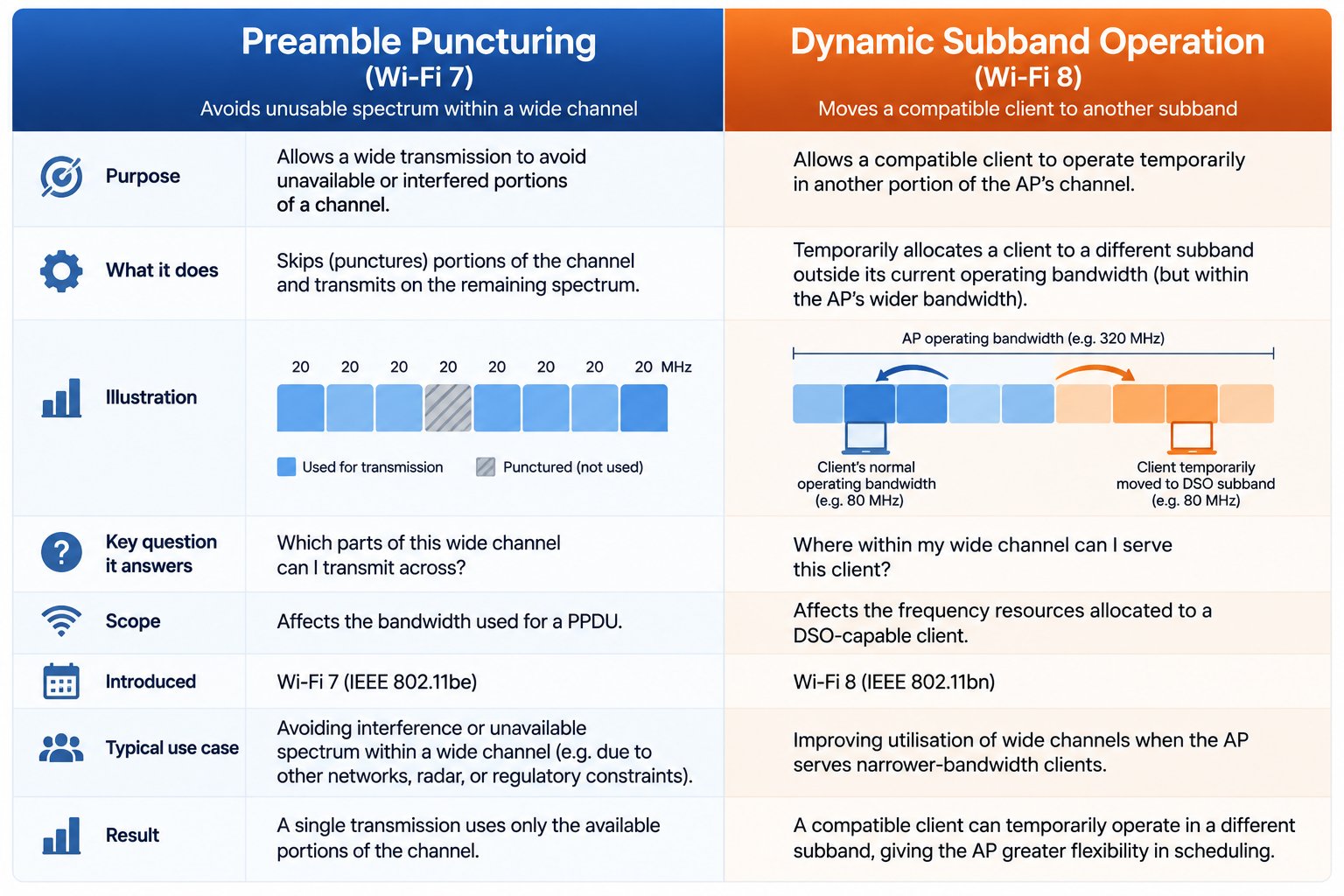
Preamble puncturing essentially asks: Which parts of this wide channel can I transmit across? DSO asks: Where within my wide channel can I serve this client?
Why this improves efficiency – and what clients gain
The important benefit of DSO is not simply that an AP can serve different clients on different frequency resources. Wi-Fi already supports frequency-domain scheduling, including through OFDMA. The problem DSO addresses is more specific: A narrower-bandwidth client is normally confined to its current operating bandwidth, even when the AP itself operates across a much wider channel.
Consider a 320 MHz AP serving a 160 MHz client: The client’s normal operating bandwidth occupies only one 160 MHz portion of the AP’s channel. The other 160 MHz may be available to the AP, but that client cannot normally be served there. DSO removes this constraint.
The AP can temporarily move a compatible 160 MHz client to a DSO subband in the other half of its 320 MHz operating channel. The client therefore gains access to additional transmission opportunities elsewhere within the AP’s wider bandwidth. This can be particularly useful when the client’s normal operating bandwidth is busy. Instead of necessarily waiting for resources to become available there, the AP may be able to serve the client temporarily on another suitable DSO subband.
For clients, the potential benefits are therefore less waiting, lower latency, and more consistent performance when alternative frequency resources are available. For the AP, the benefit is greater flexibility in deciding where within its wider channel individual clients should be served.
DSO does not give the client a wider radio or turn a 160 MHz device into a 320 MHz device. Instead, it makes the client’s existing bandwidth capability more flexible in frequency, allowing that client to use portions of the AP’s channel that would otherwise be outside its normal operating bandwidth.
Which clients can use DSO?
DSO requires support from both the access point and the client. A Wi-Fi 8 AP cannot simply move an existing Wi-Fi 6 or Wi-Fi 7 client to another part of its channel unless that client supports the required DSO operation.
A DSO-capable client must be able to temporarily retune from its normal operating bandwidth to an assigned DSO subband and then return after the exchange. The AP and client also need to exchange the information required to establish their DSO capabilities and supported subbands.
Importantly, DSO does not require the client to support the AP’s full channel width. In fact, this bandwidth mismatch is one of the principal reasons for DSO. For example, a DSO-capable 160 MHz client can potentially be served on a suitable 160 MHz subband elsewhere within a 320 MHz AP channel.
The client’s radio remains a 160 MHz radio – DSO simply gives the AP more flexibility over where those 160 MHz are located for a particular transmission opportunity. Legacy clients that do not support DSO continue to operate normally within their existing operating bandwidth. DSO is therefore an additional capability for compatible Wi-Fi 8 devices, not a requirement for every device associated with a Wi-Fi 8 AP.
A different approach to increasing capacity
DSO illustrates an important difference between Wi-Fi 7 and Wi-Fi 8: Wi-Fi 7 expanded potential capacity through technologies including 320 MHz channels, Multi-Link Operation and 4096-QAM. Wi-Fi 8 does not simply make the channels wider again. DSO instead provides greater flexibility in how the available bandwidth can be allocated among clients with different capabilities.
This also complements the Coordinated Spatial Reuse mechanism covered in Chapter 5. Coordinated Spatial Reuse creates opportunities for two coordinated APs to use the same spectrum concurrently when interference can be controlled. Dynamic Subband Operation allows an AP to move a compatible client temporarily to another portion of its operating bandwidth.
One addresses spatial reuse between APs. The other addresses frequency allocation within an AP’s channel.
Where DSO could matter most
DSO should become increasingly relevant as wide-channel Wi-Fi deployments grow and APs serve devices with widely differing bandwidth capabilities. Potential environments include:
- Enterprise networks
- High-density public venues
- Managed residential networks
- Hospitality environments
- Education and healthcare networks
- Other dense 6 GHz deployments
The actual benefits will depend on client support, traffic patterns, channel configuration and implementation. DSO is therefore not an automatic performance multiplier; it provides another scheduling option that the network can exploit when appropriate.
Key takeaways
- Wi-Fi APs can support considerably wider channels than many of the clients connected to them. Dynamic Subband Operation addresses this bandwidth mismatch.
- DSO allows a compatible client to be temporarily allocated frequency resources outside its current operating bandwidth but within the AP’s wider operating bandwidth.
- The AP can initiate the operation using a DSO Initial Control Frame and allocate a DSO subband dynamically, including on a per-TXOP basis.
- The client temporarily switches to the assigned DSO subband and subsequently returns to its normal operating bandwidth.
- DSO differs from preamble puncturing: puncturing changes which portions of a wide transmission are used, while DSO changes where a compatible client can temporarily operate.
- DSO is particularly relevant to wide-channel networks serving clients with different bandwidth capabilities.
WiFi NOW Perspective: Dynamic Subband Operation addresses a consequence of Wi-Fi’s rapid expansion in channel width. A 320 MHz AP may have enormous bandwidth available while many of its clients support only a fraction of it. DSO gives the AP greater freedom to determine where within that bandwidth a compatible client should operate for a particular transmission opportunity.
That makes DSO a good example of the broader direction of Wi-Fi 8: Rather than simply adding more bandwidth or chasing another large increase in peak PHY rate, Wi-Fi 8 is introducing mechanisms designed to make the wireless resources already available more flexible and useful.