
One of the paradoxes of modern Wi-Fi is that networks can spend a surprising amount of time doing nothing. Not because there is no data to send, nor because devices are disconnected. But because they are waiting for another transmission to finish. Before transmitting, a Wi-Fi device listens to determine whether the wireless medium is already in use. If the channel is considered busy, the device normally waits before trying again.
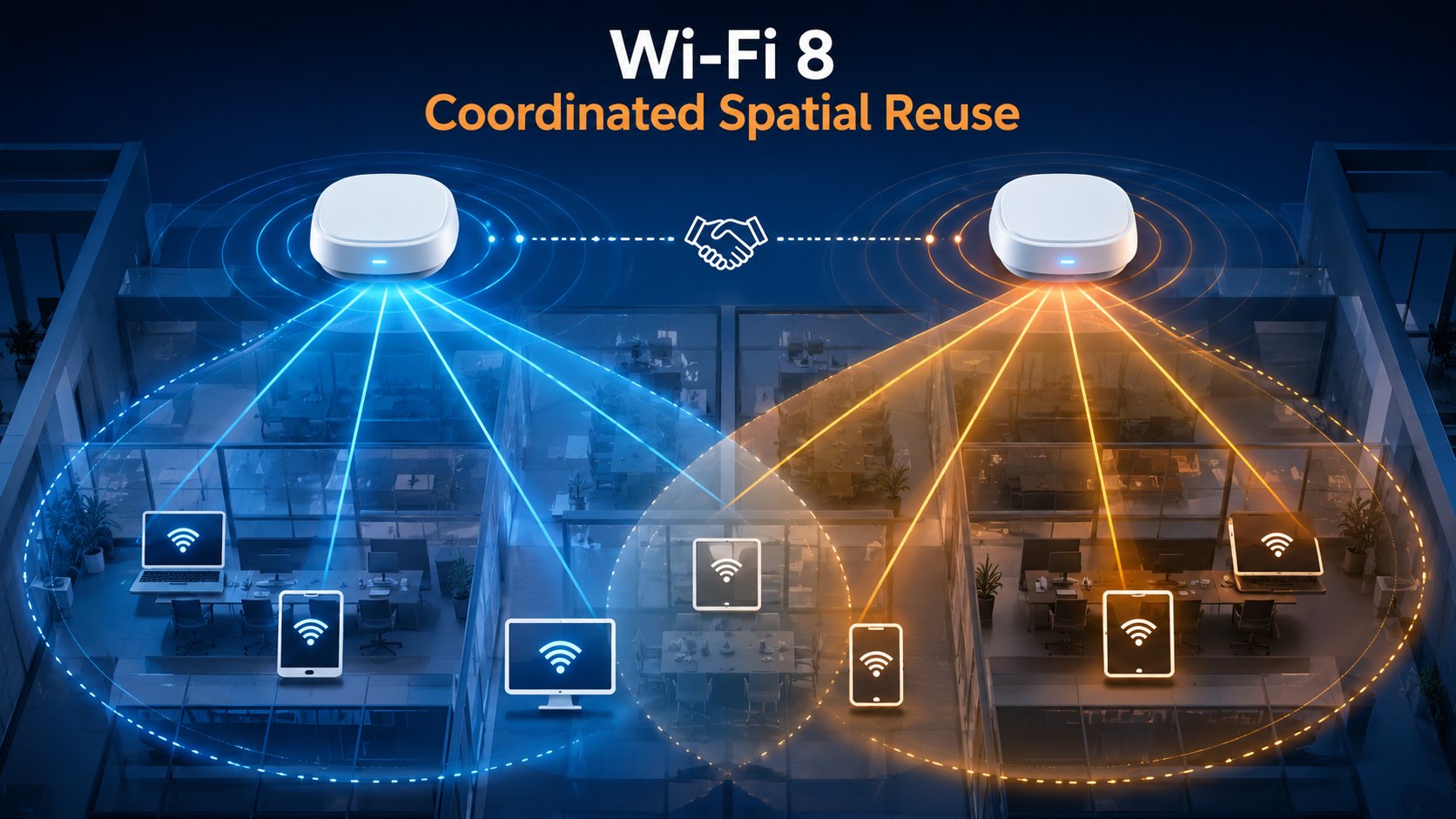
This distributed approach has allowed billions of independent Wi-Fi devices to share unlicensed spectrum successfully. But as Wi-Fi deployments become denser, the amount of time spent waiting can increasingly limit network performance. IEEE 802.11bn – the technical basis for Wi-Fi 8 – addresses this problem with Coordinated Spatial Reuse (Co-SR): A Multi-AP mechanism designed to allow two access points to transmit at the same time when their transmissions can be coordinated sufficiently to control interference.
When waiting becomes inefficient
Consider two nearby access points, each serving its own client: One AP gains access to the channel and begins transmitting, while the other AP may defer its transmission until the channel becomes available again. That is the safe approach when the APs do not know how much interference simultaneous transmissions would create. But waiting is not always necessary.
The clients may be positioned so that each has a strong connection to its own AP while receiving relatively little interference from the other AP. It may therefore be possible for both links to operate successfully at the same time. The problem is determining when this can be done without compromising either transmission. That is the problem Coordinated Spatial Reuse is designed to address.
Spatial reuse isn’t new
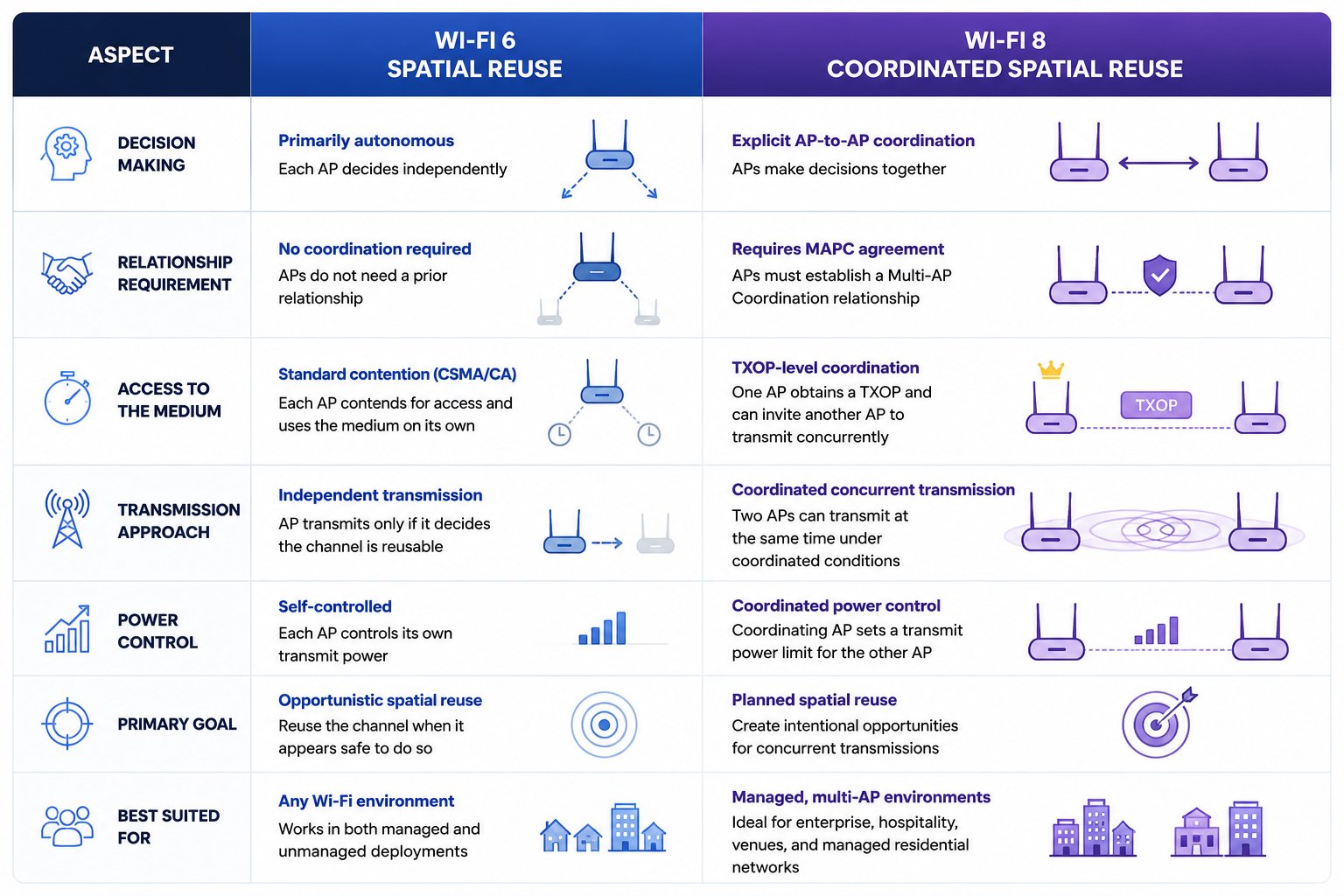
The concept of spatial reuse predates Wi-Fi 8. Wi-Fi 6 introduced important spatial-reuse capabilities, including BSS Colouring and mechanisms that help devices distinguish their own BSS from overlapping networks. These can help an AP determine whether neighbouring activity is sufficiently weak to permit reuse of the channel. The important difference is that these decisions are largely autonomous.
Wi-Fi 8 Co-SR introduces explicit coordination between access points. Instead of one AP independently deciding that it can transmit while another network is active, two compatible APs can establish a Multi-AP Coordination relationship and arrange concurrent transmissions under controlled conditions.
This represents a significant change in how Wi-Fi can approach spectrum reuse.
How Coordinated Spatial Reuse works
The IEEE 802.11bn framework defines Co-SR as a TXOP-level Multi-AP mechanism using transmit-power control. A TXOP, or transmission opportunity, is a period during which a device that has successfully gained access to the wireless medium is permitted to transmit. In simplified form, Co-SR works like this:
- A coordinating AP successfully gains access to the channel and obtains a TXOP.
- It identifies a coordinated AP with which it has established a Multi-AP Coordination agreement for Co-SR.
- The coordinating AP sends a Co-SR Trigger frame inviting the second AP to participate in a concurrent transmission.
- The Trigger frame provides coordination information, including the maximum transmit-power level permitted for the coordinated AP.
- The two APs then transmit concurrently, with their data transmissions synchronised to start and end together.
The coordinating AP therefore retains control of the TXOP while allowing a second AP to reuse the same wireless resource under defined conditions. Instead of: AP 1 transmits → AP 2 waits → AP 2 transmits, Co-SR can enable: AP 1 transmits + AP 2 transmits concurrently. The result is the possibility of carrying more traffic within the same amount of airtime.
Why power control matters
Simply allowing two nearby APs to transmit simultaneously would not necessarily improve anything. If either transmission creates too much interference, one or both links may fail. Transmit-power control is therefore fundamental to Co-SR.
The coordinating AP specifies a maximum transmit-power level at which the coordinated AP is permitted to participate in the concurrent transmission. The coordinated AP must operate within that limit. The coordinated AP can also indicate during establishment of the coordination relationship a minimum transmit-power level below which participation would not be useful. Co-SR therefore creates a controlled form of simultaneous transmission. The objective is to find opportunities where the second transmission adds useful capacity while keeping interference at an acceptable level.
From contention to selective cooperation
Coordinated Spatial Reuse does not replace Wi-Fi’s contention-based operation because APs still compete for access to the wireless medium. The important difference is what can happen after an AP has obtained access. Instead of necessarily using the resulting TXOP exclusively, the AP can under suitable conditions coordinate with another AP and allow that AP to transmit concurrently.
This illustrates one of the broader architectural themes emerging with Wi-Fi 8. The wireless medium remains distributed, but APs can increasingly cooperate where doing so improves overall network performance.
Where Co-SR could make the biggest difference
The most obvious opportunities exist in dense, managed Wi-Fi environments containing multiple overlapping access points. Enterprise networks are a natural example because offices, hospitals and university campuses frequently deploy large numbers of APs under common management, creating many opportunities for overlapping coverage. Hotels and public venues present similar conditions, particularly where large numbers of users are concentrated within relatively small areas.
Managed residential Wi-Fi and mesh networks could also benefit because multiple APs or mesh nodes are already part of the same managed system. Apartment buildings illustrate the underlying problem particularly well: dozens of Wi-Fi networks may compete for the same spectrum within a small physical area. But support for Wi-Fi 8 alone does not mean independently owned neighbouring routers will automatically coordinate with one another. Co-SR requires compatible APs participating in an established Multi-AP Coordination relationship. The distinction is important: Co-SR is most naturally applicable where AP coordination can actually be established and managed.
Better use of airtime
The potential advantage of Co-SR is straightforward: If two transmissions that would previously have occurred one after another can instead take place simultaneously, the network can make better use of the available airtime. Depending on the deployment, this can potentially deliver:
- Greater aggregate throughput across overlapping BSSs
- Less time spent waiting for neighbouring transmissions
- Lower latency caused by queued traffic
- Better utilisation of available spectrum
- Greater capacity in dense Wi-Fi environments
But the benefits will not be identical everywhere. Performance will depend on AP placement, client locations, radio propagation, traffic demand, and the power levels at which both links can operate successfully. Co-SR is therefore selective rather than universal. Its value comes from identifying situations where concurrent transmission creates additional capacity without sacrificing reliability.
More capacity without more spectrum
For decades, increasing wireless capacity has frequently meant finding more spectrum, creating wider channels or increasing spectral efficiency. Coordinated Spatial Reuse takes a complementary approach: It asks whether existing spectrum can be used more than once, at the same time, within the same physical area when interference conditions permit. That is an increasingly important question.
Wi-Fi 7 introduced 320 MHz channels in the 6 GHz band, but spectrum remains finite – and the densest Wi-Fi environments are often constrained as much by competing transmissions as by the theoretical speed of individual links. Co-SR therefore represents another way to increase network capacity: make better use of the airtime and spectrum already available.
Key takeaways:
- Spatial reuse is not new to Wi-Fi 8; Wi-Fi 6 already introduced important spatial-reuse mechanisms
- Wi-Fi 8 adds explicit Coordinated Spatial Reuse between two APs.
- IEEE 802.11bn defines Co-SR as a TXOP-level Multi-AP mechanism using transmit-power control.
- A coordinating AP obtains a TXOP and can invite a coordinated AP to transmit concurrently.
- The two AP transmissions are synchronised, while the coordinated AP operates within a transmit-power limit specified by the coordinating AP.
- Co-SR does not replace contention; it creates opportunities for additional spectrum reuse after an AP has obtained access to the medium.
- Dense managed networks are likely to provide some of the most natural deployment opportunities.
- The objective is simple: use existing spectrum and airtime more efficiently without compromising reliability.
WiFi NOW Perspective: Coordinated Spatial Reuse is one of the clearest examples of Wi-Fi 8’s shift towards more coordinated wireless networking. The idea itself is deceptively simple: Two transmissions are better than one – provided they can coexist without creating harmful interference. What changes with IEEE 802.11bn is how deliberately this can be achieved. Two APs with an established Multi-AP Coordination relationship can coordinate the timing and power of concurrent transmissions within a TXOP instead of relying only on independent assessments of the radio environment.
Co-SR does not eliminate contention, nor does it allow every nearby AP to transmit simultaneously. It creates controlled opportunities for two APs to reuse the same wireless resource when conditions permit. Its commercial importance will therefore depend heavily on implementation and deployment architecture. Managed enterprise, hospitality, public-venue and residential networks appear particularly well suited because their APs can operate as part of a coordinated system. If implemented effectively, the result is compelling: More useful Wi-Fi capacity from the same spectrum.