
Enterprise Wi-Fi networks have become extraordinarily good at generating data. Access points, controllers, switches, clients, applications, authentication systems, and cloud management platforms continuously produce telemetry describing almost every aspect of network behaviour. The challenge is no longer collecting the data. The challenge is working out what it means – and turning it into action.
This is the basic proposition behind AI Ops for enterprise Wi-Fi: Applying artificial intelligence and machine learning to network operational data so that Wi-Fi systems can identify problems, determine their likely causes, recommend or execute corrective actions, and ultimately improve the user experience with less manual intervention. The concept is not entirely new. Machine learning has been part of enterprise Wi-Fi management for years. But AI Ops is now evolving from an analytics capability into something potentially much more important: A new operational model for enterprise connectivity.
Why Wi-Fi needs AI Ops
Wi-Fi presents an unusually difficult operational environment. A wired Ethernet connection is largely deterministic. Wi-Fi operates across shared spectrum and depends on radio conditions that change continuously. Performance can be affected by interference, congestion, neighbouring networks, building materials, AP placement, channel selection, transmit power, client behaviour, roaming decisions, software versions, authentication systems, upstream network performance, and dozens of other factors.
And the Wi-Fi network controls only part of the equation. A smartphone or laptop makes many of its own connectivity decisions, while two clients standing in the same location can behave differently because they use different chipsets, drivers, operating systems, antenna designs, or roaming algorithms.
For an IT team, the result is a familiar problem: The user says “the Wi-Fi is bad”, while the network dashboard says everything is working. Finding the actual cause can require an engineer to correlate information from multiple systems and work backwards through thousands or millions of data points. This is precisely the kind of problem AI Ops is designed to address.
From dashboards to operational intelligence
Traditional network management has largely been based on visibility. Management platforms collect statistics and present them through dashboards, alarms, logs, and reports. Network engineers then interpret that information and decide what to do. Automation improved this model. Administrators could define policies or rules that caused systems to respond automatically when particular conditions occurred.
AI Ops introduces another layer: The system itself can analyse relationships within the data and determine what is significant. Instead of simply reporting that an AP has a high retry rate, for example, an AI Ops platform might determine that the retries are affecting only a particular class of clients, correlate the problem with a software update, identify similar behaviour elsewhere in the network, and suggest a likely root cause.
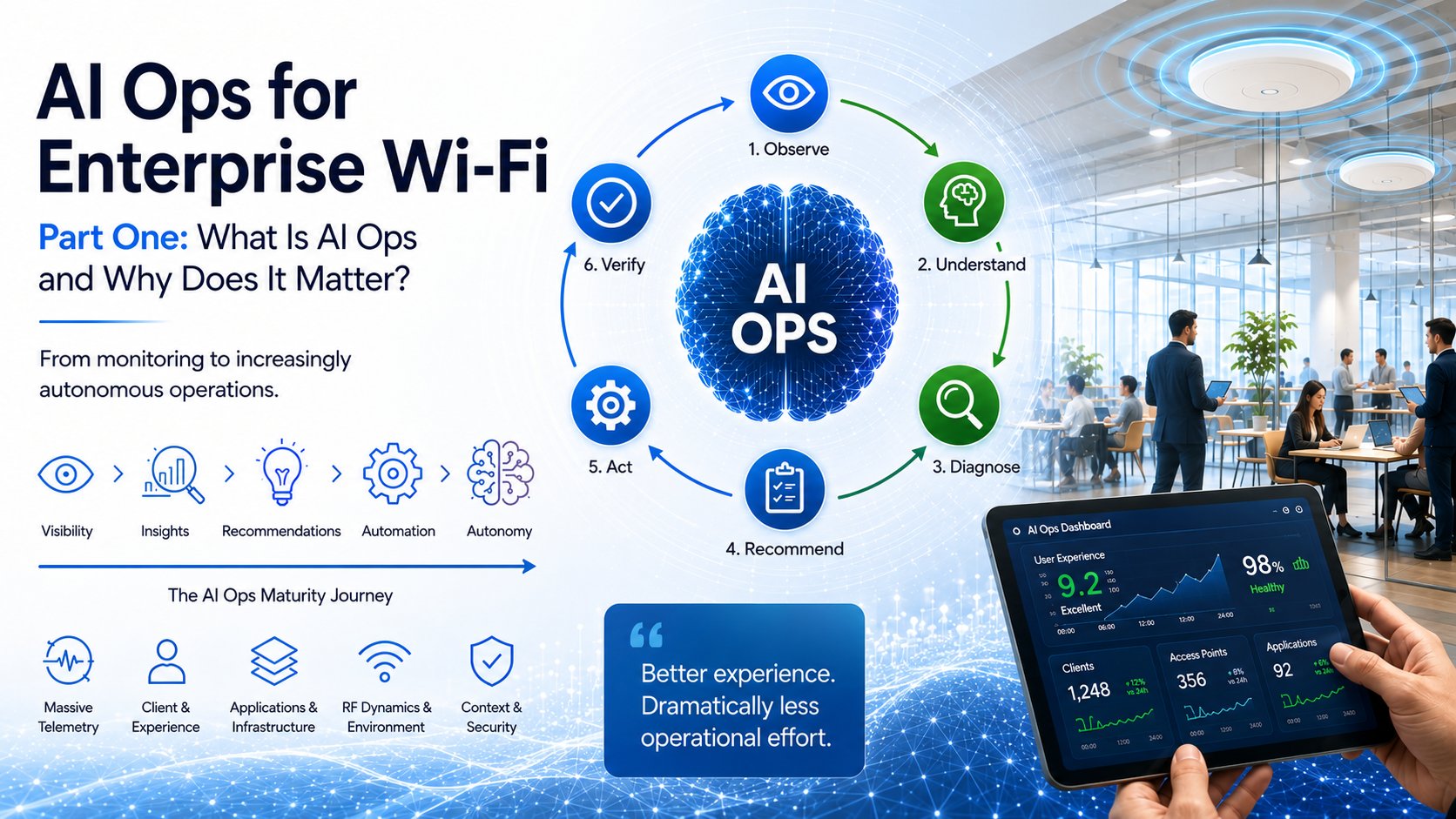
Increasingly, the ambition is to go further still: Rather than merely identifying the problem, the network can recommend a corrective action – or potentially perform that action automatically and then determine whether it worked. This creates an operational loop that can be expressed simply as: Observe → Understand → Diagnose → Recommend → Act → Verify. The further a system progresses through this loop without requiring human intervention, the closer it moves towards autonomous network operations.
AI-assisted versus AI-driven operations
This distinction is important because almost every major enterprise networking vendor now talks about AI. But “AI-powered” can mean very different things. At one end of the spectrum, AI may simply make network information easier to access. An administrator can ask a natural-language assistant why a particular client is having problems, for example, instead of navigating through several dashboards.
That can be extremely useful – but the AI is still assisting a human operator. At the other end, the system detects an emerging problem by itself, determines the probable root cause, decides on a remediation, makes the required network change, monitors the result, and reverses or modifies the action if necessary. That is a fundamentally different capability.
One useful way of thinking about the evolution of AI Ops is therefore as a progression: Visibility → Insights → Recommendations → Automation → Autonomy. Enterprise Wi-Fi platforms are already well along this path in some areas. But very few networks can yet be described as fully autonomous, and there are good reasons why enterprises may not want every network decision to be made without human oversight.
The interesting question is therefore not whether a vendor “has AI”. Almost everyone does. The important questions are what the AI can understand, what decisions it can make, what actions it can take, and how much operational work it can actually eliminate.
The foundation is telemetry
AI Ops is only as useful as the information available to it. Enterprise Wi-Fi infrastructure can generate enormous quantities of telemetry covering RF conditions, channel utilisation, interference, retries, signal levels, throughput, roaming, authentication, DHCP, DNS, application performance, client behaviour, and many other parameters. But individual measurements rarely tell the whole story.
A poor Wi-Fi experience could originate in the radio network, the wired LAN, authentication infrastructure, DNS, an application, the WAN, or the client itself. This means that one of the most important characteristics of an AI Ops architecture is its ability to correlate information across domains.
The richer and more complete the data set, the better the opportunity for the AI to distinguish symptoms from causes. Scale matters as well. Cloud-managed networking allows vendors to analyse behaviour across very large installed bases rather than within a single enterprise. Patterns observed across many networks can potentially improve anomaly detection, baselines, troubleshooting models, and recommendations.
In that sense, telemetry – and the ability to turn telemetry into useful operational context – is becoming one of the strategic assets of enterprise networking.
What can AI Ops do today?
AI Ops is already being applied to several practical enterprise Wi-Fi operational tasks:
- Anomaly detection can identify behaviour that differs from expected network or client performance without requiring administrators to define every possible failure condition in advance.
- Root-cause analysis attempts to determine why an experience or performance problem occurred rather than simply reporting the resulting symptoms.
- Client experience analysis can follow connectivity from association through authentication, addressing, roaming, and application access, helping operators identify where a user’s experience deteriorated.
- Predictive analysis can identify emerging conditions before they develop into obvious failures.
- Network optimisation can use observed conditions to improve parameters such as channels, transmit power, and other configuration settings (radio resource management, or RRM)
- Automated remediation can allow the system to take corrective action when confidence in the diagnosis and appropriate response is sufficiently high.
And increasingly, generative AI interfaces allow network teams to interact with operational systems using natural language rather than traditional management interfaces. These capabilities are not equally mature, and they should not all be grouped together simply because they involve AI. A chatbot connected to network documentation is not the same thing as an AI system capable of analysing millions of telemetry points and autonomously correcting a network problem.
The rise of the AI network assistant
Generative AI is nevertheless changing the way operators interact with networks. Instead of asking an administrator to know where particular information resides, an AI assistant can potentially become the interface between the operator and the entire operational data set. An engineer might ask: “Why did users on the third floor experience poor Microsoft Teams performance yesterday afternoon?”
Answering that question traditionally could involve checking multiple dashboards, client histories, RF statistics, application data, event logs, and configuration changes. An AI-driven operational platform could potentially assemble that information automatically and respond with an explanation – including the evidence supporting its conclusion and a recommended action.
This is an important change because AI Ops is not only about automating networks. It can also compress the amount of expertise and time required to operate them. The most capable network engineer may become considerably more productive. At the same time, less specialised IT staff may be able to diagnose problems that previously required wireless experts.
From troubleshooting to prevention
Perhaps the biggest potential change is moving enterprise Wi-Fi operations from reactive troubleshooting towards prevention. Network operations have historically been driven by events: Something fails, users complain, a ticket is opened, and an engineer investigates. AI Ops makes a different model possible.
Because the network continuously observes its own behaviour, it can potentially recognise deteriorating conditions before users notice them. A growing authentication delay, an unusual roaming pattern, rising interference, a problematic firmware release, or a change in client behaviour could be detected as an emerging pattern rather than waiting until it becomes a service-impacting incident.
The operational objective therefore shifts from finding problems faster towards preventing problems from becoming visible to users at all. That may ultimately be the most valuable promise of AI Ops.
Humans are not disappearing
Autonomous networking does not necessarily mean removing people from network operations. Enterprise networks operate under security policies, regulatory requirements, business priorities, and change-control processes that an AI system cannot simply ignore. Some actions are low-risk and easily reversible. Others can potentially affect thousands of users or critical business applications.
The likely evolution is progressive autonomy: Systems will first automate actions where outcomes are well understood and confidence is high, while escalating ambiguous or potentially disruptive decisions to human operators. The relationship between the network engineer and the platform consequently changes.
Instead of spending large amounts of time finding and correlating data, engineers increasingly supervise decisions, define policies and operational boundaries, investigate exceptional cases, and approve higher-risk actions. AI Ops should not remove expertise from enterprise Wi-Fi operations. It should allow that expertise to be applied where it has the greatest value.
The real measure of AI Ops
AI has rapidly become one of the most widely used terms in enterprise networking, and virtually every major vendor now describes some part of its platform as AI-driven or AI-powered. That makes feature labels increasingly meaningless. The useful measure of AI Ops is operational outcome.
Does the platform identify problems that would otherwise be difficult to find? Does it determine the correct root cause? Does it reduce troubleshooting time? Can it prevent incidents? Can it safely automate repetitive operational work? And ultimately, does it deliver a more consistent user experience while requiring less effort from the IT organisation? Those are much harder questions.
They are also where the differences between enterprise Wi-Fi AI Ops platforms are likely to become increasingly important.
WiFi NOW’s Take:
AI Ops is rapidly moving from an additional enterprise Wi-Fi feature towards a fundamental part of the network architecture and operating model. But putting AI into a network management platform is the easy part. The difficult part is building the telemetry, context, intelligence, integrations, and operational safeguards required to turn AI-generated insights into reliable action.
The next competitive battleground will therefore not be which enterprise Wi-Fi vendors can claim to offer AI. That threshold has already largely been crossed. The battle will be over how much of the operational lifecycle AI can genuinely take over – and how effectively it can turn increasingly complex Wi-Fi networks into simpler, more reliable services.