
Bluetooth Low Energy has evolved from a low-power companion to Bluetooth Classic into the foundation for many of Bluetooth’s most important new capabilities. Understanding its radio architecture, protocol stack and communication models explains why Bluetooth is now expanding into positioning, audio, IoT, higher-performance applications and entirely new device categories.
What is Bluetooth Low Energy?
Bluetooth Low Energy – usually abbreviated Bluetooth LE – was introduced with Bluetooth Core Specification 4.0 in 2010. Although it shares the Bluetooth name and the unlicensed 2.4 GHz spectrum with the original Bluetooth radio, now commonly called Bluetooth Classic or BR/EDR, Bluetooth LE is a distinct radio architecture designed from the outset around low energy consumption, short periods of radio activity and flexible device communication.
That distinction remains important. Bluetooth Classic continues to exist and is still widely used, particularly for established audio applications. Bluetooth LE, however, has become the principal platform on which many of Bluetooth’s newer capabilities are being developed. The architecture now supports far more than simple connections between a peripheral and a smartphone.
Bluetooth LE supports point-to-point connections, broadcast communication, mesh networking and both asynchronous and time-bound isochronous data transports. It also provides the radio foundation for technologies including LE Audio, Auracast, Direction Finding and Bluetooth Channel Sounding. This evolution is one reason why it is increasingly misleading to think of Bluetooth LE simply as a technology for keyboards, sensors and wearables.
Bluetooth LE and Bluetooth Classic are different radios
Bluetooth Classic and Bluetooth LE both operate in the 2.4 GHz ISM band, but they use that spectrum differently. Bluetooth Classic uses 79 channels with 1 MHz spacing. Bluetooth LE divides the spectrum between 2402 MHz and 2480 MHz into 40 RF channels with 2 MHz spacing. Of these, three – channels 37, 38 and 39 – have special roles as the primary advertising channels, while the other 37 can be used for data communication and secondary advertising. The basic LE radio uses Gaussian Frequency Shift Keying, or GFSK, and Bluetooth LE currently provides three principal PHY options:
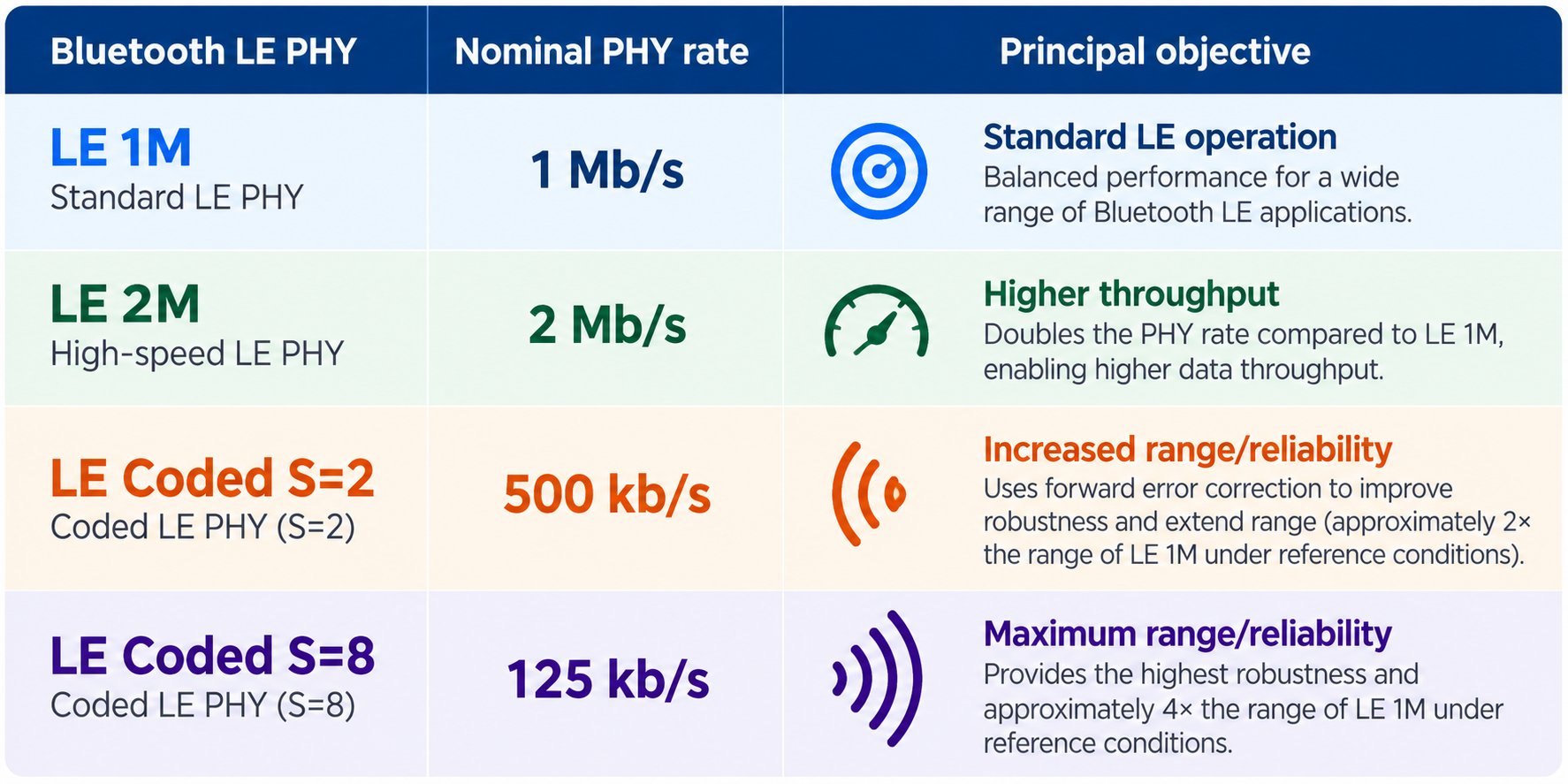
LE 1M is the original Bluetooth LE PHY. LE 2M doubles the physical-layer bit rate, while LE Coded trades data rate for greater link robustness using forward error correction. The Bluetooth SIG describes S=2 as providing approximately twice the range of LE 1M and S=8 as approximately four times the range under its reference assumptions, without increasing transmit power. Real-world range of course depends strongly on the implementation and RF environment.
This ability to trade speed, range, robustness and energy consumption is fundamental to Bluetooth LE’s versatility. The currently standardised 2 Mb/s maximum LE PHY rate should also be distinguished from the substantially higher data rates being developed as part of Bluetooth’s High Data Throughput work. We cover that evolution separately in Part 3: Bluetooth High Data Throughput.
Advertising: The mechanism at the heart of Bluetooth LE
One of the defining concepts of Bluetooth LE is advertising. A Bluetooth LE device does not necessarily need to establish a conventional connection before transmitting useful information. Instead, a device can periodically transmit advertising packets that other devices scan for. In its original or legacy advertising form, advertising uses the three primary advertising channels. A device can therefore announce that it exists, identify capabilities, transmit small quantities of data or provide the information necessary for another device to establish a connection.
This produces the familiar Bluetooth LE discovery sequence: Advertiser → Advertising packets → Scanner → Discovery → Optional connection
But a connection is not mandatory. A beacon, for example, can simply broadcast information for any nearby receiver interested in it. Bluetooth subsequently expanded this architecture with Extended Advertising. Rather than carrying all advertising data on the three primary advertising channels, Extended Advertising can direct receivers towards packets transmitted using the 37 secondary channels. This increased the amount of advertising data that could be communicated and made advertising a much more capable connectionless transport mechanism.
Bluetooth has continued developing this model with Periodic Advertising and Periodic Advertising with Responses (PAwR), which enables energy-efficient bidirectional communication between a central broadcaster and potentially very large populations of devices. Electronic Shelf Labels are an important early application. We return to PAwR and large-scale Bluetooth IoT in Chapter 6.
Connections and frequency hopping
When two Bluetooth LE devices establish a conventional connection, they agree on parameters governing how the radio link will operate. Traditionally these devices are described using the Central and Peripheral GAP roles. The Central initiates the connection, while the Peripheral has typically been advertising its availability.
Communication then takes place during scheduled connection events. Between events, particularly at the Peripheral, the radio can remain inactive. The connection interval and related parameters therefore have a major influence on the trade-off between responsiveness, throughput and power consumption. Bluetooth LE also supports peripheral latency, allowing a Peripheral to skip specified connection events when it has nothing to communicate. This is one of the mechanisms that enables devices such as sensors to remain connected while keeping their radios inactive for much of the time.
During connected communication Bluetooth LE does not remain on a single RF channel. It uses adaptive frequency hopping, moving among the available data channels according to a channel-selection algorithm and channel map. Channels experiencing significant interference can be classified as unsuitable and avoided. This is particularly important because Bluetooth shares the 2.4 GHz ISM band with Wi-Fi and numerous other technologies and devices.
Why Bluetooth LE can consume so little energy
The “Low Energy” part of Bluetooth LE does not mean that every Bluetooth LE implementation automatically consumes very little power. Rather, the architecture provides mechanisms that allow designers to minimise the amount of time during which the radio needs to be active. A sensor might wake, transmit a small quantity of information and return to sleep. A connected Peripheral can skip connection events. Advertising intervals can be selected according to the required discovery time. Connection parameters can similarly be adjusted according to the balance required between latency and energy consumption.
Newer Bluetooth features have made this relationship increasingly dynamic. Connection Subrating, for example, allows a persistent connection to operate at low duty cycle and then transition rapidly to higher-duty-cycle communication when required. The result is an architecture capable of spanning very different products: from tiny battery-operated sensors expected to operate for years to earbuds, smartphones, PCs, automotive systems and increasingly sophisticated industrial equipment.
The Bluetooth LE protocol stack
The radio is only the bottom of the Bluetooth architecture. Above it is a layered protocol stack.
A simplified Bluetooth LE architecture looks like this:
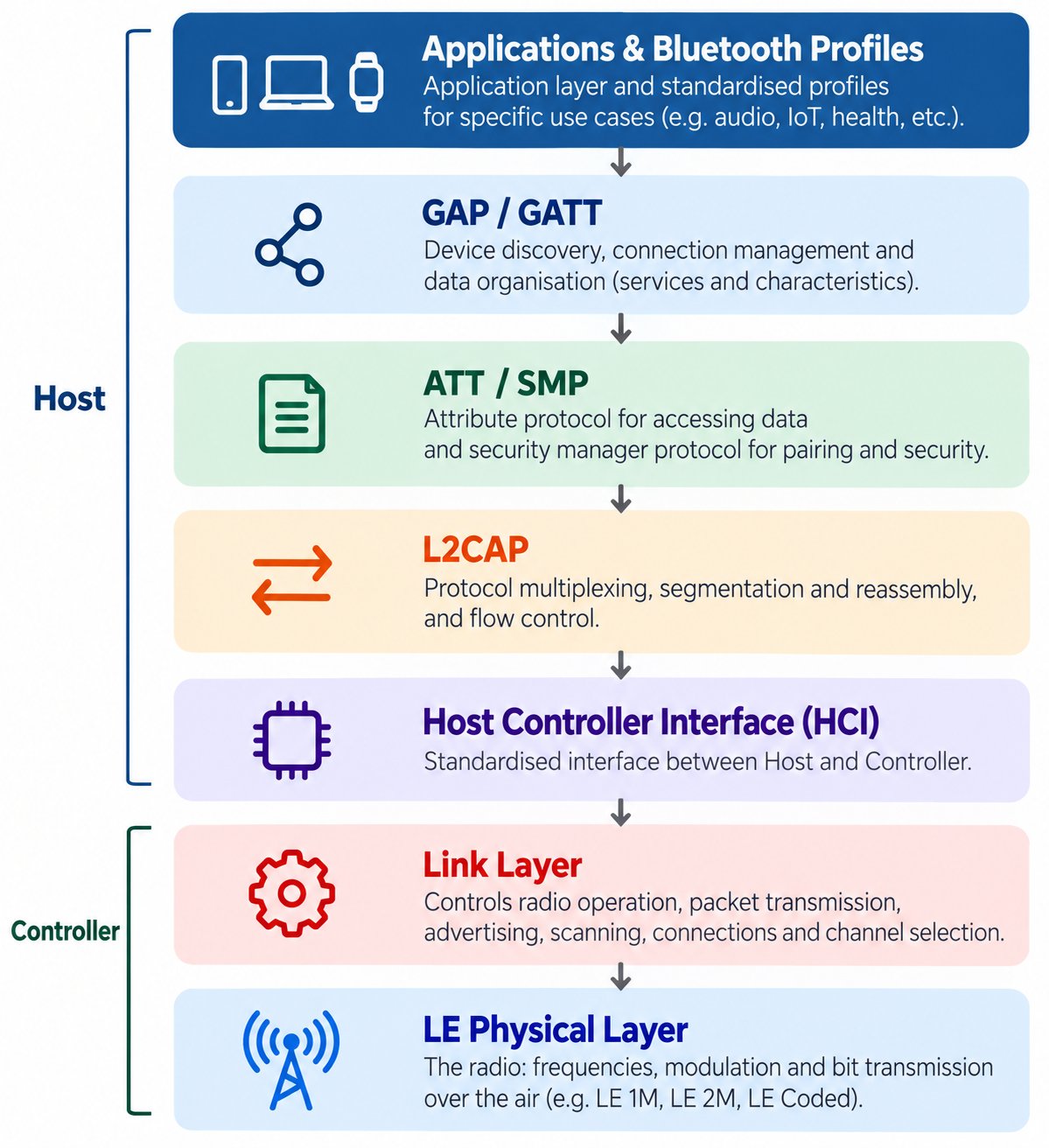
In many implementations this architecture is divided into a Host and a Controller. The Controller contains the lower-level radio functions, including the PHY and Link Layer. The Host handles higher-level protocols and application-facing functionality. The standardised Host Controller Interface – HCI – provides communication between the two, allowing implementations in which Host and Controller reside on separate processors or components.
This modularity is important commercially as well as technically. A Bluetooth controller, operating system, application processor and application software do not necessarily have to originate from the same supplier.
What the major layers do
At the bottom, the Physical Layer – PHY – defines the radio itself: frequencies, modulation and the way bits are represented over the air. Immediately above it, the Link Layer controls much of the actual operation of Bluetooth LE. It handles packet transmission, radio states, advertising, scanning, connections, channel selection and numerous link-control procedures. It is one of the most sophisticated parts of Bluetooth LE and is responsible for much of the technology’s flexibility.
Above HCI, L2CAP – Logical Link Control and Adaptation Protocol – performs functions including protocol multiplexing, segmentation and reassembly, and flow control. It provides the bridge through which multiple higher-level protocols can share the underlying Bluetooth link. Two particularly important concepts above L2CAP are ATT and GATT.
The Attribute Protocol – ATT – defines a mechanism through which data can be organised and accessed as attributes. The Generic Attribute Profile – GATT – builds on ATT and defines how those attributes are structured into services and characteristics and how devices interact with them.
This is the architecture behind many familiar Bluetooth LE applications. A sensor might expose a service containing characteristics representing temperature, battery state or configuration parameters. Another device can discover those services and read, write or subscribe to the relevant characteristics. At a higher level, Bluetooth profiles define interoperable behaviour for particular applications. Profiles are therefore not alternative radios or protocols: they use the underlying Bluetooth architecture to standardise how particular categories of devices communicate.
GAP: How devices find and interact with one another
The Generic Access Profile – GAP – defines fundamental procedures governing how Bluetooth LE devices discover one another, establish connections and use connectionless communication. Advertising and scanning are therefore central GAP concepts. GAP also defines roles such as:
- Broadcaster – transmits connectionless advertising.
- Observer – scans for advertising without necessarily connecting.
- Peripheral – advertises and accepts connections.
- Central – scans and initiates connections.
A device is not necessarily restricted to one of these roles for its lifetime. Bluetooth implementations can support multiple roles and, depending on their capabilities, participate in several communication relationships.
Bluetooth LE is no longer only point-to-point
Perhaps the biggest architectural change in how Bluetooth should be understood is the diversity of communication models now available. Bluetooth LE can support:
- Point-to-point communication, such as a wearable communicating with a smartphone.
- Connectionless broadcast, in which information is transmitted to nearby receivers without establishing individual connections.
- Periodic broadcast, in which receivers synchronise to a predictable transmission schedule.
- Bidirectional one-to-many communication, including PAwR.
- Mesh networking, in which messages can be propagated through networks containing many Bluetooth devices.
- Isochronous communication, in which data has a defined relationship with time – essential for applications such as LE Audio.
Bluetooth LE’s isochronous architecture includes Connected Isochronous Streams (CIS) and Broadcast Isochronous Streams (BIS). CIS provides connected isochronous communication, while BIS enables isochronous broadcast. These capabilities underpin LE Audio and ultimately Auracast broadcast audio. This is a profound expansion from the original perception of Bluetooth as essentially a wireless cable replacement.
Security is part of the architecture
Bluetooth LE also includes mechanisms for authentication, encryption, pairing, key generation and privacy. The Security Manager Protocol – SMP – handles important security procedures including pairing. Modern Bluetooth LE supports LE Secure Connections, which uses P-256 elliptic-curve cryptography during pairing and AES-based cryptographic mechanisms.
The practical security of a Bluetooth product nevertheless depends on implementation and configuration. The existence of secure mechanisms in the specification does not guarantee that every device or application uses the strongest available security mode.
This distinction is particularly important as Bluetooth moves beyond consumer peripherals into access systems, vehicles, industrial devices and applications involving secure ranging.
From Bluetooth 4.0 to Bluetooth Core 6.3
Another source of confusion is Bluetooth version numbering. Bluetooth LE first appeared in Bluetooth Core 4.0, but today’s Bluetooth LE is vastly more capable than that original implementation. Important additions over successive generations have included LE 2M, LE Coded, Extended Advertising, Direction Finding, Isochronous Channels, LE Audio support, Periodic Advertising, PAwR, Channel Sounding, Connection Subrating and many other enhancements.
As of October 2026, the latest adopted specification is Bluetooth Core Specification 6.3, released in May 2026. But a device being described as supporting a particular Bluetooth Core version does not mean that it supports every feature introduced by that version. Individual Bluetooth capabilities have their own implementation and qualification requirements. For this reason, statements such as “Bluetooth 5 device” or “Bluetooth 6 device” reveal considerably less about actual functionality than they may appear to.
For buyers, developers and technology strategists, the more useful question is therefore often: Which Bluetooth features does the product actually support?
Bluetooth LE as a platform
The significance of Bluetooth LE becomes clearer when viewed as an architecture rather than a single application technology. The same underlying radio and protocol framework can support a tiny sensor transmitting occasional measurements, a mouse maintaining a responsive connection to a PC, thousands of electronic shelf labels communicating with infrastructure, earbuds carrying synchronised audio streams, a smartphone measuring its distance from another device, or an industrial system discovering and communicating with equipment.
The requirements of these applications are radically different. Bluetooth addresses them not by using one fixed communication model but by providing a toolbox of PHYs, logical transports, advertising mechanisms, connection modes, profiles and higher-layer protocols that can be combined according to the application. That flexibility is the foundation for the next stage of Bluetooth’s evolution.
The following chapters examine some of the most important developments individually: Channel Sounding and precision ranging; High Data Throughput; Ultra-Low Latency; LE Audio and Auracast; and the longer-term evolution of Bluetooth towards new spectrum, IP connectivity and larger-scale IoT applications.
Key takeaways:
- Bluetooth LE is a distinct radio architecture from Bluetooth Classic, although both belong to the Bluetooth family and operate in the 2.4 GHz ISM band.
- Bluetooth LE uses 40 RF channels with 2 MHz spacing, including three primary advertising channels and 37 channels available for data and secondary advertising.
- The established LE PHY options range from 125 kb/s using LE Coded S=8 to 2 Mb/s using LE 2M, allowing designers to trade throughput against range and robustness.
- Advertising is fundamental to Bluetooth LE, enabling discovery, broadcast and increasingly sophisticated connectionless communication without requiring a conventional point-to-point connection.
- Bluetooth LE now supports point-to-point, broadcast, mesh and isochronous communication, making it substantially broader than the low-power peripheral technology it was originally perceived to be.
- The architecture is layered, with the PHY and Link Layer below HCI and L2CAP, ATT/GATT, GAP, security mechanisms, profiles and applications above it.
- Bluetooth LE’s low-power capabilities arise largely from minimising radio activity and carefully scheduling communication, rather than from a single inherently low-power radio mode.
- Bluetooth Core 6.3 is the latest adopted Core Specification as of October 2026, but Core-version numbers alone do not tell you which optional Bluetooth features a particular product implements.
Principal sources:
Bluetooth SIG, Bluetooth Low Energy Primer
Bluetooth SIG, Bluetooth Technology Overview
Bluetooth SIG, Bluetooth Core Specification
Bluetooth SIG, Bluetooth Core 6.3 Technical Overview
Bluetooth SIG feature enhancement documentation
/Claus.