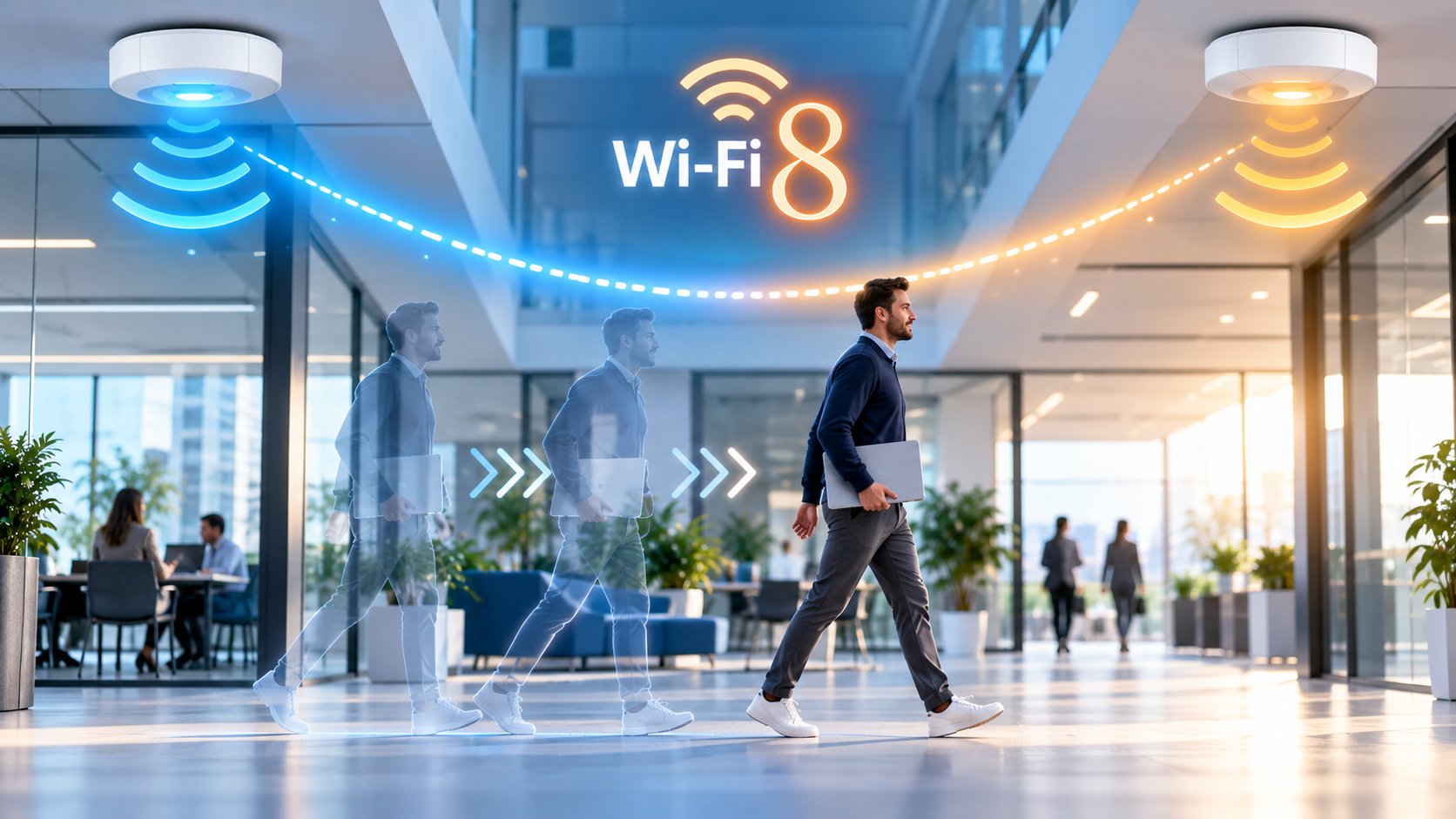

A Wi-Fi connection can be fast, low-latency, and reliable – until the user starts moving. In a network with multiple access points, a phone, laptop, headset, robot, or other mobile device may need to transition from one AP to another as it moves through the coverage area. Even when both APs provide excellent coverage, that transition can introduce packet loss, latency spikes, or brief interruptions.
For web browsing, a short interruption may hardly be noticeable. For voice, video, extended reality, industrial automation, and other real-time applications, it can matter considerably. This is why mobility forms part of the Ultra High Reliability objective of Wi-Fi 8.
IEEE 802.11bn introduces a new seamless-roaming framework designed to make transitions between access points more reliable. The objective is not simply to find the next AP faster. It is to prepare the transition and preserve more of the connection state and data flow while the device moves.
Roaming isn’t new to Wi-Fi
Wi-Fi already includes several technologies designed to improve roaming. IEEE 802.11k can help devices obtain information about neighbouring access points. IEEE 802.11v provides mechanisms that can assist network-directed transitions. IEEE 802.11r reduces authentication delays when moving between APs.
These technologies have significantly improved Wi-Fi mobility, particularly in managed enterprise networks. But a BSS transition still involves moving an active connection from one AP to another. Network state, buffered traffic, sequence information, security context, and other information may need to be handled correctly during a very short period. Any disruption during that process can result in lost packets or increased latency. Wi-Fi 8 addresses this problem as part of its broader focus on reliability.
Prepare the next AP before moving
One of the important concepts introduced by Wi-Fi 8 is the Seamless Mobility Domain (SMD). An SMD can include multiple cooperating AP Multi-Link Devices – or AP MLDs – across which a compatible client can use the Wi-Fi 8 seamless-roaming procedure.
Rather than waiting until the client has completed its move before establishing everything it needs at the new AP, the network can perform a roaming preparation phase. During this phase, the target AP can be prepared for the arriving client and relevant context can be transferred from the AP currently serving the device.
Conceptually, the process changes from: Leave current AP → establish connection with new AP → resume traffic toward:Prepare target AP → transfer relevant context → transition → continue traffic. The goal is to make the transition less disruptive to the applications using the connection.
Preserving connection context
Preparing another AP requires more than simply telling it that a client is about to arrive. An active Wi-Fi connection has state associated with it. The current IEEE 802.11bn work therefore includes mechanisms for transferring relevant context between the current AP and the target AP.
This allows the target AP to have more of the information it needs before taking over communication with the client. Once the transition occurs, the network’s Distribution System can also redirect traffic toward the new AP. The broader principle is important: Instead of treating roaming entirely as the termination of one relationship followed by the creation of another, Wi-Fi 8 attempts to preserve more continuity between them.
Protecting packets during the transition
Preparing the target AP solves only part of the problem. The current AP may still have downlink packets buffered for the client when the transition begins. Simply abandoning those packets could create packet loss, while retransmitting traffic unnecessarily could introduce other inefficiencies.
Wi-Fi 8 therefore includes procedures for handling traffic during a transient period as communication moves from the current AP to the target AP. The current AP can continue dealing with buffered downlink traffic while the transition proceeds, and the participating APs can coordinate the transfer of the connection and relevant traffic state. The detailed procedures are technically complex and continue to evolve as IEEE 802.11bn is developed. But the objective is straightforward: Keep useful data flowing through the transition while minimising packets that are lost, duplicated, or unnecessarily retransmitted.
Multi-Link Operation becomes part of mobility
There is another important difference between this approach and traditional Wi-Fi roaming: Wi-Fi 8 builds on the Multi-Link Device architecture introduced with Wi-Fi 7. The seamless-roaming procedures are therefore designed around AP MLDs and non-AP MLDs rather than treating every connection simply as an independent single radio link.
This illustrates how Multi-Link Operation can evolve beyond the headline Wi-Fi 7 benefits of greater throughput and flexible use of multiple bands. In Wi-Fi 8, the multi-link architecture also becomes part of the effort to maintain reliable connectivity as devices move through a network.
Wi-Fi 7 introduced the ability to manage multiple links as part of one device relationship. Wi-Fi 8 can build on that architecture when moving that relationship between cooperating APs.
What clients gain
The ultimate objective is not faster roaming for its own sake. It is better application continuity. For users and devices, successful seamless roaming can potentially mean:
- Fewer packets lost during transitions between APs
- Smaller interruptions to active applications
- More consistent latency while moving
- More reliable voice and video sessions
- Better support for applications that depend on continuous connectivity
This becomes increasingly important as Wi-Fi supports applications where even short interruptions can affect performance. A warehouse robot moving between APs, for example, has very different connectivity requirements from a stationary laptop downloading a file. Likewise, a voice call or XR application may expose a brief network interruption that conventional data applications would hide.Wi-Fi 8 is designed to make these transitions more dependable.
Where seamless roaming could matter most
The technology is particularly relevant to managed networks in which devices routinely move between access points. Examples include:
- Enterprise offices and campuses
- Warehouses and manufacturing facilities
- Hospitals and healthcare environments
- Hotels and conference centres
- Airports and transportation facilities
- Large public venues
- Networks supporting robots and other mobile equipment
As with other coordinated Wi-Fi 8 capabilities, the greatest opportunities arise where the network can manage multiple APs as part of a coordinated infrastructure. Seamless roaming should not be interpreted as arbitrary neighbouring Wi-Fi 8 routers automatically transferring active clients between one another.
Reliability while the network changes
Many measures of Wi-Fi performance assume relatively stable conditions: a client connects to an AP and the quality of that connection is measured. Real networks are not static: People walk through buildings. Robots move around warehouses. Devices change location. Radio conditions change. Clients leave the coverage of one AP and enter another.
A network designed for Ultra High Reliability therefore needs to remain reliable during those changes, not only when everything is stationary. This is reflected directly in the IEEE 802.11bn objectives, which include reducing packet loss relative to Wi-Fi 7 in defined scenarios, with particular emphasis on transitions between BSSs.
Seamless roaming turns that objective into a network architecture: prepare the destination, preserve relevant state, manage traffic through the transition, and reduce disruption to the application.
Key takeaways:
- Mobility and BSS transitions are explicitly part of the IEEE 802.11bn Ultra High Reliability objectives.
- Wi-Fi 8 does not replace existing roaming technologies such as 802.11k, 802.11v, and 802.11r.
- Wi-Fi 8 introduces a seamless-roaming framework built around cooperating AP Multi-Link Devices.
- A target AP can be prepared before the client completes its transition.
- Relevant connection context can be transferred between the current and target APs.
- Traffic handling during the transient period is designed to reduce packet loss and unnecessary retransmissions.
- Wi-Fi 8 builds on the Multi-Link Device architecture introduced with Wi-Fi 7.
- The ultimate objective is better application continuity as devices move through multi-AP networks.
WiFi NOW Perspective: For many years, the Wi-Fi roaming discussion has concentrated on how quickly a device can leave one AP and connect to another. Wi-Fi 8 expands the question. How much of the active connection can the network preserve while that transition happens? That is a more ambitious reliability objective.
The aim is not to make mobility invisible by definition, nor can Wi-Fi 8 guarantee zero packet loss during every transition. But the architecture increasingly allows cooperating APs to prepare for mobility rather than simply react to it. This is another example of the broader architectural direction of Wi-Fi 8: Individual connections increasingly become part of a coordinated network capable of maintaining performance as conditions change.