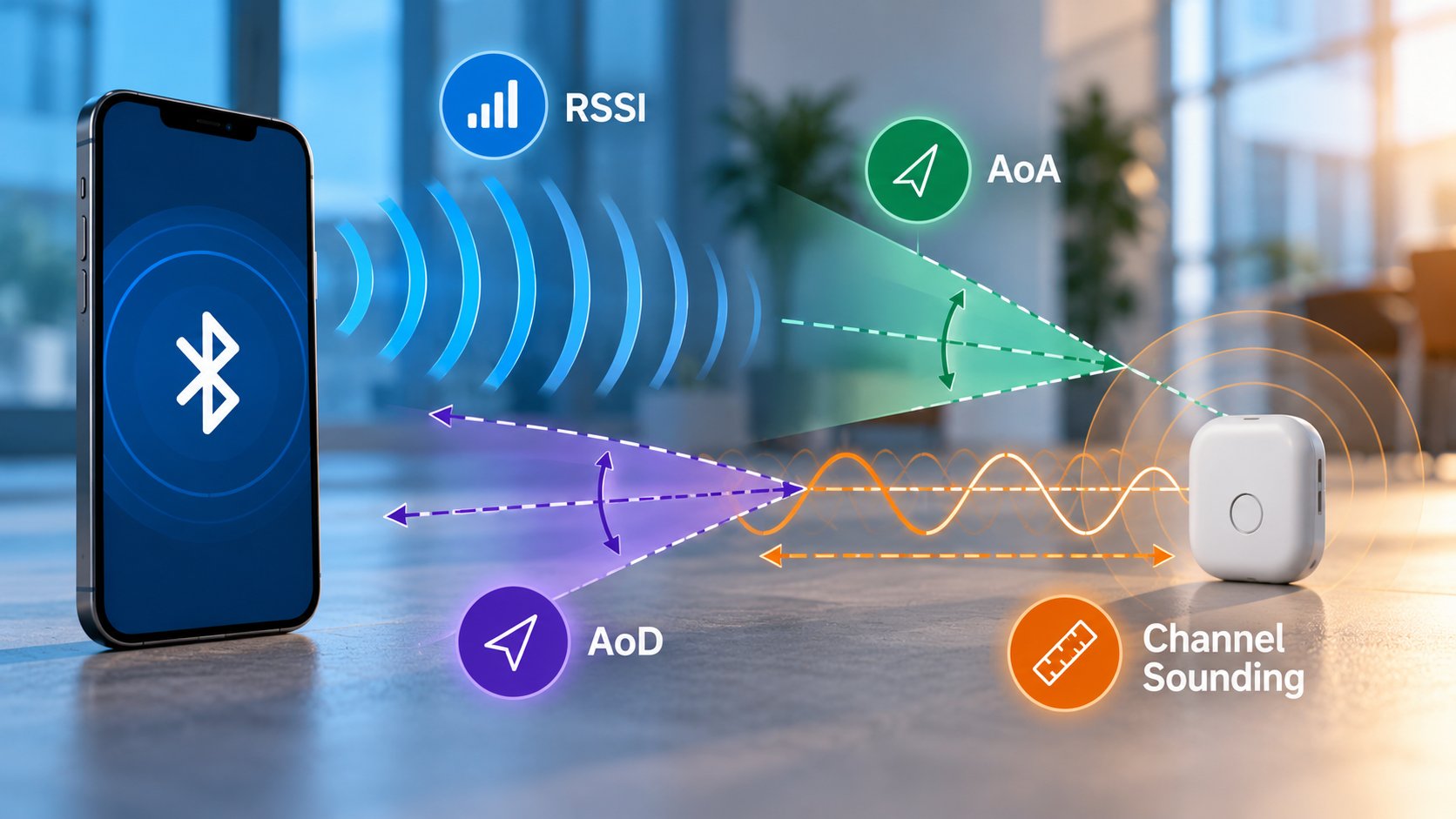
Bluetooth has been able to determine whether another device is nearby for many years. What it has historically struggled to do is determine precisely how far away that device actually is. Bluetooth Channel Sounding changes this.
Introduced with Bluetooth Core 6.0, Channel Sounding adds a standardised mechanism for secure, fine ranging between two Bluetooth Low Energy devices. Instead of estimating distance primarily from received signal strength, Channel Sounding measures properties of the radio signal itself – principally phase and propagation time – to determine the distance between devices. The Bluetooth SIG says the technology has been designed for centimetre-level accuracy, with early implementations demonstrating accuracy of around +/-20 cm. Under suitable radio and power conditions, the Bluetooth SIG says accurate measurements can potentially be made at distances of up to around 150 metres.
This represents a substantial expansion of what Bluetooth can do. A Bluetooth connection can now potentially answer not only: “Is this device nearby?” but also: “How far away is it?” That capability opens new opportunities in digital keys, access control, asset tracking, Find My networks, industrial systems, smart homes and other proximity-aware applications.
Why Bluetooth needed better ranging
The simplest Bluetooth proximity systems use Received Signal Strength Indicator, or RSSI. The principle is straightforward. Radio signals normally become weaker as the distance between transmitter and receiver increases, so received signal strength can be used as a rough proxy for distance. In practice, however, RSSI is heavily affected by the environment. Walls, furniture, people, antennas, device orientation, reflections and interference can all alter received power.
A device with a weak signal is therefore not necessarily far away, and a device with a strong signal is not necessarily close. RSSI remains useful for applications that only need approximate proximity information, but it is poorly suited to applications requiring precise and trustworthy distance measurements. Bluetooth Channel Sounding takes a fundamentally different approach: Rather than attempting to infer distance primarily from signal strength, it characterises the radio channel between two devices.
How Bluetooth Channel Sounding works
A Channel Sounding procedure takes place between two Bluetooth LE devices. One device acts as the Initiator and the other as the Reflector. The devices exchange precisely controlled radio signals across multiple frequencies. Measurements collected during these exchanges can then be processed by a distance-estimation algorithm.
Bluetooth Channel Sounding supports two complementary ranging techniques: Phase-Based Ranging (PBR) provides the high-accuracy distance measurement. Round-Trip Time (RTT) provides an additional measurement and an important security mechanism. The two techniques can be used independently or together, although their combination is particularly important for applications where security matters.
Phase-Based Ranging
Phase-Based Ranging is the principal mechanism that enables the high precision associated with Bluetooth Channel Sounding. The Initiator transmits a signal to the Reflector, which returns a signal. The procedure is repeated across multiple frequencies. The system measures the phase relationship between the transmitted and received signals. Because propagation distance produces predictable changes in phase across frequency, measurements from multiple frequencies can be combined to estimate the distance between the devices. Using many frequencies is important because a phase measurement at a single frequency can be ambiguous because the same phase relationship repeats as distance increases.
Measurements across multiple frequencies allow the ranging algorithm to resolve these ambiguities and produce a much more useful estimate of distance. The multi-frequency approach also helps the system operate in real-world radio environments where signals may reach a receiver through multiple paths because of reflections from walls, floors, furniture and other objects.
Round-Trip Time
Bluetooth Channel Sounding also supports Round-Trip Time ranging. Here the system measures the time required for radio signals to travel between the Initiator and Reflector and back again. Because radio waves propagate close to the speed of light, extremely accurate timing is required to convert propagation time into a useful distance measurement. RTT has an especially important role in securing Bluetooth ranging: A proximity-based access system, for example, should not unlock a car or door simply because an attacker has managed to relay Bluetooth communications between a legitimate device and the lock. Bluetooth Channel Sounding therefore incorporates secure RTT distance bounding as a countermeasure against sophisticated relay or man-in-the-middle attacks.
RTT can provide an independent measurement against which the Phase-Based Ranging result can be checked. The result is an important characteristic of Channel Sounding: Bluetooth is not only becoming better at determining distance – it is becoming better at determining whether that distance measurement can be trusted.
Security is part of the architecture
Security is particularly important for digital keys and access control: Consider a car that automatically unlocks when its owner’s phone approaches. An attacker could attempt to place one radio near the owner’s phone and another near the vehicle, relaying communications between them. The vehicle could potentially be fooled into believing that the phone is nearby.
These are generally known as relay attacks. Channel Sounding includes multiple mechanisms intended to make manipulation of ranging measurements significantly harder. RTT secure distance bounding is one of the principal protections. The Bluetooth specification also includes mechanisms for evaluating whether measurements show characteristics associated with an attack. Meanwhile, security continues to evolve: Bluetooth Core 6.2, for example, extended Channel Sounding attack resilience to address amplitude-based signal manipulation attacks through enhancements to the Normalised Attack Detector Metric, or NADM. This continuing work is significant because accurate ranging and secure ranging are not necessarily the same thing. For digital keys and physical access systems, both are required.
How accurate is Bluetooth Channel Sounding?
The Bluetooth SIG describes Channel Sounding as providing centimetre-level accuracy. That phrase should be interpreted carefully. It does not mean that every Bluetooth Channel Sounding implementation will locate another device to within one or two centimetres. The Bluetooth SIG says the feature was designed for accuracy within tens of centimetres and reports that early implementations have demonstrated approximately +/-20 cm accuracy. Actual performance depends on many variables including:
- Radio environment
- Distance
- Antenna configuration
- Device orientation
- Multipath propagation
- Number of measurements
- Channel Sounding configuration
- Quality of the ranging algorithm
- Radio implementation
There is therefore no single accuracy figure that applies to every Channel Sounding product. This is particularly important because the Bluetooth specification does not define the final distance-estimation algorithm. Instead, Bluetooth provides the standardised radio procedures and measurement information from which the application calculates distance. Vendors can develop and optimise their own algorithms. This means ranging algorithms themselves can become an important area of product differentiation.
How far can it reach?
Bluetooth SIG says Channel Sounding measurements can potentially operate at distances of up to approximately 150 metres when both devices are capable of transmitting at the maximum permitted power and environmental conditions are suitable. But range should not be confused with guaranteed accuracy: Maximum usable distance will depend heavily on transmit power, antenna performance, radio environment and the implementation itself. Nevertheless, this potential combination of relatively long range and centimetre-level precision is important because it allows Bluetooth to address many ranging applications without requiring a separate radio technology.
One antenna can be enough
Another important characteristic of Bluetooth Channel Sounding is that high-accuracy ranging can be implemented with a single antenna. This distinguishes it from Bluetooth Direction Finding systems based on Angle of Arrival and Angle of Departure, which typically depend on antenna arrays on one side of the radio link. Additional antennas can still be useful. Dual-antenna and multi-antenna implementations can improve robustness and ranging accuracy, particularly in difficult multipath environments. But an antenna array is not fundamental to Channel Sounding. This potentially reduces device complexity, physical size and cost – particularly for small IoT devices and tags.
Channel Sounding versus RSSI, AoA and AoD
Bluetooth now supports several mechanisms associated with proximity, ranging and location, but they solve somewhat different problems (see image below).
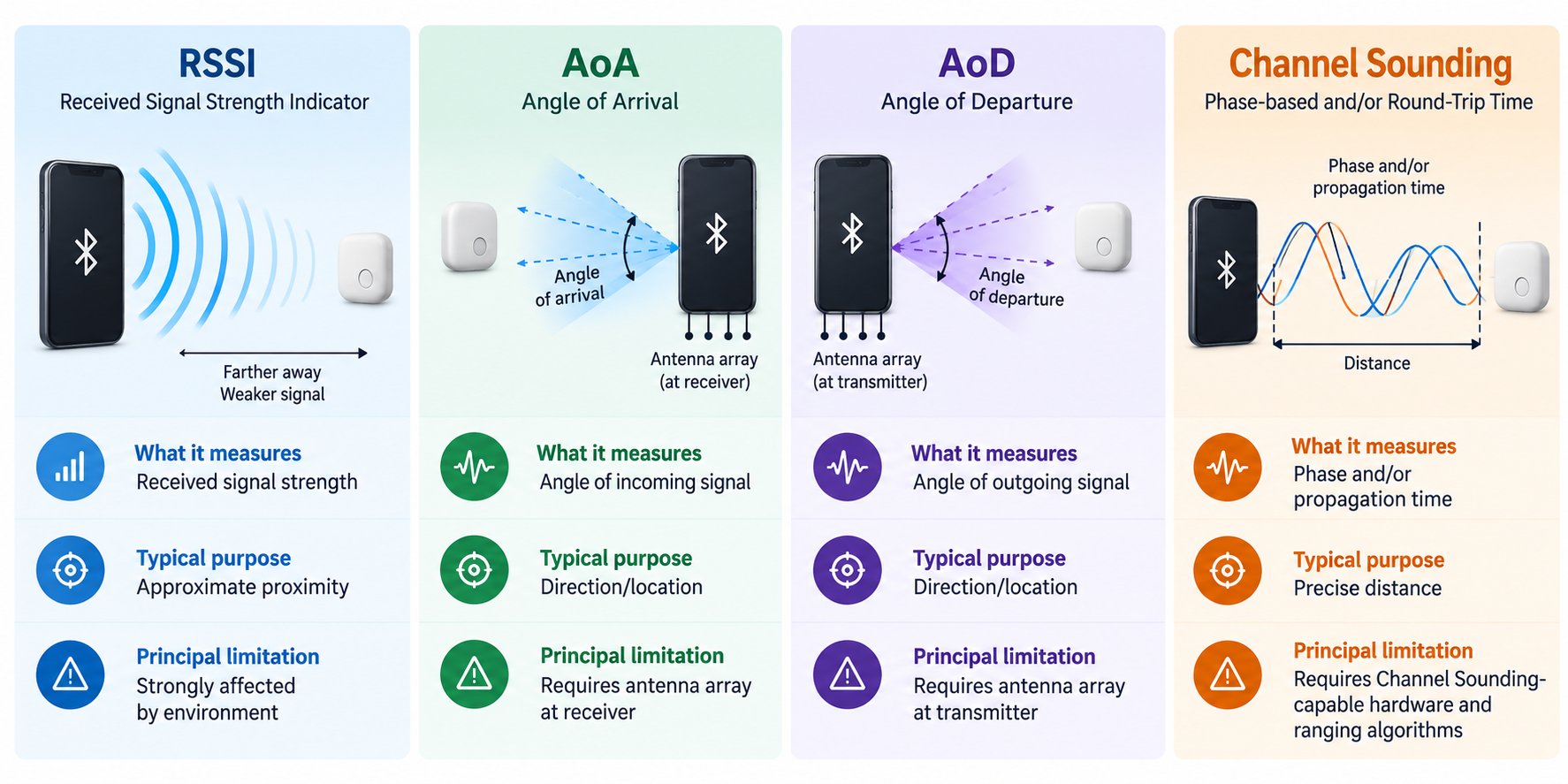
RSSI remains the simplest solution where applications only need to know whether something is approximately near or far. AoA and AoD are direction-finding technologies. They determine the angle from which a radio signal arrives or departs and can be used as part of a positioning system. Channel Sounding primarily answers a different question: What is the distance between these two devices? Multiple distance measurements from devices at known locations can then also be used as part of a broader positioning system.
Bluetooth Channel Sounding versus UWB
Channel Sounding inevitably invites comparison with Ultra-Wideband because UWB has become an important technology for high-precision ranging. But of course, the technologies are far from identical. UWB uses very wide bandwidth signals and extremely precise time-of-flight measurements. It has been designed from the outset for capabilities including precise ranging and positioning and can deliver very high ranging precision.
Bluetooth Channel Sounding takes advantage of Bluetooth’s existing 2.4 GHz radio ecosystem and uses multi-frequency phase measurements together with RTT. This gives Bluetooth an important economic and ecosystem advantage. Bluetooth LE already exists in billions of smartphones, PCs, wearables, IoT products and other connected devices. If Channel Sounding becomes a common capability in Bluetooth silicon, manufacturers may be able to add accurate ranging without integrating a completely separate UWB radio. But this does not mean that Bluetooth Channel Sounding simply replaces UWB. UWB remains particularly attractive where very high precision, robust time-of-flight ranging or advanced spatial positioning is required. Bluetooth Channel Sounding may instead expand the overall market for precise ranging by bringing substantially improved distance awareness to devices where adding UWB would otherwise be difficult to justify.
In some products the two technologies may also coexist. The practical question for device makers is therefore increasingly likely to be: How much ranging precision, security, range, power efficiency and system cost does this application require? – rather than simply asking which technology is universally better.
Important use cases
- Digital keys and access control: Secure ranging allows a vehicle, building, computer or smart lock to establish whether an authorised device is actually within the required distance. This is one of the clearest applications for the combination of PBR accuracy and RTT security.
- Find My devices: Bluetooth already forms the connectivity foundation for large device-finding ecosystems. Channel Sounding can add fine-ranging capabilities that help users determine more precisely how far away an object is once they are within Bluetooth range.
- Asset tracking: Industrial and enterprise systems can use precise distance measurements between tags and infrastructure devices to improve asset location. Multiple known reference points can potentially turn individual distance measurements into broader positioning systems.
- Industrial systems: Factories, warehouses and logistics environments can use distance awareness for locating equipment, verifying proximity, supporting worker-machine interaction and enabling context-aware automation.
- Smart home: Locks, appliances and other smart-home systems can respond according to the actual distance of an authorised device rather than relying only on Bluetooth presence or signal strength.
- Human-machine interaction: Distance can itself become an input. Devices can change behaviour according to whether a user is several metres away, approaching, standing nearby or moving away.
Channel Sounding requires new hardware
Channel Sounding is part of Bluetooth LE, but support should not be assumed simply because a product supports Bluetooth 6.x software. The feature introduces new controller and PHY functionality, and the Bluetooth SIG notes that existing products may require an updated Bluetooth LE IC. Whether an existing device can be upgraded therefore depends on its underlying radio hardware and the manufacturer’s implementation. Over time, Channel Sounding is likely to become increasingly common as support is integrated into mainstream Bluetooth silicon platforms.
Bluetooth 6.3 continues the evolution
Channel Sounding did not stop evolving with its introduction in Bluetooth Core 6.0. Bluetooth Core 6.2 strengthened resistance against certain amplitude-based attacks. Bluetooth Core 6.3, released in May 2026, introduced further Channel Sounding improvements, including PHY-specific RTT accuracy reporting and Inline PCT Transfer. These enhancements illustrate an important point: Channel Sounding should be viewed as a new Bluetooth capability that is still being actively refined rather than as a single finished feature frozen at Bluetooth 6.0.
Why Channel Sounding matters
Bluetooth Channel Sounding represents one of the most significant expansions of Bluetooth LE functionality in recent years. Bluetooth has historically excelled at discovering devices, connecting them and determining approximate proximity. Channel Sounding adds something fundamentally different: the ability to make accurate and security-aware measurements of physical distance. That moves Bluetooth deeper into applications that connect the digital and physical worlds.
Locks can determine whether a key is genuinely nearby. Devices can determine how far away another device is. Asset systems can derive much more precise location information. Consumer electronics can react to physical proximity with much greater confidence. Perhaps most importantly, these capabilities can be delivered through one of the world’s largest existing wireless ecosystems. Channel Sounding therefore does more than improve Bluetooth positioning. It turns distance itself into a native Bluetooth capability.
Key takeaways:
- Bluetooth Channel Sounding was introduced with Bluetooth Core 6.0 to provide secure, fine ranging between Bluetooth LE devices.
- Phase-Based Ranging provides the principal high-accuracy measurement, using phase information collected across multiple frequencies.
- Round-Trip Time provides an independent ranging mechanism and secure distance bounding, helping defend applications against relay attacks.
- The Bluetooth SIG targets centimetre-level accuracy, with early implementations demonstrating around +/-20 cm.
- Bluetooth SIG says measurements at distances of up to around 150 metres may be possible under suitable conditions and transmit power.
- Channel Sounding can operate with a single antenna, although additional antennas can improve accuracy and robustness.
- Bluetooth does not specify the final distance-estimation algorithm, leaving room for silicon and software vendors to differentiate.
- Channel Sounding significantly improves on RSSI-based proximity estimation and complements rather than simply replaces Bluetooth AoA/AoD direction finding.
- Bluetooth Channel Sounding does not make UWB obsolete. Instead, it makes high-accuracy ranging available to a much broader Bluetooth ecosystem and creates a new technology choice for device designers.
- Bluetooth Core 6.2 and 6.3 have already extended Channel Sounding, particularly in security, ranging accuracy reporting and implementation efficiency.¨
/Claus.