
For many users, this naturally raises the question: If Wi-Fi is already this fast, why do we need Wi-Fi 8? The answer lies in the changing nature of wireless networking.
The race for speed
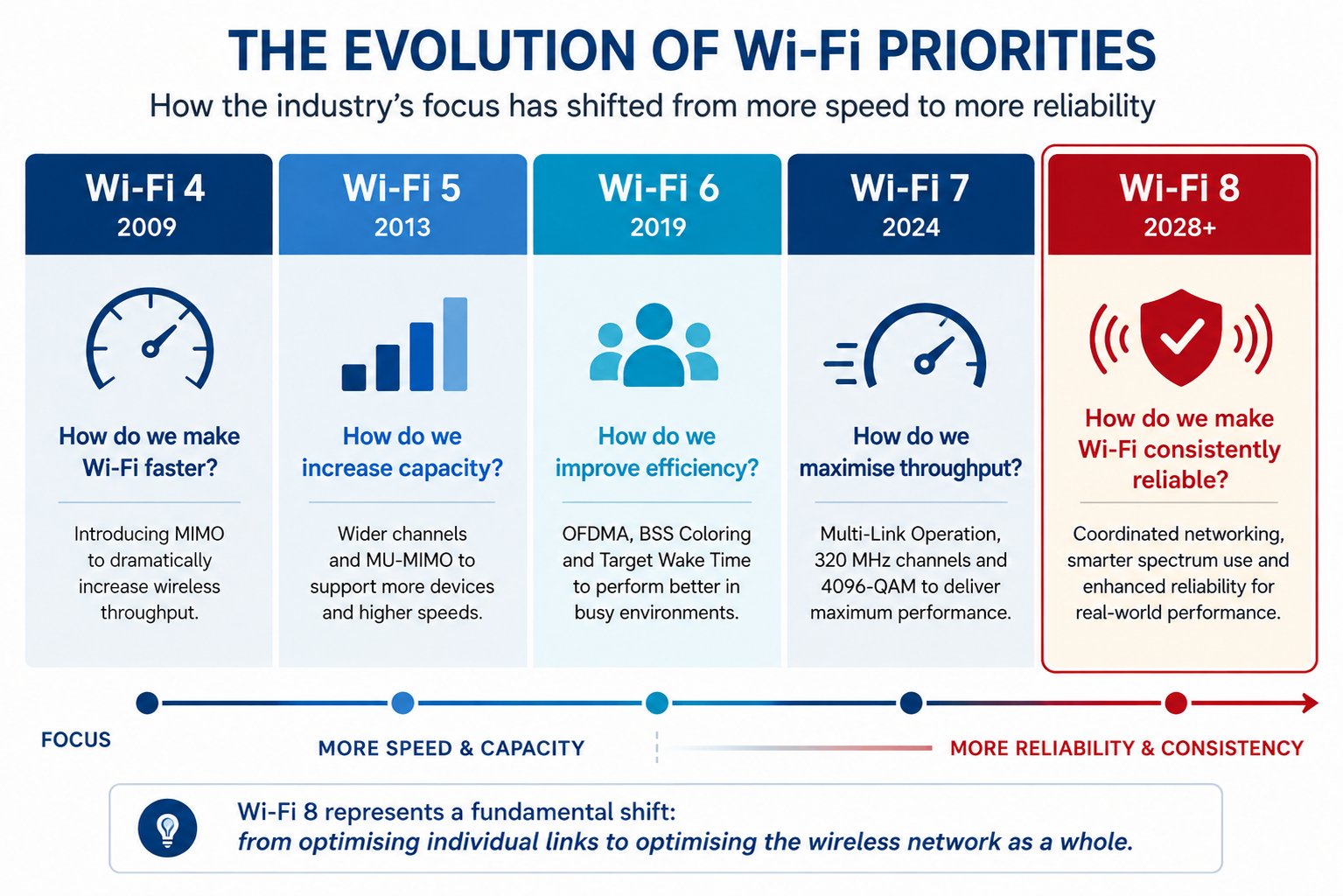
For more than two decades, the evolution of Wi-Fi was largely driven by one objective: Increasing throughput. Each new generation delivered a significant increase in wireless capacity. In Wi-Fi 4, the focus was higher throughput through MIMO. Wi-Fi 5 introduced wider channels and MU-MIMO, while Wi-Fi 6 delivered greater efficiency and determinism in dense environments. Wi-Fi 6E expanded into the 6 GHz band, and Wi-Fi 7 delivered maximum throughput through Multi-Link Operation, wider channels, and higher-order modulation.
This strategy has been remarkably successful. Modern Wi-Fi networks can now deliver multi-gigabit performance that exceeds the bandwidth requirements of almost every consumer application. But while peak performance has increased dramatically, another problem has become increasingly visible.
The experience gap
Most users no longer complain that Wi-Fi is too slow. Instead, they complain that it is inconsistent. Video meetings freeze briefly while moving through an office. Cloud gaming suffers from occasional latency spikes. Wireless performance deteriorates in apartment buildings where dozens of neighbouring networks compete for the same spectrum. Smart home devices lose connectivity even though broadband capacity is plentiful.
Hotels, stadiums and airports struggle to deliver a consistent experience despite deploying hundreds or even thousands of access points. The challenge is no longer achieving high speeds under ideal laboratory conditions. It is delivering predictable performance in the environments where Wi-Fi is actually used.
A changing wireless environment
The environments in which Wi-Fi operates have changed dramatically over the past decade. The typical home network now supports dozens of connected devices, including televisions, security cameras, smart speakers, gaming consoles, smartphones, laptops, sensors and household appliances.
Enterprise networks have become denser as organisations deploy more access points to increase capacity and improve coverage. Public venues routinely serve thousands of simultaneously connected users. Industrial facilities increasingly depend on wireless connectivity for automation, robotics and machine-to-machine communication.
These networks are no longer isolated. They operate alongside many neighbouring wireless systems, creating increasingly complex radio environments where interference, contention and mobility have become major engineering challenges.
Applications are changing too
At the same time, the applications running over Wi-Fi have evolved. Earlier generations of Wi-Fi primarily carried web browsing, email and video streaming, all of which can tolerate occasional delays or retransmissions. Today’s applications are far less forgiving. Cloud gaming demands consistently low latency. Extended reality (XR) requires stable, predictable wireless performance to avoid disrupting the user experience.
Industrial automation depends on timely and reliable communication between machines. AI-assisted services increasingly rely on continuous connectivity between edge devices and cloud resources. Real-time collaboration platforms such as Microsoft Teams and Zoom expose even short interruptions during roaming between access points. For these applications, reliability often matters more than raw throughput.
The IEEE response
Recognising these changes, the IEEE launched the 802.11bn project under the title Enhancements for Ultra High Reliability (UHR). Rather than pursuing another major increase in peak data rate, the working group established objectives centred on improving the quality and consistency of wireless networking. Among the publicly stated goals are:
- Higher throughput under realistic operating conditions.
- Lower 95th-percentile latency.
- Reduced packet loss, particularly during transitions between access points.
- Improved operation in dense environments with overlapping wireless networks.
- Lower access point power consumption.
- Enhanced peer-to-peer communication.
Taken together, these objectives signal an important shift in priorities. Future advances in Wi-Fi will be measured not only by maximum speed but also by how effectively networks perform under real-world conditions.
From faster links to better networks
Perhaps the most significant change introduced by Wi-Fi 8 is philosophical rather than technical. Previous generations largely focused on improving the performance of individual wireless links. Wi-Fi 8 increasingly focuses on improving the behaviour of the network as a whole. Many of its most important technologies aim to make neighbouring access points cooperate more effectively, use spectrum more intelligently, reduce interference, improve mobility and deliver a more consistent user experience.
This represents the beginning of a new phase in the evolution of Wi-Fi—one in which network intelligence and coordination become as important as advances in radio technology. The technologies that make this possible are explored in the following WiFi NOW Technology Guides.
Key takeaways:
- Wi-Fi 7 largely solved the problem of peak wireless throughput.
- The industry’s biggest challenge has shifted from speed to consistency.
- Modern Wi-Fi networks operate in increasingly dense, complex and interference-prone environments.
- New applications such as AI, XR, cloud gaming and industrial automation demand predictable latency and high reliability.
- IEEE 802.11bn was created to address these challenges through Ultra High Reliability rather than simply increasing peak data rates.
- Wi-Fi 8 marks a transition from improving individual wireless links to improving the behaviour of the wireless network as a whole.
/Claus.