

By Claus Hetting, WiFi NOW CEO & Chairman
The second edition of the WiFi NOW Global ISP Wi-Fi 7 Tracker identifies 108 service providers offering Wi-Fi 7 to residential broadband customers, of which at least 56 offer equipment supporting 6 GHz. The number of tracked ISP Wi-Fi 7 deployments has increased by 27% since our first edition in September, while the number of operators confirmed to support 6 GHz has increased by 30%. Wi-Fi 7 is also increasingly finding its way into mainstream residential broadband packages, including services operating at well below gigabit speeds.
In September this year, WiFi NOW published the first edition of our Global ISP Wi-Fi 7 Tracker, identifying 85 service providers offering Wi-Fi 7 gateways, routers, or managed home Wi-Fi systems. Our second edition expands the number to 108 operators across Europe, North America, Asia-Pacific, Latin America, the Middle East, and Africa.
The updated research identifies 56 operators offering Wi-Fi 7 equipment supporting 6 GHz, equivalent to approximately 52% of all tracked operators. For another 31 operators, we have not yet been able to establish whether their Wi-Fi 7 equipment supports 6 GHz, meaning that actual 6 GHz adoption among the operators represented in our tracker could be considerably higher.
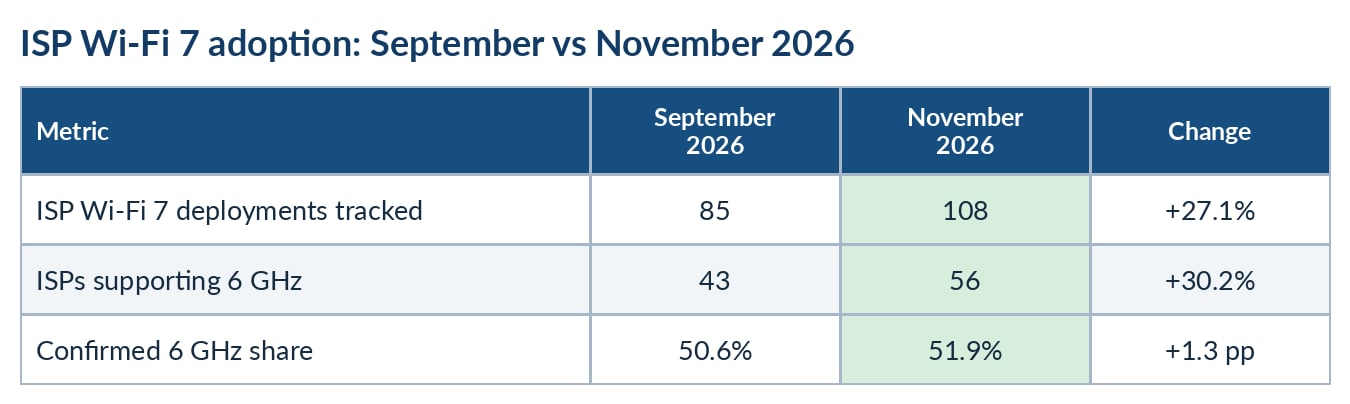
The increase includes both new commercial launches and previously unidentified deployments.
Europe and North America lead in 6 GHz adoption
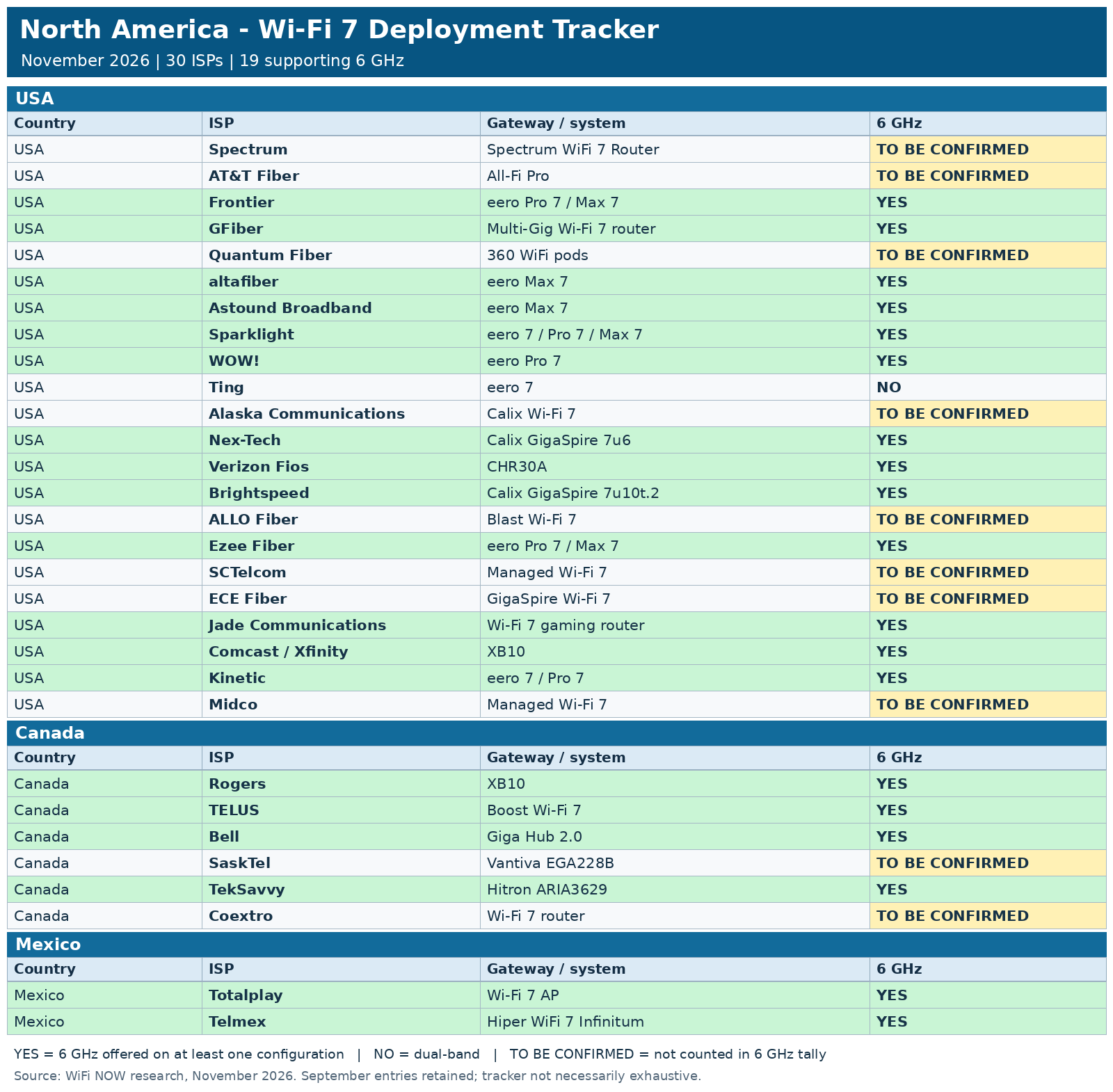
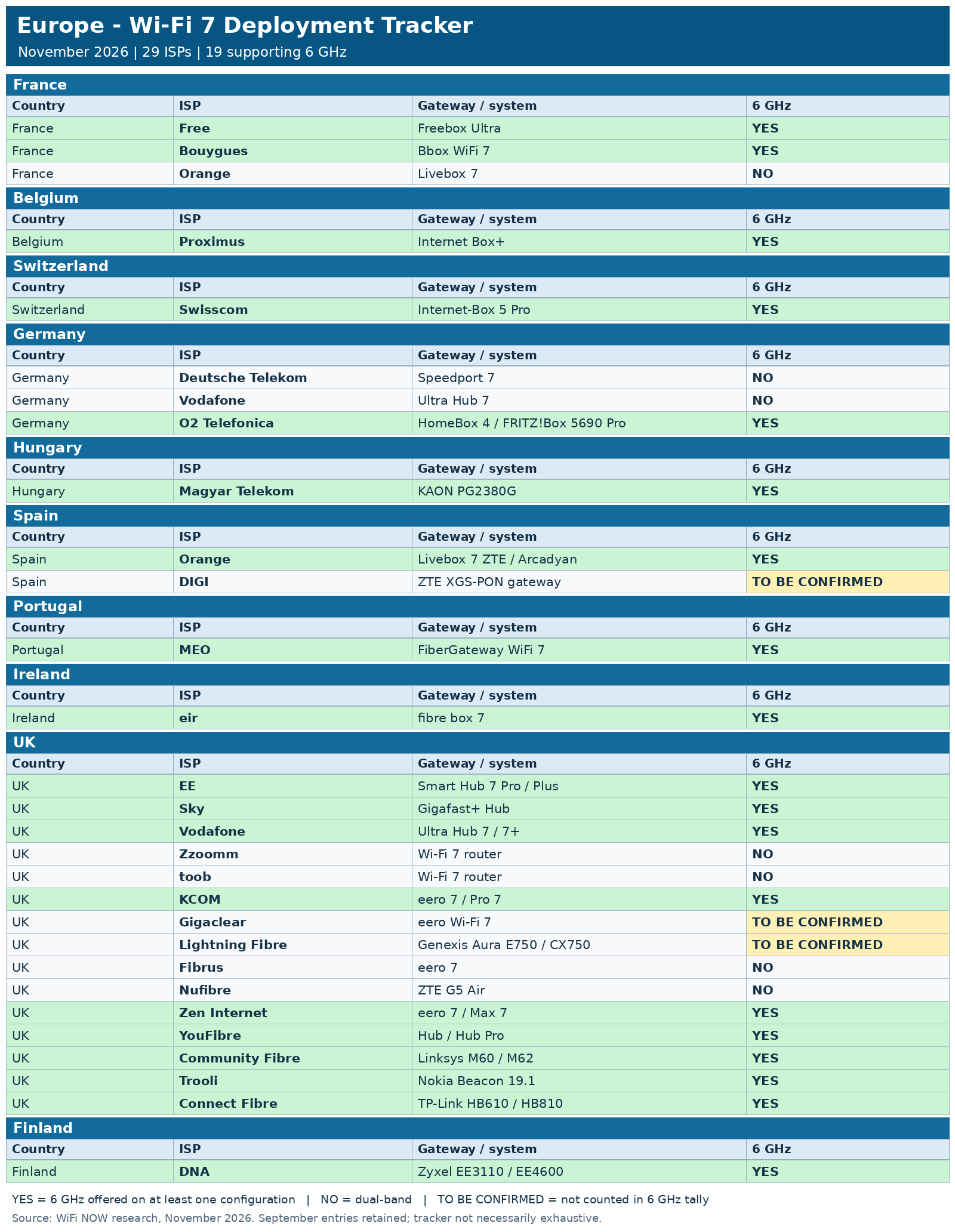
North America and Europe account for 59 of the 108 operators represented in our updated tracker. Both regions are characterised by a high proportion of operators supplying tri-band Wi-Fi 7 equipment, with confirmed 6 GHz adoption reaching 65.5% in Europe and 63.3% in North America.
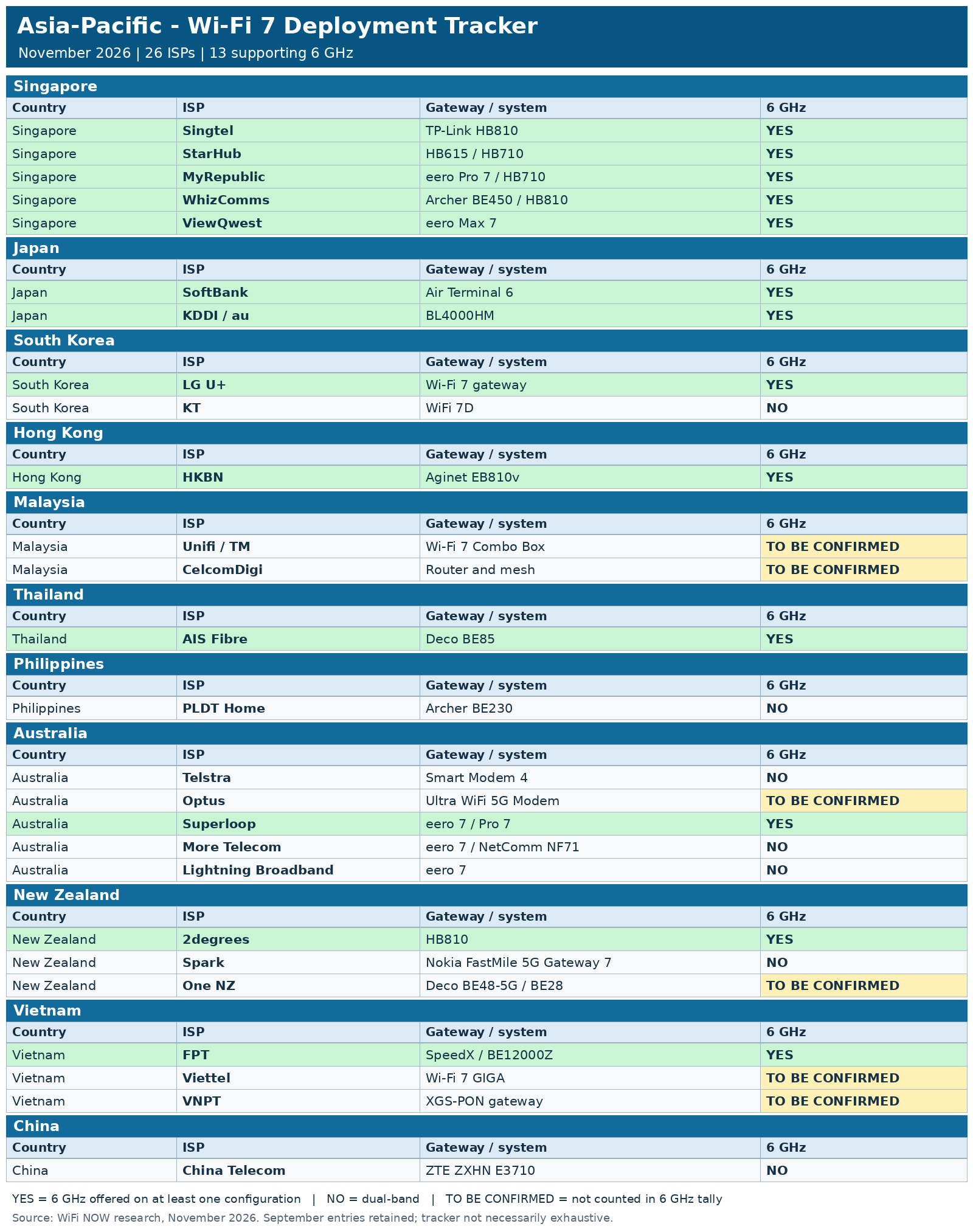
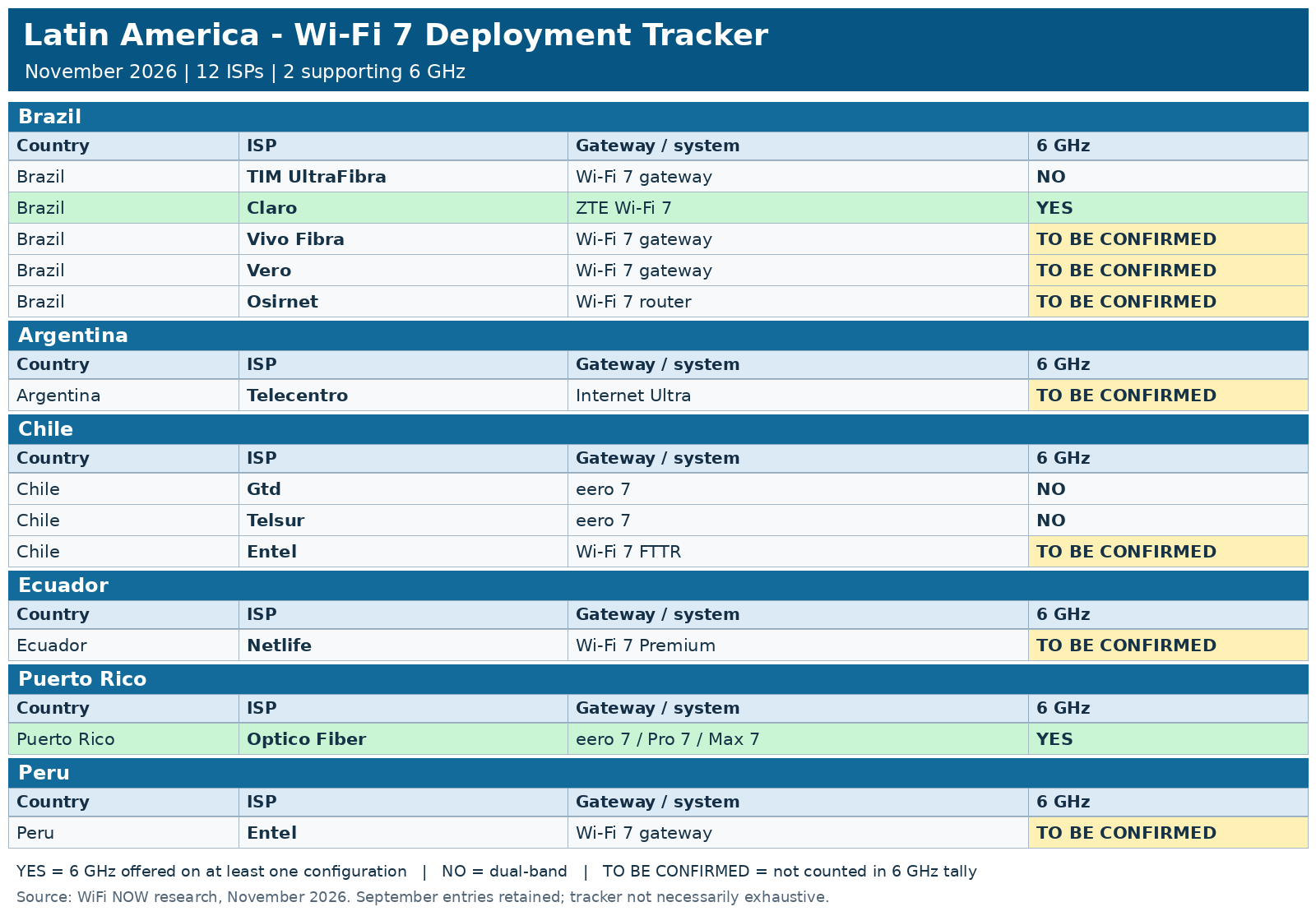
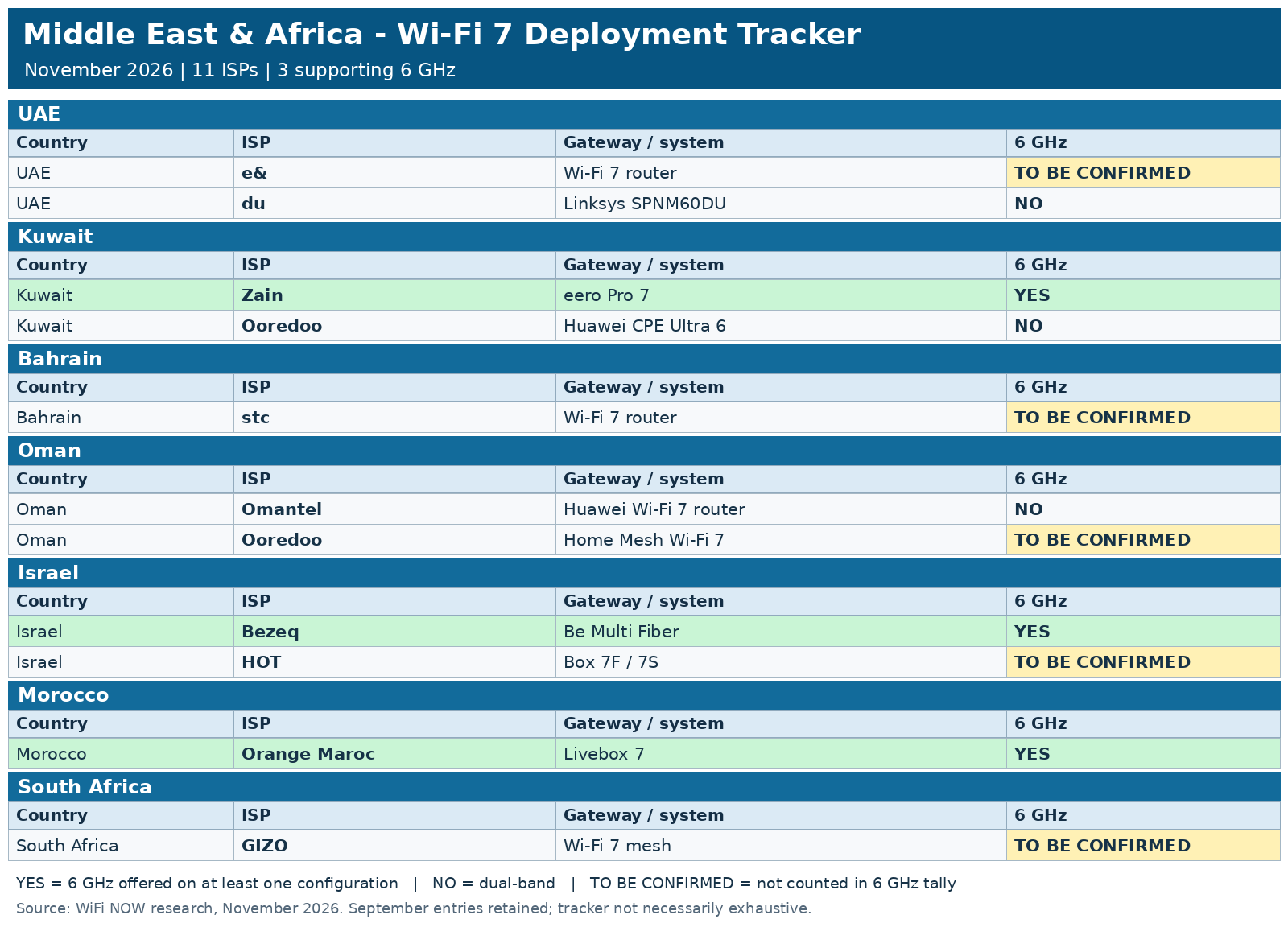
Asia-Pacific follows with 26 tracked operators, of which 13 offer equipment confirmed to support 6 GHz. The updated tracker also includes 12 operators in Latin America and 11 across the Middle East and Africa.
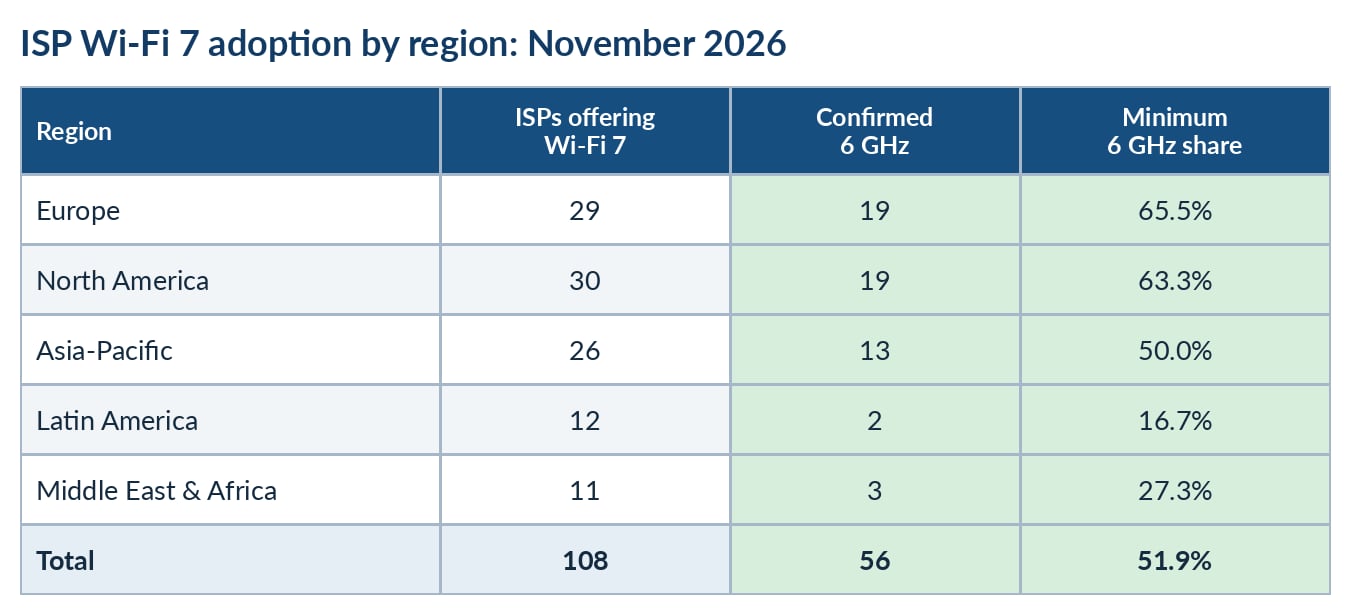
Regional differences in 6 GHz adoption need to be considered in the context of national spectrum regulations, the availability of tri-band equipment, broadband service portfolios, and the number of deployments for which frequency-band specifications have yet to be confirmed.
Wi-Fi 7 is moving beyond premium multi-gigabit broadband
One development reflected in our updated research is the increasing availability of Wi-Fi 7 on mainstream residential broadband packages. While many early ISP Wi-Fi 7 deployments were associated with flagship multi-gigabit fibre services, operators are now introducing the technology across a wider range of broadband tiers. In Canada, Bell offers its Giga Hub 2.0 Wi-Fi 7 gateway on residential fibre packages starting at 150 Mbps. In the US, Brightspeed has extended Wi-Fi 7 availability across its residential fibre portfolio, while UK alternative fibre operator Connect Fibre offers Wi-Fi 7 on packages starting at 250 Mbps.
The commercial rationale for deploying Wi-Fi 7 is thus no longer exclusively about matching the wireless performance of the home network to multi-gigabit access speeds. Operators can also use Wi-Fi 7 to improve the capacity, responsiveness, and reliability of home connectivity across their residential subscriber base.
Operators are using 6 GHz to differentiate residential broadband services
Several service providers are now offering both dual-band and tri-band Wi-Fi 7 equipment within their residential broadband portfolios.
In the UK, YouFibre offers dual-band Wi-Fi 7 equipment on mainstream broadband packages and a tri-band platform supporting 6 GHz on its flagship 8 Gbps service. Community Fibre has adopted a similar approach using Linksys Wi-Fi 7 equipment, while Australian operator Superloop offers both the dual-band eero 7 and the tri-band eero Pro 7.
Meanwhile, Vodafone UK has expanded its Wi-Fi 7 portfolio with the introduction of the tri-band Ultra Hub 7+, adding 6 GHz capability to its residential Wi-Fi 7 offering.
These examples illustrate how access to 6 GHz spectrum is becoming a commercial differentiator for residential broadband operators. While dual-band Wi-Fi 7 provides a technology upgrade within the established 2.4 GHz and 5 GHz bands, tri-band equipment allows operators to offer additional spectrum capacity, wider channels, and Multi-Link Operation involving the 6 GHz band.
Smaller and regional ISPs are contributing to Wi-Fi 7 adoption
The second edition of our tracker also reflects the growing participation of alternative fibre networks and regional broadband operators in the transition to Wi-Fi 7.
Additional operators represented in our research include Fibrus, Zen Internet, Trooli, and Connect Fibre in the UK, Kinetic and Midco in the US, Superloop and Lightning Broadband in Australia, and Osirnet in Brazil. Our updated tracker also identifies residential Wi-Fi 7 availability in Peru through Entel.
The availability of third-party Wi-Fi 7 platforms from companies such as Amazon eero, TP-Link, Nokia, Linksys, and Calix gives smaller service providers access to Wi-Fi 7 technology without necessarily having to commission their own customised residential gateway platforms.
Open software platforms are also making their way into ISP Wi-Fi 7 deployments
Another addition to our tracker is Finnish operator DNA, which has commercially deployed Wi-Fi 7 gateways from Zyxel based on prplWare and MediaTek Filogic silicon.
The deployment includes both dual-band and tri-band Wi-Fi 7 platforms, illustrating how open residential gateway software can support different hardware configurations within an individual operator’s broadband portfolio. The evolution of open gateway software platforms alongside the transition to Wi-Fi 7 is a development WiFi NOW will continue to follow.
More than half of tracked ISPs now offer 6 GHz
The number of service providers in our tracker confirmed to offer 6 GHz has increased from 43 to 56 in just over two months of research. The confirmed proportion of operators supporting 6 GHz has also increased slightly, despite the expansion of the tracker to include more regional operators and markets.
For the Wi-Fi industry, the continued adoption of 6 GHz by residential broadband operators represents a substantial opportunity to bring the benefits of additional unlicensed spectrum into consumers’ homes. As Wi-Fi 7 equipment becomes more widely available across residential broadband portfolios, national decisions concerning access to 6 GHz spectrum will continue to influence the capacity and performance that service providers can deliver over home Wi-Fi.
WiFi NOW will continue to update the tracker as new commercial deployments and technical specifications become available.
The WiFi NOW Global ISP Wi-Fi 7 Tracker – November 2026
North America
Europe
Asia-Pacific
Latin America
Middle East & Africa
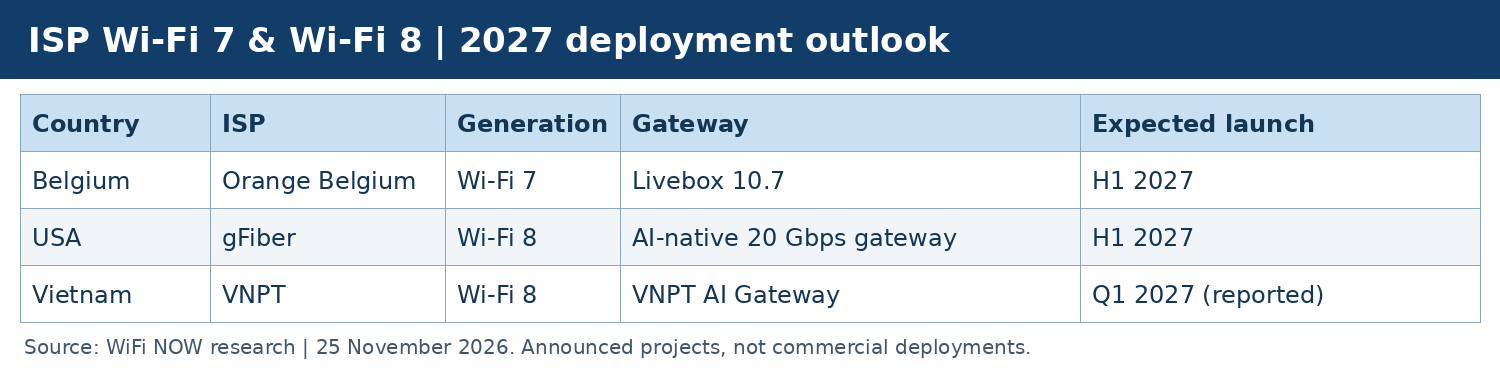
Looking ahead: ISP Wi-Fi 7 and Wi-Fi 8 deployments in 2027
As part of our expanded tracker, WiFi NOW is now also monitoring publicly announced future ISP deployments of Wi-Fi 7 and Wi-Fi 8. Our research has identified three operator projects targeting commercial availability in 2027, including Orange Belgium’s forthcoming Wi-Fi 7 gateway and two AI-native Wi-Fi 8 gateways from gFiber in the US and VNPT in Vietnam.
The latter two projects are targeting commercialisation ahead of formal Wi-Fi 8 certification. WiFi NOW will expand this forward-looking tracker as additional operators announce their deployment plans. Planned deployments are not included in our commercial Wi-Fi 7 deployment statistics.
Last updated: November 2026.
Tracker methodology
The WiFi NOW Global ISP Wi-Fi 7 Tracker includes commercially available residential broadband services where the service provider supplies Wi-Fi 7 equipment to the customer. This includes integrated gateways, ISP-customised routers, ISP-supplied third-party routers, and managed mesh systems.
Trials, demonstrations, announced products not yet commercially available, and independently purchased retail routers are excluded. Operators are counted separately in each national market. An operator offering multiple Wi-Fi 7 equipment configurations is counted once and qualifies as supporting 6 GHz if at least one commercially available configuration supports the band.
Where commercial Wi-Fi 7 availability is established but 6 GHz support cannot be confirmed, the entry is marked TO BE CONFIRMED. These operators are included in the overall Wi-Fi 7 total but excluded from the confirmed 6 GHz tally.
The tracker is not necessarily exhaustive. Increases in the number of tracked deployments include both new commercial launches and previously unidentified deployments.
/Claus.