
By Claus Hetting, WiFi NOW CEO & Chairman
Artificial intelligence is becoming an integral part of enterprise Wi-Fi network management, but AI Ops platforms differ considerably in architecture, functionality, and levels of automation. Some solutions focus on network visibility, predictive analytics, and automated troubleshooting, while others are introducing agentic AI capabilities designed to execute increasingly complex operational tasks. This final chapter of the WiFi NOW AI Ops series maps the emerging vendor ecosystem and compares the principal solutions available to enterprise customers.
1. The emerging AI Ops ecosystem
Enterprise Wi-Fi AI Ops is developing into a competitive market involving networking equipment manufacturers, specialist assurance providers, and companies offering AI-powered network management and automation. The major enterprise networking vendors occupy a central position because their platforms have direct access to operational information generated by network nodes and connected devices.
Companies including Cisco, HPE, Extreme Networks, and RUCKUS Networks are integrating AI-driven analytics and automation into their networking platforms. At the same time, specialist providers such as 7SIGNAL and Wyebot offer independent monitoring, network assurance, and automated diagnostics.
These two categories are not necessarily direct competitors. Integrated platforms can combine network intelligence with infrastructure management and control, while specialist providers may offer independent performance measurements, multivendor visibility, and additional diagnostic capabilities.
The emergence of agentic AI is introducing another distinction. Conventional AI Ops systems typically analyse network conditions and recommend corrective actions. Agentic AI systems are designed to investigate problems, coordinate workflows, and potentially execute remediation with varying degrees of human oversight.
2. Enterprise Wi-Fi AI Ops Vendor & Solutions Tracker
The following tracker identifies the principal enterprise networking platforms and specialist solutions contributing to the AI Ops ecosystem. It focuses on commercially available capabilities and publicly announced product directions. Agentic AI capabilities are distinguished from conventional analytics and automation wherever possible.
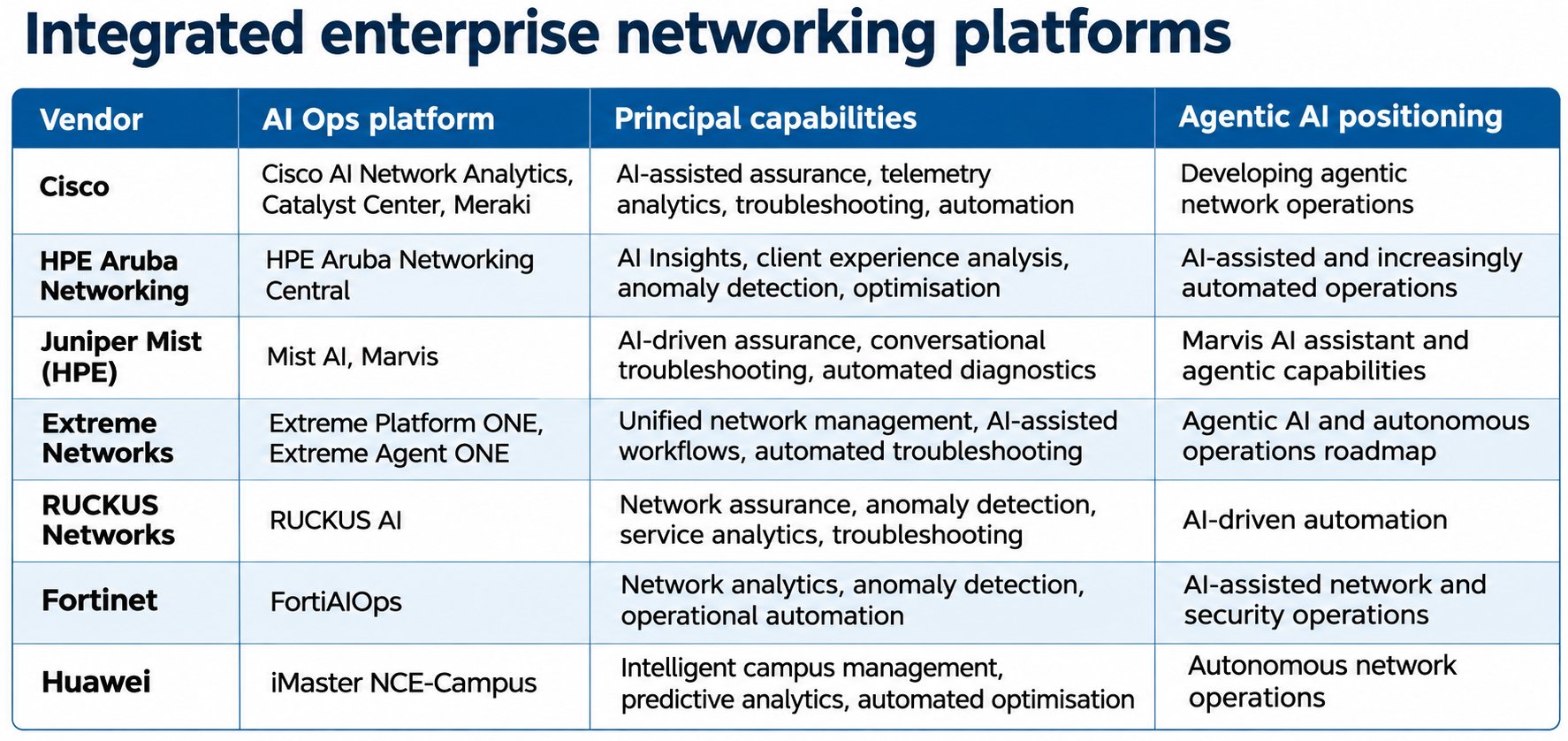
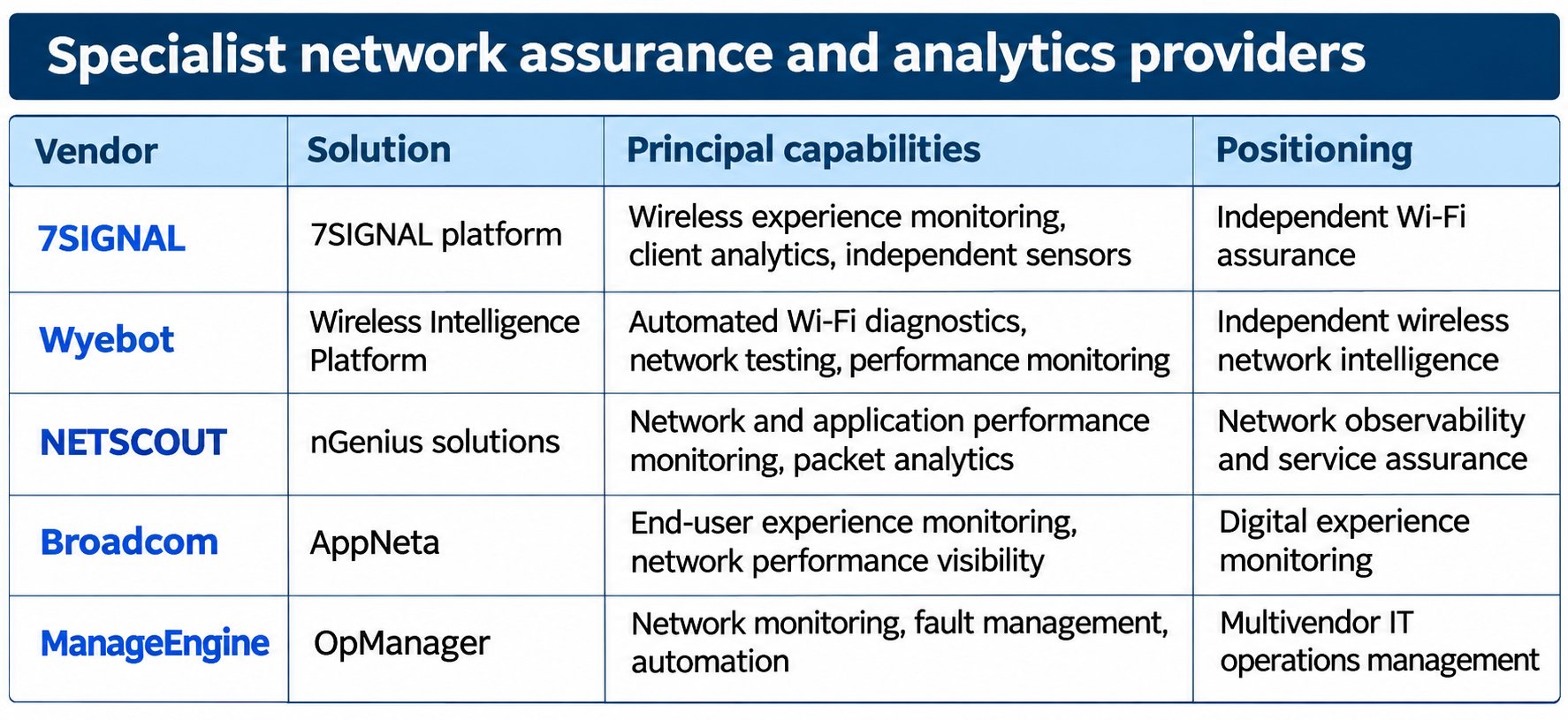
Tracker scope: Selected enterprise networking and specialist assurance suppliers. Product positioning is indicative, not a certification of feature availability. Specific capabilities and release status should be verified against current vendor documentation.
3. Comparing AI Ops capabilities
Although vendors frequently use similar terminology, the capabilities of their platforms can differ substantially. AI Ops solutions can broadly be divided into five functional categories.
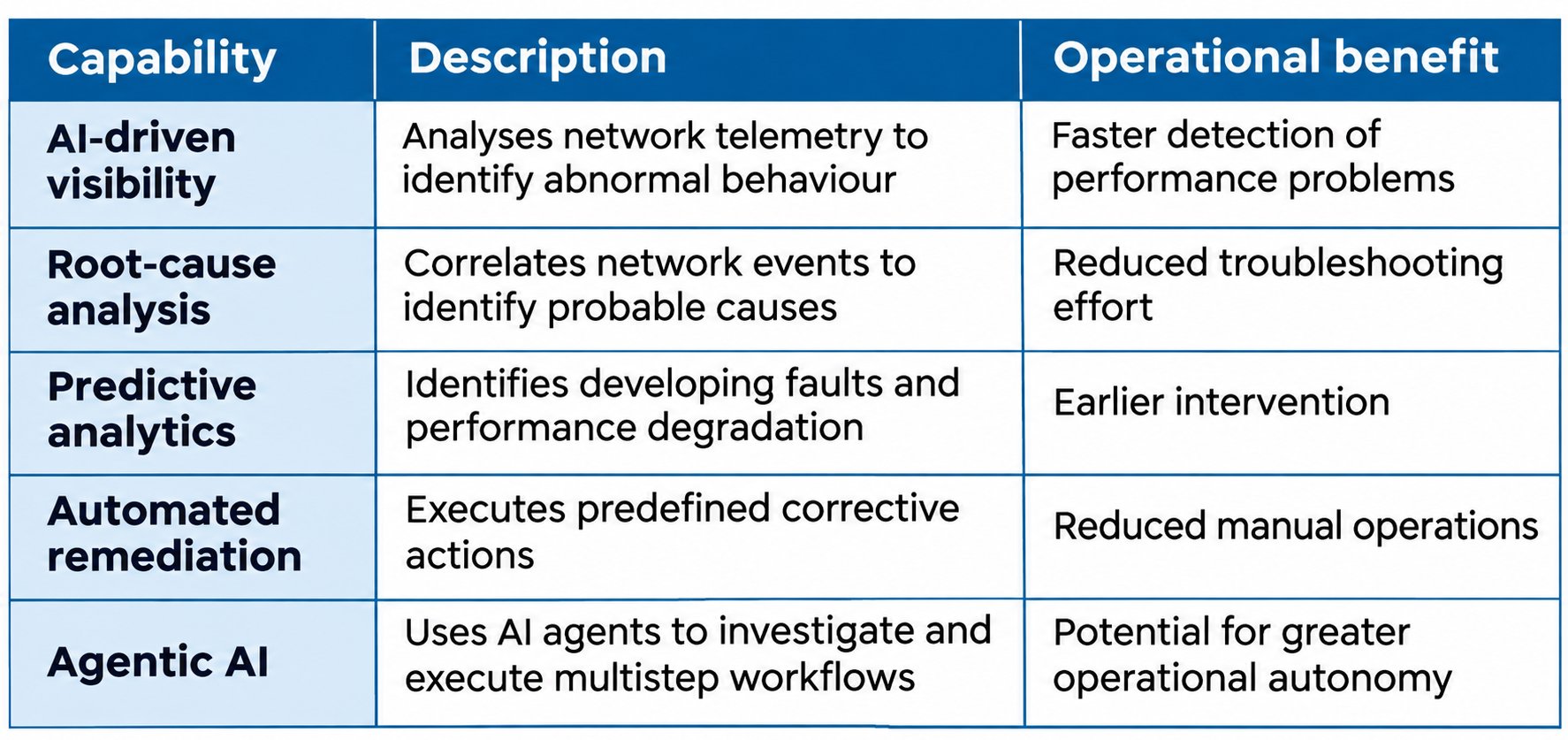
These capabilities are not mutually exclusive. A single platform may incorporate all five, although the degree of automation and operational independence can vary. For example, a system that automatically adjusts radio parameters according to predefined policies is not necessarily an agentic AI platform. Agentic operation generally involves greater flexibility in selecting and coordinating actions to achieve a specified objective.
4. Integrated platforms versus independent assurance
One of the principal architectural differences in the AI Ops ecosystem concerns the relationship between network infrastructure and network intelligence. Integrated enterprise networking platforms can collect detailed operational data directly from their own equipment. They can also apply configuration changes, adjust policies, and perform remediation through their management systems.
Independent assurance providers take a different approach. Their solutions may use dedicated sensors, client-side software, active testing, or passive monitoring to measure network performance. This can provide additional visibility into the actual experience of connected devices, including problems that may not be apparent from infrastructure telemetry alone.
Independent assurance can also be relevant to enterprises operating equipment from multiple vendors. However, the ability to identify a network problem does not necessarily include the ability to resolve it automatically. Remediation may require integration with the underlying networking platform or an external automation system. Consequently, enterprises may choose to combine integrated AI Ops with independent monitoring rather than treating the two as alternatives.
5. Cloud AI, edge intelligence, and autonomous operations
Another emerging distinction is where AI processing takes place. Most enterprise networking AI Ops platforms rely heavily on Cloud-based analytics. Centralised processing enables vendors to analyse large volumes of telemetry, correlate network events, and develop models using information collected across multiple deployments.
Edge-based AI processing introduces different possibilities. Local intelligence can support faster operational decisions, reduce dependence on continuous cloud connectivity, and address data sovereignty requirements. Hybrid architectures may combine centralised AI models with local analytics and automated network control. The development of agentic AI is also creating new requirements for orchestration, governance, and security.
Before enterprises permit AI systems to execute network changes autonomously, they must establish appropriate controls for authorisation, auditing, rollback, and human intervention. The transition from AI-assisted troubleshooting to autonomous operations will therefore depend on both technical capabilities and enterprise operational policies.
6. How should enterprises evaluate AI Ops solutions?
Selecting an AI Ops platform requires an assessment of the operational capabilities available today, rather than relying exclusively on vendor roadmaps. The following criteria provide a framework for comparing solutions.
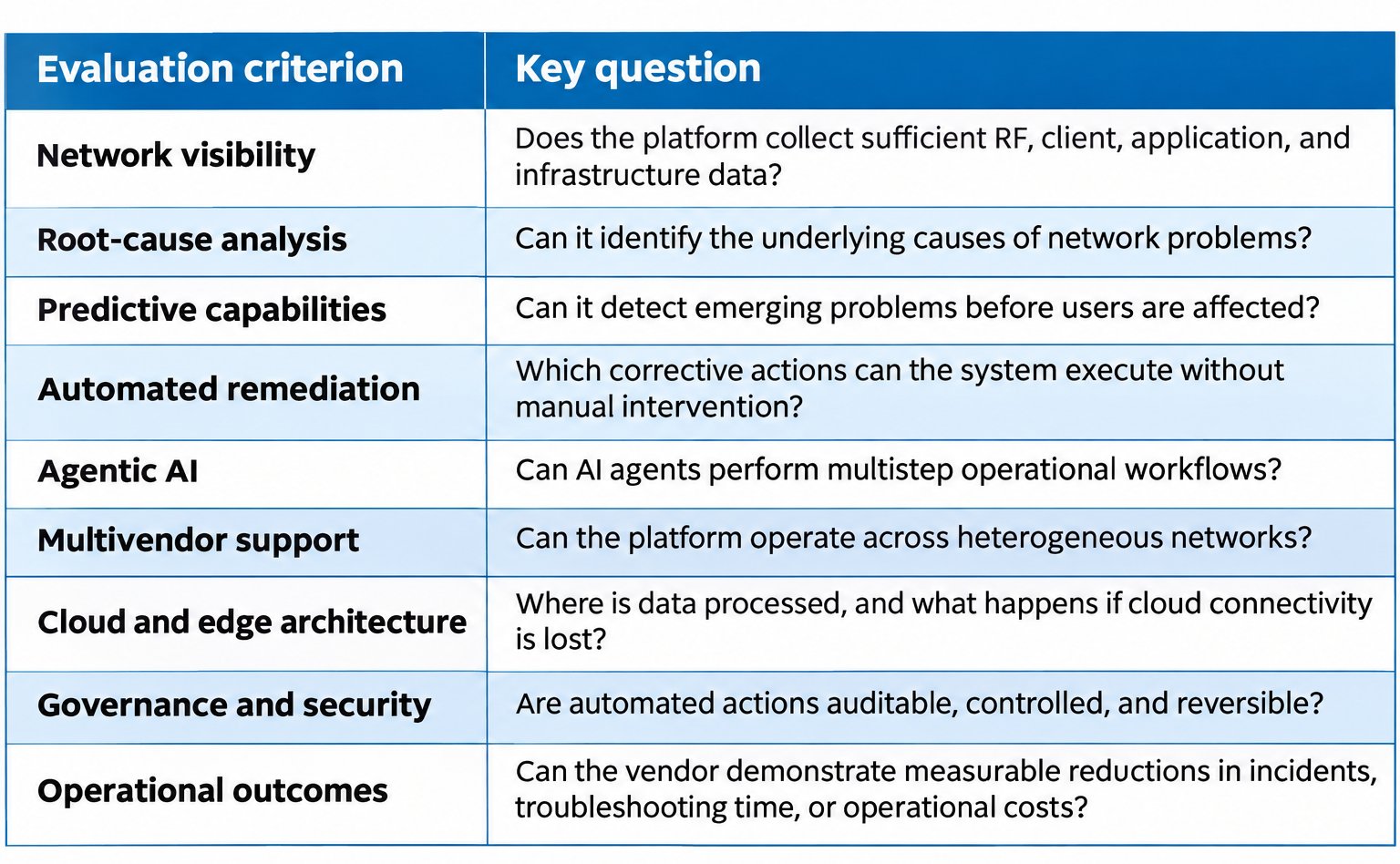
For enterprise customers, these criteria should be considered in the context of specific deployment requirements. A large university campus may prioritise RF optimisation, roaming performance, and client experience. A distributed retailer may place greater emphasis on remote troubleshooting, centralised management, and consistent network policies across hundreds of locations. The relative value of different AI Ops capabilities will depend on these operational priorities.
7. The road towards autonomous enterprise Wi-Fi
AI Ops is evolving from a collection of analytics and troubleshooting tools towards more comprehensive systems for managing enterprise networks. The progression towards greater autonomy is expected to involve automated detection, AI-assisted diagnosis, recommended remediation, controlled execution, and increasingly autonomous operational workflows. However, the availability of agentic AI features does not necessarily mean that a network can operate without human supervision.
Enterprise networks must satisfy demanding requirements for reliability, security, availability, and regulatory compliance. Automated network changes can affect large numbers of users and business-critical applications. As a result, the development of autonomous networking will require continued improvements in AI models, operational data, orchestration systems, and governance.
The competitive landscape is also likely to evolve as networking vendors expand their AI capabilities and specialist providers introduce additional automation and intelligence.
WiFi NOW’s take:
AI Ops is becoming a standard component of enterprise networking platforms, but the industry remains at different stages of development. AI-assisted analytics, automated troubleshooting, and agentic AI are not equivalent capabilities, even when presented under similar marketing terminology.
Integrated networking vendors benefit from direct access to infrastructure data and network control, while specialist assurance providers offer independent monitoring and additional visibility into client experience. As AI Ops matures, differentiation will increasingly depend on the ability to execute operational tasks reliably, rather than simply identify problems or generate recommendations.
For enterprise customers, the relevant measures are reductions in troubleshooting time, improved network reliability, and lower operational costs. The emergence of agentic AI creates opportunities for further automation, but those benefits will need to be demonstrated in production networks.
About the AI Ops Vendor & Solutions Tracker
The WiFi NOW AI Ops Vendor & Solutions Tracker is intended as a regularly updated reference covering enterprise networking platforms, specialist assurance providers, and emerging agentic AI capabilities. Future updates can incorporate newly announced products, expanded automation functionality, additional suppliers, and documented customer deployments. The tracker is designed to support enterprise technology evaluation and industry research. Inclusion does not constitute a WiFi NOW endorsement, and vendor claims should be assessed against publicly documented capabilities and operational results.
/Claus.