

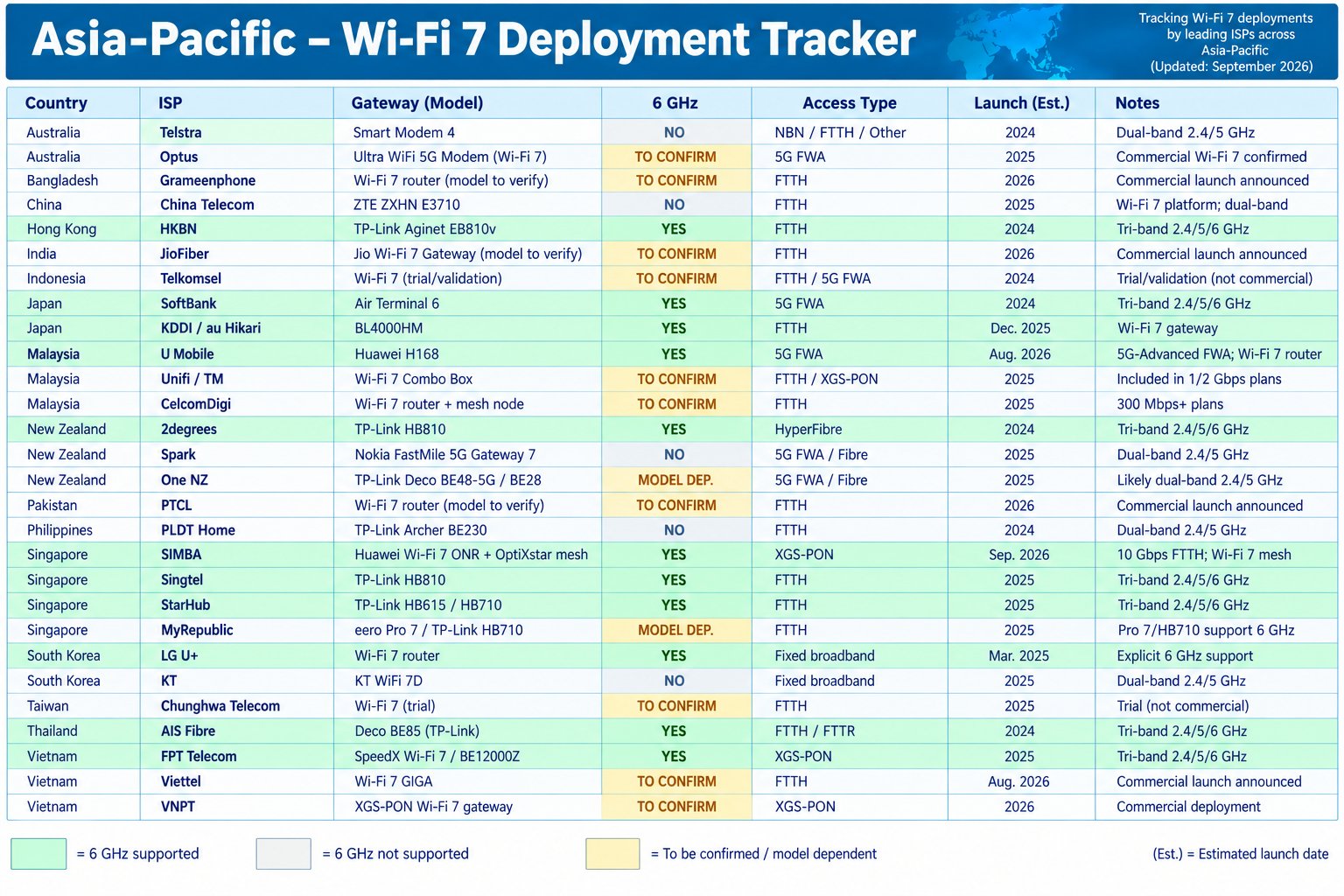
Wi-Fi 7 is rapidly making its way into ISP-supplied home gateways, routers, and managed Wi-Fi systems around the world. WiFi NOW has identified more than 85 commercial ISP Wi-Fi 7 deployments or offerings across Europe, Asia-Pacific, North America, Latin America, the Middle East, and Africa – and the number continues to grow. An important part of this transition is the growing adoption of 6 GHz spectrum. Many of the most advanced ISP Wi-Fi 7 platforms are tri-band systems operating across 2.4 GHz, 5 GHz, and 6 GHz, giving operators and their customers access to the additional spectrum available in the 6 GHz band.
The WiFi NOW Global ISP Wi-Fi 7 Tracker identifies service providers that have commercially introduced Wi-Fi 7 equipment for residential broadband customers. In addition to tracking the gateway or router, access technology, and deployment model, we explicitly identify whether each implementation supports 6 GHz. Maximum broadband tier refers to the service associated with the Wi-Fi 7 deployment where this can be established, rather than the theoretical Wi-Fi link rate.
6 GHz unlocks the full spectrum opportunity of Wi-Fi 7
Wi-Fi 7 introduces important improvements that can also be implemented in the established 2.4 GHz and 5 GHz bands. Adding 6 GHz, however, gives Wi-Fi 7 substantially more spectrum to work with and creates significantly greater scope for capacity, wide channels, and Multi-Link Operation across multiple bands. A growing group of leading service providers has adopted this tri-band approach. Examples include Free’s Freebox Ultra, Bouygues Telecom’s Bbox WiFi 7, Swisscom’s Internet-Box 5 Pro, Proximus’ Internet Box+, Magyar Telekom’s Wi-Fi 7 home gateway, EE’s Smart Hub 7 Pro, Sky’s Gigafast+ Hub, and Singtel’s customised TP-Link platform.
Other operators have initially introduced dual-band Wi-Fi 7 equipment operating in 2.4 GHz and 5 GHz. These products can still deliver important Wi-Fi 7 features, including Multi-Link Operation, but without a 6 GHz radio they cannot access the additional spectrum that represents one of the most important capacity opportunities available to Wi-Fi 7. For WiFi NOW, this makes 6 GHz support a key metric in assessing ISP Wi-Fi 7 deployments. The tracker therefore identifies explicitly whether each gateway supports 6 GHz rather than treating all Wi-Fi 7 products as technically equivalent.
Leading operators are pairing 6 GHz Wi-Fi 7 with multi-gigabit fibre
There is a clear relationship between some of the most ambitious Wi-Fi 7 deployments and the expansion of multi-gigabit fibre. Free, Bouygues Telecom, Swisscom, Proximus, Magyar Telekom, Sky, Singtel, and others are using tri-band Wi-Fi 7 platforms including 6 GHz as part of increasingly capable home connectivity services.
This makes technical sense. As access networks move from gigabit towards multi-gigabit speeds, the home Wi-Fi network increasingly needs additional spectrum and capacity if subscribers are to experience the benefits of those faster fixed connections wirelessly. The availability of 6 GHz spectrum gives operators considerably more room to deliver that capacity than would be available from the heavily used 2.4 GHz and 5 GHz bands alone.
Different models for bringing Wi-Fi 7 into the home
Service providers are using several approaches to deploy Wi-Fi 7: Some have developed integrated home gateways specifically for their broadband networks. Others use customised platforms from established CPE manufacturers, while another group has selected third-party Wi-Fi systems from companies such as Amazon eero, TP-Link, and AVM.
There are also differences within individual ISP portfolios: KCOM in the UK, for example, supplies the dual-band eero 7 with most of its full-fibre packages but supplies the tri-band eero Pro 7, including 6 GHz, with its highest-tier Power Fibre 900 service. This is an example of how 6 GHz capability can be used by operators to differentiate higher-performance managed home Wi-Fi services.
Europe currently leads ISP Wi-Fi 7 adoption
Europe is currently the most active region represented in the tracker, with deployments across France, Germany, the UK, Spain, Portugal, Ireland, Switzerland, Belgium, and Hungary. Importantly, a substantial group of European operators has selected tri-band Wi-Fi 7 equipment supporting 6 GHz. Free, Bouygues Telecom, Swisscom, Proximus, Magyar Telekom, EE, Sky, MEO, eir, and others are examples.
Asia-Pacific is also well represented, with commercial offerings from Singtel, HKBN, LG U+, AIS Fibre, Telstra, 2degrees, and others. North American adoption includes Charter’s Spectrum, AT&T, Rogers, TELUS, and Bell, while deployments are also emerging in Latin America and the Middle East.
How we define an ISP Wi-Fi 7 deployment
For the purposes of this tracker, WiFi NOW defines an ISP Wi-Fi 7 deployment as a commercially available residential broadband service under which the service provider supplies Wi-Fi 7 equipment to the customer. This can include an integrated broadband gateway, an ISP-designed or customised router, a third-party router supplied by the ISP, or a managed mesh Wi-Fi system.
We distinguish optional equipment and third-party products from integrated ISP gateways in the table. Trials, technology demonstrations, vendor design wins without confirmed commercial availability, and ordinary retail Wi-Fi 7 products are not counted as commercial ISP deployments. We also track 6 GHz capability separately: Where an ISP has launched Wi-Fi 7 but we have not been able to verify whether the equipment supports 6 GHz, the field is marked To confirm rather than inferred from the Wi-Fi 7 designation.
Wi-Fi 7 and 6 GHz adoption are set to grow
ISP adoption of Wi-Fi 7 is still at an early stage relative to the installed base of previous-generation gateways, but deployments are accelerating. The tracker also shows that many leading service providers are already combining Wi-Fi 7 with 6 GHz. This is an important development for the Wi-Fi industry: The additional spectrum gives operators greater capacity to support multi-gigabit broadband, increasingly demanding applications, and growing numbers of connected devices in the home.
As Wi-Fi 7 becomes the standard platform for new premium gateways – and ultimately moves further into mainstream ISP portfolios – 6 GHz capability is likely to become an increasingly important component of high-performance managed home Wi-Fi. WiFi NOW will continuously update this tracker as additional service providers introduce Wi-Fi 7 gateways, routers, and managed Wi-Fi services.
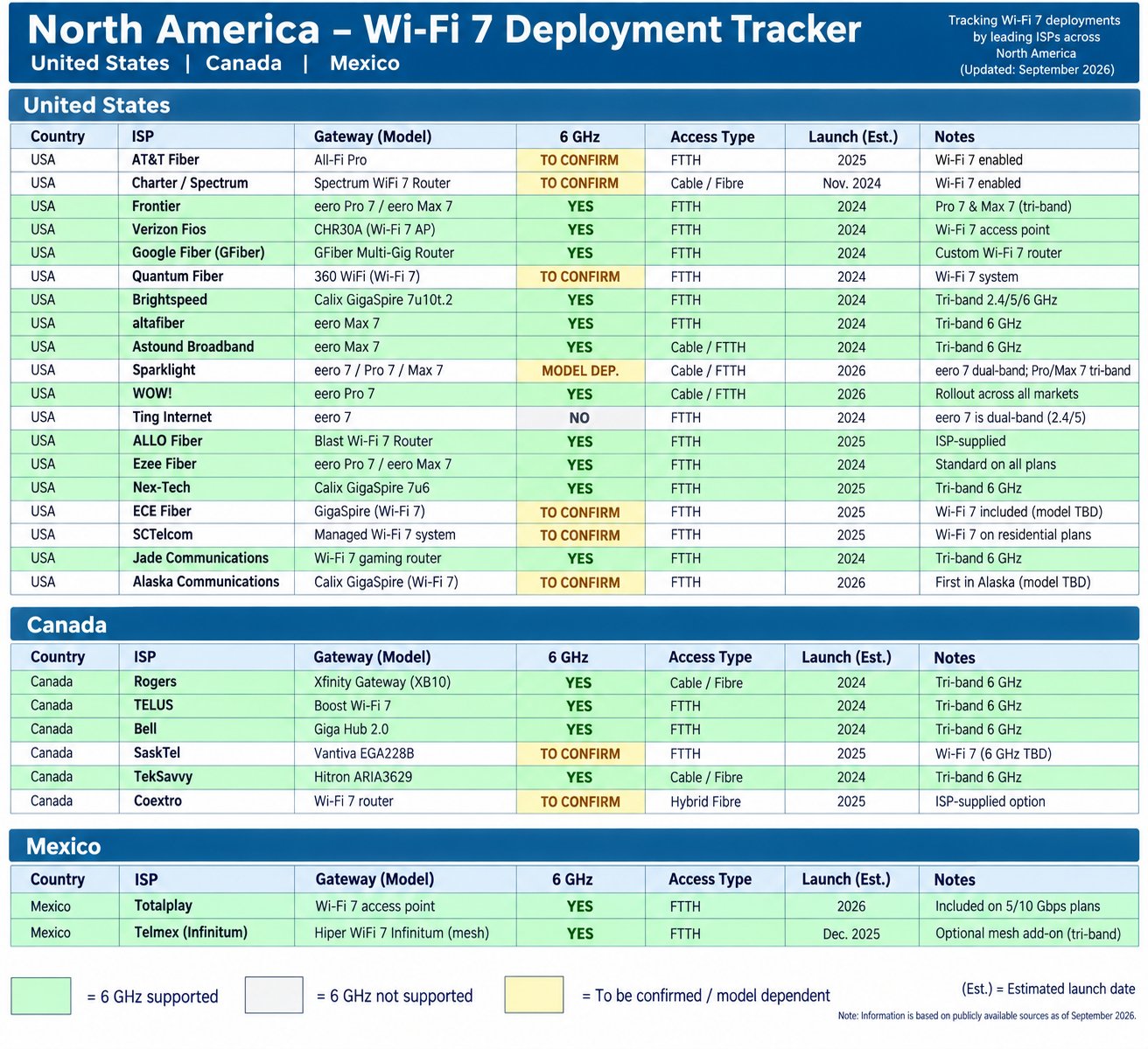
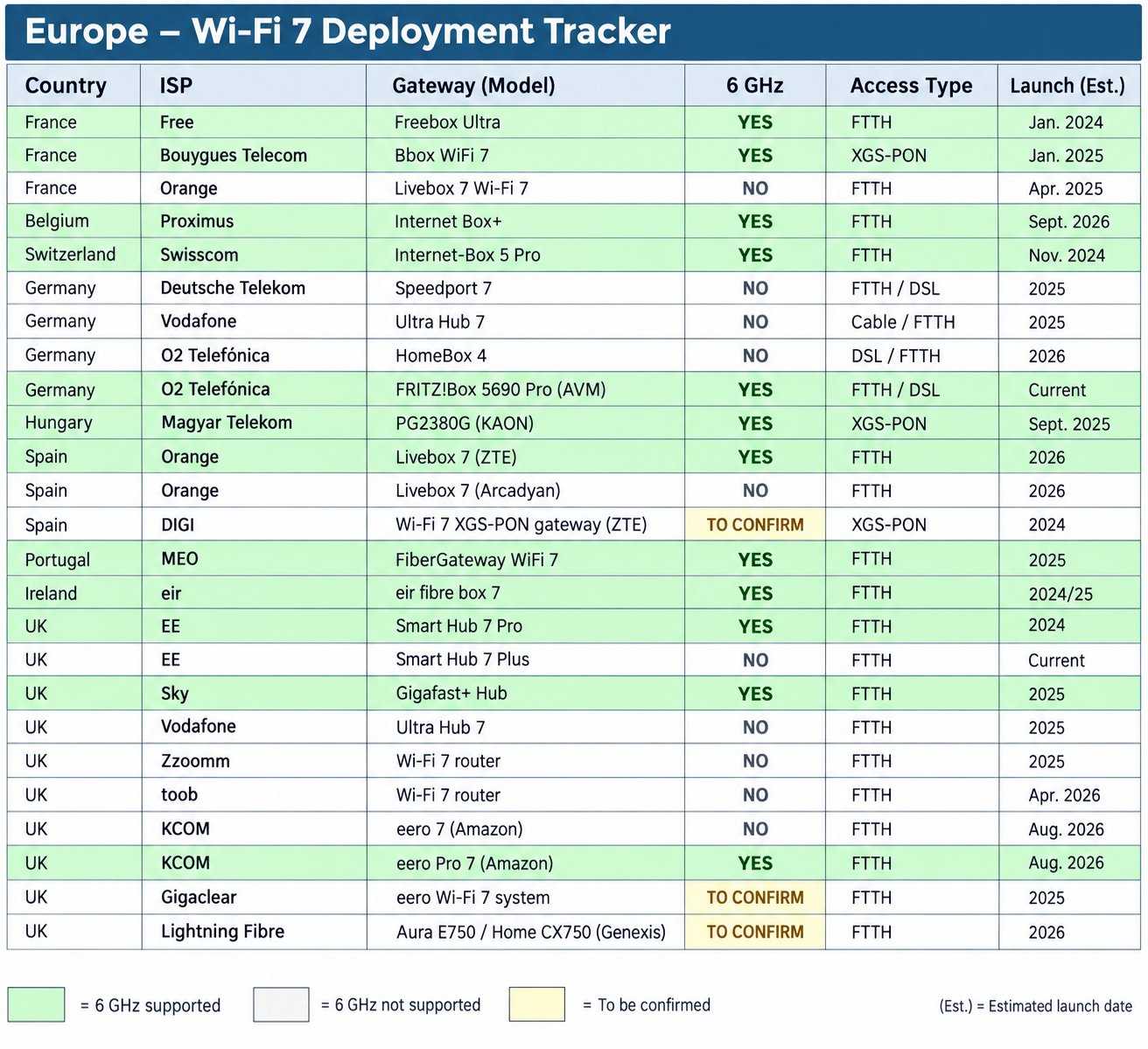
¨
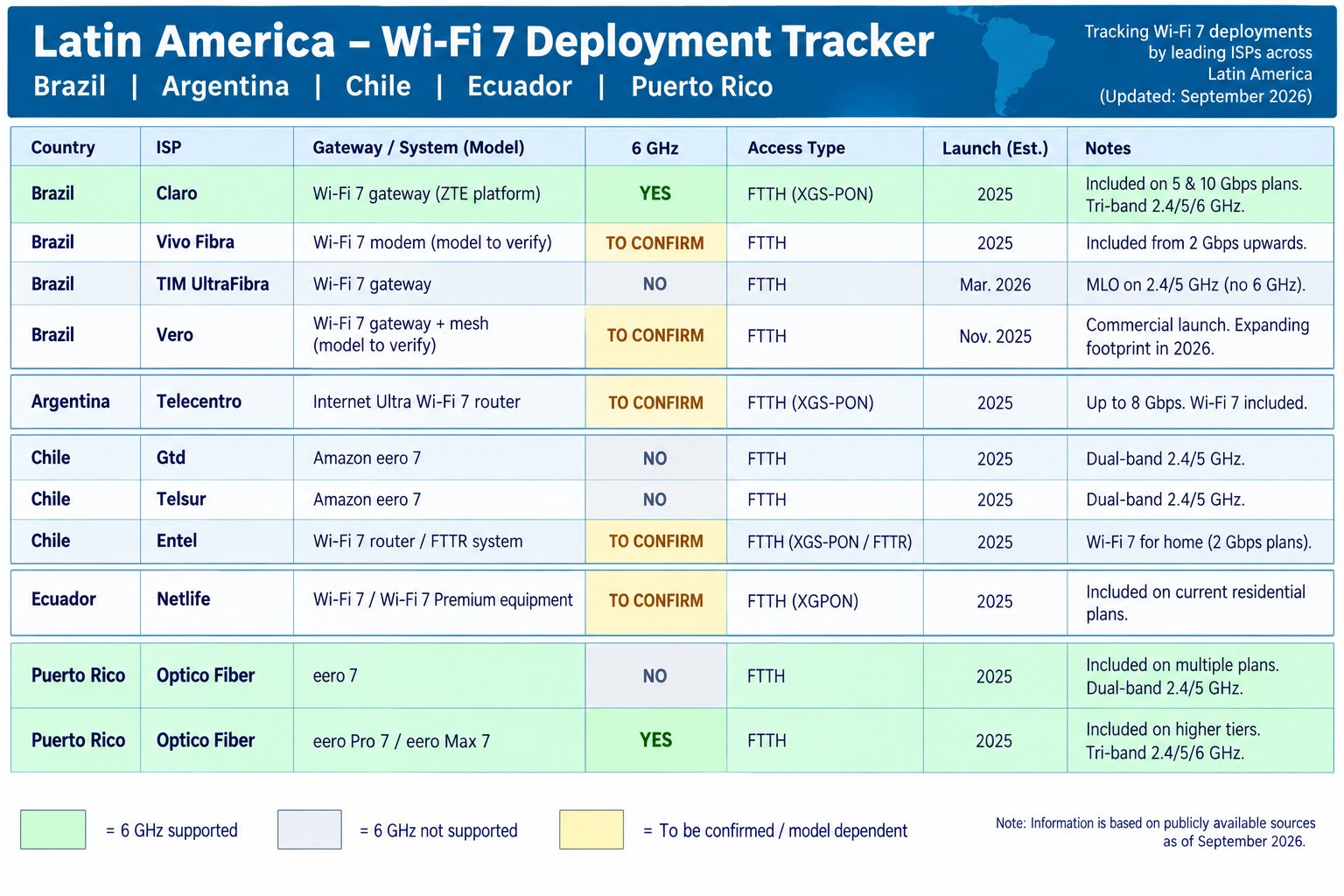
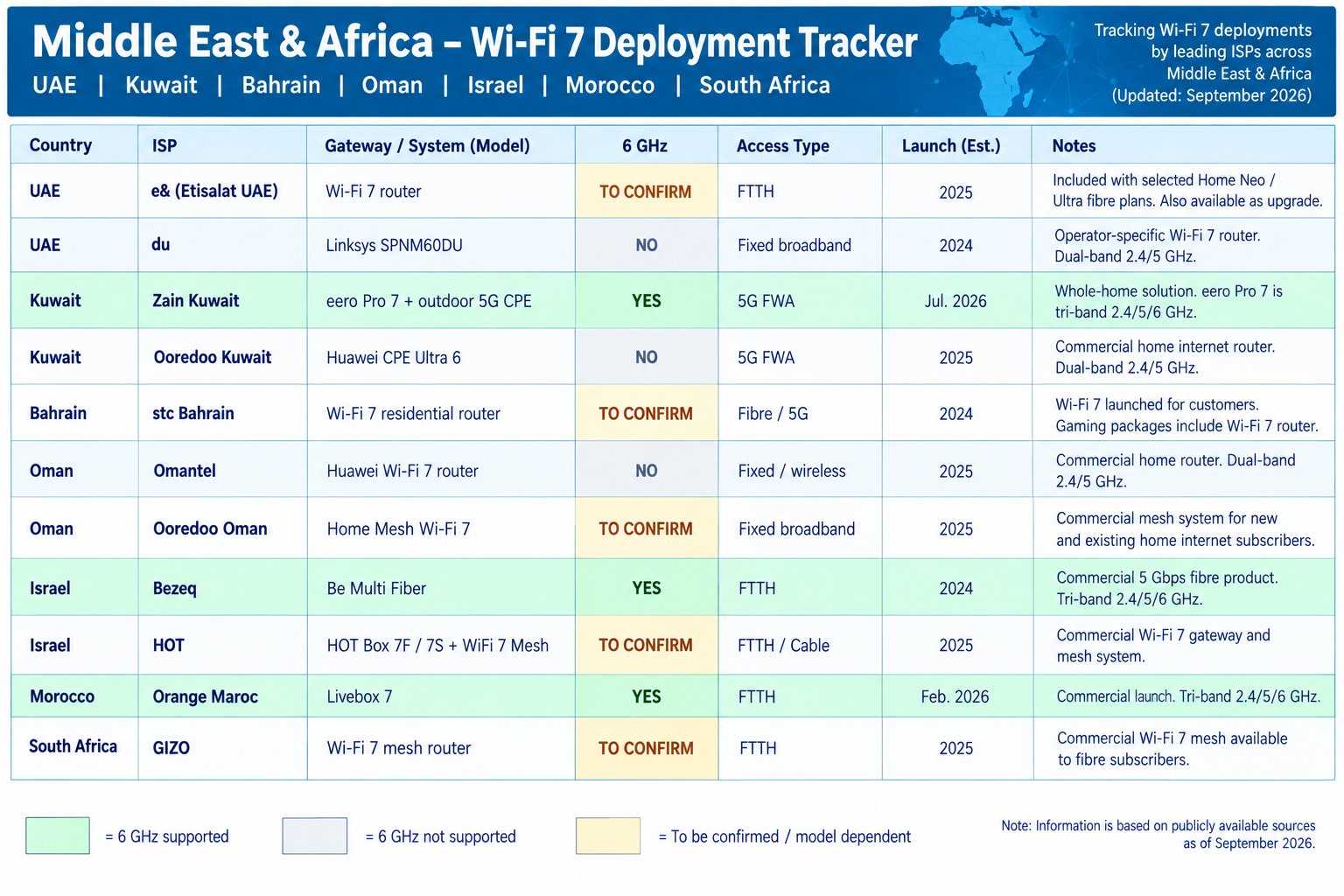
Last updated: September 2026.
Tracker methodology
The WiFi NOW Global ISP Wi-Fi 7 Tracker includes commercially available residential broadband services where the service provider supplies Wi-Fi 7 equipment to the customer. This includes integrated gateways, ISP-customised routers, ISP-supplied third-party routers, and managed mesh systems. Trials, demonstrations, announced products not yet commercially available, and independently purchased retail routers are excluded. 6 GHz support is verified separately and is not assumed simply because a product supports Wi-Fi 7. Where specifications cannot be confirmed from reliable sources, the relevant field is marked To confirm. The tracker is updated as new deployments and verified technical information become available.