By Claus Hetting, WiFi NOW CEO & Chairman
What if your laptop or enterprise workstation could continuously verify that you are the person viewing the information on the screen – without passwords, repeated logins, or even touching the keyboard? US-based Hummingbirds AI has developed an AI-powered continuous authentication solution called Guacamole that does precisely that. Now the company is working to incorporate Wi-Fi sensing to improve environmental awareness, reduce power consumption, and make authentication more efficient. We spoke to Hummingbirds AI founder and CEO Dr Nima Schei on Tech Watch.
Most of today’s authentication technologies are designed to verify the identity of a user at the point of login. But what happens afterwards? In hospitals, banks, government offices, and other environments where sensitive information is routinely accessed, ensuring that only authorised individuals can view confidential data throughout a session remains a challenge.

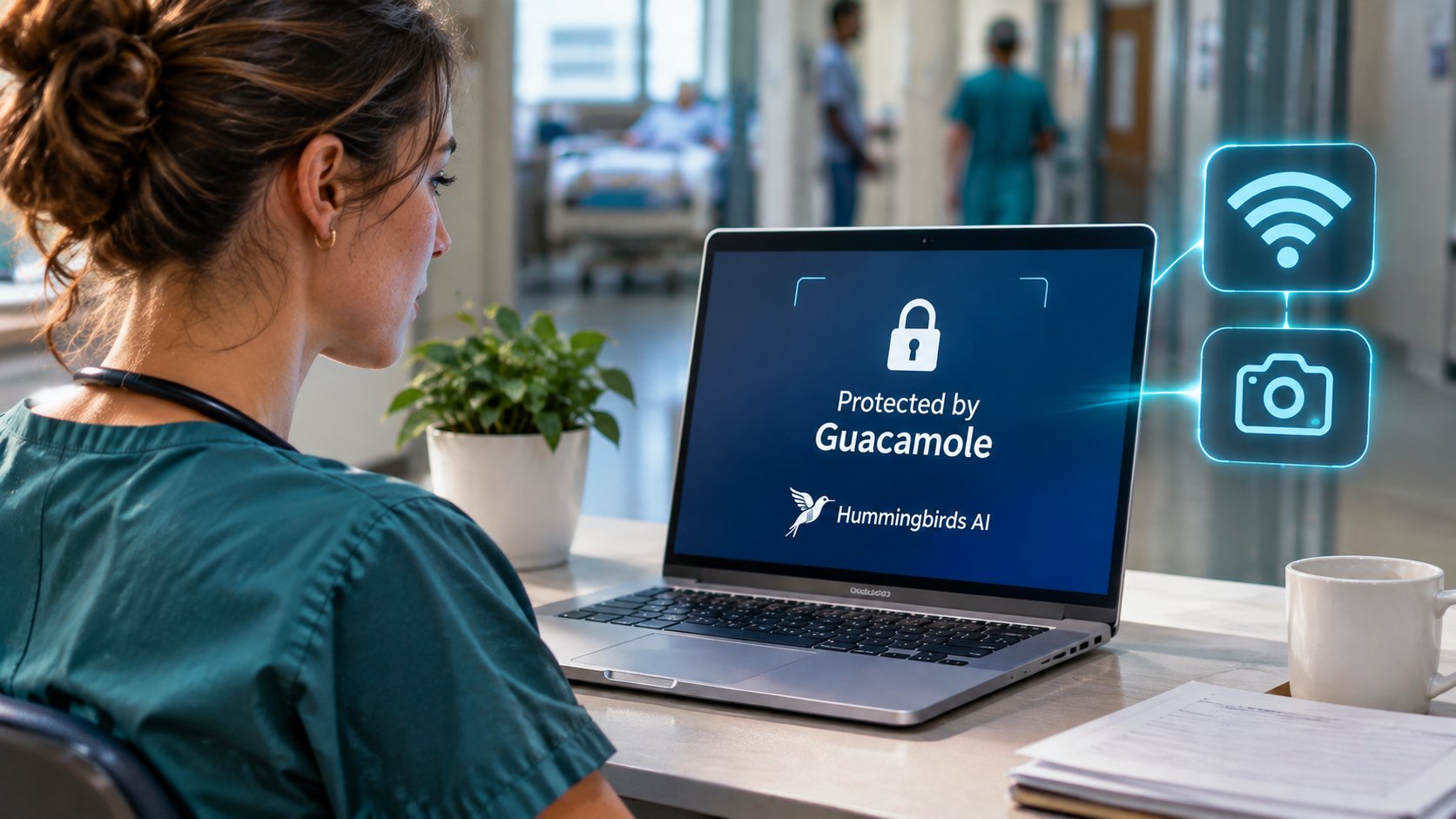
Hummingbirds AI’s Guacamole software addresses this problem by using a computer’s existing camera and locally executed AI algorithms to continuously verify the identity of the person in front of the screen. When the authorised user walks away, the screen is automatically obscured. When the user returns, access is restored following facial verification.
“Security shouldn’t be at the expense of usability. We think you can have a secure environment while there’s no friction for authentication,” says Dr Nima Schei, founder and CEO of Hummingbirds AI.
From point-in-time to continuous authentication
Nima Schei – himself a medical doctor by training – was inspired to develop the technology by the challenges faced by healthcare professionals. Doctors and nurses may access dozens of different workstations during a working day, repeatedly logging in and out to protect confidential patient information.
Guacamole automates screen protection without requiring users to terminate their existing authenticated sessions. The time between the user’s departure and the screen being obscured is configurable from three seconds to two minutes, depending on the application and security policy.
The software also offers protection against so-called ‘shoulder surfing’. If an unauthorised individual attempts to view the screen while the authorised user is working, Guacamole can issue a notification or blur the screen content. The feature has applications well beyond healthcare, including for business travellers working at airports, in cafés, or on aircraft.
According to Schei, the software works with conventional built-in and external cameras without requiring specialised infrared camera hardware. Facial recognition is performed locally on the device, and no photographs or video recordings are retained.
Adding Wi-Fi sensing to create a multimodal authentication solution
Hummingbirds AI – an Intel Prestige Partner – has been working with Intel to explore how Wi-Fi sensing can complement camera-based authentication. The objective is to combine two different sensing modalities: Radio frequency-based environmental awareness and computer vision-based identity verification.
Wi-Fi sensing can detect the presence, approach, or departure of a person without necessarily knowing who that person is. This information can be used to determine when the camera needs to be activated and when it may be possible to reduce its frame rate or switch it off altogether. In the proposed implementation, Wi-Fi sensing detects a person approaching a protected workstation and triggers the camera. The AI software then verifies the person’s identity before restoring access to the information on the screen. The distinction is that Wi-Fi sensing provides contextual awareness, while the camera remains responsible for identity verification.
Wi-Fi-assisted continuous authentication: Proposed multimodal operating sequence
- User approaches workstation: Wi-Fi sensing detects human presence.
- Camera is activated: Screen content remains protected.
- Local AI verifies identity: Facial biometrics confirm the authorised user.
- Screen access is restored: No manual reauthentication required.
Source: WiFi NOW, based on Hummingbirds AI’s proposed Wi-Fi sensing pilot.
The addition of Wi-Fi sensing could reduce the amount of time the camera needs to be active, thereby reducing battery consumption. Nima Schei says the existing Guacamole software is already computationally lightweight, typically consuming only a couple of percentage points of CPU resources.
Hummingbirds AI has proposed a pilot project to quantify the benefits of adding Wi-Fi sensing to the existing solution. The pilot would compare camera-only and Wi-Fi-assisted authentication on the same PC, measuring camera-active time, false camera activations, the time sensitive information remains visible following a user’s departure, and the time required to restore verified access.
Local AI processing and enterprise-wide deploymentAll authentication processing takes place locally on the device rather than in the Cloud. The standalone version of Guacamole can operate without Internet connectivity once the software licence has been activated. For enterprise environments, Hummingbirds AI has also developed a connected version of the software. This allows facial biometric profiles to be synchronised across multiple workstations, eliminating the need for individual employees to register separately on every computer they use.
Enterprise IT departments can assign groups of users to groups of devices and integrate Guacamole with existing user management systems. The software is designed to complement rather than replace existing enterprise identity and access management infrastructure. The technology thus addresses both information security and operational efficiency, particularly in environments where multiple employees share a large number of workstations.
Guacamole: Key technology features and capabilities
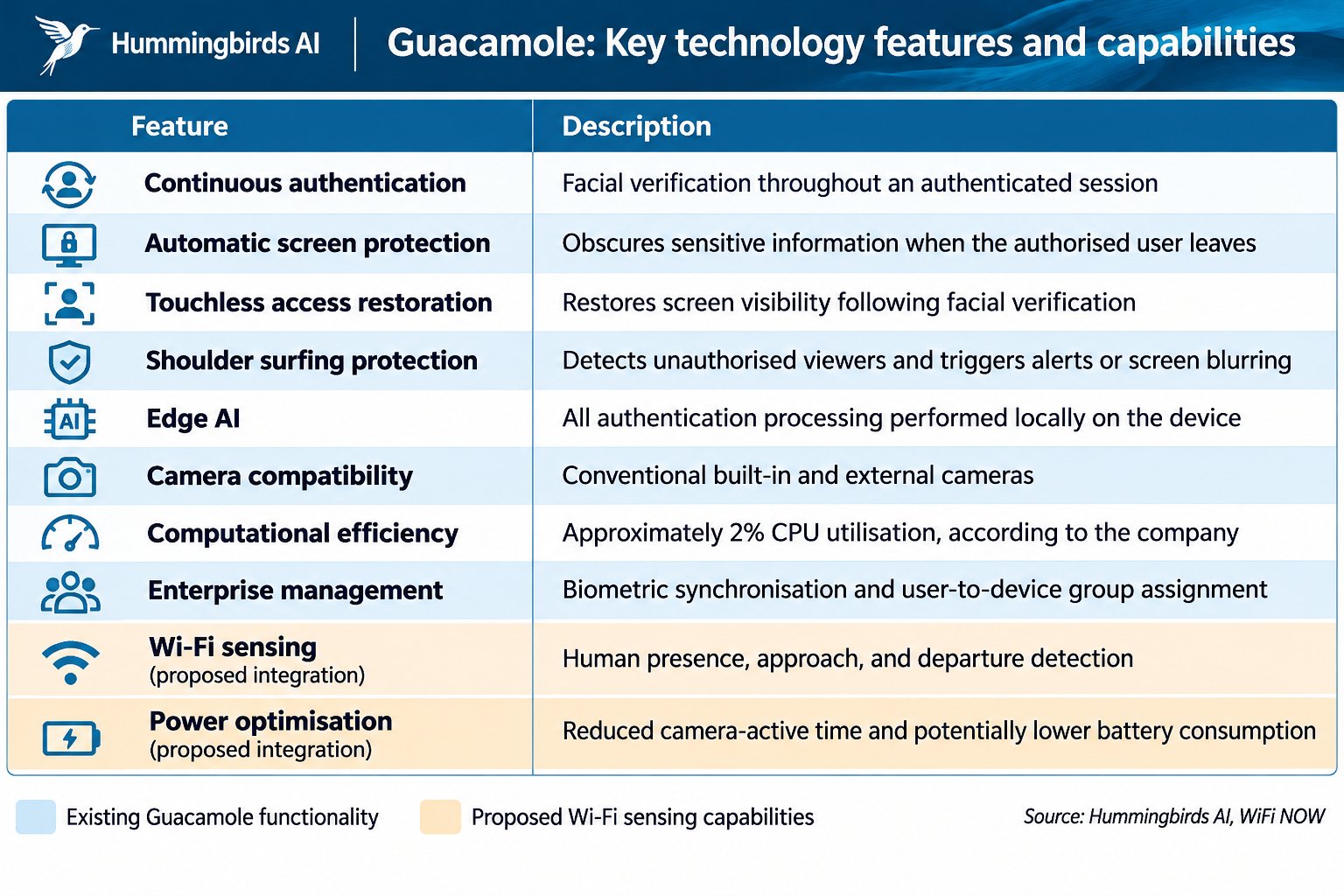
Source: Hummingbirds AI, WiFi NOW Tech Watch interview and accompanying presentation.
First OEM products expected in 2027
Hummingbirds AI is pursuing two routes to market. The first is through PC manufacturers, which would preload Guacamole onto new devices in much the same way that antivirus software is distributed today. The second is a subscription-based enterprise software model targeting existing fleets of computers in hospitals, banks, and other organisations.
Schei says the company is working with major global PC manufacturers on testing and validation and expects the first OEM products incorporating its technology to reach the market in early 2027. The company is also seeking additional PC and chipset partners to participate in its proposed Wi-Fi sensing pilot.
WiFi NOW’s take:
Continuous authentication represents a new and commercially relevant use case for Wi-Fi sensing. Combining RF sensing with computer vision allows each technology to do what it does best: Wi-Fi sensing detects changes in the physical environment, while computer vision establishes identity. The potential market extends well beyond healthcare to virtually any professional environment where confidential information is accessed on a screen. And because the solution is designed to leverage hardware already present in computers, the barriers to adoption could be relatively low.For the Wi-Fi industry, this is another example of how Wi-Fi sensing could evolve into an embedded feature of everyday computing, delivering value independently of its traditional role in connectivity.
Watch our full Tech Watch interview with Hummingbirds AI founder and CEO Dr Nima Schei here.
/Claus.