By Claus Hetting, WiFi NOW CEO & Chairman
Future Wi-Fi 8 (IEEE 802.11bn) – due to be released in early 2028 – comprises dozens of great features intended to improve Wi-Fi reliability and performance across nearly every Wi-Fi use case and segment. But with such a diverse set of features there’s a real risk that the benefits of the upcoming standard may be unclear or too hard to convey to the ecosystem and to end-users. MediaTek now suggests taking a page out of Bluetooth’s playbook to introduce ‘profile’-based groupings of Wi-Fi 8 features together to match specific use cases and end-user devices.
What will the next iteration of Wi-Fi – meaning Wi-Fi 8 – be about? Well – if you watched our recent webinar on the topic, you will know that IEEE 802.11bn (now having reached the Draft 1.0 milestone) is about reliability and that the new standard consists of a long list of features designed to improve the Wi-Fi experience in multiple ways. While some features are arguably more important than others, Wi-Fi 8 will not be about speed. MediaTek now suggests that ‘profiles’ are created to match use cases, similar to how it is done in Bluetooth.

“It is already clear at this point that Wi-Fi 8 will be another excellent standard and a huge step up in reliability and real-life performance. But we believe the industry needs to spend more time on linking the features of 802.11bn to real-world applications. This will help clarify why Wi-Fi 8 is great and necessary upgrade for the end-user. Clearly not all features are relevant for all segments so one way to do that is to create profiles for different segments or verticals,” says James Chen, VP Product & Technology Marketing at MediaTek.
One example is the wearables segment. “Wearables is arguably the most important new category of devices to take off since the smartphone. Wearable use cases are dominated by uplink. So for example: Smart AI glasses send more data more than they receive. Also wearable device themselves – think of either a watch or glasses – are small devices and hence Wi-Fi and other radio components are tightly incorporated into the device,” he says.
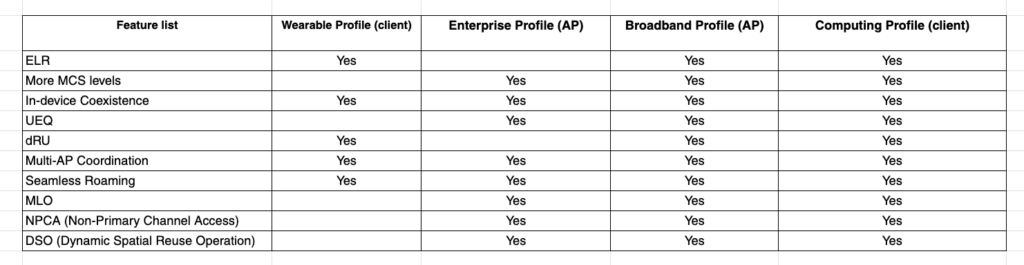
MediaTek suggests the following Wi-Fi 8 features could be part of “wearable” certification profile: ‘ELR’ (Enhanced Long Range) and ‘DRU’ (Distributed Resource Unit) for extended uplink range and speed, and ‘in-device coexistence’ to improve inter-radio co-existence due to the tight placement of Wi-Fi, Bluetooth, ultra-wideband, and potentially 5G inside the wearable device. Finally ‘seamless roaming’ should be included in this profile because wearables will need to roam freely (without re-associations) between APs with reduced latency inside homes and offices.
“Similarly, an enterprise profile could include ‘multi-AP coordination,’ ‘seamless roaming,’ ‘MLO,’ ‘UEQ’ – unequal modulation for more capacity – as well as ‘DSO’ and ‘NPCA’ to allow more clients to be operating at the same time. Other profiles could be for home broadband and computing notebooks,” says James Chen. A Wi-Fi 8 feature versus end device or market segment could for example look as in the table below.
What is the right way to take Wi-Fi 8 to market? Is it time to change the way new Wi-Fi releases are certified? In the coming years there will be plenty of discussion on this topic. Let us know if you agree or disagree or have other ideas by writing to us at [email protected].
/Claus.