By Claus Hetting, WiFi NOW CEO & Chairman
Deutsche Telekom deploys 1,000,000 RDK-B Wi-Fi 7 home gateways
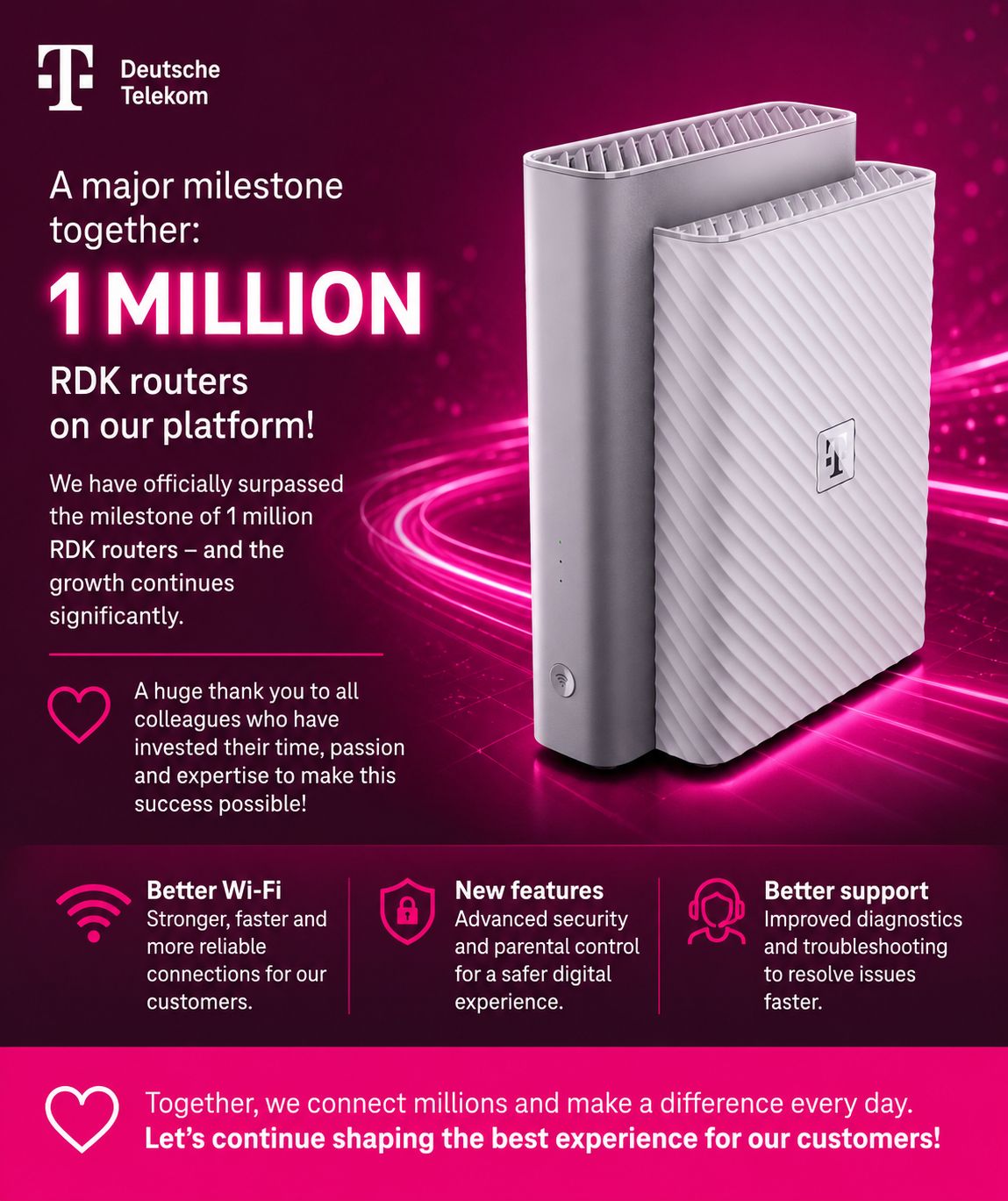 Deutsche Telekom launched its Wi-Fi 7-enabled Speedport 7 RDK-powered router earlier this year and the company now says that deployment has surpassed 1,000,000 gateways. We’re guessing that this is the biggest RDK-based deployment outside the US and likely the biggest by a telco (as opposed to a cableco) anywhere. Earlier this year DT described the project as “our most successful product launch ever” in a conversation with WiFi NOW (read the full story here). DT famously selected RDK-B as their preferred platform for home gateways in October 2021. The results are also a huge win for MediaTek in that DT’s Speedport 7 gateway and extender is powered by MediaTek’s Filogic Wi-Fi 7 platform. The announcement came in this LinkedIn post.
Comcast Xfinity launches same day gateway delivery for Orlando, Florida
Comcast’s Florida Xfinity customers can now get Wi-Fi connectivity on the same-day they sign up by having their new gateway delivered to their doorstep, Comcast says in a news release. Same-day gateway delivery will be available to nearly all new Florida customers across the Xfinity footprint by the end of 2026. The new service means Comcast Xfinity “becomes the first major wired Internet provider to offer same day Wi-Fi connectivity, redefining how quickly customers can get connected and up and running at home,” the company says. One of the reasons for the new service is that Florida is the primary destination for domestic migration within the United States. More than 300,000 people relocated to the state last year, which is nearly 1,000 new residents on average per day, Comcast says.
Bluetooth innovation accelerating, says Qualcomm’s Joel Linsky
Bluetooth is entering one of the most significant periods of innovation in its 25-year history, expanding far beyond audio into AI, gaming, precision location services, digital keys, and advanced device tracking, said Qualcomm VP of Engineering Joel Linsky in our latest TECH WATCH Interview (available here). One of the most important developments is Bluetooth High Data Throughput (HDT), which increases Bluetooth’s peak data rate from 2 Mbps to 7.5 Mbps.
While these numbers may seem modest compared to Wi-Fi, the impact on Bluetooth applications is substantial. The higher throughput enables lossless, high-quality audio, lower latency gaming experiences, better support for AR/VR devices, and increased bandwidth for AI-enabled wearables and smart glasses. Perhaps surprisingly, the higher data rate can also reduce power consumption: By transmitting the same amount of data in less time, devices spend less time actively transmitting, improving battery life for products such as earbuds and headsets, Joel Linsky said.
One of the potentially more controversial recent issues is that Bluetooth will shortly be moving into the 5 GHz and 6 GHz bands, which means Bluetooth signals will need to coexist with Wi-Fi. For now, it is not clear what mechanisms may be incorporated (on either side) to mitigate potential interference issues.
/Claus.