By Claus Hetting, WiFi NOW CEO & Chairman
We can thank the good people at Opensignal for collecting the data that exposes precisely what is going on with broadband and Wi-Fi speeds across the world: The company’s latest report documents how outdated CPEs (and arguably lack of in-home Wi-Fi management as well as spectrum) in many cases deliver only a fraction of what they should, essentially fleecing the consumer. The full report can be found here – and it is an eye-opener.
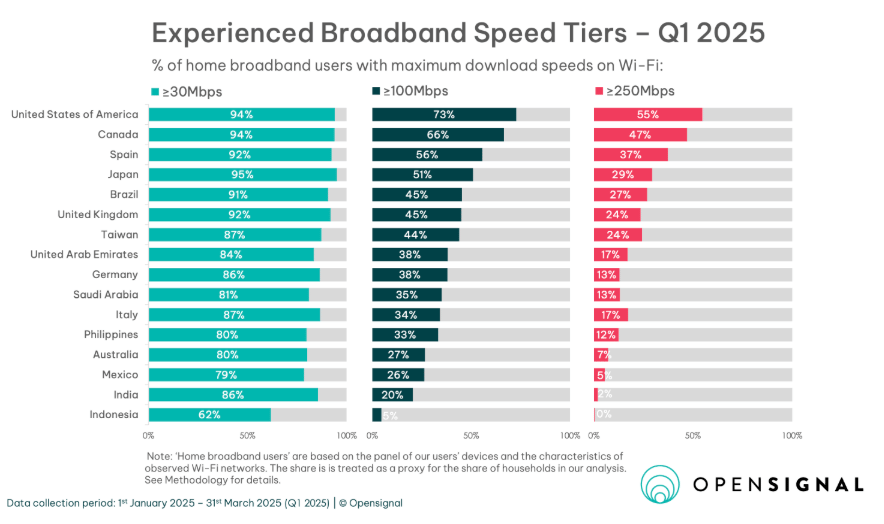
Do home broadband subscribers actually get the bandwidth and Wi-Fi experience that they pay for? Broadly speaking, the answer is a resounding no. A new report from Opensignal documents the (in many cases) massive gap between promised speeds and actual Wi-Fi performance. The chart at the top presents the results in a nutshell: If you don’t pay for more than 30 Mbps into your home, you’re for the most part receiving the full amount. But once you pay for 100 Mbps or 250 Mbps, it starts to look shockingly bad for a lot of markets – even for supposedly affluent countries.
Even in the US you only get (on average) about 55% of your money’s worth if you opt for 250 Mbps connection or more. It may be only mildly surprising that India and Indonesia only get a couple of percent of what they pay for (for 250 Mbps or more) but it is nothing less than stunning that countries such as Australia, Italy, and Germany don’t do much better at 7-17% (at 250 Mbps or more).
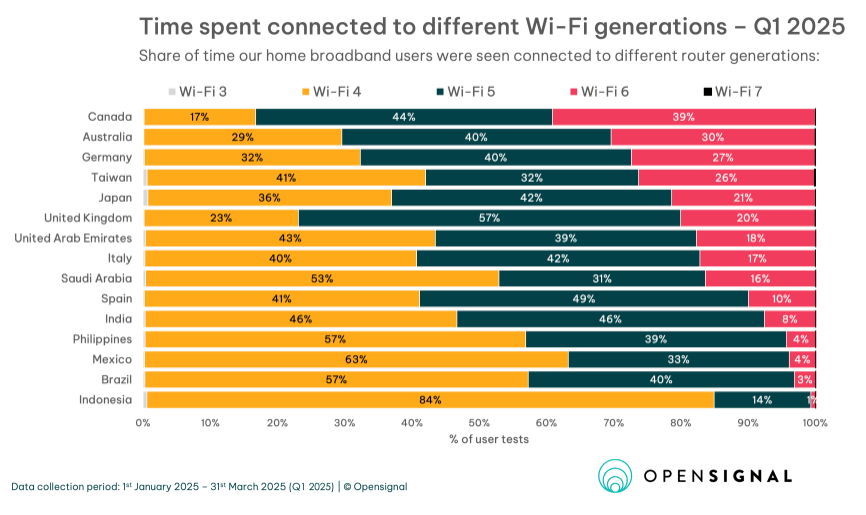
So what on Earth is going on here? Opensignal is correct in concluding that better fixed infrastructure (such as fibre) does not necessarily translate into a better Wi-Fi experience. A lot of the problems arise from the outdated CPE equipment ostensibly delivered by the service provider. In fact, the number of CPEs not even supporting Wi-Fi 5 – a standard that is today more than 10 years old – is another shocker (see below). In many markets (some of them affluent) around half the CPEs don’t support Wi-Fi 5.
Opensignal’s analysis mentions 6 GHz briefly – and lack of CPE support for 6 GHz is clearly an issue – but remote home Wi-Fi management is not mentioned as at least a partial solution to some of the reported shortcomings. Home Wi-Fi management (there are plenty of vendors capable of delivering this) is not a massive capital investment – as opposed to rolling out new CPEs – although of course both should be done. It is incumbent upon broadband service providers to rectify this situation in one way or the other because all the technology to ‘make Wi-Fi great again’ is certainly available and some of it has been around for a very, very long time.
/Claus.