
Artificial intelligence has become the industry’s favourite buzzword. But beyond chatbots and generative AI, one of the most practical applications may be much closer to home: Inside the broadband gateway sitting quietly in your living room.
In the latest edition of Tech Watch, MediaTek VP James Chen explained how the company is applying AI to solve very specific Wi-Fi problems—not by creating another AI assistant, but by making wireless networks faster, more reliable, easier to operate, and significantly more energy efficient. The vision is disarmingly pragmatic. Rather than asking what AI can do, MediaTek is asking what AI should do for broadband operators and Wi-Fi users.
The AI that doesn’t write poetry – and instead improves Wi-Fi
James Chen began by drawing an important distinction: The AI running inside future gateways is not designed to generate images, write emails, or act as a conversational assistant. Instead it is purpose-built machine learning focused entirely on improving Wi-Fi operation. MediaTek divides this into two broad categories:
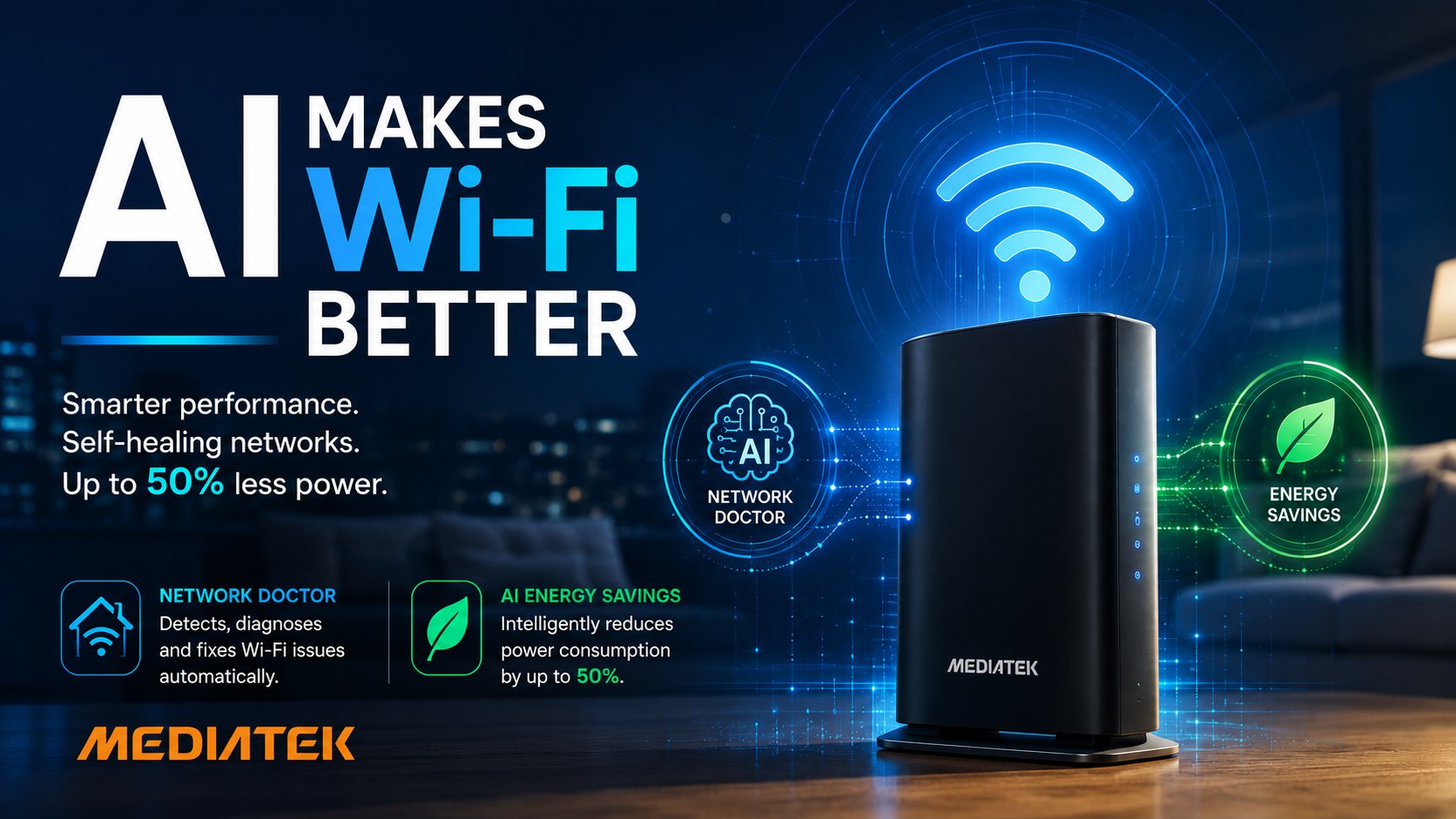
- AI-powered Network Doctor that automatically detects and resolves Wi-Fi issues.
- AI-driven energy management that intelligently reduces gateway power consumption when full performance isn’t required.
Perhaps most interestingly, neither application necessarily requires massive AI hardware. For premium gateways, MediaTek can employ a modest 3 TOPS neural processing unit (NPU), while many mainstream gateways can execute smaller neural-network models directly on the existing CPU without requiring dedicated AI acceleration. That dramatically lowers the cost barrier for operators.
The end of the Wi-Fi support call?
The most compelling demonstration was what MediaTek calls Network Doctor. The idea is simple: Instead of waiting for customers to complain about poor Wi-Fi—or forcing operators to analyse cloud telemetry after the fact—the gateway continuously monitors its own wireless performance in real time. When interference or another problem appears, the gateway:
- Detects the issue.
- Determines the root cause using an AI model trained on previous scenarios.
- Applies the appropriate optimisation automatically.
- Continues monitoring to verify that the problem has actually been solved.
The customer never notices. The operator never receives the support call. The truck never leaves the depot. James Chen describes this as placing “a technician inside your gateway.”
From cloud analytics to edge intelligence
Operators have attempted similar ideas before: Remote management systems such as TR-069 collected operational data and sent it to cloud-based analytics platforms for diagnosis. The concept worked but reaction times were slow, and automated optimisation remained limited. MediaTek believes AI changes that equation. Instead of uploading data to the cloud for later analysis, the gateway performs diagnosis locally, allowing problems to be identified and corrected immediately.
This represents an important shift: Cloud analytics becomes edge intelligence.
Closed-loop automation finally arrives
During the discussion, one particularly interesting question emerged. Would this AI simply report problems to higher-level operator platforms, or could it actually solve them? James Chen’s answer was revealing. MediaTek certainly could expose APIs for third-party management platforms, but the company’s ambition is much greater. Because MediaTek controls the Wi-Fi subsystem itself, it believes the gateway should resolve many wireless problems internally without involving external software platforms.
In other words: Detect → Diagnose → Optimise → Verify, all inside the Wi-Fi stack. This is essentially closed-loop Wi-Fi automation. AI and Wi-Fi 8 are natural partners One obvious question followed: Is this only a Wi-Fi 8 feature? Not exactly.
According to James Chen, these AI techniques are fundamentally standards-independent and can work on older Wi-Fi generations as well. However, newer standards provide many more optimisation “knobs” for AI to manipulate. Features introduced with Wi-Fi 7—including puncturing—and the growing collection of Wi-Fi 8 capabilities such as Multi-AP Coordination provide AI with considerably more flexibility when resolving interference and performance issues.
This is perhaps one of the strongest practical arguments for Wi-Fi 8: The standard is not simply introducing new PHY capabilities. It is creating a much richer control environment where AI can continuously optimise network behaviour.
AI that saves operators money—and electricity
The second demonstration focused on something even more tangible: energy consumption. Today’s broadband gateways typically operate at essentially constant power regardless of traffic. Whether users are streaming 8K video or everyone is asleep, the gateway continues running at full capability.
MediaTek believes this makes little sense. Its AI model continuously monitors network activity and intelligently adjusts radio resources. If traffic falls dramatically, the gateway can reduce active radio chains – for example, operating as a 1×1 system rather than 4×4 – while still maintaining connectivity. When demand increases again, full capability is restored automatically. The result? Potential Wi-Fi energy savings approaching 50%.
AI learns your home
Of course, simply turning antennas off is not enough. A smaller radio configuration also reduces coverage – which is where machine learning becomes valuable. Rather than blindly reducing power, the gateway learns where client devices are typically located inside the home and adapts accordingly. For example: A small apartment may comfortably operate at reduced radio capability during quiet periods while a large house with distant devices may require maintaining additional spatial streams. The optimisation therefore becomes personalised rather than static.
What about Agentic AI?
Interestingly, MediaTek has not abandoned its more ambitious AI gateway roadmap. James Chen confirmed that the company continues developing high-performance gateways featuring AI processors in the 50 TOPS range for future agentic AI applications. The challenge, however, is economic rather than technical. Broadband operators remain highly sensitive to gateway costs, and it remains unclear whether subscribers are willing to pay enough to justify the additional hardware. Until that business model becomes clearer, MediaTek sees greater near-term opportunity in practical AI solutions that require either very small NPUs—or none at all.
WiFi NOW: Our Take
For several years, the broadband industry has discussed AI in increasingly abstract terms. MediaTek’s approach is refreshing because it focuses on immediate operational benefits rather than futuristic concepts. Automatic fault diagnosis, self-healing Wi-Fi, and intelligent power management directly address two of every operator’s biggest challenges: reducing operating costs and improving customer experience.
Perhaps even more importantly, these capabilities highlight how AI and Wi-Fi 8 complement each other. Features such as Multi-AP Coordination and richer radio control mechanisms become far more valuable when intelligent software can optimise them continuously in real time. The industry has long promised autonomous Wi-Fi networks. With practical edge AI now becoming feasible on mainstream gateway hardware, that vision finally appears to be moving from conference presentations into real products.
/Claus.