
By Claus Hetting, WiFi NOW CEO & Chairman
The next major expansion of Bluetooth may not involve faster data rates, better audio, or more precise positioning. Instead, it could involve connecting billions of everyday objects that have never been connected before – without requiring conventional batteries.
This is the promise of Ambient IoT, an emerging category of wireless devices powered by energy harvested from their surroundings. Rather than relying on batteries that eventually need replacing, Ambient IoT devices can obtain energy from radio waves, light, heat, motion, or other environmental sources.
For Bluetooth, Ambient IoT represents an opportunity to expand beyond conventional wireless peripherals, wearables, and sensors into markets requiring extremely low-cost, miniature connected devices. The Bluetooth Special Interest Group (SIG) has identified Ambient IoT as an important development area, highlighting the role that Bluetooth Low Energy (LE) already plays in energy-harvesting applications and the potential for further ecosystem development.
But the commercial opportunity also raises important questions: How does battery-free wireless connectivity work? How does it compare with established RFID technology? And what will it take for Bluetooth Ambient IoT to achieve mass-market adoption?
1. What is Ambient IoT?
Ambient IoT refers to a class of connected devices designed to operate using extremely small amounts of energy, typically obtained from the surrounding environment. The concept addresses one of the fundamental limitations of conventional IoT: The cost and complexity of powering large populations of connected devices.
Consider a logistics company that wants to monitor millions of individual packages, or a retailer that wants to connect every product on its shelves. Even when conventional wireless sensors are inexpensive, equipping each device with a battery creates additional costs associated with manufacturing, installation, maintenance, and eventual disposal.
Ambient IoT seeks to remove or significantly reduce this dependency. An Ambient IoT device may consist of a miniature semiconductor chip, an antenna, an energy-harvesting circuit, and potentially one or more sensors. Depending on its architecture, the device may operate entirely without a battery or use a small energy-storage component to support intermittent operation.
The International Telecommunication Union (ITU) identifies battery-free operation, miniature form factors, and reduced maintenance as important characteristics of Ambient IoT systems. However, battery-free does not mean energy-free. Every device must obtain sufficient energy to perform its intended functions.
Energy harvesting: Where does the power come from?
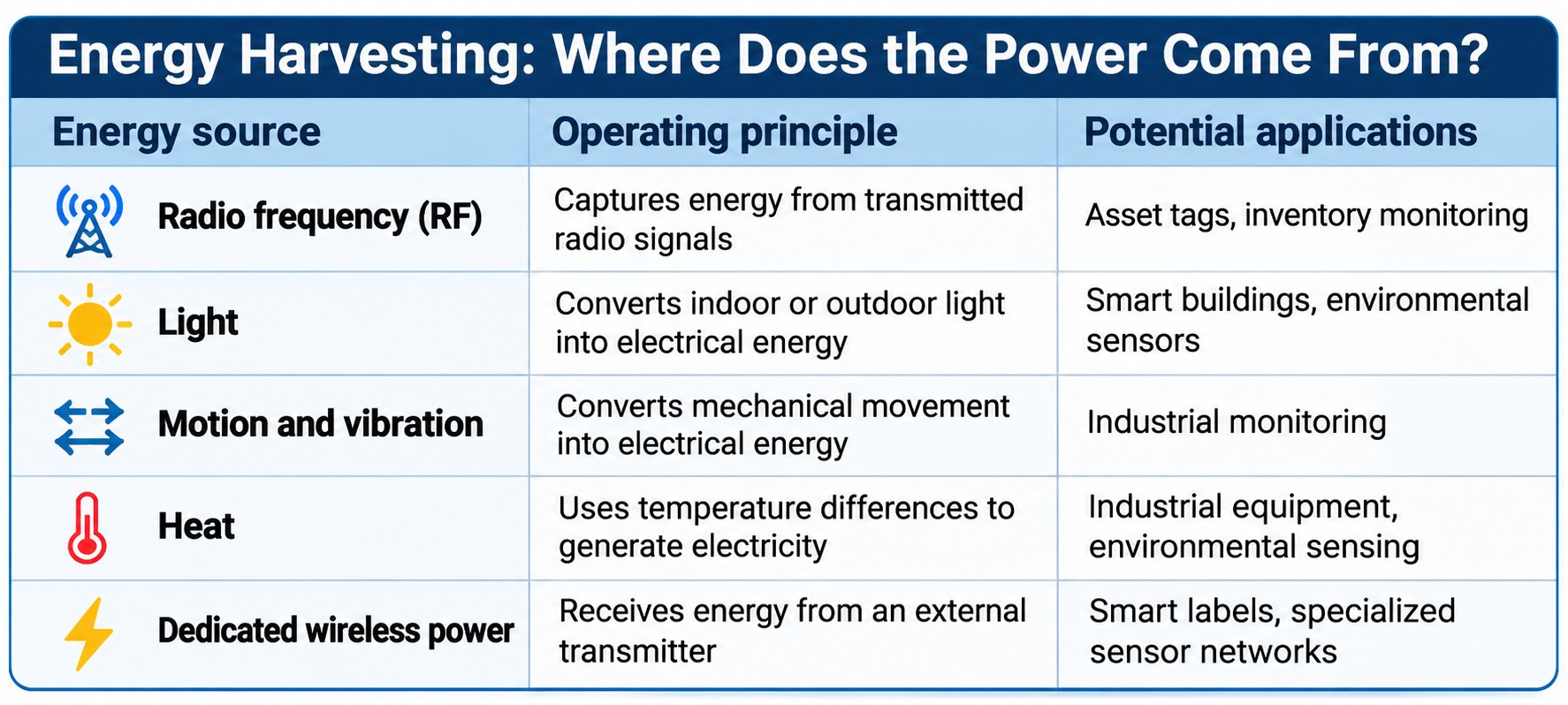
The energy available from these sources can be extremely limited and variable. Consequently, Ambient IoT devices must minimise their energy consumption and often operate intermittently rather than maintaining continuous wireless connections.
2. How does Bluetooth Ambient IoT work?
Bluetooth LE was originally designed to support wireless connectivity with significantly lower energy consumption than Bluetooth Classic. Its architecture allows devices to communicate using short data exchanges and spend much of their operating time in low-power states. These characteristics make Bluetooth LE attractive for energy-harvesting applications, particularly where devices need to transmit relatively small amounts of information. However, there are important differences between conventional Bluetooth LE devices and the broader vision of Ambient IoT.
Active radio transmission versus backscatter
Conventional Bluetooth LE devices generally use active radio transmitters. Even when transmitting only a small amount of data, the device must generate and transmit its own radio signal. An alternative approach is backscatter communication.
Rather than generating a new radio signal using a conventional transmitter, a backscatter device modifies and reflects an existing radio signal. By changing the electrical characteristics of its antenna, the device can encode information into the reflected signal. This can substantially reduce the energy required for communication.
Backscatter is already fundamental to passive RFID technology and is being investigated for emerging Ambient IoT architectures. It is important, however, not to assume that all Bluetooth Ambient IoT implementations use backscatter or that conventional Bluetooth LE receivers automatically support every backscatter scheme.
Comparing conventional Bluetooth LE with Ambient IoT
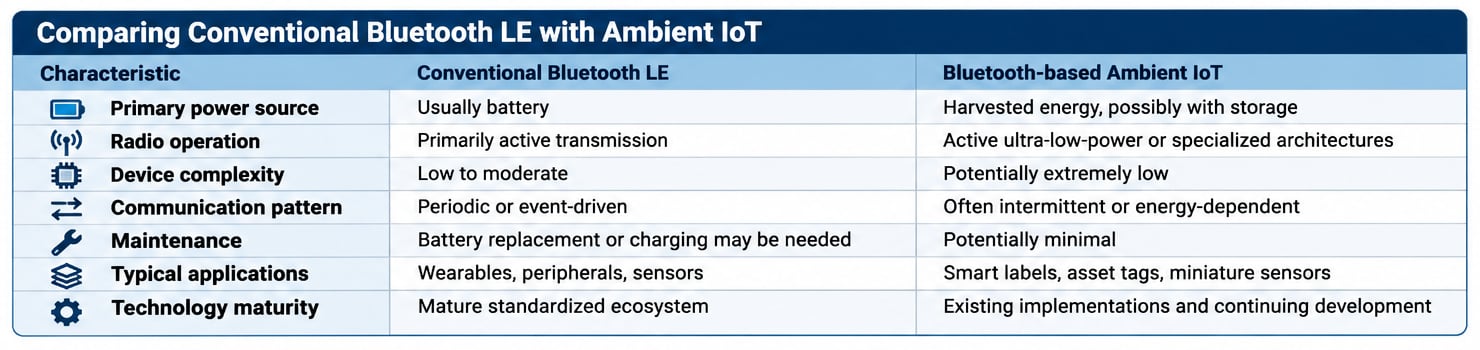
The distinction is not absolute. Bluetooth LE devices powered by harvested energy already exist, and some Ambient IoT devices use conventional active radio communication. The broader objective is to develop wireless systems that operate reliably within extremely constrained energy budgets.
The importance of infrastructure
An Ambient IoT system typically requires more than a miniature connected device. Depending on the implementation, the system may include energy sources, readers, gateways, and software platforms responsible for collecting and processing information. For example, a warehouse might deploy wireless infrastructure that communicates with thousands of miniature tags attached to individual packages.
Those tags could periodically report their identity or sensor information, while a centralised platform aggregates the data to provide inventory visibility.
The potential attraction of Bluetooth is its established ecosystem of radios, gateways, development tools, and software. However, the extent to which existing infrastructure can support a particular Ambient IoT implementation depends on the underlying radio architecture and interoperability requirements.
3. Bluetooth Ambient IoT versus RFID, Wi-Fi, and cellular IoT
One of the most important questions surrounding Ambient IoT is whether it can provide meaningful advantages over technologies that already address low-cost identification and tracking. Passive UHF RFID is particularly relevant. RFID technology has been commercially deployed for decades and is widely used in retail, logistics, manufacturing, and supply chain management.
Passive RFID tags operate without batteries by harvesting energy from the radio signals transmitted by RFID readers. This allows tags to be manufactured at very low cost and deployed in enormous quantities. Bluetooth Ambient IoT must therefore compete against an established technology with substantial commercial scale.
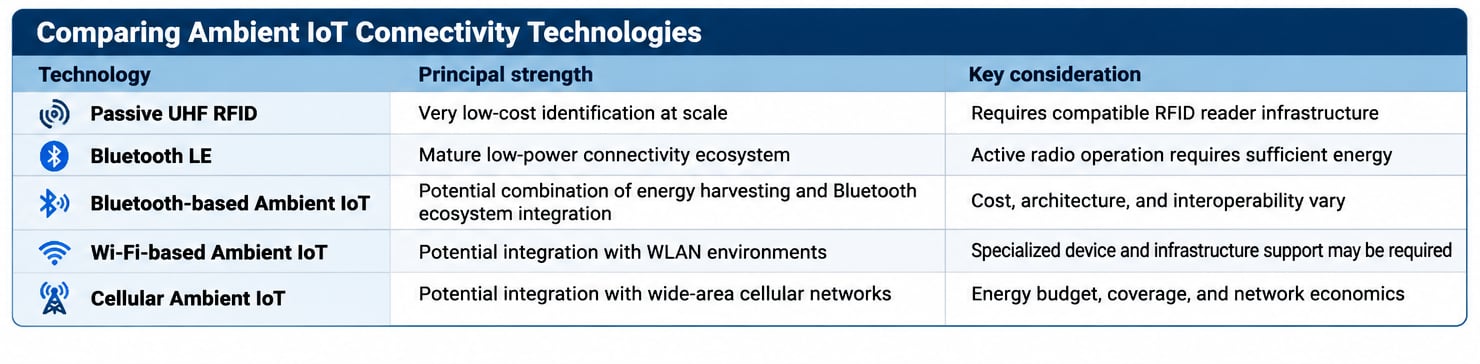
Ambient IoT is not exclusive to Bluetooth. Standardization and research activities also involve cellular technologies, WLAN-based approaches, and other low-power radio architectures.
Can Bluetooth compete with RFID?
Bluetooth has several potential advantages, particularly in environments where Bluetooth connectivity is already widely deployed. These include access to an established semiconductor ecosystem, integration with connected devices, and the possibility of combining identification with sensing and application-level services. However, RFID has significant advantages of its own.
Passive RFID tags can be exceptionally inexpensive, and RFID systems are already optimized for large-scale inventory operations. For applications requiring only identification, RFID may remain the most economical solution. Bluetooth-based Ambient IoT could become more attractive where applications require additional sensing capabilities, integration with existing Bluetooth systems, or other functionality that justifies the cost of the device and supporting infrastructure. The commercial outcome will depend on total system economics rather than radio technology alone.
4. Five commercial markets for Bluetooth Ambient IoT
The potential market for Ambient IoT extends across industries where large numbers of objects need to be identified, monitored, or connected.
Retail and inventory management
Retail is among the most promising markets. Retailers already use RFID and electronic shelf labels to improve inventory accuracy and operational efficiency. Ambient IoT could extend connectivity to individual products, packaging, and other objects that would be uneconomical to equip with conventional battery-powered sensors. Potential applications include product identification, inventory visibility, shelf monitoring, and environmental sensing. For example, a connected product label might provide not only identification information but also temperature-related data, assuming sufficient harvested energy and appropriate sensor integration.
Supply chains and logistics
Logistics companies manage enormous numbers of packages, pallets, containers, and other assets. Conventional tracking systems frequently rely on scanning at specific locations or attaching battery-powered devices to higher-value assets. Ambient IoT could enable more granular tracking by reducing the cost and maintenance requirements of connected tags. Potential applications include package identification, movement detection, environmental monitoring, and automated inventory management. The commercial value would come from improved visibility and reduced manual handling, rather than connectivity for its own sake.
Industrial IoT
Industrial environments contain large populations of machines, components, tools, and other assets that could benefit from wireless identification or monitoring. Battery-free sensors could reduce maintenance requirements in locations where replacing batteries is difficult or expensive. Applications might include equipment identification, environmental monitoring, vibration-related sensing, and condition monitoring. However, industrial environments also present significant technical challenges, including metal surfaces, interference, limited energy availability, and demanding reliability requirements.
Healthcare
Hospitals and healthcare facilities need to manage medical equipment, supplies, and other assets across complex indoor environments. Ambient IoT could potentially support low-maintenance identification and monitoring of these objects. Examples include equipment inventory, medical supply tracking, and environmental monitoring. Healthcare applications would require particular attention to reliability, privacy, security, and integration with existing operational systems.
Smart buildings
Modern commercial buildings increasingly use wireless sensors to monitor temperature, humidity, occupancy, and other environmental conditions. Replacing or recharging batteries across thousands of devices can create substantial maintenance costs. Energy-harvesting Bluetooth sensors could reduce these requirements, particularly where indoor light or other suitable energy sources are available. Ambient IoT may therefore complement conventional Bluetooth LE, Wi-Fi, and other building connectivity technologies rather than replacing them.
5. The emerging Bluetooth Ambient IoT ecosystem
Bluetooth’s potential role in Ambient IoT rests partly on the size and maturity of its existing ecosystem. Bluetooth LE is supported by a broad range of semiconductor manufacturers, device developers, operating systems, and infrastructure providers. This ecosystem could help accelerate the development of energy-harvesting devices and applications.
The Bluetooth SIG has highlighted Ambient IoT as an important opportunity and has published research examining the role of Bluetooth LE in enabling this emerging device category. In particular, a research note commissioned from ABI Research identifies Bluetooth LE as an important existing technology for Ambient IoT applications while examining further work required to support the market’s development.
Standardization remains important
There is a distinction between energy-harvesting products that already use Bluetooth LE and potential future Bluetooth features designed specifically for more constrained Ambient IoT architectures. The former can use existing standardized Bluetooth functionality. The latter may require additional technical development, particularly for specialized communication mechanisms, ultra-low-complexity devices, and infrastructure interoperability.
As of November 2026, Bluetooth Ambient IoT should therefore be understood as a developing technology category rather than a single, universally implemented device architecture. This distinction matters for equipment manufacturers and enterprises evaluating potential deployments. A product marketed as Bluetooth Ambient IoT should be assessed according to the Bluetooth specifications it actually supports, its power architecture, and its compatibility with existing infrastructure.
6. What are the barriers to mass-market adoption?
Although Ambient IoT offers considerable potential, several challenges must be addressed before the technology can scale across mass-market applications.
Reliable energy availability
Harvested energy is not necessarily available continuously. Indoor lighting conditions change, RF energy varies with distance and environmental conditions, and mechanical or thermal energy sources may be intermittent. Devices must therefore be designed around realistic energy budgets. A device that works reliably in a laboratory may perform differently when deployed in a warehouse, factory, or retail environment.
Device and infrastructure economics
Eliminating a battery does not automatically make a device inexpensive. Energy-harvesting circuits, antennas, sensors, semiconductor components, packaging, and manufacturing processes all contribute to cost. Infrastructure requirements are equally important. A system requiring dense deployment of specialized readers or wireless power transmitters may be economically unattractive even when individual tags are inexpensive.
Communication range and scalability
Ambient IoT devices typically operate under strict power constraints. These constraints can affect communication range, transmission frequency, data rates, and reliability. Large deployments also introduce challenges related to device discovery, simultaneous transmissions, interference, and network management. Systems designed to support thousands or millions of objects must address these issues without significantly increasing device complexity.
Security and privacy
Extremely constrained devices may have limited processing capability and energy available for cryptographic operations. Nevertheless, commercial applications may require authentication, data integrity, privacy protection, and secure device management. These requirements become particularly important in healthcare, logistics, and industrial environments. Security cannot simply be eliminated to reduce power consumption.
Competition from established technologies
Ambient IoT will not enter an empty market. RFID, NFC, conventional Bluetooth LE, and other wireless technologies already serve many of the applications being considered. Bluetooth Ambient IoT must therefore offer measurable improvements in functionality, operating cost, integration, or deployment flexibility.
7. Outlook: Can Bluetooth connect billions of battery-free devices?
Ambient IoT represents an important potential expansion of the wireless connectivity market. The opportunity is not simply to replace batteries in existing IoT devices. It is to make connectivity economically viable for objects that have traditionally remained unconnected. Individual products, packaging, tools, industrial components, and building materials could potentially become sources of digital information.
For Bluetooth, this could represent an expansion from connecting personal electronics and conventional sensors toward enabling connectivity across much larger populations of physical objects. However, the path to commercial scale will depend on several factors.
Energy harvesting must become sufficiently reliable for practical applications. Device costs must be competitive with existing identification technologies. Infrastructure must support economical deployment, and interoperability must allow products from different manufacturers to operate within common ecosystems. The development of appropriate standards will also be essential.
Research published in 2026 identifies energy harvesting, backscatter communication, scalable network architectures, and lightweight security among the important technical areas shaping Ambient IoT development. Bluetooth LE already provides an established foundation for low-power connectivity, and energy-harvesting Bluetooth applications demonstrate that battery-free operation is technically achievable.
The next challenge is to translate these capabilities into interoperable, affordable, and commercially scalable solutions. Ultimately, the success of Bluetooth Ambient IoT will not be measured by how many devices can operate without batteries, but by how many previously unconnected objects can be connected at a commercially viable cost. That could become one of the most significant long-term opportunities for the Bluetooth ecosystem.
Sources and further reading:
Bluetooth SIG – Official website
Bluetooth SIG – Ambient IoT
Bluetooth SIG – The role of Bluetooth technology in Ambient IoT
ABI Research – The Ambient IoT: The emergence of a new class of Bluetooth IoT devices
International Telecommunication Union
IEEE Communications Surveys & Tutorials – A Survey on Ambient IoT (2026)
/Claus.