Bluetooth Technology Guide Part 5 | TECHNOLOGY GUIDES
Bluetooth wireless audio is entering a new era: For decades, Bluetooth has been synonymous with wireless headphones, earbuds, speakers, and hands-free communication. But a new generation of Bluetooth audio technology is expanding the possibilities far beyond conventional point-to-point connections.
At the centre of this transformation are two innovations: Bluetooth LE Audio – a new audio architecture based on Bluetooth Low Energy – and Auracast broadcast audio, which enables a single audio source to transmit to multiple compatible receivers simultaneously.
Together, these technologies promise improvements in audio efficiency, flexibility, accessibility, and scalability. They also create opportunities for Bluetooth to become part of the audio infrastructure of airports, conference centres, cinemas, sports venues, public transport systems, and other shared environments.
1. Why Bluetooth needed a new audio architecture
Traditional Bluetooth audio has largely relied on Bluetooth Classic, also known as Bluetooth Basic Rate/Enhanced Data Rate (BR/EDR). This architecture has supported billions of wireless audio products, including headphones, speakers, and automotive hands-free systems. Bluetooth Classic audio uses profiles such as the Advanced Audio Distribution Profile (A2DP) for stereo audio streaming and the Hands-Free Profile (HFP) for voice communications.
Although enormously successful, this architecture has limitations. Audio connections are generally organised around individual devices or paired relationships, while supporting multiple independently synchronised receivers can require proprietary implementations. Power consumption, latency, audio quality, and device interoperability also involve tradeoffs that depend on the implementation.
Bluetooth LE Audio introduces a fundamentally different approach. Rather than extending the existing Bluetooth Classic audio architecture, LE Audio uses Bluetooth Low Energy as its transport foundation, together with new audio profiles, protocols, and capabilities. The result is an architecture designed to support a broader range of audio applications, from conventional wireless earbuds to hearing aids and broadcast audio systems. Importantly, LE Audio does not automatically replace Bluetooth Classic audio. Both technologies continue to coexist, and many products support both.
2. Understanding Bluetooth LE Audio
Bluetooth LE Audio was introduced as part of the Bluetooth 5.2 generation, with the associated audio specifications subsequently completed by the Bluetooth Special Interest Group (SIG). Its principal innovations include the LC3 codec, isochronous communication, multi-stream audio, and broadcast audio.
The LC3 codec
The Low Complexity Communication Codec (LC3) is one of the foundations of LE Audio. LC3 was designed to deliver good perceived audio quality at relatively low bitrates, making it possible to improve audio efficiency compared with the traditional SBC codec used in Bluetooth Classic audio.
For manufacturers, the benefits may include reduced radio airtime, lower power consumption, or improved audio quality within a given bitrate budget. These benefits depend on device design, codec configuration, and operating conditions. LC3 does not guarantee that every LE Audio product will outperform every Bluetooth Classic audio product. Nevertheless, it provides a more efficient foundation for a new generation of wireless audio devices.
Isochronous communication
One of the most important architectural changes is the introduction of isochronous communication. Traditional Bluetooth LE was originally designed primarily for relatively small and intermittent data exchanges, such as sensor readings, control commands, and device status updates.
Audio requires something different: A continuous sequence of data packets delivered according to predictable timing requirements. Bluetooth LE Isochronous Channels provide mechanisms for transporting time-sensitive data with defined timing relationships. The architecture supports two principal operating modes:
- Connected Isochronous Streams (CIS): Used for time-synchronised audio communication between connected devices.
- Broadcast Isochronous Streams (BIS): Used to distribute synchronised audio from a broadcaster to receivers without establishing individual connections.
Multiple streams can be organised into Connected Isochronous Groups (CIGs) or Broadcast Isochronous Groups (BIGs). This architecture provides the technical foundation for multi-stream audio and Auracast broadcasting.
Multi-stream audio
LE Audio supports multiple synchronised audio streams between a source and compatible receiving devices. For example, a smartphone can deliver coordinated left and right audio streams to two separate earbuds. This offers manufacturers greater flexibility in designing wireless earbuds and other multi-device audio systems. The same underlying architecture also supports more advanced applications involving multiple audio channels, independent receivers, and synchronised playback.
3. What is Auracast broadcast audio?
Auracast is a Bluetooth SIG-branded broadcast audio capability built on LE Audio. Its defining characteristic is simple: One Bluetooth audio transmitter can broadcast audio to multiple compatible receivers simultaneously without establishing a separate connection to each receiver. This represents a significant departure from conventional Bluetooth audio pairing.
In a traditional wireless headphone scenario, a smartphone or another audio source establishes a connection with a particular headset. With Auracast, a transmitter broadcasts audio that compatible devices within coverage can discover and receive. A broadcaster does not need to maintain a separate audio connection for every listener. In principle, there is no protocol-defined limit on the number of passive receivers listening to the same broadcast. In practice, coverage, radio conditions, receiver compatibility, and deployment design determine the user experience.
How Auracast works
An Auracast system typically includes three functional elements:
Auracast transmitter: A transmitter converts an audio source into a BLE Audio broadcast. The source can be a television, public address system, conference mic, computer, or dedicated audio distribution platform.
Auracast receiver: A compatible receiver captures and decodes the broadcast audio. Receivers may include headphones, earbuds, hearing aids, speakers, or other audio-capable devices.
Broadcast assistant: A broadcast assistant helps users discover and select available audio broadcasts. For example, a smartphone may provide an interface for selecting an Auracast broadcast and instructing compatible earbuds to receive it. The assistant is not necessarily the device carrying the audio stream. Auracast broadcasts can be publicly accessible or protected using a broadcast code. This enables both open audio distribution and controlled listening experiences.
A new model for audio distribution
Consider an airport departure lounge with several television screens displaying different programmes. Rather than playing audio through loudspeakers, each television could be associated with an Auracast transmitter. Passengers using compatible headphones or hearing aids could select the audio corresponding to the screen they want to watch. The same principle applies to conference presentations, museum exhibits, sports broadcasts, and multilingual audio services. The important distinction is that the broadcaster transmits the audio once, regardless of how many compatible listeners receive it.
4. Bluetooth Classic vs LE Audio vs Auracast
The three technologies serve related but different purposes.
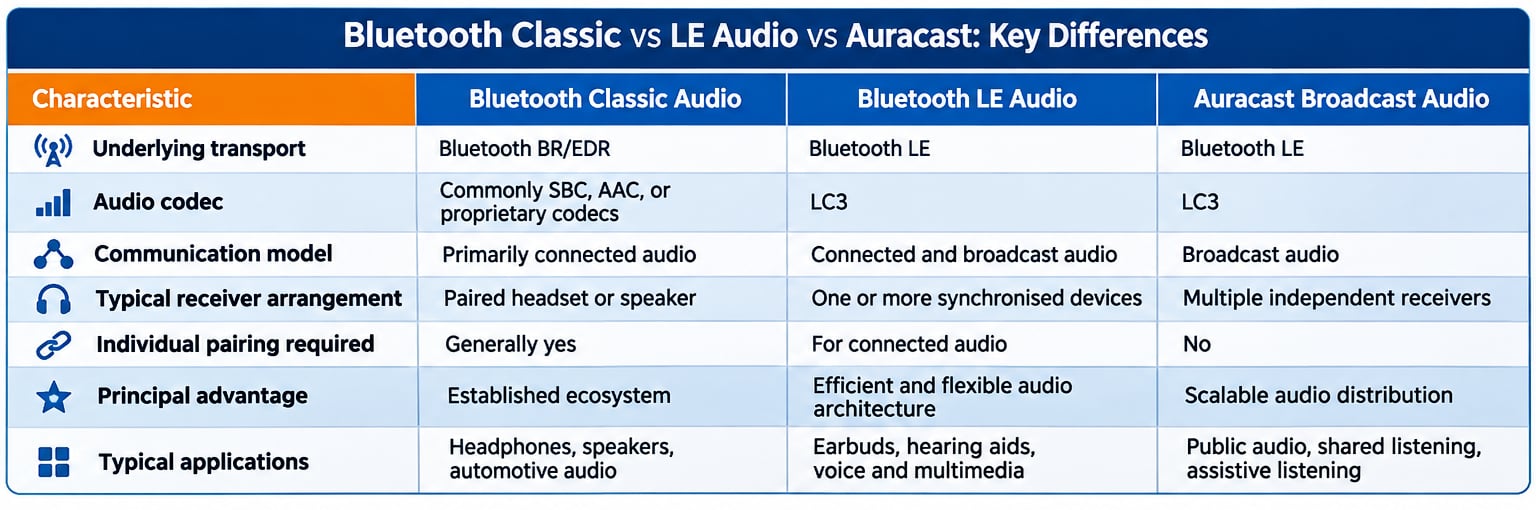
LE Audio creates opportunities for semiconductor vendors, audio device manufacturers, and consumer electronics companies to develop more efficient and flexible products. Auracast extends the opportunity into infrastructure, venue systems, accessibility solutions, and audio distribution services.
5. The accessibility revolution
One of the most important potential applications of Auracast is assistive listening. Millions of people rely on hearing aids, cochlear implants, and other hearing assistance devices to understand speech in challenging acoustic environments. Public spaces can be particularly difficult because of background noise, reverberation, and the distance between speakers and listeners.
Traditional assistive listening technologies include induction hearing loops, infrared audio systems, and radio-frequency systems. These solutions can work well, but they may require dedicated infrastructure, specialised receivers, or specific hearing-aid capabilities. Auracast introduces another option.
A venue equipped with Auracast transmitters can make audio available directly to compatible hearing aids, earbuds, and other receivers. For example, a conference venue could broadcast a speaker’s microphone audio directly to audience members using compatible hearing devices. This may improve speech intelligibility by providing a direct audio feed rather than relying entirely on sound travelling through the room.
Could Auracast replace hearing loops?
Auracast has the potential to complement and, in some deployments, replace existing assistive listening systems. However, replacement is not automatic. Induction hearing loops are widely deployed and supported by many hearing aids equipped with telecoils. They also form part of established accessibility practices and requirements in various markets.
Auracast adoption depends on the availability of compatible hearing devices, receiver accessibility, reliable broadcast discovery, and appropriate venue infrastructure. There are also practical questions concerning visitors who do not own Auracast-compatible devices. Venue operators may need to provide loan receivers or maintain existing assistive listening systems during a transition period.
The longer-term opportunity is substantial: Auracast could help make assistive listening a standard capability of public audio infrastructure rather than a separate, specialised service.
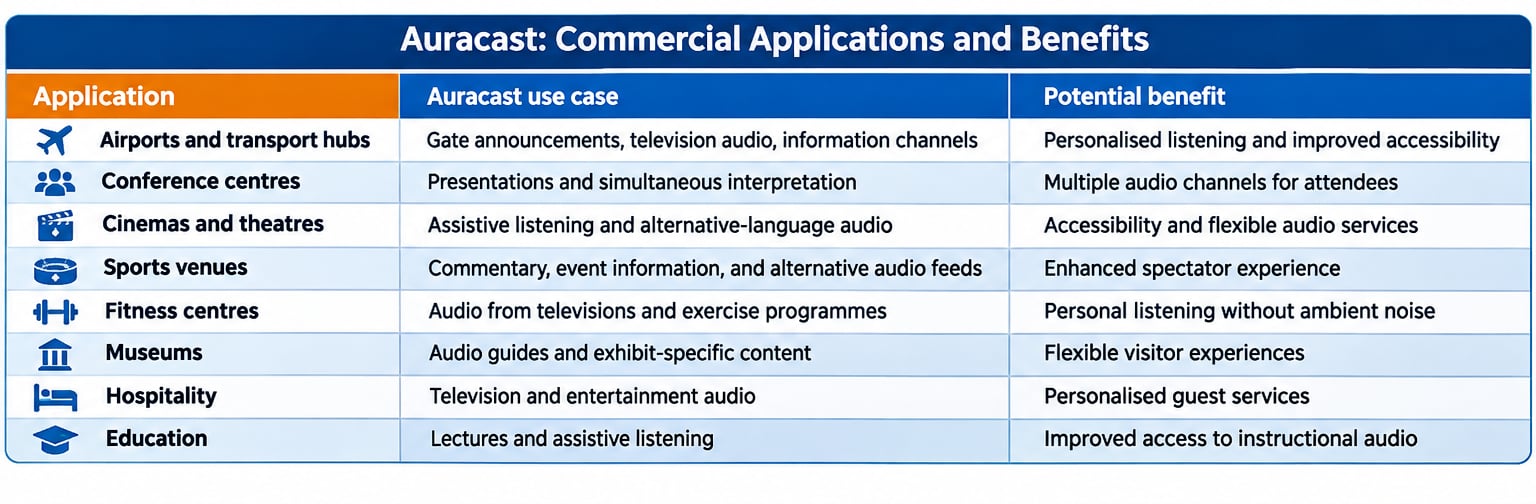
6. Commercial applications: From airports to sports venues
The commercial potential of Auracast extends across several industries.
Conferences and multilingual events
Conference venues represent a particularly interesting opportunity. International conferences frequently require simultaneous interpretation into multiple languages. Traditionally, these systems use dedicated infrared or RF receivers, which must be distributed, maintained, collected, and sometimes sanitised.
An Auracast-enabled venue could broadcast separate language channels that attendees select using compatible personal devices. This could reduce dependence on dedicated receivers over time. However, conference deployments also introduce requirements for coverage, reliable channel selection, coexistence with other wireless systems, and manageable audio latency. For professional event applications, these factors must be tested carefully before Auracast can replace established interpretation systems.
Airports and public transport
Transport environments offer another opportunity: Auracast could provide audio associated with specific information displays, waiting areas, or public announcements. Passengers could listen privately through compatible devices without requiring the entire space to be filled with loudspeaker audio. However, safety-critical public announcements require particular attention. Auracast should not be assumed to replace mandatory public address systems, especially where emergency notification, universal accessibility, or regulatory requirements apply. Instead, it may initially serve as a supplementary audio distribution channel.
Sports and entertainment
Stadiums and arenas could potentially offer multiple audio experiences. Spectators might choose between live commentary, alternative-language coverage, or specialised event information. Similarly, museums and visitor attractions could offer location-specific audio experiences through personal devices. Such applications may eventually support new premium services or more personalised visitor experiences, although the underlying business models remain to be proven.
7. Deployment challenges: Why Auracast is not simply plug-and-play
Although the broadcast concept is straightforward, large-scale commercial deployment introduces technical and operational challenges.
Coverage and radio planning
Auracast operates in the 2.4 GHz ISM band used by Bluetooth and several other wireless technologies, including Wi-Fi. Transmitters must be positioned and configured to provide adequate coverage while managing interference and coexistence. Large venues may require multiple transmitters, careful coverage planning, and consideration of how users move between broadcast areas. Unlike conventional connected audio, broadcast reception does not rely on individual acknowledgements and retransmissions from each listener. This makes the radio environment particularly important.
Device compatibility
Not every Bluetooth 5.2 or newer device will support LE Audio or Auracast. Bluetooth version numbers alone will not guarantee support for the necessary audio profiles, broadcast capabilities, or user interfaces. Manufacturers must implement features, and products must provide a practical way for users to discover and select broadcasts. For operators, the installed base of compatible receivers will be a key consideration.
Audio latency and synchronisation
Audio delay matters in applications where listeners can simultaneously hear sound from loudspeakers or observe the original audio source. Excessive latency can produce distracting echoes or noticeable lip-sync problems. LE Audio provides mechanisms for synchronised audio delivery, but overall latency depends on the complete implementation, including encoding, buffering, transport, and decoding. Professional audio applications must evaluate end-to-end performance rather than relying solely on Bluetooth specification capabilities.
Security and privacy
Auracast supports both open and encrypted broadcasts. Open broadcasts are useful for public information and accessibility services, while encrypted broadcasts can restrict access to authorised listeners who possess the required broadcast code. However, broadcast encryption is not equivalent to individual user authentication or digital rights management. Commercial deployments involving paid content, confidential meetings, or restricted audio may require additional access-control procedures.
Operational integration
Venue operators must also consider how Auracast integrates with existing audio systems. Questions include how broadcasts are named, how users discover them, how multiple channels are managed, and how technical staff monitor system performance. The commercial opportunity therefore extends beyond Bluetooth transmitters and receivers to include audio management software, services, integration, and support.
8. The emerging Bluetooth audio ecosystem
The development of LE Audio and Auracast creates opportunities across multiple segments of the wireless industry. Semiconductor vendors provide the Bluetooth controllers, radio platforms, and audio processing capabilities required for compatible products.
Consumer electronics manufacturers integrate these capabilities into headphones, earbuds, smartphones, televisions, and speakers. Hearing-aid manufacturers are particularly important because accessibility is one of the most compelling Auracast applications. Professional audio manufacturers and systems integrators represent another essential part of the ecosystem.
Their role is to bring Auracast into venues, public address systems, conference installations, and other commercial environments. Relevant industry participants include Qualcomm, Nordic Semiconductor, Silicon Labs, NXP Semiconductors, Infineon Technologies, Sennheiser, GN, Sonova, and WS Audiology.
These companies participate in different parts of the broader Bluetooth, audio, and hearing technology markets. Their inclusion does not imply that every product or platform they offer will support Auracast. The Bluetooth SIG plays the central role in defining the specifications, qualification requirements, and ecosystem framework.
For commercial customers, interoperability and product availability will be essential. Auracast’s long-term success depends on whether devices from different manufacturers can deliver a consistent and accessible listening experience in real-world environments.
9. Commercial outlook: Can Bluetooth become public audio infrastructure?
LE Audio is an important evolution of Bluetooth technology because it provides a more flexible foundation for wireless audio. Auracast could be even more significant because it changes the distribution model. Instead of connecting one audio source to one listener, Bluetooth can broadcast audio to an open-ended population of compatible receivers. This creates a potential new infrastructure market.
Airports, conference centres, cinemas, hotels, sports venues, and other facilities may eventually regard Auracast transmitters as a standard component of their audio systems. The opportunity is particularly interesting because users may increasingly bring their own receivers, reducing the need for venues to supply dedicated listening equipment. However, the transition will take time.
The installed base of compatible devices, ease of broadcast discovery, accessibility requirements, radio performance, and integration costs will all influence adoption. The market must also demonstrate that Auracast provides compelling benefits compared with established professional audio and assistive listening technologies.
For Bluetooth technology vendors, the opportunity extends beyond selling more chips. It includes broadcast infrastructure, audio system integration, management platforms, testing tools, and potentially new services built around shared and personalised audio. The most important development may be the transformation of Bluetooth from a personal connectivity technology into a shared wireless audio platform.
If Auracast achieves widespread adoption, listening to a public audio broadcast could become as familiar as connecting to a Wi-Fi network. That would represent a fundamental change in how Bluetooth is used, and potentially create an entirely new category of wireless infrastructure.
Technical references and further reading:
Bluetooth SIG – LE Audio
Bluetooth SIG – Auracast broadcast audio
Bluetooth SIG – Bluetooth Core Specification
Bluetooth SIG – Assigned Numbers and Specifications
This article is part of the WiFi NOW Bluetooth Technology Guide, covering the technologies, standards, applications, and commercial opportunities shaping the next generation of Bluetooth connectivity.
/Claus.