
By Claus Hetting, WiFi NOW CEO & Chairman
Bluetooth is evolving beyond low-power connectivity towards applications where responsiveness is critical. New developments in the Bluetooth specification aim to reduce communication latency, improve input responsiveness, and support increasingly demanding applications in gaming, extended reality (XR), human-machine interfaces, and real-time device control. Here’s an overview.
1. Why latency matters for Bluetooth
Bluetooth has traditionally been optimised for low power consumption, interoperability, and reliable short-range connectivity. These characteristics have made Bluetooth Low Energy (LE) successful in applications ranging from wireless peripherals and wearable devices to sensors and smart home products. However, a growing category of wireless applications places much greater emphasis on responsiveness.
In gaming, the delay between pressing a controller button and registering the input can influence the user experience. In extended reality, latency can affect how naturally virtual environments respond to physical movements. In industrial human-machine interfaces (HMIs), delayed inputs can reduce operational responsiveness.
These applications are driving efforts to improve Bluetooth latency performance. The objective is not necessarily to compete with Wi-Fi in terms of data throughput. Instead, Bluetooth is evolving towards delivering highly responsive, energy-efficient communication for devices that exchange relatively small amounts of information. The central challenge is to reduce latency without sacrificing Bluetooth LE’s fundamental low-power advantages.
2. Understanding Bluetooth latency
Wireless latency is the time required for information to travel from one device to another. In practice, the perceived delay in a Bluetooth application can include several components:
- Input latency: The time required for a sensor or input device to detect an event.
- Protocol latency: The time spent waiting for an opportunity to transmit information over the Bluetooth connection.
- Transmission latency: The time required to transmit the data over the radio link.
- Processing latency: The time spent processing information at the receiving device.
- Application latency: Additional delays introduced by software, operating systems, rendering, or other application functions.
For many Bluetooth LE applications, the scheduling of wireless communication is a particularly important contributor. Bluetooth LE devices normally exchange data during scheduled connection events. The interval between these events determines how frequently communication opportunities occur.
Historically, standard Bluetooth LE connection intervals have had a minimum of 7.5 milliseconds. That is sufficient for many sensors, wearables, and peripherals, but it can impose limitations on applications requiring very frequent communication.
Importantly, connection interval is not the same as end-to-end latency. A shorter connection interval creates more frequent communication opportunities, but the actual application response time also depends on the controller, host stack, software, and device implementation.
3. Bluetooth Core 6.2: A major step towards lower latency
One of the most significant developments is the introduction of Shorter Connection Intervals in Bluetooth Core Specification 6.2. This feature allows compatible Bluetooth LE devices to use connection intervals as short as 375 microseconds, compared with the previous minimum of 7.5 milliseconds.
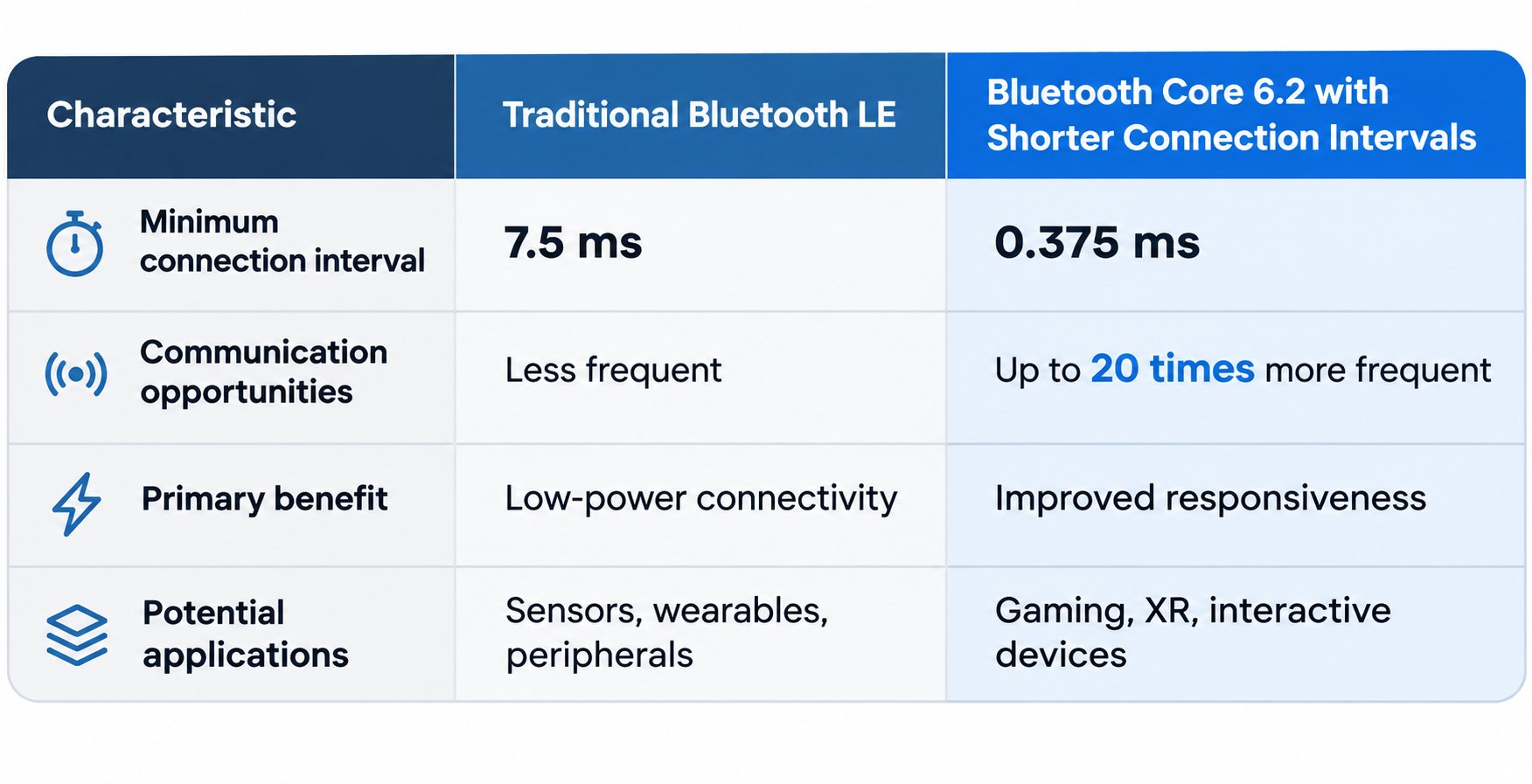
Shorter Connection Intervals represent a substantial change in how frequently Bluetooth devices can exchange information. The feature is particularly relevant to applications requiring high-frequency input reporting, such as gaming peripherals and interactive controllers.
However, achieving these shorter intervals requires support from the relevant Bluetooth hardware and software. Bluetooth Core 6.2 compatibility alone should not be interpreted as a guarantee that every device implements the feature.
Connection intervals versus polling rates
Polling rate describes how frequently a peripheral reports its state to a host device. A 1,000 Hz polling rate corresponds to one report every millisecond. This is a useful reference point because high-performance gaming peripherals increasingly target reporting frequencies of 1,000 Hz or more.
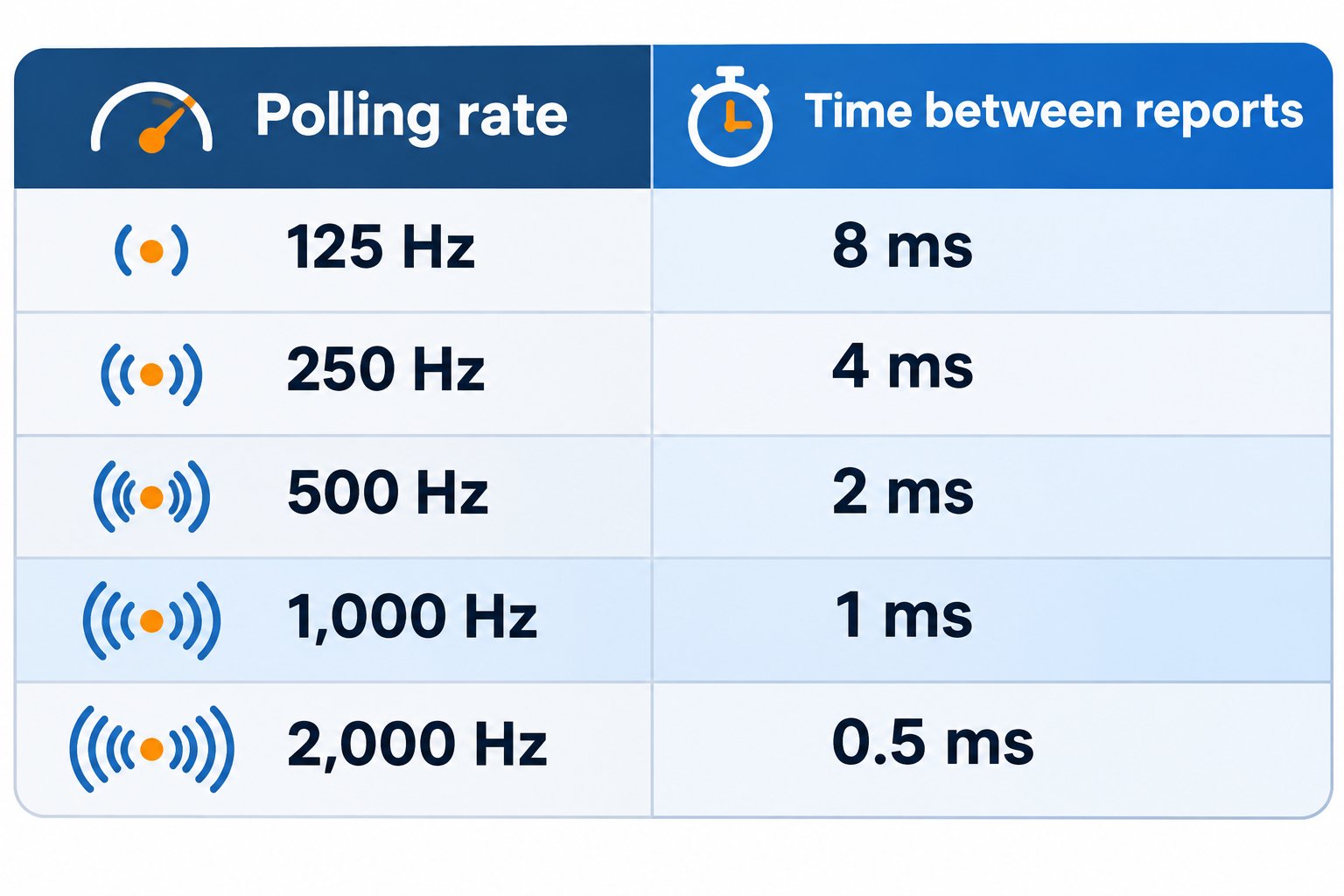
The new minimum Bluetooth LE connection interval of 0.375 milliseconds creates opportunities for supporting much higher reporting frequencies than previously possible. Nevertheless, connection intervals and application polling rates are different parameters. A 375-microsecond connection interval does not automatically translate into a particular polling rate or guaranteed sub-millisecond end-to-end latency.
4. Gaming: One of the clearest opportunities
Gaming peripherals represent an important commercial opportunity for lower-latency Bluetooth. Gaming mice, keyboards, and controllers frequently use proprietary 2.4 GHz wireless technologies to achieve high polling rates and predictable responsiveness.
These proprietary solutions can deliver excellent performance, but they often require dedicated USB receivers and vendor-specific wireless implementations. Bluetooth offers an alternative based on a widely supported, interoperable wireless standard.
Historically, however, Bluetooth LE’s minimum connection interval has limited its ability to match the most demanding proprietary gaming solutions. Shorter Connection Intervals could help close that gap.
For device manufacturers, the potential advantages include simplified connectivity, reduced dependence on proprietary receivers, and broader compatibility across computers, tablets, and other consumer devices. The commercial opportunity extends beyond gaming mice and keyboards to handheld gaming devices, game controllers, and other interactive accessories.
The remaining challenge is ensuring consistently low latency under realistic operating conditions, including radio interference, host operating system scheduling, and power-management constraints.
5. Extended reality and human-machine interfaces
Extended reality applications combine physical movement, sensor information, and real-time digital interaction. VR and AR headsets may rely on wireless controllers, tracking accessories, wearable sensors, and other peripheral devices to interpret user movements.
These devices frequently transmit relatively small packets of information, but the timing of those packets can be important. A delayed movement report can contribute to a mismatch between physical actions and the response displayed by the application. Lower-latency Bluetooth connectivity could therefore benefit several categories of XR devices.
XR controllers and tracking accessories: Faster reporting of controller movements, button presses, and sensor information can improve responsiveness in interactive virtual environments.
Industrial human-machine interfaces: Wireless control panels, handheld terminals, and operator interfaces may benefit from shorter and more predictable communication delays.
Wearable input and motion sensors: Devices that capture gestures, motion, or other physical inputs could support more responsive interactions with connected systems.
In industrial applications, however, lower latency alone does not make Bluetooth suitable for safety-critical or deterministic control systems. Such systems may require strict guarantees regarding latency, availability, reliability, and fault handling that go beyond the capabilities of a conventional Bluetooth LE connection.
6. The trade-off between latency and power consumption
Bluetooth LE’s success has been built on its ability to minimise power consumption. Many Bluetooth devices conserve energy by remaining inactive for extended periods and communicating only when necessary. Shorter connection intervals can change this operating model.
More frequent communication opportunities may require the radio and associated processing systems to become active more often, increasing energy consumption. This creates an important design trade-off.
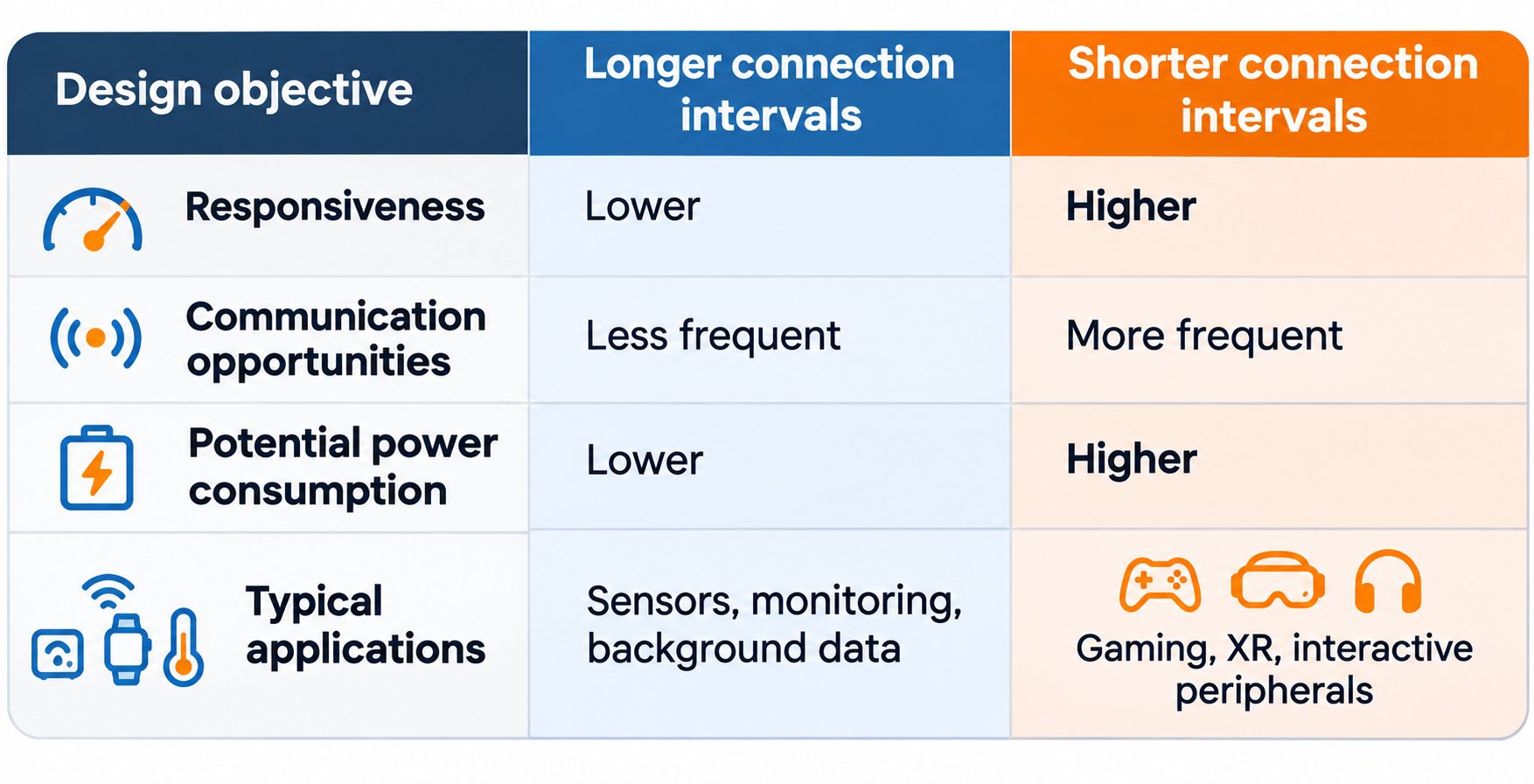
Actual power consumption depends on traffic patterns, radio activity, controller implementation, and device power-management strategies. A well-designed device may use shorter intervals only when rapid interaction is required, returning to less frequent communication during periods of inactivity. This kind of adaptive operation could become increasingly important as Bluetooth expands into more demanding interactive applications.
7. Latency is only part of the performance equation
For many applications, predictable latency is as important as achieving a low average latency. A gaming controller that normally responds quickly but occasionally experiences substantial delays may deliver a worse experience than one with slightly higher but more consistent latency. This distinction introduces the concept of latency variation, commonly referred to as jitter.
Bluetooth operates primarily in the globally available 2.4 GHz band, which is shared with Wi-Fi and numerous other wireless technologies. Interference, retransmissions, scheduling decisions, and other factors can influence the time required to deliver data. As a result, real-world Bluetooth latency performance depends on more than the minimum connection interval specified by the standard.
Developers must consider radio conditions, packet delivery reliability, host processing, power management, and application-level scheduling. For latency-sensitive applications, performance testing should therefore examine both average latency and the distribution of latency measurements, including worst-case behaviour.
8. What ultra-low latency means for the Bluetooth ecosystem
The evolution towards lower latency could influence several parts of the Bluetooth industry. For silicon vendors, shorter connection intervals create opportunities to develop controllers and SoCs optimised for high-frequency communication while maintaining efficient power consumption.
For peripheral manufacturers, the technology could make standards-based Bluetooth more competitive with proprietary wireless solutions. For operating system and platform providers, support for shorter connection intervals and efficient data handling will be essential to translating improvements at the radio level into better application responsiveness.
Finally, for end users, the longer-term benefit could be more seamless connectivity across a wider range of interactive devices without requiring dedicated wireless receivers. However, these benefits will depend on adoption across the complete ecosystem, including both peripheral and host devices.
9. Outlook: Bluetooth moves into more demanding applications
Bluetooth Ultra-Low Latency is part of a broader evolution in the technology. Bluetooth LE is no longer confined to applications where low power consumption and modest data rates are the primary design requirements.
New capabilities are expanding its potential role in high-performance peripherals, interactive systems, and increasingly sophisticated wireless devices. Bluetooth Core 6.2’s Shorter Connection Intervals feature represents a concrete step in this direction, reducing the minimum supported connection interval from 7.5 milliseconds to 375 microseconds.
That is a significant technical improvement, but its practical impact will depend on implementation, ecosystem support, and measurable end-to-end performance. The larger opportunity is to make standards-based Bluetooth a viable option for applications that have traditionally relied on proprietary low-latency wireless technologies. If the industry succeeds, Bluetooth could become an increasingly important connectivity platform not only for low-power sensors and peripherals, but also for the next generation of responsive, interactive wireless devices.
About this series
This article is Part Four of the WiFi NOW Bluetooth Technology Guide, a seven-part Resource Centre series exploring Bluetooth technology, emerging capabilities, applications, and the industry ecosystem. The next chapter examines Bluetooth LE Audio & Auracast, including the transition to LE Audio, broadcast audio, and new opportunities for consumer and commercial wireless audio applications.
/Claus.