
WiFi NOW’s TAKE: Bluetooth technology is developing leaps and bounds – which also means we feel compelled to cover it in detail. Bluetooth HDT (as well as legacy 6.x versions) are closely associated to Wi-Fi in that these technologies often coexist on APs as well as on client devices. A future important hot (and somewhat controversial topic) is Bluetooth wanting to share the 5 GHz and 6 GHz bands with Wi-Fi.
Based on a conversation with Qualcomm VP of Engineering, Joel Linsky.
For most people, Bluetooth is still synonymous with wireless earbuds and computer peripherals. But – according to Qualcomm VP of Engineering Joel Linsky – Bluetooth is entering one of the most significant periods of innovation in its 25-year history, expanding far beyond audio into AI, gaming, precision location services, digital keys, and advanced device tracking.
Bluetooth HDT: A Major Data Rate Upgrade
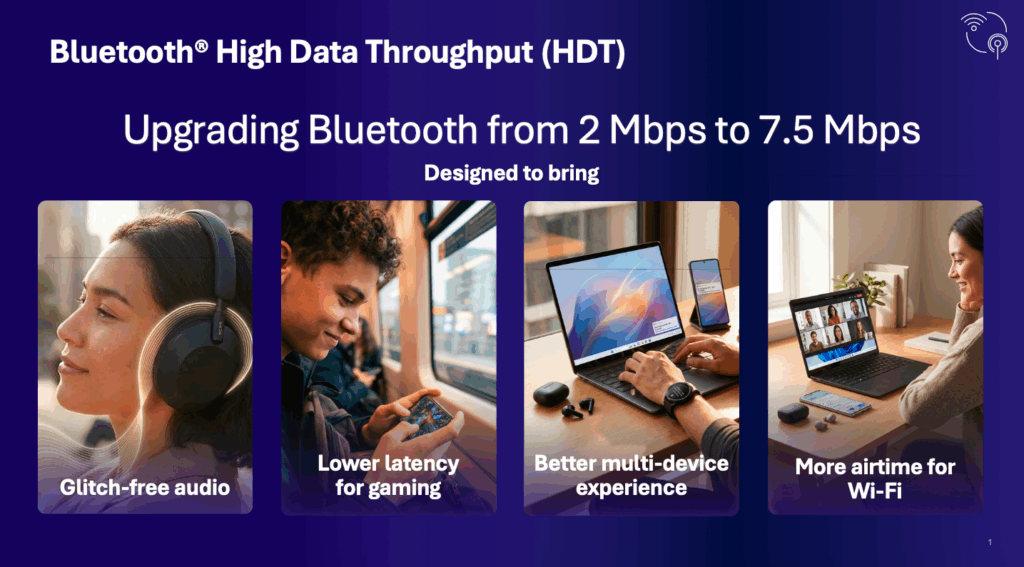
One of the most important developments is Bluetooth High Data Throughput (HDT), which increases Bluetooth’s peak data rate from 2 Mbps to 7.5 Mbps. While these numbers may seem modest compared to Wi-Fi, the impact on Bluetooth applications is substantial. The higher throughput enables:
- Lossless, high-quality audio
- Lower latency gaming experiences
- Better support for AR/VR devices
- Increased bandwidth for AI-enabled wearables and smart glasses
- Perhaps surprisingly, the higher data rate can also reduce power consumption. By transmitting the same amount of data in less time, devices spend less time actively transmitting, improving battery life for products such as earbuds and headsets.
A Better Neighbour to Wi-Fi
Linsky also points out an often-overlooked benefit: faster Bluetooth transmissions leave more idle time in the spectrum, improving coexistence with Wi-Fi. As Bluetooth completes transmissions more quickly, Wi-Fi gains additional opportunities to access the channel, making the two technologies better spectrum-sharing partners. This is particularly important as both technologies continue to operate heavily in the crowded 2.4 GHz band.
Beyond 2.4 GHz
The Bluetooth community is actively exploring operation in 5 GHz and 6 GHz spectrum bands. Moving beyond 2.4 GHz could provide several benefits:
- Reduced congestion
- More available spectrum
- Higher potential data rates
- Greater flexibility for future applications
Linsky envisions future Bluetooth devices dynamically selecting the most appropriate frequency band and even operating simultaneously across multiple bands to optimize performance.
Bluetooth 6.x: Precision Location Comes to Bluetooth
While HDT focuses on speed, the Bluetooth 6.x family introduces another major capability: Bluetooth Channel Sounding. This technology enables precise distance measurement between devices, opening the door to a wide range of new applications:
- Finding misplaced earbuds and devices
- Secure digital car keys
- Asset tracking
- Smart home automation
- Industrial and logistics applications
Unlike traditional Bluetooth proximity techniques based on signal strength (RSSI), Channel Sounding delivers true ranging capabilities and adds an important security layer that makes spoofing significantly more difficult. This is particularly valuable for automotive digital key applications, where security is essential.
Competing With Ultra-Wideband?
Bluetooth Channel Sounding inevitably invites comparisons with Ultra-Wideband (UWB), which already supports precision location services. Joel Linsky believes the technologies are more complementary than competitive. While UWB still offers superior accuracy, Bluetooth brings a powerful advantage: ubiquity. Bluetooth is available across virtually all smartphone tiers, whereas UWB remains largely confined to premium devices. This makes Bluetooth-based ranging solutions easier and less expensive to deploy at scale.
The AI Connection
AI is emerging as another major driver of Bluetooth innovation. As smart glasses, voice assistants, and wearable AI devices become more common, Bluetooth will increasingly serve as the low-power wireless link connecting microphones, sensors, and edge AI experiences. Higher throughput and lower latency will allow these devices to exchange more information while maintaining the battery life consumers expect.
Wireless Technologies Are Converging
Perhaps the most important takeaway from the discussion is that wireless technologies are no longer developing in isolation. Wi-Fi, Bluetooth, and Ultra-Wideband increasingly overlap in capabilities while simultaneously complementing each other. Rather than competing for a single role, they are becoming parts of a broader wireless platform where each technology contributes its unique strengths.
For the wireless industry, that means the future is not about choosing between technologies. It’s about combining them to deliver better user experiences. And with HDT, Channel Sounding, AI support, and expansion into new spectrum bands all on the roadmap, Bluetooth’s next chapter may be its most ambitious yet.
Watch our full interview with Joel Linsky here.