
Convention centres. Stadiums. Hotel atriums. Warehouses. These are some of the most challenging environments in enterprise Wi-Fi, where traditional ceiling-mounted omnidirectional access points often struggle to deliver both capacity and coverage. Cambium Networks believes it has the answer.
In a recent edition of Tech Watch, Maurice Dini, Product Line Manager for Enterprise at Cambium Networks, introduced the company’s new X7-56X Wi-Fi 7 access point – a purpose-built directional AP designed specifically for high-density venues and difficult installation scenarios.
A different approach to high-density Wi-Fi
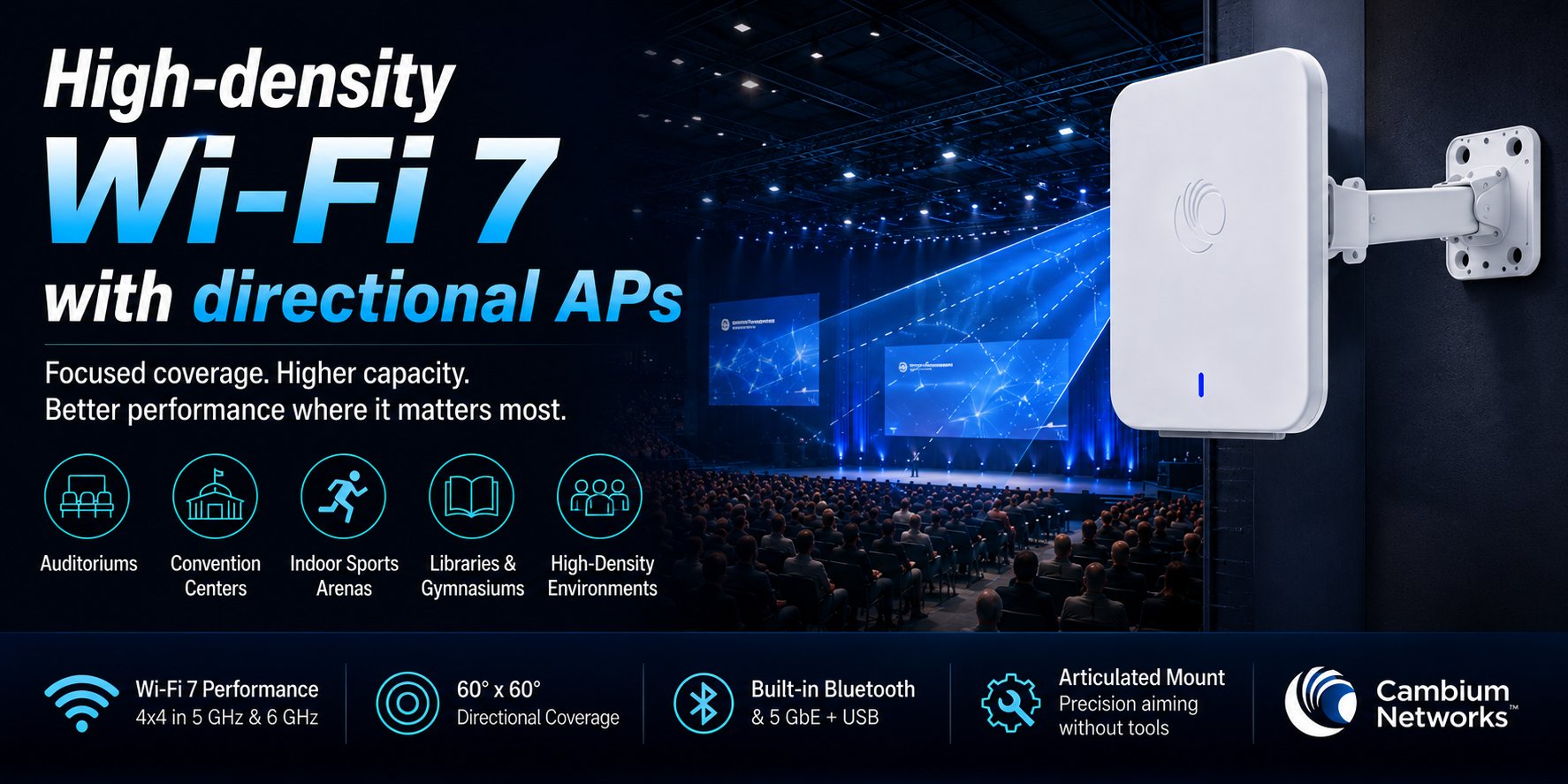
Unlike conventional enterprise APs that radiate equally in all directions, the X7-56X concentrates its RF energy into a 60° × 60° directional beam. The objective is simple: deliver capacity where users actually are while reducing unnecessary RF energy elsewhere. According to Maurice Dini, this approach is especially valuable in locations with very high ceilings or where AP placement is limited.
“Instead of blasting the entire building, you can concentrate the energy where you need it the most and improve channel reuse,” he explains. Typical deployment scenarios include:
- Auditoriums
- Convention centres
- Indoor sports arenas
- Hotel atriums and meeting spaces
- Libraries and gymnasiums
- Exhibition halls
- Transportation hubs
- Warehouse aisles
Built for Wi-Fi 7
The new AP is a tri-band Wi-Fi 7 platform featuring:
- 4×4 operation in both 5 GHz and 6 GHz
- A software-definable third radio that can operate as either dual 5 GHz or 5 GHz + 6 GHz
- Integrated Bluetooth
- 5 Gigabit Ethernet
- USB connectivity
The AP joins Cambium’s broader Wi-Fi 7 portfolio but is unique because of its integrated directional antenna rather than an external antenna solution.
Why directional matters
One of the interview’s key themes is that many enterprise deployments compensate for poor AP placement simply by installing more access points. Maurice Dini argues this often increases interference rather than improving performance. A directional AP allows network designers to focus RF coverage on specific seating areas, corridors or warehouse aisles while reducing energy in unwanted directions. The approach can improve both downlink performance and uplink reception by lowering the surrounding noise floor. As Claus Hetting observes during the discussion, many large public venues simply aren’t suited to traditional omnidirectional ceiling-mounted APs.
Precision aiming
Recognising that directional antennas only work when correctly aligned, Cambium has also introduced an optional articulated mounting bracket. The bracket allows installers to:
- Mount on walls, poles or ceilings
- Rotate the AP by ±60°
- Adjust direction in 2-degree increments
- Route Ethernet cabling internally for a cleaner installation
- Make adjustments without tools
The angle markings on the bracket also allow installers to reproduce exactly the orientation specified during network planning.
Designed with planning tools in mind
Cambium has ensured the X7-56X is supported across the industry’s leading Wi-Fi design platforms. In addition to Cambium’s own free Wi-Fi Designer, support is being added across:
- Hamina
- Ekahau
- Sidos
- iBwave
- Intangi
This allows designers not only to position the AP but also to model its directional beam and installation angle before deployment.
Available now
The X7-56X and its articulated bracket are available immediately worldwide. For enterprises deploying Wi-Fi into increasingly challenging environments – from exhibition halls to sports venues – the product fills a niche that has traditionally required external antennas and more complex installations. By integrating a directional antenna directly into a Wi-Fi 7 access point, Cambium is aiming to simplify deployment while improving capacity exactly where it is needed most.
/Claus.
WiFi NOW’s take:
Directional Wi-Fi APs is one of those ideas whose time has finally arrived. As enterprise Wi-Fi moves into Wi-Fi 7 and 6 GHz, simply adding more omnidirectional APs is no longer the optimal answer for many challenging environments. High ceilings, large open spaces, convention centres, sports arenas, and warehouse aisles all benefit from being able to direct RF energy precisely where users are located.
What we particularly like about Cambium’s approach is that it integrates the directional antenna directly into the access point instead of relying on external antennas and additional RF components. Combined with support in mainstream planning tools and an adjustable mounting system, the solution makes directional deployments far more practical for enterprise installers.
We believe this represents a broader trend the industry will increasingly embrace: Purpose-built access points for specific deployment scenarios rather than expecting a single omnidirectional AP to solve every wireless challenge. As Wi-Fi networks become denser and capacity demands continue to grow, smarter antenna design may prove just as important as the next generation of the Wi-Fi standard itself.
Download the presentation document used during the video here.
/Claus.