By Claus Hetting, WiFi NOW CEO & Chairman
The emergence of physical AI and autonomous machines is changing enterprise wireless requirements. Private 5G specialist Celona says the answer is to bring Wi-Fi and private 5G together into a single converged wireless platform. And the company believes this approach could significantly reduce infrastructure costs.
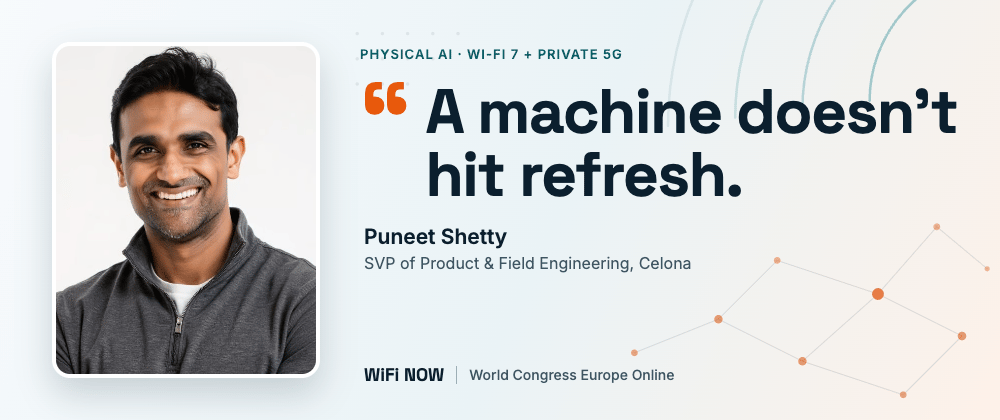
A machine doesn’t hit refresh. That simple observation from Puneet Shetty, SVP of Product & Field Engineering at Celona, captures one of the most important changes taking place in enterprise wireless networking: The arrival of physical AI and autonomous machines that depend on continuous, predictable wireless connectivity.
Speaking at WiFi NOW’s WWC Europe Online, Puneet Shetty explained why physical AI is creating new demands on enterprise networks – and why Celona, historically a private 5G specialist, now believes Wi-Fi and private 5G must work together. The company has expanded its portfolio to include Wi-Fi 7 as part of its new Orion converged wireless platform. Rather than treating the two technologies as competitors, Celona is combining them under a common architecture, management system, and commercial model.
Machines don’t tolerate network interruptions
For decades, enterprise wireless networks have primarily been designed to connect people. And people, as Puneet Shetty points out, are remarkably forgiving when networks don’t perform perfectly. If a webpage fails to load, we refresh it. If a video call freezes, we wait. If wireless coverage deteriorates, we move or reconnect. Autonomous machines behave differently.
A robot losing connectivity in a warehouse may stop immediately, potentially disrupting an entire industrial process. As AI increasingly moves into the physical world through autonomous robots, machine vision, and intelligent industrial equipment, connectivity becomes operationally critical. According to Puneet Shetty, physical AI is intensifying four fundamental networking requirements:
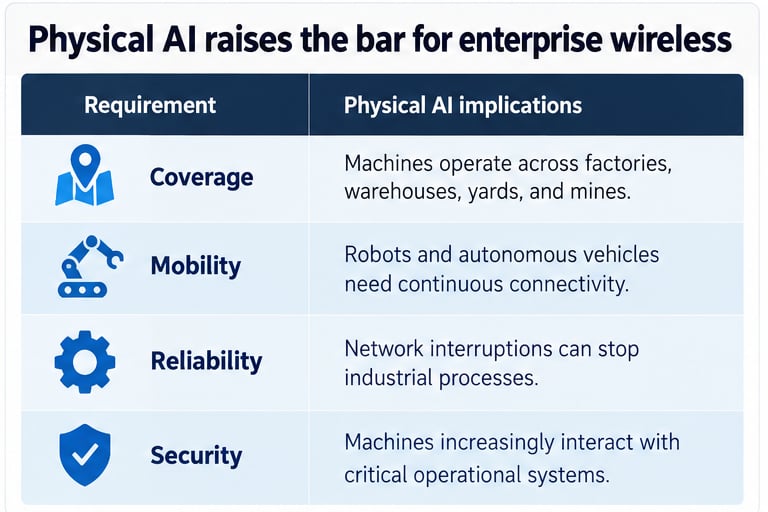
The challenge is that enterprises increasingly need to satisfy all four requirements simultaneously.
Why Wi-Fi and private 5G belong together
For a company that built its business around private 5G, Celona’s embrace of Wi-Fi is significant. Puneet Shetty says Wi-Fi offers enormous throughput, capacity, device density, and an extensive ecosystem of compatible devices. Private 5G provides complementary advantages in predictable performance, seamless mobility, wide-area coverage, and security. But private 5G also has limitations, including a smaller device ecosystem and different capacity economics. The question is therefore not which technology wins, but which is best suited to a particular device, application, and location.
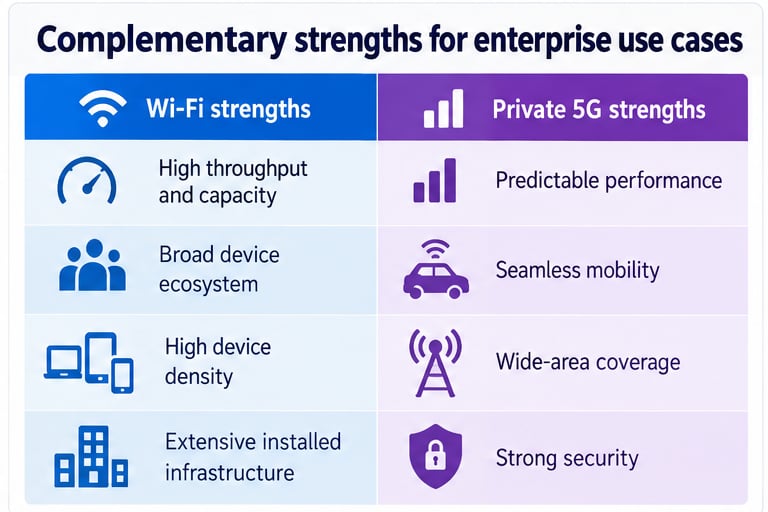
Celona believes enterprises should be able to use both technologies as part of one wireless infrastructure, selecting the appropriate radio for each application.
Four industrial examples of wireless convergence
Puneet Shetty illustrated the concept with examples from industrial environments in which Celona operates.
- Warehousing: Existing Wi-Fi networks may already support thousands of scanners, tablets, laptops, and printers. But autonomous forklifts moving continuously through long aisles may benefit from private 5G’s mobility and predictable connectivity.
- Manufacturing: An autonomous robot may use private 5G while operating on the factory floor, then switch to high-capacity Wi-Fi when docked to download software updates or new AI models.
- Oil and gas: Wi-Fi serves operational buildings, while private 5G extends connectivity across large outdoor refinery environments. Puneet Shetty described one deployment covering an area equivalent to 400-500 football fields.
- Mining: Wi-Fi connects offices and workshops, while private 5G supports autonomous vehicles and industrial equipment operating across extensive outdoor areas.
The common principle is to use each wireless technology where it delivers the greatest operational benefit.
Celona Orion: Convergence beyond the access point
Celona’s new Orion platform combines Wi-Fi 7 and private 5G access points with a common software architecture and AI-driven network operations. Interestingly, Celona has deliberately chosen separate Wi-Fi and private 5G radios rather than combining both technologies into a single access point. Puneet Shetty argues that their different RF characteristics make separate radios more practical for industrial deployments. Instead, convergence takes place across four network layers:
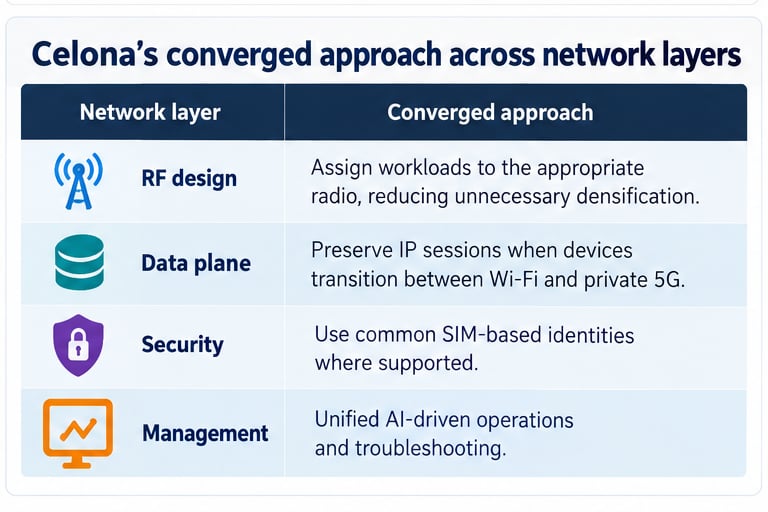
One important example is application session persistence. A worker moving between indoor Wi-Fi and outdoor private 5G coverage should ideally maintain connectivity without having to log into applications again.Celona’s converged architecture is designed to make such transitions seamless.
Can convergence cut wireless infrastructure costs in half?
Perhaps the most provocative part of Celona’s proposition concerns economics. The company now includes Wi-Fi access points at no additional cost with its private 5G subscriptions, challenging the assumption that deploying both technologies necessarily means paying for two separate networks.
Puneet Shetty presented a cost comparison based on a 500,000-square-foot brownfield manufacturing environment preparing to introduce robotics and physical AI workloads. A conventional Wi-Fi refresh would require substantial access-point densification. Celona’s converged approach instead uses private 5G for mobility-intensive applications while retaining Wi-Fi for other workloads.
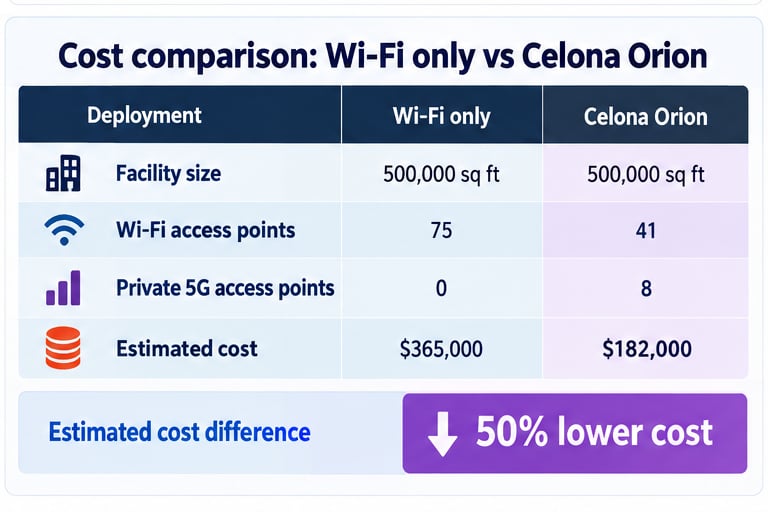
According to Celona, the converged architecture reduced estimated costs by approximately 50%, largely by avoiding the additional Wi-Fi infrastructure required to support robotics applications. Actual savings will depend on the deployment environment and application requirements, but the example illustrates how convergence could potentially reduce rather than increase wireless infrastructure costs.
Physical AI could accelerate wireless convergence
Celona’s move from private 5G specialist to converged wireless provider reflects an important shift in enterprise connectivity. As autonomous machines and physical AI applications become more prevalent, enterprises will need networks supporting increasingly diverse requirements.
Puneet Shetty’s central argument is that Wi-Fi and private 5G deliver greater value together than either technology can deliver alone – provided they operate as one platform rather than two independent networks. For enterprises planning Wi-Fi 7 upgrades while preparing for physical AI, this could present an alternative to conventional wireless refresh strategies. And if Celona’s cost projections prove achievable more broadly, convergence could become an increasingly attractive option for industrial enterprises.
/Claus.