By Claus Hetting, WiFi NOW CEO & Chairman
Artificial intelligence is changing the requirements for residential Wi-Fi as processing moves into gateways, access points, and connected devices. Speaking at WiFi NOW World Congress Europe Online 2026, Wi-Fi Alliance CEO Kevin Robinson outlined the technologies and industry initiatives needed to support this transformation.
The smart home is undergoing a fundamental transformation. For years, the industry’s focus has been on connecting more devices, from security cameras and smart thermostats to appliances and sensors. But according to Wi-Fi Alliance CEO Kevin Robinson, connectivity alone is no longer sufficient.
AI is changing consumer expectations. Rather than simply responding to commands, home systems will increasingly coordinate services, anticipate user needs, and manage everyday interactions with minimal intervention. Kevin Robinson identifies three essential components: Connected devices, an AI orchestration layer, and a network capable of supporting AI-driven operations. Wi-Fi provides the foundation that brings these elements together.
Smart home adoption is accelerating – and so is AI
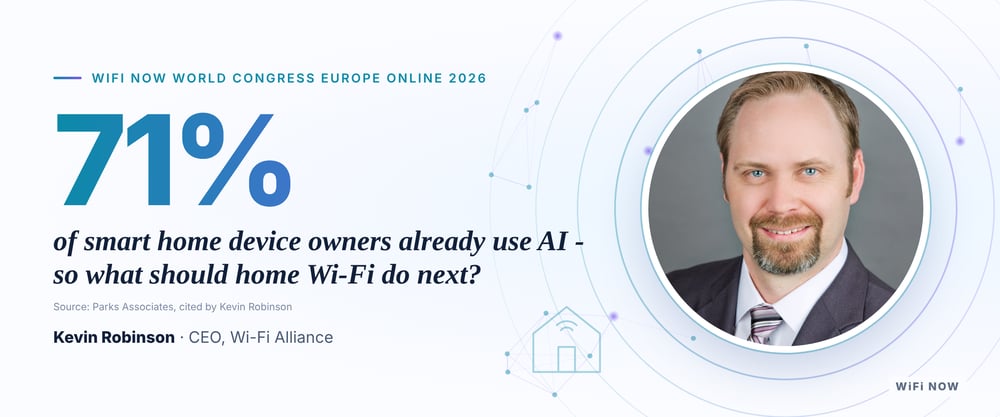
Citing Parks Associates, Kevin Robinson noted that 71% of smart home device owners already use AI, compared with 58% of Internet households overall. Meanwhile, ABI Research expects approximately 614 million smart home devices to ship in 2026. Research and Markets forecasts that the consumer IoT market will grow from $250 billion in 2026 to $447 billion by 2030. The opportunity is substantial, but the industry’s challenge is shifting from device connectivity towards delivering coordinated, AI-enabled services.
AI is moving into the home – and changing network traffic
One of the most important developments is the movement of AI processing from distant Cloud data centres into the home itself. While Cloud infrastructure will continue to play a major role, many applications require faster responses than remote processing can consistently deliver. Video analytics, intelligent assistants, and sensor-driven applications increasingly depend on local inference running on gateways, access points, or connected devices.
This also changes residential traffic patterns. Traditional broadband consumption has been dominated by downstream traffic, but AI-enabled cameras, sensors, and wearable devices are generating growing volumes of uplink traffic. Kevin Robinson highlighted video-enabled smart glasses as an example: Such devices may offload video processing to local computing resources to reduce power consumption and hardware complexity. The location of AI processing – whether in the cloud, on a gateway, or directly on the device – is therefore becoming an important consideration in residential network design.
Consumer expectations are shifting beyond broadband speeds
According to Parks Associates, 95% of US households now have Internet connections, while the average connected household has 17.8 devices. Nearly half of US households have at least one smart home device, compared with just 9% in 2014. But Kevin Robinson says the criteria consumers use to evaluate their home networks are changing.
Watch the full video presentation & access WWC Europe 2026 presentation materials here.
Historically, broadband speeds have dominated both service provider marketing and consumer perceptions of network quality. While speed remains important, consumers increasingly expect consistent coverage, low latency, and uninterrupted connectivity. These characteristics become especially important when AI-enabled services depend on continuous communication between devices and local computing resources.
Wi-Fi 7 is coming to smaller, lower-power devices
Wi-Fi Alliance is working to extend the benefits of the latest Wi-Fi generations to a broader range of products. Kevin Robinson highlighted the ability of Wi-Fi CERTIFIED 7 devices to operate using 20 MHz-only channels, making advanced Wi-Fi capabilities accessible to devices that do not require the bandwidth or complexity of wider channels. This approach can improve spectrum efficiency and coverage while reducing power consumption and RF design complexity. The objective is to bring newer Wi-Fi capabilities into IoT products without imposing unnecessary hardware costs.
Wi-Fi for Matter: Improving interoperability and battery life
Kevin Robinson also highlighted Wi-Fi Alliance’s collaboration with the Connectivity Standards Alliance, the organisation responsible for Matter. The Wi-Fi for Matter programme optimises Wi-Fi connectivity for Matter-enabled devices, requiring at least Wi-Fi CERTIFIED 6 capabilities and WPA3 security.
It also enables longer device sleep periods by allowing access points to handle certain network management and discovery functions, reducing battery consumption. These developments are intended to improve interoperability and power efficiency across products from multiple manufacturers.
Standard Power 6 GHz could transform whole-home coverage
One of the most compelling topics in Kevin Robinson’s presentation concerned the benefits of Standard Power operation in the 6 GHz band. Wi-Fi Alliance has conducted a residential trial in a single-family home in the San Francisco Bay Area, comparing Standard Power 6 GHz Wi-Fi with Low Power Indoor (LPI) operation. The trial evaluated 14 locations, including line-of-sight and non-line-of-sight conditions.
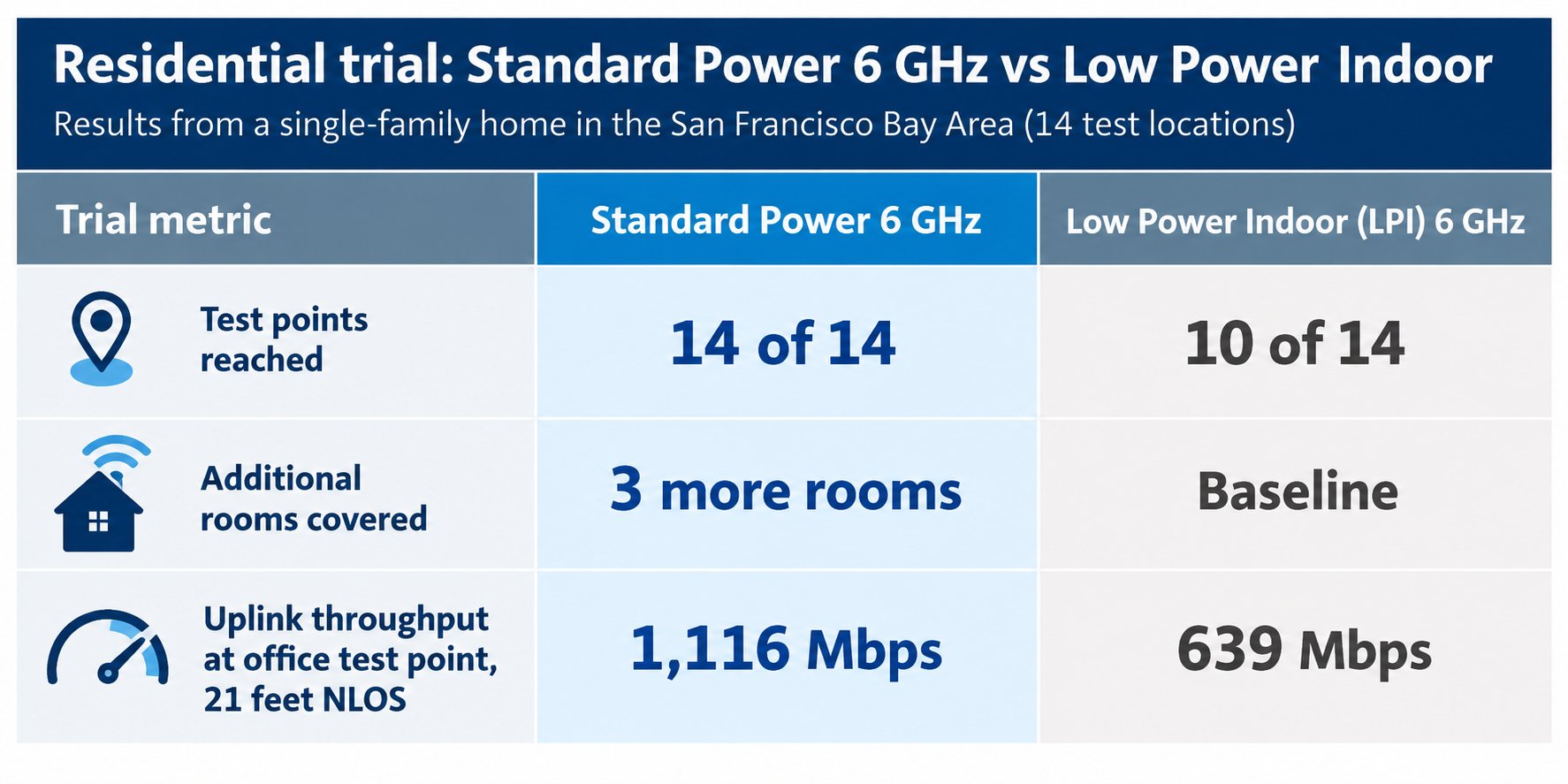
Standard Power reached all 14 test points, while LPI failed at four locations. It also extended coverage into three additional rooms and delivered substantially higher uplink throughput at the specified office test point. The results suggest that Standard Power 6 GHz could deliver better whole-home coverage from a single access point, potentially reducing the need for additional access points or mesh nodes. For broadband service providers, this could improve the economics of delivering gigabit-class Wi-Fi throughout residential premises. Results will depend on home layouts, RF conditions, and applicable regulations.
Security and privacy will determine consumer trust
Kevin Robinson also identified security and privacy as essential conditions for wider adoption of AI-enabled residential services. According to research presented during the session, 72% of consumers are concerned about the privacy implications of AI, while 47% have experienced at least one digital security failure during the previous year. Meanwhile, only 48% believe the benefits of online services outweigh privacy concerns, down from 58% the previous year.
Wi-Fi Alliance is addressing these concerns through its certification and security programmes. WPA3 security is mandatory for newly certified products, while ongoing work includes improvements to identity, authentication, and authorisation mechanisms. Kevin Robinson also confirmed plans to support post-quantum cryptographic requirements in 2027.
Shared data and network intelligence: The next frontier
Perhaps the most forward-looking part of Kevin Robinson’s presentation was about Wi-Fi Alliance’s work on enabling AI systems to interact more effectively with Wi-Fi networks. The organisation is pursuing three closely related initiatives:
- Standardised AI training datasets and data models: Common frameworks will allow AI systems to interpret network information consistently and support decision-making across different Wi-Fi environments.
- Dynamic Analytics Reporting: Shared analytics capabilities will allow access points and client devices to exchange detailed Layer 2 network statistics, supporting end-to-end monitoring, improved roaming decisions, and application optimisation.
- Multivendor interoperability testing: Certification will help ensure that equipment from different manufacturers can communicate and cooperate as network capabilities evolve.
Together, these initiatives point towards Wi-Fi networks becoming active participants in AI-driven operations rather than simply providing connectivity.
From connectivity to intelligence
Kevin Robinson’s central message is that the next phase of residential Wi-Fi will be defined by more than higher speeds: For broadband service providers, AI orchestration and local computing create opportunities to deliver new services and differentiate the home networking experience. For equipment vendors, shared data frameworks and interoperability will be essential to bringing these capabilities to market. Wi-Fi Alliance’s role is to provide the standards, certification, and technical foundation needed to support this transition.
This article is based on Kevin Robinson’s presentation – “Building the Intelligent Connected Home” – delivered at WiFi NOW World Congress Europe Online 2026.
/Claus.