Getting a model to run on an IoT chip is no longer what makes edge AI difficult – the challenge today is making millions of devices behave reliably in the field. In a conversation at WiFi NOW World Congress Europe Online 2026, Silicon Labs’ Vaseem Kazia explained why 20 MHz Wi-Fi 7, Matter, and well-planned multi-protocol radios will shape the next decade of connected products.
Watch Vaseem Kazia’s interview and all the presentations from WWC Europe 2026 Online Edition here.
Few companies have done more to incorporate Wi-Fi into small, cheap, and battery-powered devices than Silicon Labs, a longstanding WiFi NOW partner. At Wi-Fi World Congress Europe Online, WiFi NOW CEO Claus Hetting sat down with Vaseem Kazia of Silicon Labs for a one-on-one conversation that ranged from smart cameras and thermostats to multi-protocol coexistence, hardware security, and – curiously – even Wi-Fi-connected cattle. The discussion kept circling back to one highly practical theme: Intelligence only earns its place in an IoT product when it makes it better for the people who buy, run, and depend on it.
Where edge AI earns its place
Vaseem Kazia’s core principle is simple: “Incorporate intelligence where the signal is created – then choose the type of connectivity that best fits the job.” The Cloud remains the right place for heavier learning, fleet learning, and lifecycle management – but it no longer needs to see every raw signal before a product can respond, he said.
A security camera can discriminate a person from a delivered package or a tree moving in the wind, a thermostat can judge whether a room is occupied, and a machine sensor can spot changes in vibrations or sound before the machine fails. The fundamental task is the same for all of them: “These devices process a continuous stream of information and then decide whether attention is needed.” Handling that locally avoids the delay, cost, and privacy exposure of streaming everything to the Cloud – and saves energy on battery-powered devices, Vaseem Kazia said.
“The user doesn’t want the stream of pixels, all the temperature readings, and every bit of data that comes from the devices. They want to know the right alert or the right action at the right time. Edge AI should improve the customer experience, operating costs, or product reliability – ideally all three – and the defining design question follows from it: What is the smallest useful decision that a device can take locally, and how will we know whether it’s good enough?,” Vaseem Kazia said.
The processing power for taking on such tasks is already available on Silicon Labs chips today, and future generations will add dedicated neural processing engines.
Why 20 MHz Wi-Fi 7 matters to IoT
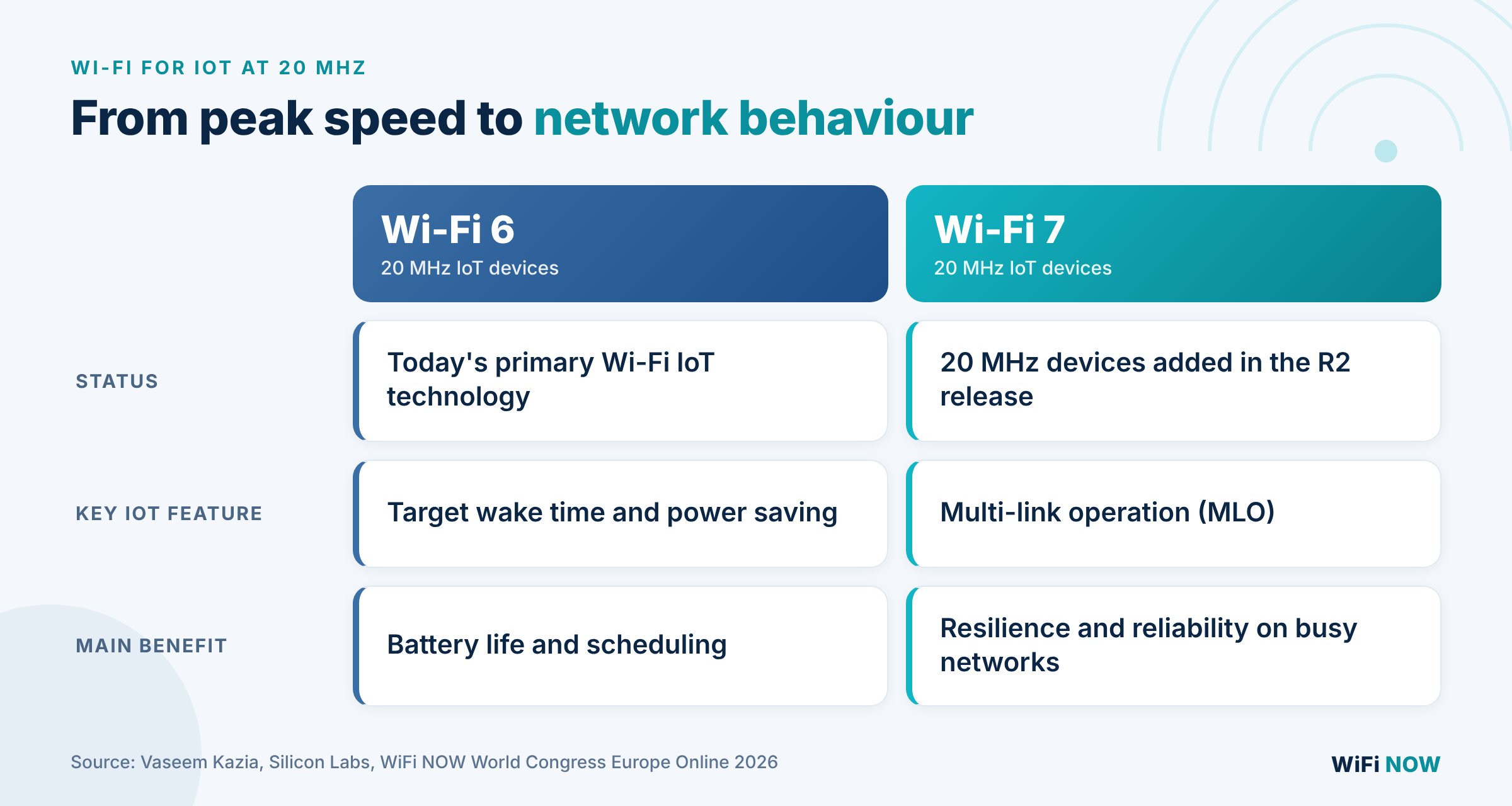
Wi-Fi 7 is best known for 320 MHz channels and multi-gigabit speeds, so 20 MHz-only Wi-Fi 7 devices can look a bit like a contradiction. But Vaseem Kazia sees the role of Wi-Fi 7 in IoT as important under certain circumstances: “For a lot of IoT devices, Wi-Fi 7 not a requirement. A thermostat, sensor, or battery-powered appliance sends small bursts of data and spends most of its life asleep. What some devices need – however – is predictable behaviour on a busy network together with sensible power consumption. The conversation then shifts from a peak rate to network behaviour, and that’s exactly where Wi-Fi 7 enters the picture,” he says.
Wi-Fi 6 remains the workhorse of Wi-Fi IoT today with target wake time and other power-saving features. The 20 MHz device class introduced in the recent Wi-Fi 7 R2 release adds multi-link operation (MLO), which Kazia expects to improve the resilience and reliability of IoT connections considerably.
That matters because homes are getting crowded. Thirty or forty connected devices per home is no longer unusual, and Vaseem Kazia said he runs 40 to 50 Wi-Fi devices in parallel within his home.
Matter changes the integration story, not the product
Matter has grown from lights and locks into cameras and energy management, and Vaseem Kazia was clear about what that does and does not change: “Matter is changing the integration story more than it changes the physical product. A camera still needs good detection, privacy controls, security and storage, and a sensor still needs accurate measurement and firmware rollback. What Matter provides is common onboarding and control that is portable across silicon vendors and devices. We spend less time rebuilding the basics and more time on experience, which matters for the end user,” he said.
The flip side is that anything that sets a product apart has to come from beyond the standard. “The product team still has to earn the preference from the customers with differentiation. Matter reduces the integration friction, but it does not make the complete product by itself,” he said.
Multi-protocol without the complexity
Running Wi-Fi, Thread, and Bluetooth in one product sounds like a project for compounding complexity, but Vaseem Kazia argued that the opposite can be true: “The point is to give each radio a clear job to make the overall system simpler for the user.” In a home security system the Wi-Fi camera handles video and richer updates, Thread sensors run on small batteries, and Bluetooth takes care of first-time setup from a phone.
Making that work requires a shared identity – so that the system knows it connects to the same light bulb over Thread or over Wi-Fi – as well as coherent commissioning and coexistence planning, which is among the harder tasks, because the protocols compete for the same spectrum. Aside: Bluetooth is no longer strictly required for Matter onboarding, since devices can now onboard over Wi-Fi using unsynchronised service discovery.
When to choose Wi-Fi – and the connected cow
Asked when he would pick Wi-Fi for an IoT product designed to last a decade, Vaseem Kazia siad that he would start with the deployment and not a default choice of radio. “That means asking where the device lives, whether it moves, who owns the infrastructure, how much data it sends, what its power budget is, and how long it must be supported. Wi-Fi is a strong fit on managed sites with IP connectivity, bursty traffic, and regular updates, while ultra-wideband or Bluetooth channel sounding handle proximity ranging better than a 20 MHz Wi-Fi device can,” he said.
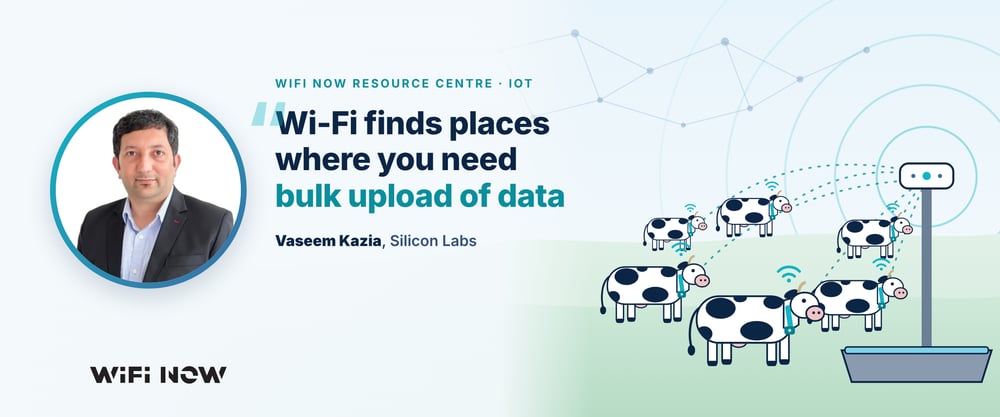
A curious but excellent example can be found within cattle ranching: Silicon Labs works with a rancher that monitors tens of thousands of cattle across a terrain of tens of thousands of acres – the kind of deployment where most people would assume cellular or LoRa is the only thing that would work. Yet every sensor on the animals connects with Wi-Fi. When the cattle come to the feeding or watering areas, they pass within range of Wi-Fi access points, and the sensors bulk upload readings collected over the day, avoiding cellular data costs. “Wi-Fi finds applications where you need bulk upload of data, updates OTA, and so on,” he said.
Trusting a device that makes its own decisions
“If we want devices to make decisions, we have to trust the whole chain behind it,” Vaseem Kazia says. That means knowing the device, what software and model it uses, whether that model is deprecated, and whether a bad update can be rolled back. It starts with a hardware root of trust – secure boot, protected keys and secure debug – and must continue throughout the product’s life cycle, with AI models themselves signed and authenticated so their origins are known, he says.
Matter certificates make commissioning easier, but Vaseem Kazia sees independent security certification, a secure update path, and a software bill of materials (SBOM) as what will really make life easier for device makers. Silicon Labs has achieved PSA Certified Level 4 – which Kazia described as the highest grade of security available – on its Series 3 devices, with more to come in future Series 3 parts.
The edge is harder than the AI
The final question was whether the edge has now become harder than the AI. The short answer is yes. “Getting a model to run on the part is not really the hard part anymore. A team may test a few hundred devices in the lab, but in the field, power, RF conditions, and real-world data change constantly, and users expect onboarding and updates to work perfectly. The model may be fine, but you may still fail at commissioning, which is very painful for the end user,” he said.
That is why he describes edge AI as a product and operations discipline. “A demo can show in a few devices that inference works, but a fleet of millions of devices is when we know that it operates at scale,” he said.
WiFi NOW’s perspective
This interview shows how far IoT has moved past the speed race that still dominates Wi-Fi headlines. Wi-Fi’s value proposition for IoT is shifting from peak throughput to predictable performance, power efficiency, and reliability. The arrival of multi-link operation for low-cost 20 MHz devices matters more to a home with 50 connected devices than any 320 MHz channel.
Matter accelerates that shift by turning onboarding and control into a commodity, which pushes differentiation into the device itself – into how well it filters, infers, and protects. That is where edge AI, on-chip neural processing, and high-grade hardware security become competitive weapons. This explains why vendors such as Silicon Labs are investing in all three. The connected cow adds a lesson of its own: IoT connectivity does not always need to be continuous.
Above all, Vaseem Kazia’s point that edge AI is an operations discipline deserves to be heard well beyond the chip industry. Demos are easy, fleets are hard. The companies that master commissioning, updates, security, and rollback across millions of devices will be the ones that turn edge AI from a promise into a business. The next decade of IoT will arguably not be won by the cleverest model or the fastest radio – but by devices that keep behaving predictably – when millions are deployed in the field.
This WiFi NOW Resource Centre report is based on Vaseem Kazia’s presentation, “Intelligence at the Edge”, given at WiFi NOW World Congress Europe Online 2026, October 2026.