By Claus Hetting, WiFi NOW CEO & Chairman
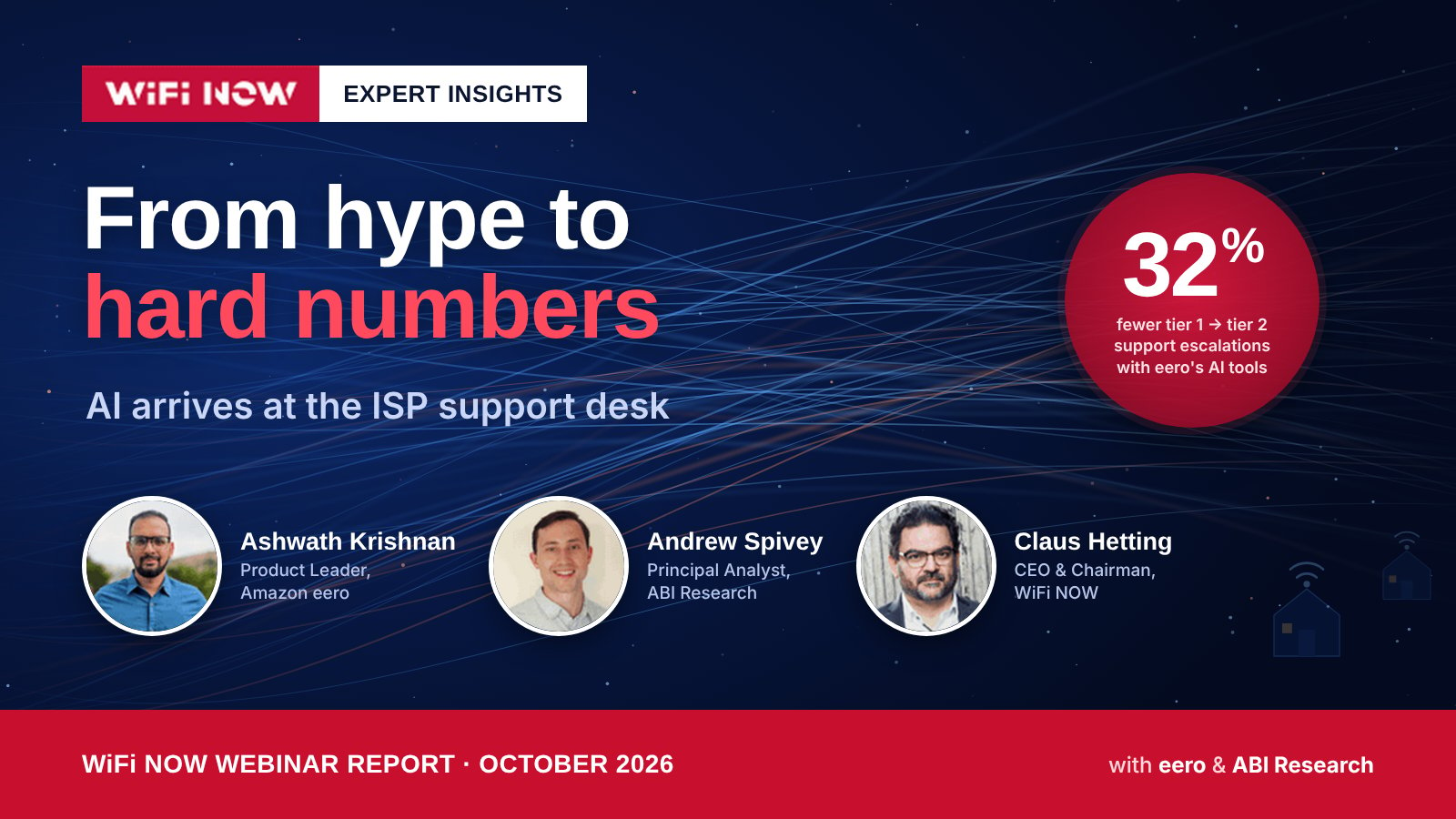
Operators have heard the AI pitch for years. eero’s new tools cut support escalations by a third, the first real proof point we have seen.
That pitch has come in many forms, from self-optimising networks and digital twins to gateways clever enough to know who is walking down the hallway. The ambition is genuine and the technology is advancing at a remarkable pace, but there is one question that hangs over all of it, and it is the one operators keep coming back to: Where is the proof that AI actually does something meaningful for the business?
That question framed our latest WiFi NOW industry update webinar, which brought together Andrew Spivey, Principal Analyst at ABI Research, and Ashwath Krishnan, Product Leader at Amazon eero. The answer that emerged was refreshingly concrete. If you want AI to pay its way, start where the pain is measurable and where the data already lives, which is to say at the very moment a frustrated subscriber picks up the phone.
Don’t miss watching the full webinar here including access to the PDF presentations.
Ten opportunities, one hard question
Andrew Spivey opened with a reminder of just how wide the field has become. ABI Research counts at least ten distinct ways in which AI can reshape home broadband, ranging from network automation, edge intelligence and smarter use of spectrum, through personalised services, energy optimisation and digital twins, to automated customer support, smart home enablement, Wi-Fi sensing and – as he put it – applications that nobody has even conceived of yet.
He sorts these into two broad buckets: AI that improves experiences operators already deliver, and AI that makes entirely new experiences possible. Wi-Fi sensing is perhaps the clearest example of the second kind. On its own, the technology has struggled for years to get much beyond simple presence detection, but with AI behind it, it can learn the distinctive gait of each member of a household and recognise when a stranger walks through the door.
Importantly, this is no longer slideware, and Tier 1 operators are now moving from trials to real implementation. In the US, Comcast uses large language models to monitor quality of experience right down to the endpoint and to resolve congestion before customers notice it. In the UK, Virgin Media O2 has launched an AI voice agent to handle customer calls, while in Canada, TELUS has built its SmartHome+ Assistant on top of more than 2,000 supported smart devices to create a personalised control panel for each user.
China Unicom runs AI on in-home cameras for fall detection and family alerts, and Deutsche Telekom and Reliance Jio are rolling out AI-powered features of their own. But Andrew Spivey’s perhaps most useful insight concerned why any of this matters: ABI’s consumer research shows that price is the number one reason subscribers churn, with reliability a close second, and AI has the potential to tackle both at once. Better QoE addresses reliability directly, while new AI-powered services give operators something tangible with which to justify what they charge. The catch is the one that every operator already feels keenly, namely the gap between enormous possibility on the one hand and hard proof of return on the other.
Why ISPs can’t simply copy the enterprise playbook
Enterprise Wi-Fi got to AI operations first, with large language models finding their way into enterprise network management several years ago, so it is fair to ask why the ISP world has been noticeably slower to follow. Andrew Spivey’s answer comes down to scale and complexity: A large ISP may have millions of subscribers spread across several countries, a stack of legacy OSS/BSS systems built up over decades, and a patchwork of CPE generations in the field, some of which belong to the customer rather than the operator. Where an enterprise can refresh or segment its network in one go, an ISP upgrades in patches, and simply opening up those systems to an AI agent becomes a substantial project in its own right.
Then there is the human factor: Operators, much like enterprises, are deeply wary of the word autonomous, because, as Spivey put it, autonomous means they lose control, and nobody wants an agent that goes rogue and starts deleting customer profiles. Add internal resistance to sharing data, legitimate worries about hallucinations, and questions of data sovereignty and jurisdiction, and it becomes easy to see why so many promising pilots have stalled.
The lesson for vendors is clear: AI for ISPs has to plug into the systems operators already run, it has to keep a human firmly in charge, and it has to prove its value in numbers that a sceptical CFO will accept.
eero’s bet: start at the support desk
This is precisely the brief that eero has set out to meet. Many in our industry know eero as the company that pioneered consumer mesh Wi-Fi, but far fewer realise how large it has become on the operator side. eero has worked with ISPs since 2017 and today serves more than 200 service providers in around 35 countries, covering tens of millions of homes, and that installed base generates a vast and continuous stream of network data, which is exactly the raw material AI needs.
Ashwath Krishnan described four ways in which eero is applying AI. The first is continuously improving connectivity, with AI running across hardware, firmware and applications; AI-driven radio resource management, for instance, has been live for years and is designed to make changes at moments when customers will not notice them.
The second is faster and simpler troubleshooting, for subscribers and support agents alike. The third is simpler integration, with eero’s agents speaking open protocols such as A2A and MCP and plugging into operators’ existing ticketing, business intelligence and OSS/BSS tools, so that integrations which once took three to six months can, according to Krishnan, shrink to a matter of days or weeks. The fourth is faster time to value from data, combining operator data with eero data and allowing teams to query it in natural language and obtain insights within minutes.
The whole stack is built on AWS, using Amazon Bedrock and Redshift, which means eero inherits ongoing improvements in models and security without having to rebuild them itself. Operators can use the capabilities straight out of the box in eero Insight, its network management platform, or pull them into their own systems over time as their integration work progresses.
What the demo showed
Two features in eero Insight do most of the heavy lifting: The first – Highlights – gives the support agent a bird’s-eye view of the customer’s network the moment a call comes in, so there is no guesswork because the system has already read the network’s real-time state. The second, AI-powered troubleshooting, runs a detect, diagnose and resolve loop that correlates network events, device diagnostics, historical performance and knowledge-base content, and then either takes action or recommends what to do next.
In the live demonstration, Highlights flagged looping packets on a colleague’s home network. A single click passed all of that context to the AI agent, which traced the loop to port 4, identified a direct eero-to-eero cable link as the cause, and established that the problem had started around six hours earlier. On a second network, it diagnosed a duplicate CIDR conflict caused by a third-party device and suggested monitoring the network over a longer period to see whether the problem was recurring.
Two design choices stood out: First, the agent also tells support staff what not to do, flagging steps known to conflict with eero’s TrueMesh technology and make matters worse, which, as Ashwath Krishnan pointed out, is often half the battle with newly trained agents.
Second, the human remains firmly in charge: the AI can apply a fix when the agent instructs it to, but it never acts on its own authority, which goes straight to the heart of the concern about autonomy that Spivey had raised earlier. The workflow has also been designed around how support agents actually work in practice, with more than 90% of interactions consisting of a single click that takes the agent from seeing the problem to knowing what to do about it.
The proof point: 32% fewer escalations
Here – finally – is the kind of number the industry has been asking for. eero’s own support team has been using these tools in production since June 2026, across thousands of calls, and in that time escalations from tier 1 to tier 2 have fallen by 32%, with most of that reduction arriving in the very first month.
That matters rather more than it might first appear. Customer support is a notoriously high-turnover business in which new agents arrive, lean heavily on their more experienced colleagues for help, and then move on, only for the whole cycle to begin again with the next intake. Cutting escalations by a third means that the first person on the phone is far more likely to solve the problem themselves, which in turn frees up the most experienced experts to concentrate on the genuinely difficult cases.
The second signal concerns what the industry calls the “glide path”, meaning the time it takes for a new hire to perform as well as an average agent. Krishnan reported that within the first couple of weeks, untenured agents were resolving issues just as effectively as their veteran colleagues, and with only minimal training. For any operator that has to keep paying to train a constantly rotating front line, that represents a direct and very tangible cost saving.
eero rolled the capabilities out to its ISP partners in September 2026, and essentially all of them now have access. The early feedback from operators in North America, Europe and Asia-Pacific mirrors the internal results, and one provider recently told Krishnan that he could now put a completely untrained person on a call and let them talk their way to the root cause of a problem with the help of the AI.
It is still early days, as both speakers were careful to acknowledge. As adoption grows, eero will be tracking three metrics in particular, namely average handle time, first-call resolution and agent CSAT, and it intends to publish operator case studies once there is enough runway behind the new capabilities, much as it has previously done with Sparklight. We very much look forward to seeing those numbers.
The bigger prize: The gateway itself
Support, however, is the beachhead rather than the destination, and Spivey’s closing argument was about the home gateway. ABI Research has been tracking routers for more than 20 years, and for most of that time they have been little more than simple conduits that route traffic between the home and the internet. He now sees them evolving into AI-driven smart home hubs, in much the same way that the mobile phone grew from a device for calls and texts into the centre of our digital lives.
ISPs hold a genuine structural advantage here, because a gateway already sits in nearly every home in North America and Europe and is typically refreshed every few years. That advantage will not last forever, though, with Apple, Amazon and Google all pushing deeper into the home. “ISPs really need to be the drivers of this,” Andrew Spivey warned, adding that they simply cannot afford to be passive, or others will come along and capture the market. Gateways that combine Wi-Fi with Bluetooth and 802.15.4 are best placed to take on that role, and on the question of whether the AI should run at the edge or in the cloud, he was clear that there is no one-size-fits-all answer.
eero’s own roadmap points in much the same direction. Its next step is to help operators’ data teams combine network data from the street with data from inside the home, in order to build a complete picture of each customer’s quality of experience. It also plans to enrich its AI agent with context from the wider Amazon ecosystem, drawing on devices and services such as Fire TV, Ring, Echo and Prime Video, so that support agents no longer need to hop between four or five different portals to understand what is going on in a household.
Wi-Fi 8 adds an interesting twist to all of this. eero is already working towards its first Wi-Fi 8 product, and for the first time in the history of the standard the headline is not speed but reliability. As Spivey observed, the old message of “higher number, higher speed” was easy to sell, whereas reliability is a far harder story to convey to ordinary consumers. AI that keeps the network healthy, and can demonstrate that it does so, may well turn out to be the most convincing way of telling that story.
What operators should take from this
- Start where the money is measurable. Support costs, escalation rates and training time are numbers every operator already knows, and AI that moves them builds the business case for everything that follows.
- Keep humans in control. When it comes to adoption, “assisted” beats “autonomous” every time, so let the AI diagnose and propose while people make the decisions.
- Demand open integration. Support for A2A, MCP and data streaming into existing ticketing, BI and OSS/BSS systems should be table stakes rather than a six-month integration project.
- Treat the gateway as strategy, not merely hardware. It is the operator’s foothold in the AI-powered home, and if operators hand it over, someone else will happily take that market.
- Ask for proof. eero’s 32% figure raises the bar, and every AI vendor pitching to an ISP should now be expected to come with numbers of its own.
The era of AI announcements in broadband is steadily giving way to an era of AI results. It is telling that the first of those results are emerging from one of the least glamorous corners of the business, and that is precisely why they are so believable.
/Claus.