By Claus Hetting, WiFi NOW CEO & Chairman
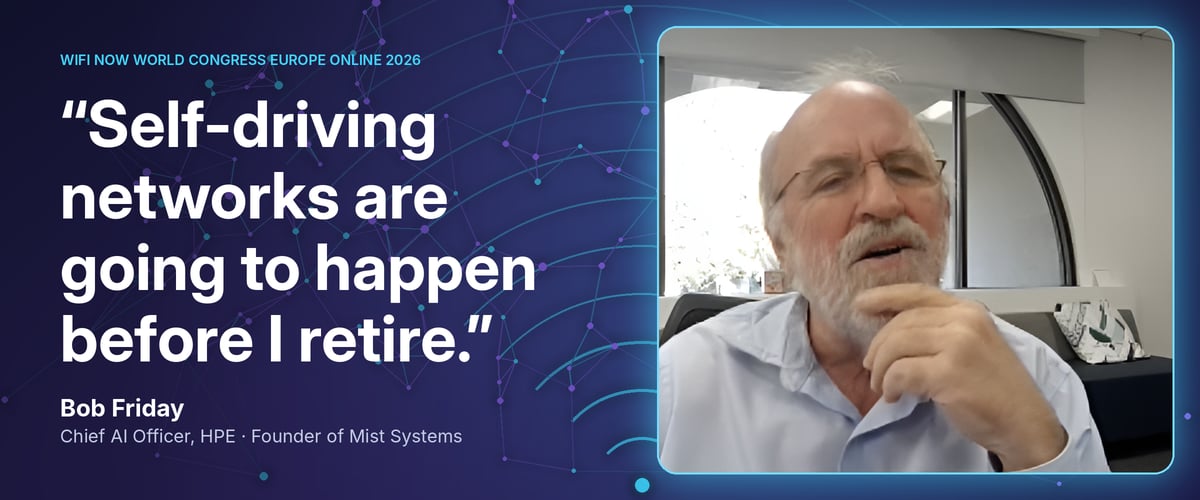
HPE Chief AI Officer Bob Friday believes enterprise networking is approaching a historic turning point, as AI systems progress from merely identifying network problems to reasoning, troubleshooting, and resolving them on their own. The next breakthrough – he says – will be trusted autonomous operations powered by agentic AI.
Bob Friday is the inventor of AI-driven enterprise Wi-Fi. As the original visionary and technical driving force behind Mist Systems – which he founded in 2014 – Bob created the world’s first AI-based enterprise Wi-Fi solution – one that placed cloud-based data collection, machine learning, and the actual end-user experience at the centre of network operations. Following Juniper’s acquisition of Mist in 2019 and HPE’s subsequent acquisition of Juniper, Bob Friday is now Chief AI Officer at HPE. Speaking at WiFi NOW World Congress Europe Online 2026 he explained why he believes enterprise networks capable of diagnosing and fixing increasingly complex problems by themselves are now within reach.
Don’t miss watching Bob’s presentation here including access to PDF presentations
From Mist Systems to the agentic AI era
Bob Friday was experimenting with neural networks as a master’s student in the 1980s, albeit ones with around 10,000 weights rather than the trillion or so in today’s frontier models. What changed – he explains – was the arrival of cheap cloud computing, storage, and open-source machine learning frameworks, which made practical AI commercially viable around 2014. That was the year he started Mist on the insight that Wi-Fi could only be properly optimised by understanding what users were actually experiencing.
Bob now sees agentic AI as the next great architectural transition. He believes the most important change is that engineers are beginning to let AI models work out how a problem should be investigated rather than simply follow a predefined workflow. “That is probably the biggest transition – meaning starting to trust these models to actually reason on par with humans, especially in network troubleshooting,” he says.
The five foundations of self-driving networks
Bob Friday sets out five foundations that have guided Mist since the beginning.
Data, APIs, and AI at the edge
Without the right data, no AI system can reliably find problems, determine their causes, or validate a fix – which is precisely why Mist built its own access point in the first place. “People always ask me why we bothered to build the access point,” Bob Friday says. “It was because we wanted to make sure we got the right data to optimise and predict the user experience.”
That foundation is supplemented by client-side ‘synthetic users’ – HPE’s Marvis Minis – which test services even when no real users are present. The newest layer is the Model Context Protocol (MCP) through which partners such as Infoblox and Zscaler contribute data. This is important because – as Bob puts it – “there are really only two problems with Wi-Fi: Can’t connect and it sucks,” and the cause of the first is frequently found in DHCP or DNS rather than within the wireless network itself.
Service Level Experiences
Rather than device status and traffic statistics, SLEs measure the experience actually delivered to users, since a network can look perfectly healthy while users suffer. The latest evolution is the Large Experience Model, which combines network telemetry with Zoom and Microsoft Teams data to predict application performance.
“Zoom and Teams are the canaries in the network coal mine,” Friday says, since packet loss, latency, and jitter show up in video calls long before anyone notices them elsewhere. An SLE violation is no longer just something for an engineer to investigate; it can now be the trigger that sets an AI agent to work.
AI-driven support
Mist deliberately tied its support team to its data science team, since every support case reveals missing telemetry or another procedure that could be automated. Bob Friday is adamant: “If a vendor is not using its own Cloud AI Ops agentic solution in its support team, it really hasn’t started the journey to self-driving.”
HPE’s own support team has used Marvis on every ticket since 2018. Because each problem solved there is transported into the product, support is left with ever harder cases – “needle in the haystack” problems such as 802.11r roaming, which is precisely where Bob Friday expects agentic AI to make the difference. The measure he watches most closely is how often engineers still have to log into individual devices, because “if the data is still in the device, it’s hard to self-drive,” he says.
Conversational & agentic interfaces
Networking has moved from the command line to dashboards, and Bob sees natural-language assistants and agents as the next step: Systems that reason, plan, act, and observe until a problem is solved.
Trusted autonomous actions
The fifth and arguably most important foundation is trust, and the degree of trust required depends very much on what the AI is being asked to do. Raising a ticket to replace a suspect Ethernet cable is a modest risk. “If I’m 90% accurate, it’s probably worth having that cable replaced, even if I replace some good ones,” Bob Friday says – whereas changing critical configurations is quite another matter.
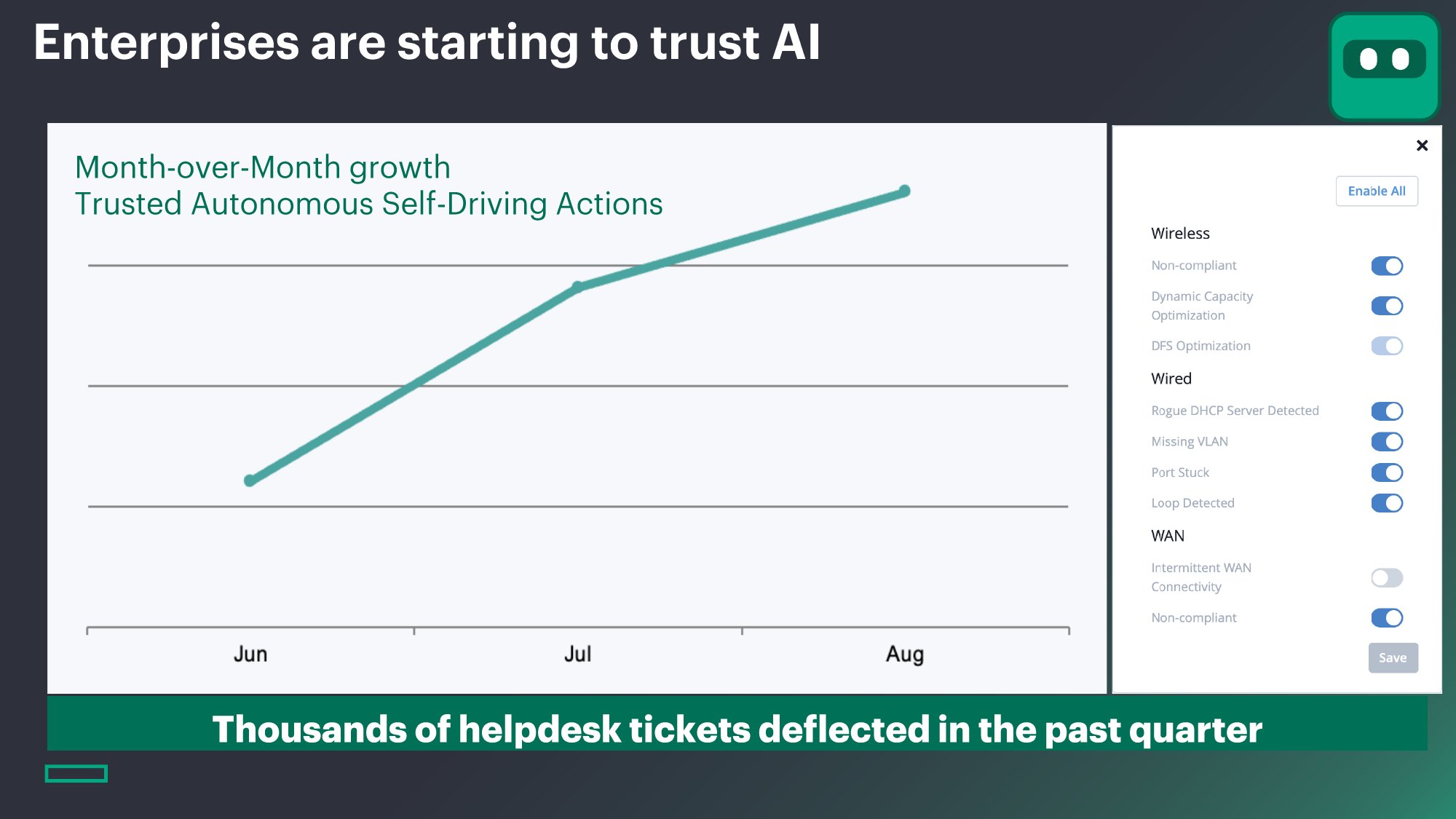
Operators long ago came to accept radio resource management adjusting power and channels, and HPE now offers a defined list of trusted self-driving actions that customers can enable one by one. The list – announced in May – already covers actions such as fixing a missing VLAN, dealing with a rogue DHCP server, detecting loops, freeing stuck ports, and optimising DFS channels and capacity. Bob reports double-digit month-on-month growth in its use, with thousands of helpdesk tickets deflected in the past quarter alone.
A practical example: Correcting a missing VLAN
Friday’s clearest illustration begins with clients reporting DHCP failures, which Marvis traces to a probable missing VLAN on a switch port. Marvis Minis validate the diagnosis with synthetic tests before the system configures the VLAN – autonomously or with an engineer’s approval – and tests again to confirm that connectivity has been restored. It is this cycle of investigating, acting, and verifying – rather than executing a predefined script – that distinguishes agentic networking from conventional automation.
Marvis and the agentic harness
Under HPE, Marvis is being extended into data centre networking and core routing alongside wireless, wired, and SD-WAN – this is important because so many problems experienced by Wi-Fi users originate elsewhere. Tying it together is what Bob calls the Marvis Self-Driving Agentic Harness, a single architecture for both human-led troubleshooting and autonomous operations, with context memory, dynamic selection of tools and skills, and guardrails governing what agents may do. Its effectiveness depends entirely on what lies beneath it: “If your APIs are garbage, then your agentic’s garbage.”
Agentic AI is – in his words – “really a non-deterministic programming language”, which means that conventional software testing is no longer sufficient, and experienced support engineers and field specialists must judge whether an agent’s reasoning is actually correct. Those same experts are now writing the skill files that encode their troubleshooting knowledge. HPE is bringing those skills back into the product itself – which leads to an interesting mostly tongue-in-cheek question from Bob: “Am I going to be hiring computer scientists going forward, or English majors?” Customers, meanwhile, are not waiting.
Enterprises that have spent years writing Python scripts against vendor APIs are now moving their automation to tools such as Claude Desktop connected to MCP servers, and some are building their own self-driving agents across their networks. This is a shift from deterministic to non-deterministic automation, Bob Friday says.
It also raises an architectural question: Networks used to send SNMP alerts up to an orchestrator such as HP OpenView or ServiceNow. Today, they are increasingly sending AI-generated diagnoses and solutions, and it is far from settled which system will sit on top. Bob Friday’s bet is that a harness optimised specifically for networking will win on efficacy. This is why HPE has every solution verified by domain experts, he says.
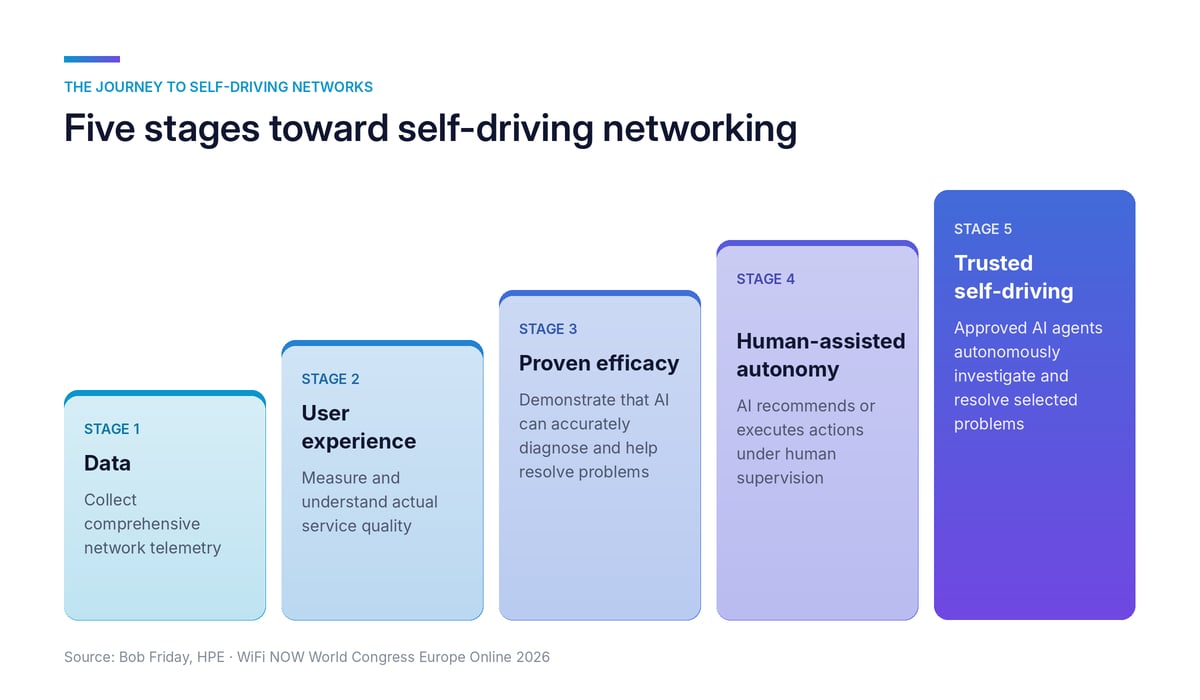
Approved AI agents autonomously investigate and resolve selected problems
Bob believes the industry is now approaching the move from stage four to stage five (see image above) and that – as with cars – trust can only be earned through accumulation. “We have to put millions of miles on the network to earn the trust of our IT customers,” he says. He expects enterprises to hand ever more to their AI assistants over the next year or two. “I feel like self-driving networks are going to happen before I retire.”
Towards the end of the discussion Bob Friday expanded on the long term view, suggesting that AI may ultimately prove as transformative as the Industrial Revolution. “We’re going to have to change the definition of work going forward,” he says. For network engineers, that is likely to mean less routine troubleshooting and more time defining policies, writing skills, and validating what AI agents do.
WiFi NOW’s perspective
Bob Friday’s views carry particular weight because Mist’s original decision to manage networks around the user experience created the data foundation on which today’s agentic capabilities are being built. High-quality experiential data is becoming a genuine competitive differentiator, and the ability to demonstrate reliable autonomous operation is becoming just as important as the sophistication of the models themselves.
Self-driving enterprise networks will not arrive overnight – nor will they remove the need for experienced engineers – but if Bob is right, the next two years could mark the beginning of a significant shift in how networks are run. The question is no longer whether AI can identify network problems, but instead how quickly enterprises will become comfortable allowing AI agents to resolve them.
This WiFi NOW Resource Centre report is based on Bob Friday’s presentation “Next Generation of Self-Driving Networks” at WiFi NOW World Congress Europe Online, October 2026.