
By Claus Hetting, WiFi NOW CEO & Chairman
Every Wi-Fi generation since Wi-Fi 4 has tightened its demands on signal quality, and the RF front end has quietly paid for it in range, power, and calibration effort. Dr Ali Fard – who worked on one of the first Wi-Fi chips with digital predistortion – now argues that the correction loop has reached its limits and that the fix belongs in the amplifier itself.
The RF front end rarely makes headlines, but Dr Ali Fard has spent a large part of his career on it: As CEO and CTO of QuantalRF – the CMOS SOI front-end specialist that was named Best Wi-Fi Startup at the WiFi NOW Awards 2025 – he builds the amplifiers that sit between the Wi-Fi chip and the antenna. Back in 2010 he worked on one of the first chips to bring digital predistortion (DPD) to Wi-Fi together with Intel.
At WiFi NOW World Congress Europe Online 2026 he used his session “Enabling Future Wireless with Innovations in RF” to explain why that technique cannot keep scaling with the standard – and what has to replace it. “Every wireless standard today keeps advancing, and I wanted to show why the RF front ends have not kept up with the pace and what the costs are and what has to change,” Dr Fard said. That challenge particularly urgent for Wi-Fi 8 and for the new wave of battery-powered AI devices at the edge.
The future asks three things of the front end
Dr Ali Fard focused on three asks of the front end:
- Cleaner signals. Every Wi-Fi generation packs more bits into each symbol, which means the amplifier must add far less error at the output power the product actually needs.
- Cheaper bits. AI devices typically send more data than they receive and run on small batteries. “The energy per bit decides how long they last, and that translates back into the user experience,” Dr Fard says.
- Simpler radios. Wi-Fi 8 switches channel, width and power state more often than any Wi-Fi standard before it, and every correction that must be retrained along the way adds cost and risk.
The industry has spent the past decade and a half solving all three on the digital side of the radio. Dr Ali Fard’s talk was a direct challenge to that idea: “This whole talk argues that each of these belongs inside the RF front end,” he said.
Watch Dr Fard’s full presentation here including access to PDF documents.
Where front ends fell behind
The numbers are clear: Each generation has raised the peak single-stream rate at the widest channel and densest modulation while cutting the signal error (EVM) the standard allows. This means that Wi-Fi 7 tolerates only half the error of Wi-Fi 5 and that Wi-Fi 8 keeps that bar while adding reliability targets on top.
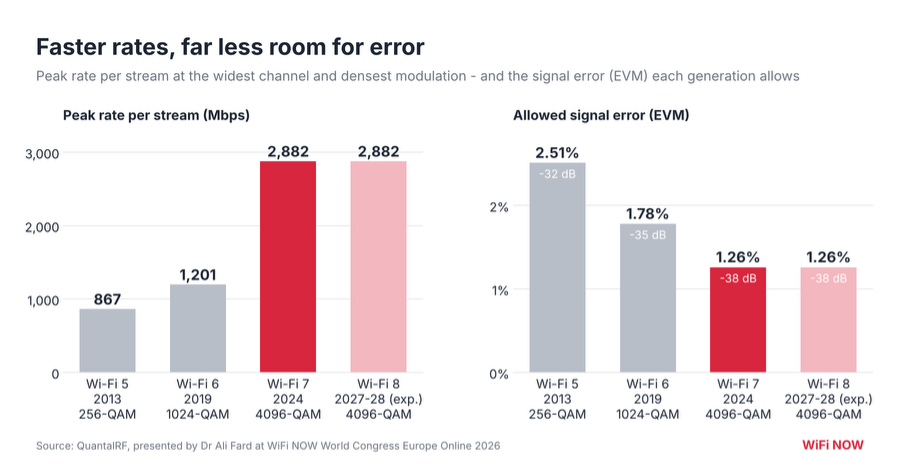
Because that budget covers the whole transmitter including the PHY and transceiver, the front end itself needs to be around 7 dB cleaner. At -45 dB the transmitter totals -38.8 dB and passes, while at -40 dB it totals -37.0 dB and consequently fails.
Front ends have kept up by giving away output power. The published data sheet of a Wi-Fi 7 mobile front-end module shows its rated output power at the top data rate falling from 19 dBm for Wi-Fi 4 to 14.5 dBm for Wi-Fi 7. That is a 4.5 dB drop that in theory means 30 to 40 percent less Wi-Fi range at the top rate. The alternatives are a predistortion loop that costs power as well as a calibration effort or a higher supply voltage. Routers on 5 V can afford that but phones on a 3.8 V battery cell and wearables at 3.3 V or lower cannot.
Efficiency has paid the price: For a front end that reaches about 33 percent at saturation, efficiency at each generation’s top rate has dropped from 11.1 percent to 7.6 percent with Wi-Fi 7 – even with digital predistortion. “That’s brutal for us analog RF designers,” Dr Ali Fard said. Cellular, satellite, and Wi-Fi have all hit the same wall: “Backoff has grown a lot faster than the amplifier efficiency has improved, and predistortion has come in here to fill up the gap.”
Predistortion: The rescue that became a risk
Ironically, Dr Ali Fard himself helped bring predistortion into Wi-Fi. “I actually co-developed one of the first chips with predistortion at Intel back in 2010. But I can tell you, I had many sleepless nights over it,” he says. Wi-Fi 4 amplifiers met the standard on their own in 2009, but when Wi-Fi 5 with 256-QAM arrived in 2013, the back-off problem could have crippled the standard had DPD not gone mainstream.
Wi-Fi 6, Wi-Fi 6E, and Wi-Fi 7 then pushed the loop much harder. At 320 MHz a DPD loop needs about 1 GHz of receiver bandwidth kept awake while it trains – and it has to be retrained for each condition – yet output power still fell by 4.5 dB. Wi-Fi 8 adds a new twist: IEEE 802.11bn (Ultra High Reliability) keeps the Wi-Fi 7 waveform but targets 25 percent more throughput under poor signal conditions, 25 percent lower latency for the slowest 5 percent of packets, and 25 percent fewer dropped packets, with certification expected from late 2027.
To get there the radio will change channel, width, and power state far more often, so a correction trained in one condition must hold in many. “I believe now and in the future, linearity has to be designed back into the amplifier. There is no escape at this point,” Dr Ali Fard said.
The loop that doesn’t know when to stop
To illustrate the fundamental problem, Dr Ali Fard presented a a puzzle he used to set his university students: The Collatz Conjecture is a rule a child can follow: Halve an even number, triple an odd one, then add one, and then repeat. Starting at 7 you reach 1 in 16 steps while 27 takes 111 steps and peaks at 9,232. After 89 years nobody has proven that every number gets there.
A predistortion loop is the same kind of object: A simple rule fed back into itself. With plenty of headroom, it converges just as textbook theory predicts. But near compression the signal peaks clip and there is no correct answer to converge to. In Dr Ali Fard’s simulations the loop found its best answer after about 13 iterations and then kept going until it ended 10 dB worse, while packets at identical average power drifted up to 11 dB from their best result depending on their own peaks.
“Convergence is actually not guaranteed,” Dr Ali Fard said, and for the user that means a device that runs hot and feels laggy as it drops to lower MCS rates. “The loop’s best answer is usually not where the loop stops. And in the field, nobody can see the iteration, which one was the best one, and this is the part that gave me nightmares back in 2010,” he said. The cost of the wideband receiver, the training air time and the stored coefficients meanwhile lands on the system-on-chip and the battery.
Edge AI: a small battery and a body in the way
The stakes are highest for AI glasses, wearable cameras, and other body-worn devices used in markets from the consumer segment to law enforcement and the military. These devices stream far more data up than they download – often continuously – to a phone that may be in a pocket or in another room. “The human body costs almost more than walls,” Dr Ali Fard said, noting that a person in the path costs about 10 to 20 dB of signal-to-noise ratio. A 15 dB loss alone forces the radio down about five modulation steps, so a link that carries 600 Mbps at 1024-QAM in an 80 MHz channel falls to 144-216 Mbps at 16-QAM.
Heat matters just as much as range: A tier-one wearables maker told Dr Ali Fard that every 50 mW saved is worth about one degree Celsius on the human body for a device that has to stay at around 39 to 40 degrees on the wearer’s face. That is why QuantalRF’s QWX27104 – launched earlier this year for edge and mobile devices – draws the same current at 80, 160, and 320 MHz within 2 percent, which means a 320 MHz channel delivers half the energy per bit of a 160 MHz one. “Energy per bit is going to count,” he said.
From one calibration to none
QuantalRF’s answer is to incorporate intelligence in the amplifier instead of a loop around it. Its CMOS SOI process places the amplifier, receive amplifier, antenna switch, and on-chip sensing and adaptive control on a single die, so the correction lives next to the amplifier and the Wi-Fi chip no longer has to run it.
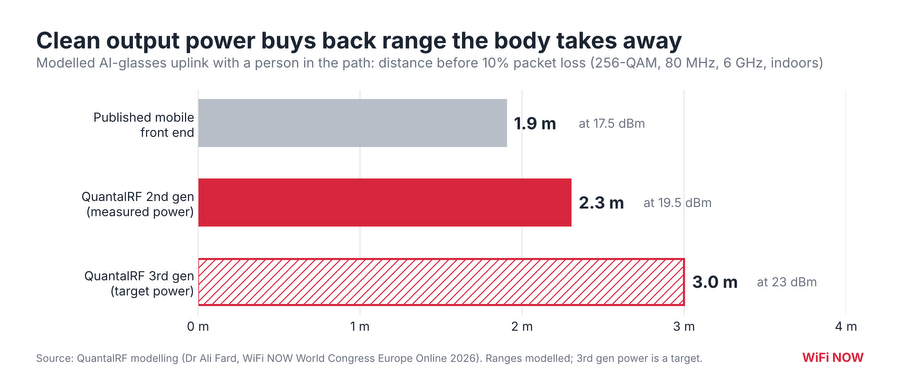
The second-generation part shows what that buys: QuantalRF extracted six coefficient sets once with a 160 MHz signal, froze them, and then reused them across 5.18 to 7.055 GHz and every bandwidth from 20 to 320 MHz at a cost of no more than 0.4 dB. Against a GaAs reference front end, the frozen correction held at -51 to -53 dB EVM at 20 MHz where the GaAs part floored at -37 to -42 dB. At 80 MHz QuantalRF measured 3.9 dB more clean output power – roughly a third more range indoors.
The third generation removes the loop altogether. “Third generation means no loop at all, and we’re launching that next year,” Dr Ali Fard said, with customer sampling expected around the end of the first quarter of 2027. It is designed to meet Wi-Fi 7 signal quality without predistortion and targets twice the amplifier efficiency and 3.5 dB more output power – development targets that have yet to be proven in customers’ products. What that clean power buys is clearest in Dr Ali Fard’s modelled AI-glasses uplink (256-QAM at 80 MHz in the 6 GHz band, indoors) with a person in the path:
Dr Ali Fard concluded with four questions every buyer should put to a front end: Does it beat the standard by at least 7 dB, does it deliver more output power with less energy per bit, does it work without digital correction, and if correction is needed, can it run on one frozen set of coefficients?
“If you can’t answer these four questions or demands, you have to start thinking that the front end is not doing the job. It’s just a loop around it that does it,” he said.
The WiFi NOW’s perspective
Most Wi-Fi 8 conversations focus on the MAC-layer features behind ultra high reliability. Dr Ali Fard’s session was an important reminder that those promises also rest on the analogue end of the radio doing its job. A standard that makes devices hop between channels, widths, and power states punishes any correction that only holds where it was trained, so front-end linearity deserves to be treated as a system-level reliability challenge rather than a component specification.
AI glasses and other body-worn devices are also turning Wi-Fi’s download-heavy traffic model on its head as their makers count milliwatts and degrees Celsius as closely as megabits. If QuantalRF’s figures hold up in real products – and the third-generation samples due in 2027 will be the real test – device makers could reclaim range and battery life that Wi-Fi has quietly surrendered over the past decade. If Wi-Fi 8 is about reliability, the most reliable correction loop may well be the one that never has to run.
This WiFi NOW Resource Centre report is based on Dr Ali Fard’s presentation “Enabling Future Wireless with Innovations in RF” at WiFi NOW World Congress Europe Online 2026, October 2026.
/Claus.