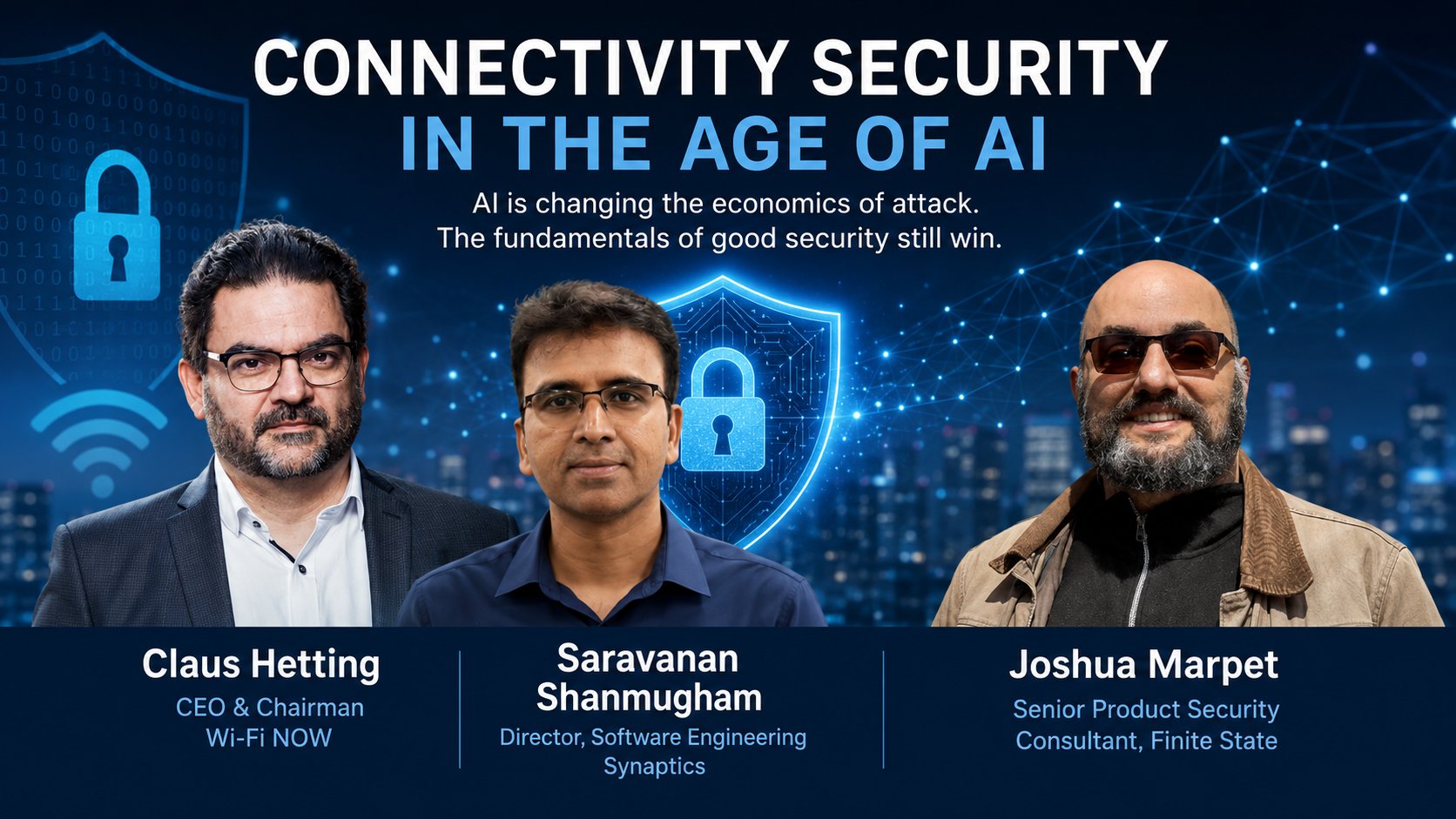

That was one of the central conclusions from the latest WiFi NOW Industry Update Webinar, where experts from Finite State and Synaptics discussed how AI is reshaping security for Wi-Fi networks, enterprise infrastructure, and connected edge devices. Their message was ultimately reassuring: the fundamentals of good security have not changed. However, organizations that neglect those fundamentals now face significantly greater risk because attackers can exploit weaknesses faster and more cheaply than ever before.
AI is accelerating attackers – not reinventing attacks
Joshua Marpet, Senior Product Security Consultant at Finite State, argued that AI should primarily be viewed as a productivity multiplier. Classic attack techniques—including phishing, credential theft, password cracking, rogue access points, Evil Twin attacks, and vulnerability discovery—remain largely unchanged. What AI changes is the amount of work required.
Tasks that once required days of manual effort can now often be completed in minutes or even seconds. AI can rapidly generate convincing phishing campaigns, clone login portals, automate reconnaissance, analyze large code bases for vulnerabilities, and assist attackers in identifying exploitable weaknesses. Cloud GPU infrastructure has further reduced the cost of brute-force attacks, making password cracking substantially cheaper than only a few years ago.
According to Marpet, this creates a growing asymmetry between attackers and defenders. Attackers can automate large portions of their workflow, while defenders must still identify vulnerabilities, schedule maintenance windows, deploy patches, and verify remediation across complex environments.
AI also strengthens defenders
Despite the increased threat landscape, both speakers emphasized that AI is equally capable of improving defensive capabilities. Organizations can already use AI to:
- Detect anomalous behaviour across large log datasets
- Identify suspicious traffic patterns
- Accelerate code reviews
- Discover software vulnerabilities during development
- Automate security monitoring
- Continuously validate infrastructure configurations
Rather than replacing security teams, AI enables them to analyze significantly larger amounts of operational data and identify threats much earlier than traditional tools.
Secure-by-design becomes essential
While Joshua Marpet focused primarily on operational security, Synaptics’ Saravanan Shanmugham examined security from the perspective of modern Edge AI chipsets. Today’s IoT devices are no longer simple sensors. They increasingly execute AI workloads locally, store valuable data, and communicate across multiple wireless interfaces including Wi-Fi, Bluetooth, and cloud services.
This dramatically expands the available attack surface. Wireless connectivity is only one component of a much larger security challenge that also includes:
- Firmware integrity
- Device identity
- Over-the-air software updates
- Debug interfaces
- Cloud onboarding
- Physical access
- Application processors
- Bluetooth and other radios
As more intelligence moves to the edge, security must extend throughout the complete device architecture rather than focusing solely on network encryption.
Wi-Fi 7 raises the security baseline
The webinar also highlighted several security improvements introduced with Wi-Fi 7. These include:
- Mandatory WPA3 support
- Stronger authentication mechanisms
- Improved session protection
- Enhanced Multi-Link Operation security
- Support for stronger encryption options including broader adoption of AES-256
While these improvements significantly strengthen wireless connectivity, the speakers stressed that Wi-Fi security alone cannot secure an entire connected product. Security must extend from silicon through firmware and software to cloud services.
Hardware Root of Trust remains fundamental
Synaptics presented a layered approach to embedded security beginning with hardware. Key elements include:
- Hardware root of trust
- Hardware-bound device identities
- Secure boot
- Authenticated firmware
- Anti-rollback protection
- Secure key management
- Subsystem isolation
- Lifecycle security from manufacturing through end-of-life
The objective is to ensure every software component—including AI models—is authenticated before execution while preventing compromised software from spreading across the device.
Zero Trust reaches the silicon
One particularly interesting concept discussed was applying Zero Trust principles inside a System-on-Chip. Instead of assuming that processor subsystems inherently trust one another, Synaptics advocates isolating:
- Application processors
- Wi-Fi subsystems
- Bluetooth subsystems
- Secure processing islands
If one subsystem becomes compromised, the architecture limits the “blast radius” by preventing attackers from moving freely throughout the chip. This extends Zero Trust principles beyond enterprise networks and into embedded hardware itself.
The fundamentals still matter
Despite AI’s growing capabilities, Joshua Marpet repeatedly returned to one central message: organizations should focus on getting the basics right.
Recommended best practices include:
- Deploy WPA3 wherever possible.
- Use strong, long passphrases instead of weak shared passwords.
- Eliminate default passwords and predictable naming conventions.
- Disable WPS.
- Separate IoT devices onto dedicated VLANs.
- Use 802.1X authentication for enterprise deployments.
- Apply least-privilege access policies.
- Lock down exposed management interfaces.
- Use behavioural monitoring rather than relying solely on traditional antivirus.
- Maintain offline backups to improve ransomware resilience.
According to Joshua Marpet, AI makes poor security practices far more expensiv – but it does not eliminate the effectiveness of proven defensive fundamentals.
Regulation is becoming a major driver
Another important theme was the rapidly expanding regulatory environment for connected products. Manufacturers increasingly need to comply with multiple international frameworks covering cybersecurity, secure development practices, software bills of materials (SBOMs), and lifecycle security.
Examples discussed during the webinar included:
- The EU Cyber Resilience Act
- The EU Radio Equipment Directive
- New U.S. regulatory initiatives
- Emerging requirements across Australia, Japan, Saudi Arabia, and other regions
For global device manufacturers, security compliance is quickly becoming as important as technical performance.
AI will increasingly automate defence
Looking ahead, both speakers expect AI to become progressively more autonomous in security operations. Future AI systems are likely to:
- Continuously monitor infrastructure
- Detect configuration drift
- Identify newly introduced vulnerabilities
- Validate policy compliance
- Recommend or even implement corrective actions
However, neither speaker believes AI will replace experienced security professionals. Instead, AI will automate repetitive analysis while allowing engineers to focus on architecture, secure design, and responding to increasingly sophisticated threats.
WiFi NOW Perspective
The webinar highlighted an important reality that extends well beyond Wi-Fi itself: AI is not fundamentally changing cybersecurity—it is changing the economics of cybersecurity. Attackers now require less expertise, less time, and fewer resources to exploit weaknesses that have existed for years.
For wireless vendors, enterprise IT teams, service providers, and IoT manufacturers, this shifts the priority toward disciplined implementation of proven security fundamentals. Secure-by-design architectures, Zero Trust principles, strong identity management, lifecycle security, and continuous monitoring are becoming baseline requirements rather than optional enhancements.
As AI capabilities continue to mature, organizations that have already invested in robust security foundations will be best positioned to benefit from AI-powered defence while limiting the advantages now available to attackers.