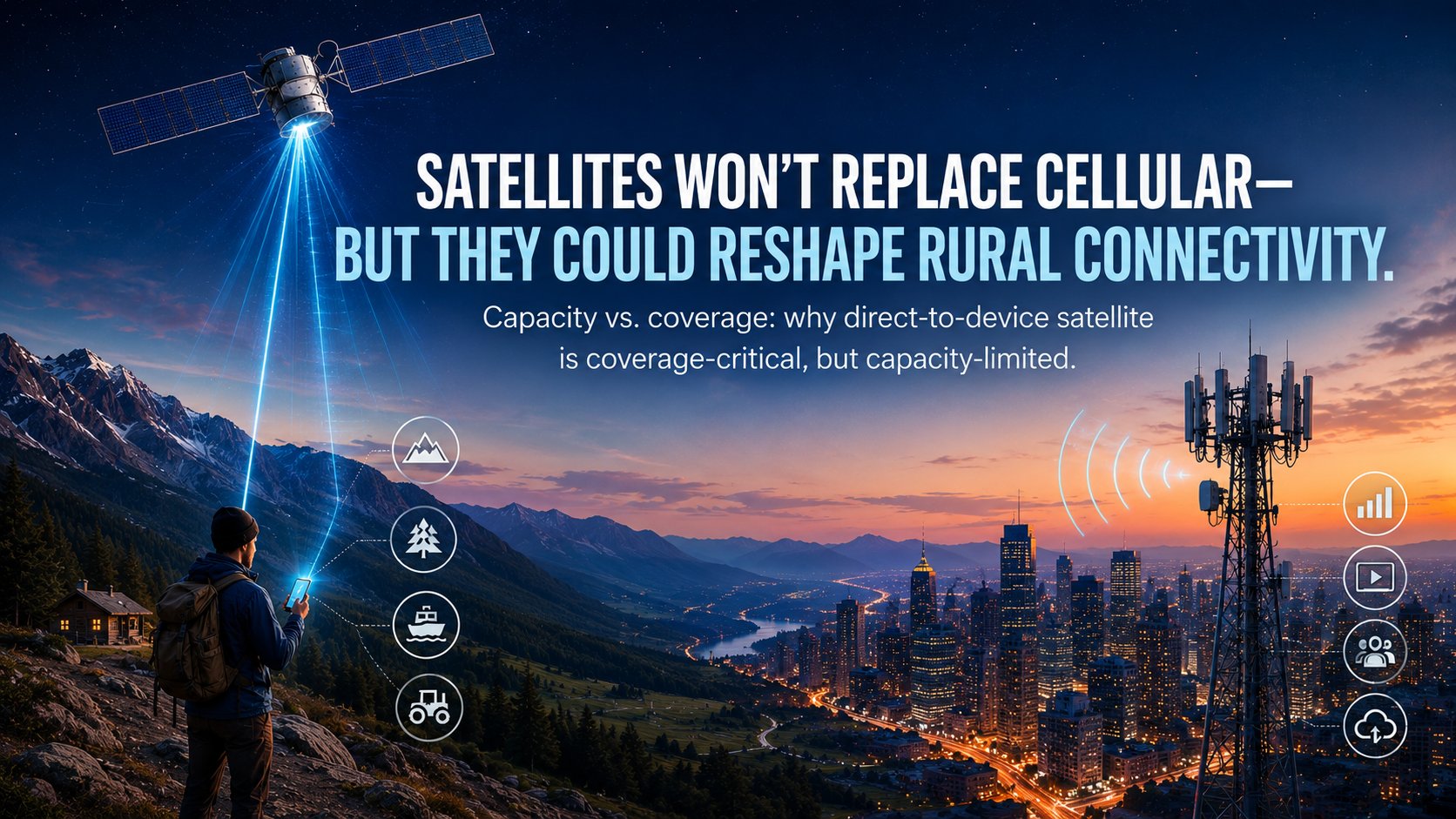

The hype surrounding direct-to-device (D2D) satellite services continues to build. Every few weeks another announcement suggests that satellites are about to transform mobile communications – or perhaps even replace cellular networks altogether. According to independent telecom analyst and author William Webb, that isn’t going to happen.
Speaking on WiFi NOW Tech Watch, Webb presented the conclusions from his newly released book Beyond the Tower, arguing that while D2D satellite will become an important addition to mobile connectivity, it is fundamentally constrained by physics, spectrum availability, and capacity.
A solution for coverage – not capacity
The strongest argument for D2D satellite is simple: There are still vast parts of the world where cellular coverage does not exist. Although countries routinely advertise population coverage exceeding 99%, landmass coverage tells a very different story. William Webb points out that Canada’s terrestrial networks cover less than one-third of the country’s land area, Australia roughly 35%, and even the United States reaches only about 60% of its territory. These are precisely the environments where satellite connectivity makes sense.
For hikers, emergency services, shipping, agriculture, mining, and remote industries, direct satellite access can provide an important safety net where building conventional cellular infrastructure is economically impossible.
The business case is surprisingly plausible
One of the most valuable aspects of William Webb’s analysis is an attempt to build an economic model for D2D satellite. Because virtually none of the operators disclose detailed financial assumptions, the calculations necessarily involve estimates. Nevertheless, Webb concludes that a satellite network dedicated solely to D2D mobile services is difficult to justify economically.
The picture changes dramatically when the same satellite constellation also delivers broadband services. That is precisely where Starlink currently enjoys a structural advantage. Broadband revenues effectively subsidise D2D capabilities, allowing satellite operators to spread infrastructure costs across multiple services. Webb estimates that this could produce substantial long-term profitability for Starlink, while newer entrants such as Amazon’s Project Kuiper will require years to reach similar scale.
Spectrum remains the biggest strategic challenge
Another major issue is spectrum. Satellite operators essentially have two options: Operate using dedicated Mobile Satellite Service (MSS) spectrum, or partner with mobile operators and use terrestrial mobile spectrum. Dedicated satellite spectrum offers global independence but very limited bandwidth.
Using mobile spectrum provides far greater capacity but requires cooperation with mobile network operators that own those frequencies. William Webb notes that recent spectrum acquisitions by companies such as SpaceX and AST suggest satellite operators would prefer to control more of their own spectrum assets, although today’s spectrum holdings remain insufficient to deliver a broad consumer service without mobile operator partnerships. Apple’s current GlobalStar-based implementation illustrates these limitations, supporting primarily emergency messaging and a small number of low-bandwidth services.
Can satellites use Wi-Fi spectrum?
One particularly timely discussion concerns the FCC’s recent proposal to investigate direct satellite communication using unlicensed spectrum—including portions of the 900 MHz, 2.4 GHz, and 5 GHz bands. William Webb is skeptical.
His concern is straightforward: A low-earth-orbit satellite observes an enormous coverage area on the ground. Within that footprint it simultaneously “sees” thousands – or even millions – of Wi-Fi, Bluetooth, and other unlicensed devices transmitting at similar power levels. Distinguishing the intended transmitter from this sea of competing signals becomes extraordinarily difficult.
“The uplink would seem to be nearly impossible,” William Webb argues.
A supplementary downlink may be more realistic in carefully selected situations, particularly in sparsely populated regions with little interference. But even then, the satellite itself risks creating interference for terrestrial users, while no Wi-Fi standards currently exist for this type of satellite operation.
Physics still wins
Perhaps the most compelling part of Webb’s presentation is its focus on capacity.
Satellite systems simply cannot match terrestrial cellular networks. Using a straightforward comparison of spectrum, spectral efficiency, and cell size, Webb estimates that dense urban terrestrial networks deliver roughly 10,000 times more capacity per square kilometre than today’s satellite systems.
This enormous gap is not easily solved. Satellite beams cannot realistically become much smaller, spectrum is inherently scarce, and improvements in spectral efficiency are incremental rather than revolutionary. Even T-Mobile reports that satellite usage currently represents only around 0.0002% of total network traffic.
What happens next?
William Webb expects D2D satellite services to continue expanding, with increasing competition from SpaceX, Amazon, AST SpaceMobile, and Chinese satellite operators. Capabilities will gradually improve toward roughly 2G or 3G-class connectivity. What will not happen, he says, is the replacement of terrestrial mobile networks.
Instead, D2D will become another layer within the overall connectivity ecosystem—particularly valuable for rural coverage and emergency communications – but secondary to conventional cellular infrastructure. Indoor service, high-capacity broadband, and dense urban connectivity will remain firmly in the domain of terrestrial wireless networks.
WiFi NOW’s take: Much of today’s discussion around direct-to-device satellite focuses on spectacular demonstrations – a video call from the wilderness or a text message sent from a mountaintop. Those demonstrations are impressive, but they can obscure the more important engineering reality. Coverage and capacity are fundamentally different problems. Satellite networks solve coverage extraordinarily well. Terrestrial networks solve capacity extraordinarily well.
The future of wireless connectivity is therefore unlikely to be either satellite or terrestrial. It will be a carefully engineered combination of both, with Wi-Fi continuing to play its critical role as the dominant technology for delivering high-capacity indoor connectivity while satellites extend communications into places terrestrial networks simply cannot economically reach.
William Webb’s presentation is available for download here and his book is available on Amazon here.