
Hamina demonstrates how AI can automate wireless network planning, simplify onsite surveys, and provide real-time visibility into deployed Wi-Fi networks across multiple infrastructure vendors.
From network planning to continuous visibility
Artificial intelligence is changing the way wireless networks are designed, validated, and managed. Tasks that traditionally required much manual effort, including interpreting floor plans, modelling building structures, positioning access points, and analysing RF coverage, can increasingly be automated. At the WiFi NOW DVT Forum, Jussi Kiviniemi of Hamina demonstrated an integrated approach to wireless engineering that brings together AI-assisted network design, onsite measurement, and remote network visibility.
The demonstration covered three stages of the network lifecycle: Design: Automatically construct building models, calculate wireless coverage, position access points, and plan supporting infrastructure. Validate: Use mobile surveying tools and dedicated measurement hardware to verify actual wireless conditions and identify potential problems. Monitor and troubleshoot: Integrate with existing network management platforms to visualise deployed networks, investigate client behaviour, and analyse operating conditions remotely.
The central proposition is that wireless network engineering should not consist of disconnected planning, surveying, and troubleshooting activities. Instead, these functions can operate as complementary parts of a continuous workflow.
1. AI-powered network design: From floor plan to wireless network
Automatically interpreting building floor plans
Traditional wireless network planning begins with understanding the physical environment. Engineers typically import floor plans, establish drawing scale, identify walls, specify construction materials, and construct a model suitable for predicting RF propagation. These activities are essential because walls, floors, and other physical structures influence how wireless signals propagate through a building. Incorrect assumptions about building geometry or materials can affect the reliability of predicted coverage.
Hamina’s AI-assisted planning software automates substantial parts of this process. During the demonstration, Jussi Kiviniemi imported a relatively low-quality floor plan obtained from an online image search. Rather than requiring a detailed CAD drawing, the system interpreted the available image and automatically constructed a building model. According to Jussi, the software can work with several forms of input, including conventional floor plans, JPEG or PNG images, and photographs of existing drawings.
The AI identifies relevant building structures and interprets construction elements for use in RF modelling. This reduces the manual preparation required before wireless network design can begin. However, the resulting model remains dependent on the quality and correctness of the source information and the AI’s interpretation. Engineers should therefore review important assumptions, particularly where construction materials and building geometry have a significant effect on predicted RF propagation.
Automatic access point placement
Once the building model has been constructed, the next step is to design the wireless network. Hamina maintains models of wireless access points from different manufacturers, allowing engineers to evaluate coverage based on the characteristics of selected equipment. During the demonstration, Kiviniemi selected Eero Pro 7 access points as an example. The software initially allowed manual positioning of access points, with predicted coverage calculated according to their locations and the surrounding building structure.
Jussi then demonstrated the automatic planning function. Rather than manually placing each access point, the engineer can instruct the software to generate a network design. The system automatically positions access points and produces a proposed wireless coverage model.
This changes the role of the engineer from manually constructing every element of the initial design to reviewing and refining an automatically generated proposal. The approach can potentially reduce planning time substantially, particularly for buildings where floor plans and physical structures would otherwise require extensive manual modelling.
Extending planning beyond access points
Wireless network planning is not limited to radio coverage. Access points require physical connectivity, appropriate switching infrastructure, and sufficient power. Hamina’s demonstration showed how these supporting requirements can be included in the planning workflow. The software can model switching infrastructure, determine cabling requirements, calculate cable routes, and generate a bill of materials. For example, an existing switch may have sufficient Ethernet ports for a previous generation of access points but lack the port capacity or power budget required for a new deployment. By incorporating these constraints into the design process, engineers can identify infrastructure requirements before installation.
The demonstrated planning functions include:
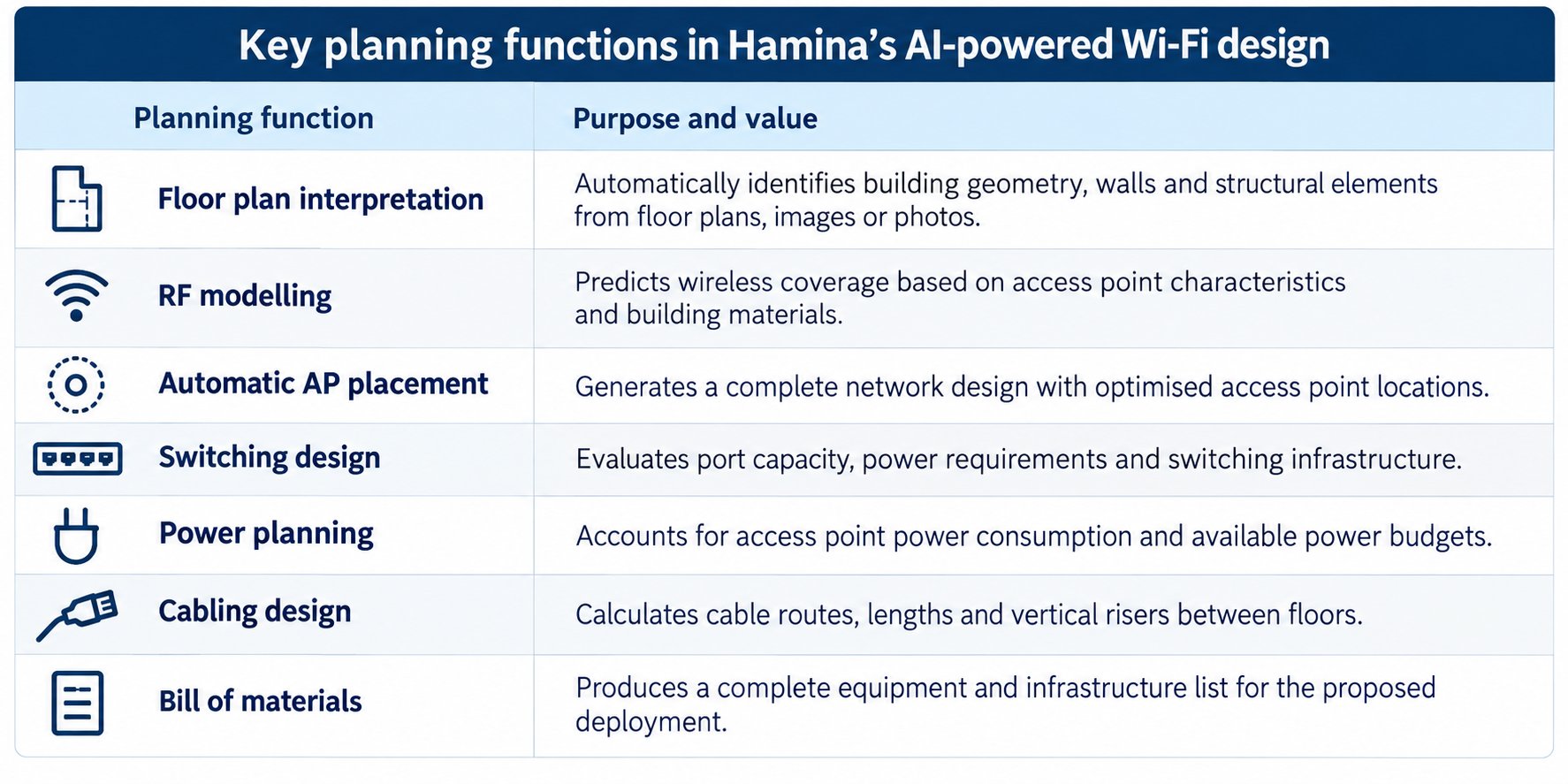
The significance is that the initial network design can become a more complete engineering deliverable, rather than simply a wireless coverage heat map.
2. Multi-floor RF modelling and three-dimensional building construction
One of the more significant capabilities demonstrated was automatic construction of a complete multi-floor building model. Conventional planning workflows frequently require engineers to prepare individual floors and then account for signal propagation between them. This is important because wireless signals do not stop at floor boundaries. Access points on one level may provide useful coverage on adjacent floors, while signals from other levels can also contribute to interference and channel contention.
Jussi demonstrated how Hamina’s AI could construct a four-floor building model automatically. The resulting three-dimensional representation allowed the software to visualise wireless coverage across the complete structure. Engineers could examine how access point signals propagated between floors and assess the effect of access point positioning throughout the building. The system also supported cabling routes between levels.
According to Jussi, constructing comparable building models manually could previously require days of work, whereas the demonstrated automated process completed the initial model in seconds. He also emphasised that the demonstration was running on an ordinary laptop rather than specialised high-performance computing equipment. These observations illustrate the potential speed of AI-assisted modelling, although they should not be interpreted as independently benchmarked performance figures for every building or design scenario.
Importantly, engineers can still manually modify the resulting models and designs. Automation therefore provides a starting point for engineering decisions rather than eliminating the need for professional review.
3. Onsite Wi-Fi validation using Hamina Onsite
The second part of the demonstration moved from predicted network performance to actual wireless measurements. Even a carefully prepared RF model cannot fully represent every operating condition encountered after installation. Actual performance depends on the installed equipment, client devices, configuration, interference, and the physical environment. Onsite validation is therefore essential for establishing whether the deployed network meets its design objectives.
Mobile surveying and measurement hardware
Jussi demonstrated the Hamina Onsite application running on an iPhone and connected to a compact wireless measurement device. The device was described as a recently introduced, cable-free, multi-radio Wi-Fi 7 measurement platform. The combination allows an engineer to collect wireless measurements and inspect operating conditions while moving through the building. The application presented information about signal quality, redundancy, interference, and other wireless conditions.
It also offered spectrum-related views across the 2.4 GHz, 5 GHz, and 6 GHz bands. This gives engineers a way to investigate whether observed network conditions correspond to the original design assumptions. Rather than relying exclusively on predicted RF coverage, the engineer can examine measurements from the actual environment.
Site surveys without existing floor plans
A particularly interesting capability was the ability to conduct a site survey without importing an existing floor plan. Kiviniemi demonstrated how the application could use an iPhone’s scanning capabilities to identify surrounding walls and other major physical structures. As the engineer moves through the environment, the application constructs a representation of the space. This can then be used to support wireless measurement and heat-map generation.
Alternatively, the engineer can import an existing drawing or photograph of a floor plan. The result is greater flexibility when surveying buildings where accurate architectural drawings are unavailable. The demonstration also showed automatic identification of access points and their configurations, together with information about neighbouring networks and potential interference.
From measurements to actionable findings
The onsite workflow is designed to provide more than a collection of RF measurements. Hamina presented the ability to identify conditions that may require engineering attention, including inadequate signal coverage, insufficient redundancy, and interference. The application can therefore support both deployment validation and troubleshooting.
The important distinction is between measuring wireless conditions and interpreting their implications for network operation. Measurements establish what is happening at a particular location. Analysis helps engineers determine whether those conditions represent a problem and what should be investigated next.
4. Real-time network visibility through infrastructure integration
The third part of the demonstration addressed networks that are already deployed and operational. Enterprise Wi-Fi infrastructure vendors typically provide their own cloud-based or centrally managed network administration platforms. These systems collect information about access points, connected clients, radio configurations, utilisation, and network health.
However, the presentation argued that the available operational information is not always presented in a form that allows engineers to visualise the complete RF environment or investigate wireless behaviour spatially. Hamina’s approach is to integrate with existing infrastructure management systems and add a dedicated wireless visibility layer.
Integrating with existing network management platforms
Kiviniemi demonstrated how Hamina could retrieve information from infrastructure management systems using vendor APIs. He referenced integrations involving platforms from Cisco Meraki, Juniper Mist, HPE Aruba, Extreme Networks, and Arista. Rather than replacing the vendor’s management platform, Hamina uses information obtained through the integration to provide additional visualisation and analysis.
The software can automatically construct a three-dimensional representation of the deployed environment. Access points and their operating conditions can then be displayed within that model. The key difference from the initial design workflow is that the information now reflects the operational network rather than a purely predictive simulation. Hamina presented this as a means of giving engineers remote visibility into wireless conditions without requiring a physical visit to the site.
Visualising coverage and network health
The demonstration included spatial views of access point status, coverage, utilisation, and network health. Jussi showed how engineers could inspect the operational implications of disabled radios or access points. For example, an access point with disabled radios might not necessarily create a coverage hole if neighbouring access points, including those on adjacent floors, continue to provide sufficient coverage. The three-dimensional view helps engineers understand this relationship.
Instead of treating a failed access point as an isolated alarm, the system can place the event within the context of the surrounding RF environment. This is particularly relevant in multi-floor buildings where access point coverage overlaps vertically as well as horizontally. The demonstration also included views of non-Wi-Fi interference and radio utilisation. It is important to distinguish these remotely generated views from independent onsite spectrum measurements. The remote capabilities depend on the telemetry and other information made available through the connected infrastructure platform.
5. Client-level analysis and troubleshooting
Beyond access point and radio-level visibility, Hamina demonstrated analysis of individual connected clients. Jussi selected a client device within an operational network and examined its wireless conditions. The software displayed information including signal levels, data rate, retry percentage, operating band, and channel. In the example, the selected device was connected on the 2.4 GHz band and exhibited a relatively low data rate together with substantial retransmission activity.
These observations indicated that the client might be experiencing a wireless performance problem. The ability to combine client metrics with spatial network information can help engineers investigate whether a problem is associated with coverage, interference, client behaviour, or radio configuration.
Following client movement and roaming
The demonstration also showed how the software could follow changes in a client’s wireless connection. As a mobile device moves, its signal levels may change and it may transition between radios or access points. Hamina’s interface allows engineers to observe these changes and investigate the client’s connection behaviour. In the specific example shown, the client transitioned between radios on the same access point rather than roaming to a different access point.
The distinction matters because roaming behaviour can involve different radios, frequency bands, and access points. The interface also provided the ability to disconnect a client from the network as a potential troubleshooting action. Such interventions should be used carefully because disconnecting a device does not necessarily resolve the underlying cause of poor performance.
Adding context to network telemetry
The wider significance of this capability is the combination of operational telemetry with a spatial representation of the wireless environment. Traditional dashboards can show that a client has poor signal quality or excessive retransmissions. A spatial model may help engineers understand where that client is operating, which access points are nearby, and how surrounding RF conditions relate to the observed behaviour. This can make troubleshooting more intuitive, particularly across complex buildings and multi-vendor environments.
6. Unifying the wireless network lifecycle
The Hamina demonstration illustrated three distinct but complementary categories of wireless network engineering.
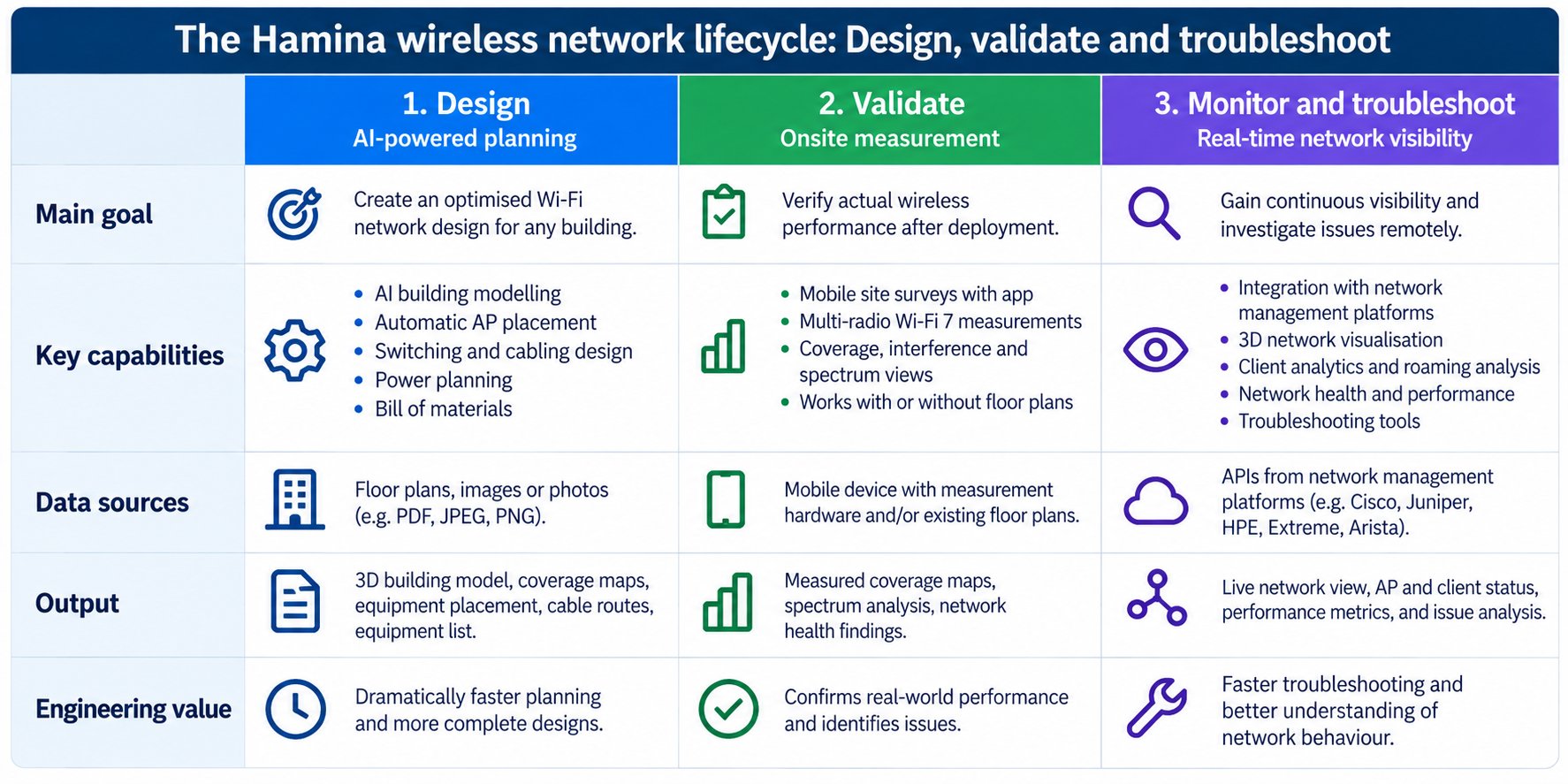
Historically, these activities have often relied on separate tools and workflows. Network designers create predictive models, survey engineers collect field measurements, and operations teams investigate problems through infrastructure management dashboards. Hamina’s approach is to bring these activities closer together.
The potential advantage is greater continuity between what was originally designed, what was measured during deployment, and what is happening during operation. For example, an engineer may use an AI-generated model to plan access point locations, validate coverage after installation, and subsequently investigate a client problem using information from the operational network. Each stage provides a different perspective on the same physical wireless environment.
This does not eliminate the differences between predictive modelling, onsite measurement, and operational telemetry. Each remains subject to its own assumptions and limitations. However, integrating these perspectives can reduce the effort required to move between planning, validation, and troubleshooting.
7. Engineering implications: Faster workflows, but validation remains essential
The demonstration points to several broader developments in wireless network engineering.
AI reduces manual modelling work
Interpreting floor plans and constructing building models have traditionally been time-consuming preparation tasks. Automating these steps allows engineers to spend more time reviewing network requirements, assessing coverage objectives, and refining designs. The ability to generate initial designs quickly may also make it practical to compare more deployment alternatives.
Wireless design increasingly includes supporting infrastructure
Access point positioning alone is insufficient for producing a deployable network. Switching capacity, power budgets, cabling routes, and equipment requirements are integral to the installation. Combining these functions with wireless planning can help identify infrastructure constraints earlier in the project.
Onsite measurements remain important
AI-generated predictions are useful, but they do not replace physical validation. Real buildings contain materials, objects, interference sources, and operating conditions that may not be fully represented in the design model. Onsite measurements provide the evidence needed to confirm actual network behaviour.
Network visibility becomes more spatial
Operational dashboards contain substantial amounts of telemetry. Presenting that information within a three-dimensional building model can help engineers understand relationships between clients, radios, access points, and the physical environment. This is useful when troubleshooting coverage and roaming issues.
Vendor-independent analysis can complement infrastructure management
Hamina’s integrations illustrate the potential value of a specialist analysis layer operating alongside existing network management platforms. Such an approach can be relevant to organisations managing equipment from multiple manufacturers or seeking a consistent engineering workflow across different network environments. The actual scope of remote analysis will nevertheless depend on supported integrations, available telemetry, and the capabilities exposed by individual infrastructure vendors.
Conclusion: AI moves wireless engineering toward a more integrated workflow
Hamina’s DVT Forum demonstration showed how AI-assisted network planning, mobile onsite validation, and real-time operational visibility can be brought together in a common wireless engineering workflow. The most striking aspect was the speed with which the software generated an initial multi-floor building model and proposed network design from a relatively simple floor plan.
Equally important was the ability to move beyond predictive modelling and investigate the behaviour of an operational network through existing infrastructure management integrations. The broader direction is clear: Wireless network engineering is moving toward tools that automate repetitive preparation work while giving engineers more immediate access to information about actual network conditions.
For enterprise IT teams, wireless integrators, and managed service providers, the potential benefits include faster planning, more consistent deployment validation, and more efficient troubleshooting. The engineering objective remains unchanged: To deliver reliable wireless connectivity that meets the requirements of users and applications. AI and integrated network visibility tools offer new ways to achieve that objective, provided their outputs are supported by sound engineering judgement and appropriate validation.
Source: Jussi Kiviniemi, Hamina, presentation and live demonstration at the WiFi NOW DVT Forum Online, September 2026.
More information: Hamina