
WiFi NOW Design, Validation & Test Forum 2026 | Post-event report
The wireless industry is moving from a focus on maximum throughput toward reliability, predictable performance, and increasingly intelligent network operation. At the WiFi NOW Design, Validation & Test Forum 2026, Joerg Koepp, Market Segment & Technology Manager at Rohde & Schwarz, explained why this evolution from Wi-Fi 7 through Wi-Fi 8 and toward Wi-Fi 9 will fundamentally change how wireless products and networks must be tested and validated.
For decades, successive Wi-Fi generations have delivered higher peak data rates, wider channels, and more advanced modulation schemes. These developments remain important, but they are no longer sufficient measures of wireless performance. Increasingly, the industry’s attention is turning toward how Wi-Fi behaves under real-world conditions: Whether connections remain reliable, latency is predictable, networks adapt to interference, and applications receive the performance they require.
According to Koepp, this evolution demands a corresponding change in testing methodologies. Conventional RF measurements and interoperability testing remain essential, but they must increasingly be complemented by evaluations of complete system behaviour under realistic operating conditions.
For the full video and all details, watch the WiFi NOW Design, Validation, & Test Forum 2026 here.
1. From regulatory compliance to application experience
Traditional Wi-Fi testing has been built around three established requirements: Regulatory compliance, standards conformance, and interoperability. Regulatory testing ensures that equipment operates within permitted spectrum and emission limits. Standards conformance establishes whether devices implement the relevant IEEE specifications correctly. Interoperability testing, including Wi-Fi Alliance certification, verifies that products from different manufacturers can communicate and operate together.
However, Joerg Koepp explained that these approaches do not necessarily establish how well a wireless network performs under real-world conditions. A device may comply with regulations, implement the standard correctly, and interoperate with other equipment while still delivering an unsatisfactory application experience. Organisations including the Broadband Forum and Wireless Broadband Alliance have therefore expanded the industry’s focus toward performance benchmarking and service quality.
The evolution of Wi-Fi testing
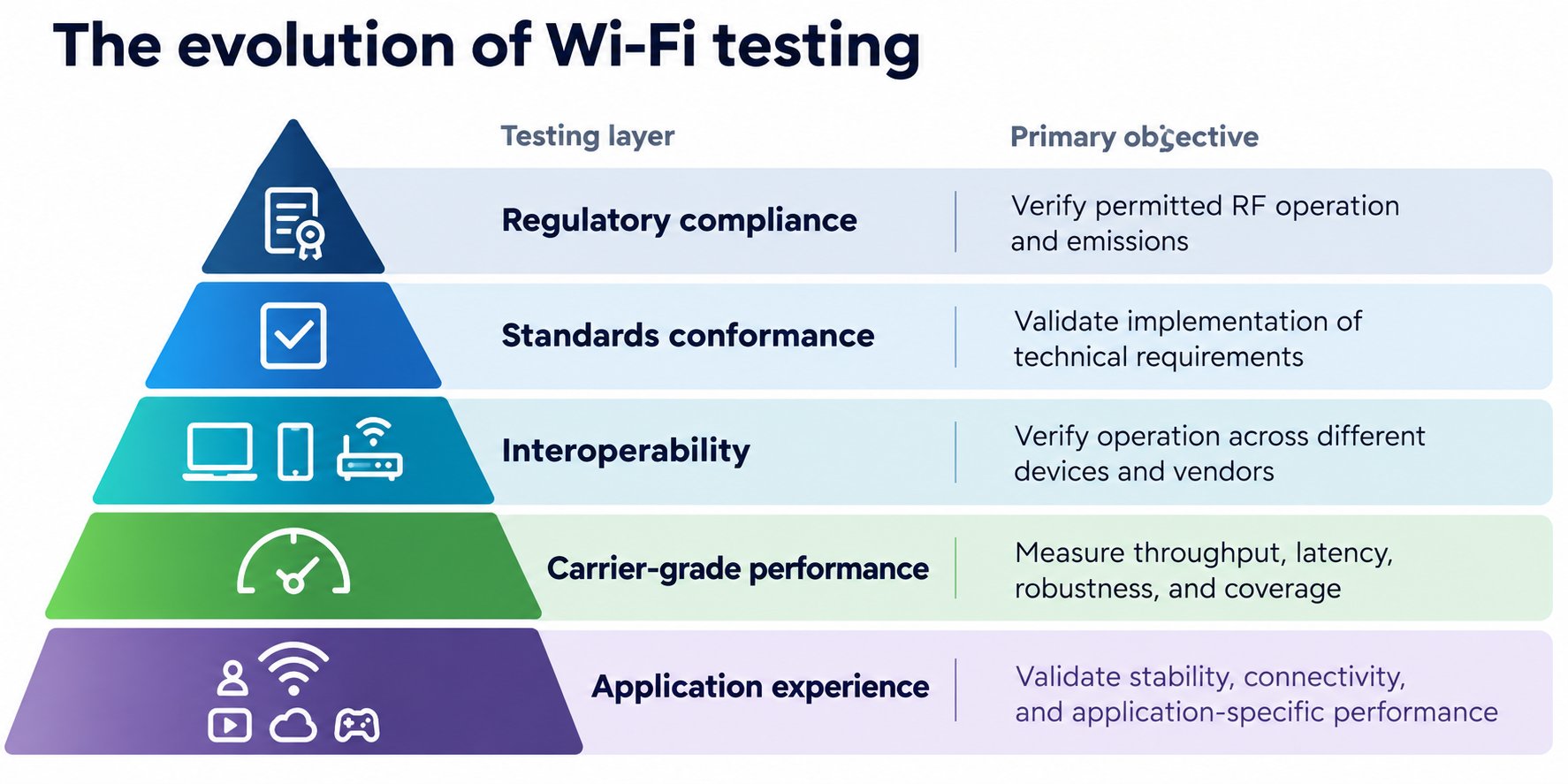
The distinction is important: Compliance and interoperability establish whether equipment works as intended, while performance benchmarking determines how well it works under practical operating conditions.
2. Wi-Fi 8 changes the definition of wireless performance
The transition from Wi-Fi 7 to Wi-Fi 8 represents an important change in the industry’s technical priorities. Wi-Fi 7, based on IEEE 802.11be, is associated with Extremely High Throughput (EHT). Wi-Fi 8, being developed through IEEE 802.11bn, is instead focused on Ultra High Reliability (UHR).
Rather than concentrating primarily on increasing theoretical peak speeds, Wi-Fi 8 aims to improve effective performance under challenging conditions, including interference, variable signal quality, and dense deployments. Joerg Koepp emphasised that the objective is increasingly to make better use of available physical resources rather than simply increasing theoretical maximum data rates. Wi-Fi 8 introduces additional mechanisms and configuration options intended to improve reliability and efficiency, including:
- Distributed Resource Units (DRUs) and bandwidth allocation.
- Unequal modulation and more flexible modulation and coding configurations.
- MIMO stream configurations and related optimisation.
- Power allocation and adaptation.
- More sophisticated combinations of radio parameters.
These mechanisms provide equipment manufacturers with greater flexibility, but also introduce substantial implementation complexity. The standard defines how individual mechanisms should operate, but it does not necessarily prescribe how an access point or client device should select among them in every situation.
Consequently, different implementations may deliver different performance outcomes even when they conform to the same standard. Joerg Koepp compared the expanding range of Wi-Fi 8 configuration options to operating an audio mixing console with numerous adjustable controls.
For equipment developers, the challenge is therefore twofold: Validating a much larger number of technical configurations and understanding how the different mechanisms interact to determine overall performance.
3. Dynamic spectrum management introduces new testing requirements
Another important development discussed during the presentation was the increasing use of dynamic spectrum management. As wireless spectrum becomes more heavily utilised, regulators are introducing mechanisms that allow different services to share frequency resources while protecting incumbent users. Joerg Koepp highlighted three approaches:
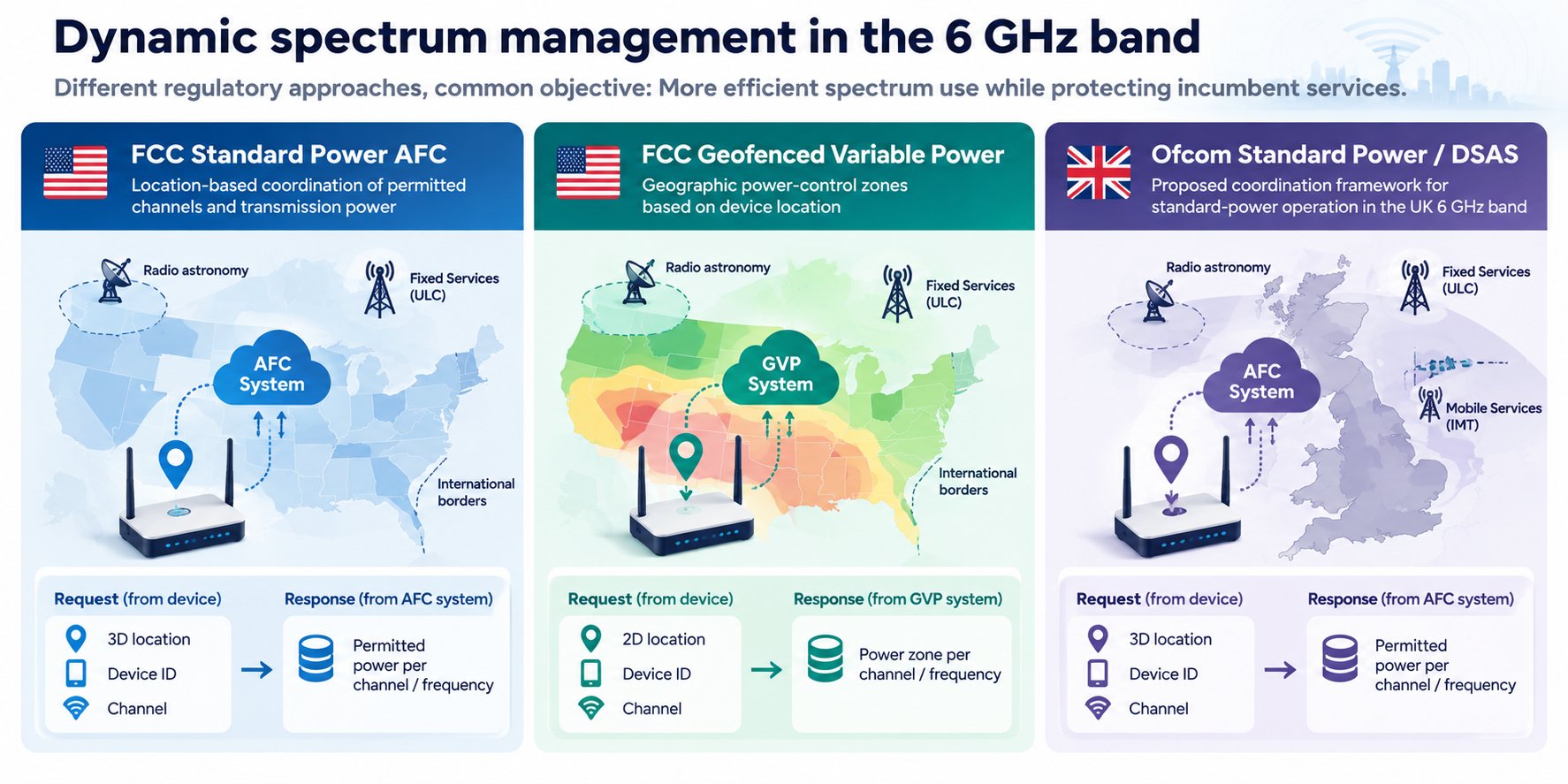
These mechanisms introduce dependencies between regulatory databases, access points, client devices, and their operating environments. Testing must therefore establish whether equipment correctly responds to externally supplied operating restrictions, including permitted channels and transmission power limits.
Joerg Koepp suggested that such mechanisms could eventually support increasingly flexible spectrum-sharing arrangements, potentially including different allocations for particular locations or events. Rohde & Schwarz sees signalling-based testing as an important tool for validating these dynamic operating conditions, including the ability of devices to respond correctly to transmission power instructions.
4. Wi-Fi optimised for AI versus Wi-Fi optimised by AI
One of the presentation’s most important distinctions concerned the role of artificial intelligence in future wireless networks. Joerg Koepp separated the topic into two categories: Wi-Fi optimised for AI applications and Wi-Fi optimised through AI and machine learning.
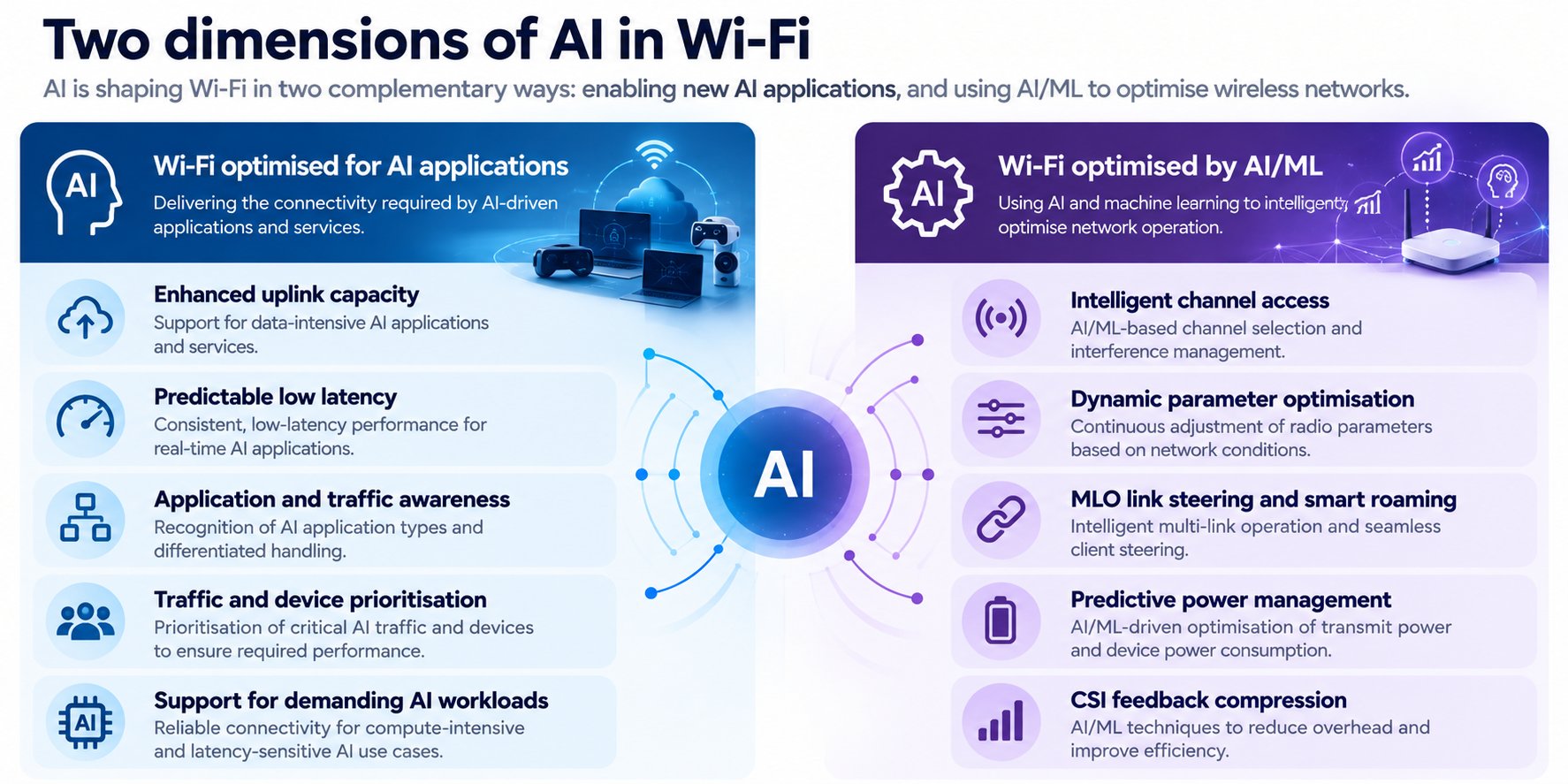
Emerging AI applications may impose new requirements on wireless connectivity, including predictable latency, increased uplink capacity, application-aware traffic handling, and differentiated prioritisation. However, Joerg Koepp pointed out that AI applications do not represent a single uniform traffic category. Different applications generate different traffic patterns and have different performance requirements.
Consequently, testing must reflect the characteristics of specific applications rather than treating AI traffic as one generic workload.
Wi-Fi optimised by AI
The second category involves using AI and machine learning to control and optimise wireless operation itself. Examples include dynamically selecting channels, adjusting transmission parameters, steering traffic across multiple links, managing interference, and optimising power consumption. These capabilities introduce a different validation challenge.
An AI-controlled radio may continuously adjust its behaviour depending on environmental conditions, traffic demands, and optimisation algorithms. Testing must therefore establish not only whether individual RF parameters are correct, but whether the system makes appropriate decisions across a broad range of conditions. This becomes particularly important when algorithms produce unexpected outcomes.
5. Wi-Fi 9: Toward intelligent wireless networking
Although Wi-Fi 9 remains at an early exploratory stage, Koepp outlined the industry’s emerging direction toward intelligent wireless networking. The applications being considered extend beyond conventional connectivity to include immersive entertainment, autonomous systems, AI-driven applications, and human-machine interaction. Two requirements stand out.
Predictable performance: Networks must deliver application-appropriate performance, including latency characteristics that remain dependable over time.
Adaptability: Networks must adjust their behaviour to changing traffic demands, application requirements, and environmental conditions.
Additional areas under consideration include post-quantum cryptographic security, extreme power efficiency, and peer-to-peer networking. These are emerging directions under study rather than finalised Wi-Fi 9 specifications but the overall trajectory is clear: Future wireless systems will be expected to provide dependable, application-specific connectivity while responding intelligently to changing conditions.
6. Testing intelligent Wi-Fi: Shift-left development, simulation, and real-world scenarios
The increasing complexity of wireless systems requires changes not only in what engineers measure, but also in when and how testing takes place. Koepp identified three closely related developments.
Shift-left testing and automation
Shift-left testing means performing more extensive validation earlier in the product development process rather than waiting until late-stage certification, production, or field deployment. Koepp explained that field optimisation tools remain valuable for identifying and resolving operational problems. Network engineers can change access point locations, antenna configurations, and deployment parameters, but they generally cannot fundamentally redesign how an access point’s internal algorithms operate.
These implementation decisions must be evaluated during development. Automated test workflows are therefore becoming increasingly important, particularly as Wi-Fi 8 introduces more configuration options and interactions between radio parameters.
Scenario-based testing and field-to-lab validation
Traditional RF measurements under controlled conditions remain essential, but they cannot fully describe how wireless equipment performs when multiple variables interact. Koepp highlighted several complementary approaches:
- Channel emulation to reproduce wireless propagation conditions.
- Ray tracing and environmental simulation to model physical environments.
- Application-based testing to evaluate performance against specific service requirements.
- Field-to-lab testing to reproduce conditions observed in actual deployments.
- Automated workflows to evaluate larger combinations of operating parameters.
A particularly important benefit is repeatability. By capturing or modelling real-world conditions and reproducing them in the laboratory, engineers can compare hardware designs, firmware revisions, and optimisation strategies under consistent conditions.
This approach can also help geographically distributed engineering teams reproduce comparable test environments without requiring identical large-scale physical facilities.
Validating AI-driven radio behaviour
AI-based radio optimisation introduces additional challenges because system behaviour may change continuously as algorithms respond to traffic, interference, and channel conditions. Joerg Koepp argued that conventional testing at a limited number of operating points may therefore be insufficient. Instead, engineers need to evaluate radio behaviour across broader operating conditions, including situations that stress optimisation algorithms and expose potentially unexpected responses.
The objective is to understand whether the system continues to make appropriate decisions as circumstances change. Taken together, these developments point toward a more integrated testing methodology combining precision RF measurements, automation, digital simulation, and application-aware performance evaluation.
7. Rohde & Schwarz: Testing across the wireless product lifecycle
Rohde & Schwarz positions its wireless test and measurement portfolio across the complete product development lifecycle, from early research and prototyping through engineering validation, conformance testing, and mass production. Joerg Koepp highlighted several platforms during the presentation.
The R&S SMW and FSW instruments support advanced signal generation and analysis for research and engineering activities. The R&S CMX500 provides a high-performance signalling test platform supporting advanced Wi-Fi technologies, including Wi-Fi 6E and Wi-Fi 7, with Wi-Fi 8 development and testing capabilities forming part of the company’s technology direction. The R&S CMP180 addresses high-performance wireless testing, including engineering and production environments.
Joerg Koepp also highlighted the company’s work across adjacent wireless technologies, including Bluetooth and Ultra-Wideband (UWB). For example, the CMP180 can support production testing requirements involving multiple wireless technologies, while Rohde & Schwarz also provides dedicated UWB solutions for research, certification, and production testing. This cross-technology capability is increasingly relevant for connected devices that integrate several wireless interfaces.
Beyond mainstream Wi-Fi evolution, Joerg Koepp identified Wi-Fi HaLow, wireless sensing and positioning, and millimetre-wave technologies as important emerging areas. These developments are expanding the scope of wireless testing beyond conventional connectivity and increasing demand for flexible measurement platforms.
Conclusion: Testing must evolve with wireless intelligence
The transition from Wi-Fi 7 to Wi-Fi 8, and eventually toward intelligent Wi-Fi 9, represents more than another generational technology upgrade. It signals a change in how wireless performance is defined and evaluated.
For equipment manufacturers, chipset developers, and test laboratories, the implications extend across the entire development process. More complex radio implementations require earlier validation, greater automation, and testing methodologies capable of reproducing realistic operating conditions. Joerg Koepp’s central message is that the next generation of wireless testing must combine traditional precision RF measurements with repeatable, application-aware evaluation of complete system behaviour. As Wi-Fi becomes more intelligent, the ability to validate that intelligence will become an essential part of delivering reliable wireless connectivity.
This report is based on the presentation “From speed to reliability: Testing & validation for the era of intelligent Wi-Fi” delivered by Joerg Koepp, Market Segment & Technology Manager at Rohde & Schwarz, during the WiFi NOW Design, Validation & Test Forum 2026, and the accompanying session transcript. For more information about Rohde & Schwarz WLAN test and measurement solutions, visit rohde-schwarz.com.