By Claus Hetting, WiFi NOW CEO & Chairman
As Wi-Fi evolves towards Wi-Fi 8, the wireless industry is facing a fundamental change in how devices must be designed, tested, and validated. Peak throughput is no longer sufficient as the primary measure of wireless performance. Reliability under challenging RF conditions, application-level responsiveness, AI workloads, radio coexistence, and increasingly complex device architectures are creating new requirements for test and measurement.
At the WiFi NOW DVT Forum in September 2026, Khushboo Kalyani of LitePoint, a Teradyne company, outlined how the industry must adapt its validation methodologies to address these challenges. The following report examines the major technology trends, emerging testing requirements, and implications for wireless device development.
For the full video and all details, watch the WiFi NOW Design, Validation, & Test Forum 2026 here.
1. The benchmark is shifting from peak speed to predictable performance
For much of Wi-Fi’s development history, successive generations have been characterised by increasing peak data rates. Wider channels, higher-order modulation, additional spatial streams, and more efficient spectrum utilisation have contributed to substantial increases in theoretical throughput.
Wi-Fi 8, based on the developing IEEE 802.11bn standard, represents an important change in emphasis. Rather than primarily targeting another increase in headline throughput, Wi-Fi 8 focuses on improving the reliability and consistency of wireless connectivity, particularly under challenging radio conditions. This changes what engineers need to measure. Traditional performance testing might establish the maximum throughput of a device under favourable signal conditions.
While this remains important, it provides limited information about how the device behaves as signal strength deteriorates, interference increases, or the distance between the access point and client changes. LitePoint argues that future validation must examine the entire performance curve, not simply its maximum point.
The objective is to determine whether performance deteriorates progressively and predictably as RF conditions worsen, rather than experiencing sudden and severe reductions in data rate. This distinction matters for applications that depend on stable connectivity, including real-time communications, industrial systems, robotics, and AI-enabled devices.
A device that delivers exceptional peak throughput but experiences abrupt performance failures may provide a worse user experience than one with more consistent performance across changing conditions. The central validation question is therefore changing from “How fast can the device operate?” to “How reliably does the device perform as conditions deteriorate?”
2. Reliability requires both RF testing and live system validation
LitePoint identifies two complementary approaches to validating wireless reliability: conducted RF testing and what the company calls mission mode testing. Conducted RF testing examines the characteristics of the radio hardware in a controlled environment. Mission mode testing evaluates communication between devices operating with their actual firmware and system configurations. Both are necessary because RF hardware performance and complete system behaviour are not the same thing.
Conducted RF testing
Conducted testing remains fundamental to device development because it provides repeatable measurements of transmitter and receiver characteristics. Relevant measurements include:
- Transmit power and power spectral density (PSD): Verify RF output characteristics and operation within applicable limits.
- Spectrum mask: Evaluate unwanted emissions and spectral containment.
- Error vector magnitude (EVM): Measure modulation accuracy and transmitter signal quality.
- Receiver sensitivity: Determine the ability to decode signals under weak-signal conditions.
These measurements help identify hardware-related issues and establish the fundamental capabilities of the radio. For Wi-Fi 8, LitePoint connects such measurements with emerging mechanisms intended to improve operation under less favourable RF conditions. For example, receiver sensitivity testing becomes particularly relevant when evaluating extended-range transmissions and the ability to decode packets at low signal levels.
Mission mode testing
Mission mode validation goes further by testing devices operating with live firmware, including their actual rate adaptation & other system-level algorithms. LitePoint identifies three relevant measurement areas:
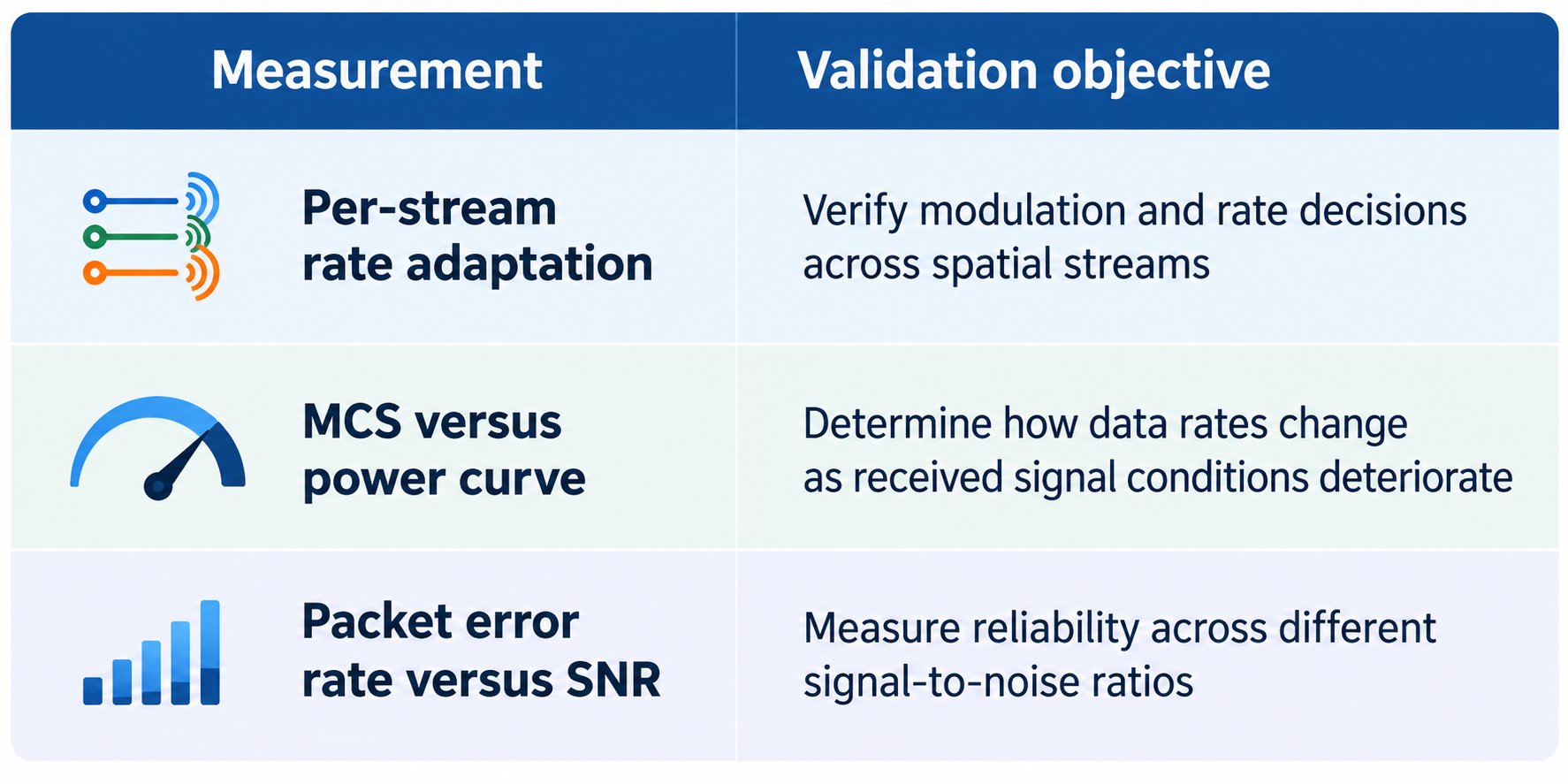
Mission mode testing can reveal problems that conventional conducted RF measurements may not detect. A radio may meet its hardware specifications while the complete device still exhibits poor rate adaptation, excessive retransmissions, or unexpected performance instability. This is especially important as Wi-Fi 8 introduces additional mechanisms intended to improve performance in interference-limited environments. The implication is that device validation must increasingly connect PHY-layer measurements with the behaviour of the complete wireless system.
3. Packet-level analysis connects RF conditions with device behaviour
As validation moves beyond isolated RF measurements, engineers need better visibility into the actual exchange of wireless packets between devices. LitePoint addresses this requirement with its IQsniffer radio traffic analysis solution. IQsniffer operates in conjunction with LitePoint test equipment to capture and analyse wireless traffic during device operation. According to LitePoint, the solution supports three principal functions:
- Capture: Observe real-world signal exchanges between devices.
- Identify: Locate radio traffic problems during mission mode operation.
- Evaluate: Determine how PHY-layer conditions influence device-level performance.
This type of analysis is particularly valuable when diagnosing problems that occur only under specific operating conditions. For example, a device might experience unexpectedly low throughput even though its transmitter characteristics satisfy conventional RF requirements. Packet-level analysis can help engineers determine whether the problem is related to rate adaptation, interference, retransmissions, or other aspects of wireless communication.
The broader significance is the ability to correlate RF measurements with observed system behaviour. Rather than treating RF performance and application performance as separate engineering disciplines, validation increasingly requires an understanding of how one influences the other.
4. AI at the edge introduces new wireless performance requirements
The increasing use of AI applications creates additional demands on wireless connectivity. LitePoint illustrates this with a familiar example: An AI application appears to be responding slowly, producing text irregularly, or failing to return a response. Users may attribute the problem to the AI service itself. However, the underlying cause could be wireless connectivity.
A delayed uplink transmission, packet loss, or connection timeout can prevent a request from reaching the processing system or delay the delivery of its response. This becomes particularly relevant as AI processing moves closer to the network edge. AI-enabled access points and gateways Wireless chipset and platform suppliers are increasingly incorporating AI processing capabilities into access points and residential gateways.
In LitePoint’s presentation, the example architecture combines a Wi-Fi radio with a neural processing unit (NPU) capable of performing local inference, with cloud processing available when required. This introduces two separate but interconnected performance constraints:
- Radio capacity and the ability to transfer application data reliably.
- Compute capacity and the ability to process AI workloads within the required time.
An application may be constrained by either one. Consequently, RF performance becomes part of the overall AI application performance equation.
New validation metrics for AI workloads
LitePoint identifies several additional considerations for AI-oriented wireless validation.
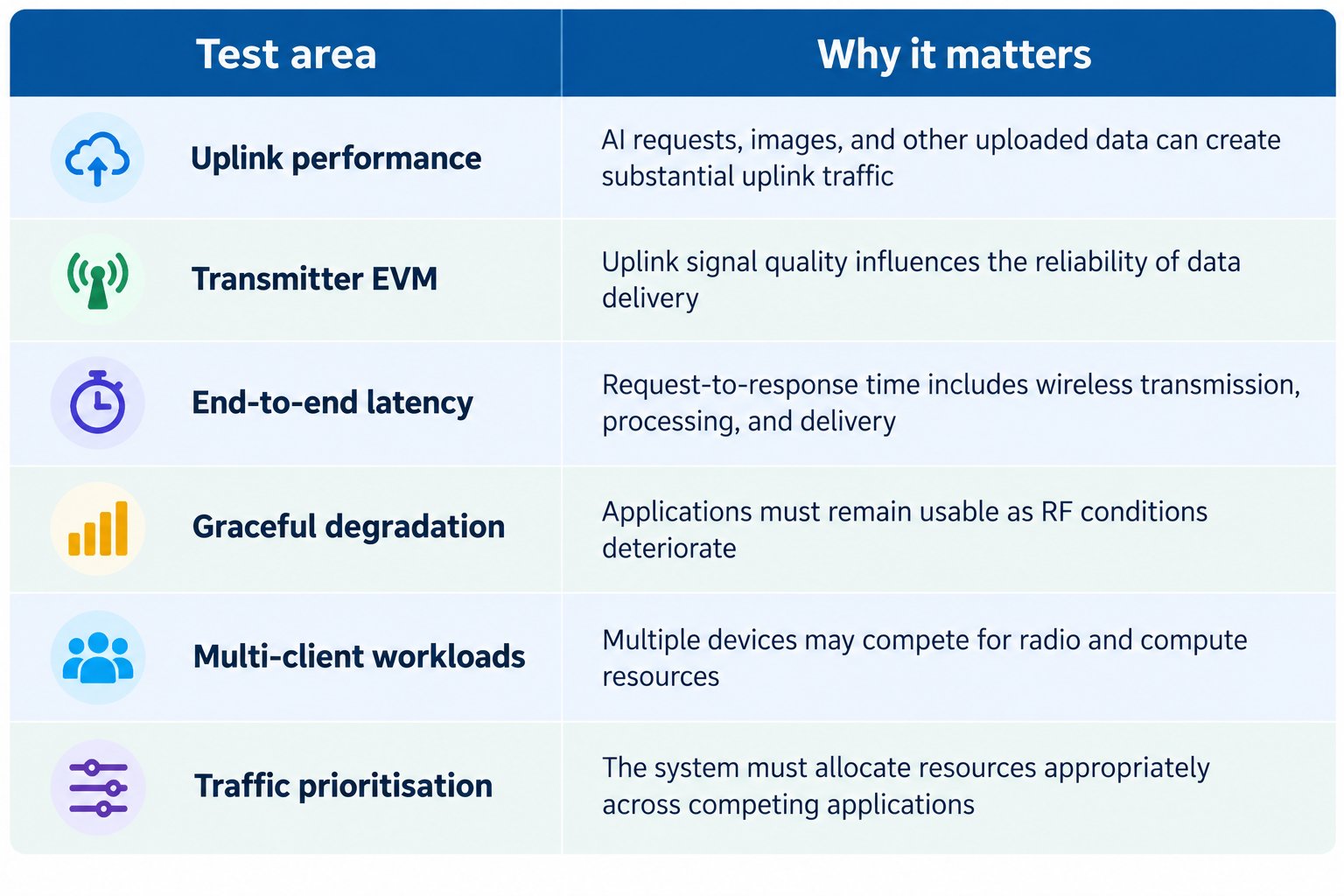
The important change is that traditional RF measurements must be interpreted in the context of actual application requirements. For example, testing an AI-enabled gateway may require simultaneous uplink-heavy traffic from multiple devices while measuring request-to-response latency and packet delivery reliability.
A system that performs well with a single client under ideal RF conditions may behave very differently when several AI-enabled devices compete for wireless and processing resources. This introduces a requirement for more realistic workload-based validation.
5. Increasing radio counts make coexistence testing essential
Wireless devices are becoming increasingly complex because they incorporate multiple radio technologies. A single device may include Wi-Fi, Bluetooth, cellular, and other wireless interfaces. Some radios operate in shared frequency bands, while others occupy adjacent spectrum. LitePoint notes that devices may contain seven to ten radios, depending on their architecture and intended functions. This creates additional opportunities for interference, unwanted coupling, and receiver desensitisation.
Interference in the 2.4 GHz environment
The 2.4 GHz band provides a familiar example. Wi-Fi and Bluetooth operate in overlapping spectrum, and their transmissions must coexist. Bluetooth frequency hopping can result in transmissions overlapping with Wi-Fi activity, potentially causing packet collisions or degraded communication performance. Adjacent cellular operation introduces additional challenges.
LitePoint highlights the proximity of cellular bands n40 and n41 to the 2.4 GHz Wi-Fi spectrum as an example of situations in which adjacent-band interference and unwanted emissions can affect receiver performance. The potential consequences include:
- Increased packet errors and data loss.
- Reduced throughput.
- Receiver desensitisation.
- Dropped connections.
- Less predictable application performance.
From isolated testing to crowded RF environments
Traditional validation may establish that each radio operates correctly when tested independently. However, this does not necessarily establish that all radios will perform satisfactorily when operating simultaneously. A Wi-Fi receiver may satisfy sensitivity requirements under controlled conditions but experience degraded performance when another radio within the same device is transmitting.
Similarly, a product may function correctly in a quiet laboratory environment but behave unpredictably in a crowded wireless environment. LitePoint argues that coexistence testing should therefore become an integral part of product development rather than a specialised activity performed late in the validation process. The objective is to identify coexistence problems before devices reach production, when hardware and system changes become more expensive.
6. Wi-Fi in millimetre-wave spectrum will change testing methodologies
Another important development highlighted by LitePoint is the IEEE 802.11bq initiative, which explores Wi-Fi operation in millimetre-wave spectrum. The presentation describes operation in the 42-71 GHz frequency range, potentially combining a high-capacity millimetre-wave data link with a sub-7 GHz connection through multi-link operation.
The concept is that a lower-frequency link can provide connectivity and control functions while a millimetre-wave link supports high-speed data transmission. This represents a significant change from conventional Wi-Fi testing in the 2.4 GHz, 5 GHz, and 6 GHz bands.
New test requirements
LitePoint identifies five principal changes associated with millimetre-wave Wi-Fi.
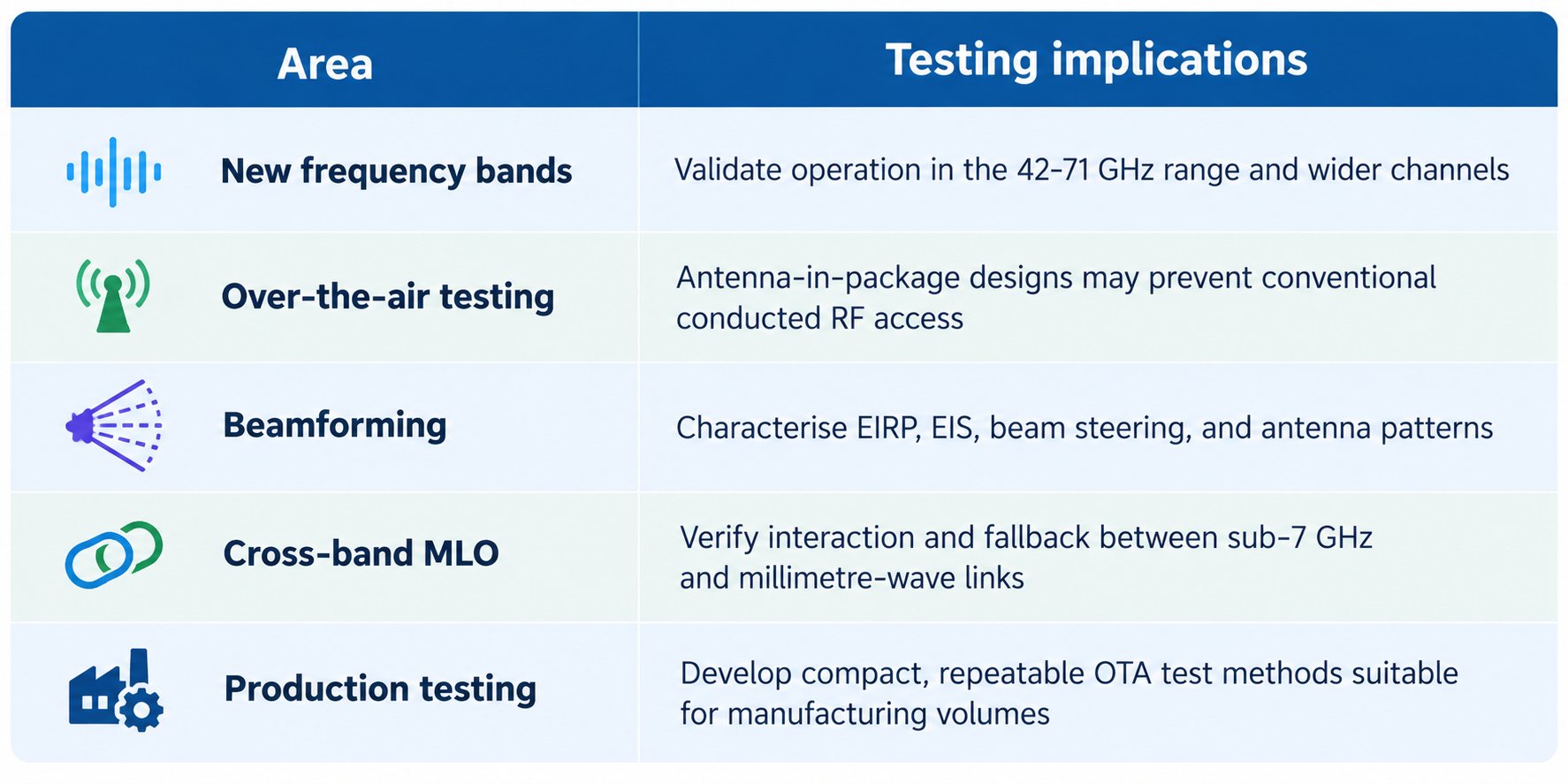
Millimetre-wave operation makes antenna performance and beamforming central to the wireless link. The device must maintain connectivity while accounting for directionality, blockage, beam alignment, and other propagation characteristics. This introduces additional testing requirements beyond those associated with conventional conducted RF measurements.
Over-the-air validation becomes increasingly important
At millimetre-wave frequencies, antenna-in-package integration may eliminate convenient RF test connectors. Consequently, over-the-air (OTA) measurements become essential for evaluating the complete radio and antenna system. Engineering teams must consider test chambers, near-field and far-field measurement techniques, antenna patterns, and repeatability.
The transition also affects manufacturing. High-volume production requires test procedures that can deliver reliable results within practical cycle times. IEEE 802.11bq remains a developing initiative, and the presentation describes future testing requirements rather than an already established commercial Wi-Fi test regime.
7. Wi-Fi 7 and Wi-Fi 8 are multiplying the test matrix
The increasing complexity of wireless standards creates another challenge: The number of possible test configurations is growing substantially. Wi-Fi 7 introduced capabilities including 320 MHz channels, multi-link operation, multi-resource unit allocation, and preamble puncturing. Wi-Fi 8 builds on the Wi-Fi 7 foundation while introducing additional reliability-oriented mechanisms.
For validation engineers, this means that the number of possible combinations of features, channel conditions, device configurations, and operating modes can become extremely large. Testing every possible permutation manually is increasingly impractical.
Automation becomes central to validation
LitePoint identifies several capabilities required from next-generation test automation systems.
- Chipset-specific test libraries: Pre-validated test flows reduce configuration effort.
- Consistent workflows: Common methods support R&D, characterisation, validation, and manufacturing.
- Scalable execution: Automation supports increasing test volumes and multiple devices.
- Result correlation: Comparable measurements across development stages make problems easier to isolate.
- Faster debugging: Structured logs and analysis tools help engineers identify failures.
- The company’s IQfact+ software platform is presented as an example of this approach.
The objective is to create a more continuous testing process from early development through volume manufacturing. Rather than rebuilding test procedures at each stage, engineers can reuse and adapt established workflows. This also supports more consistent correlation between laboratory measurements and manufacturing test results.
Test automation as a development requirement
The issue is not simply engineering convenience. As new wireless products reach the market more rapidly, manufacturers must complete increasingly complex validation programmes within constrained development schedules. Without automation, the expanding test matrix can increase engineering effort, delay product launches, and raise test costs. LitePoint’s argument is that automation is becoming necessary to maintain both validation coverage and development efficiency.
8. Implications for the wireless device industry
The developments described by LitePoint point towards a broader change in wireless engineering. Testing is moving from relatively isolated measurements of radio characteristics towards a more comprehensive evaluation of how wireless devices behave under realistic operating conditions. This has implications across the device ecosystem. For chipset suppliers, it increases the importance of validating advanced PHY features, rate adaptation, and multi-radio operation.
For access point and gateway manufacturers, it introduces additional requirements related to live firmware, AI processing, application responsiveness, and interference management. For device manufacturers, it raises the importance of testing complete products rather than relying exclusively on reference-design or component-level results. For test equipment suppliers, it creates demand for more integrated solutions combining RF measurements, packet-level analysis, OTA testing, and automated workflows.
The direction is particularly relevant to Wi-Fi 8. As the industry places greater emphasis on ultra-high reliability, validation must demonstrate that these improvements translate into measurable device and system performance.
9. Key conclusions
LitePoint’s presentation identifies five priorities for the future of wireless device development and validation.
1. Reliability becomes a primary validation target: Engineers must measure performance across changing RF conditions, not simply peak throughput.
2. RF performance and AI application performance become increasingly interconnected: Wireless testing must consider end-to-end responsiveness, uplink traffic, and realistic AI workloads.
3. Radio coexistence must be tested systematically: Multi-radio devices need to operate reliably in crowded and interference-prone environments.
4. Automation becomes essential to maintaining test coverage: Increasing numbers of feature combinations require scalable and repeatable validation workflows.
5. Millimetre-wave Wi-Fi will accelerate the transition towards OTA testing.
Beamforming, antenna integration, and cross-band operation will introduce new measurement requirements. The overarching conclusion is that the future of wireless validation is not simply about measuring whether a device meets its radio specifications. It is about establishing whether the complete device can deliver reliable, predictable performance under the conditions in which it will actually be used. For Wi-Fi 8 and emerging AI-enabled wireless devices, that distinction is becoming increasingly important.
About LitePoint:
LitePoint is a San Jose-based wireless test and measurement company and part of Teradyne. Founded in 2000 and acquired by Teradyne in 2011, LitePoint develops solutions for wireless device design, characterisation, validation, and manufacturing. Its portfolio covers Wi-Fi, cellular, Bluetooth, UWB, NFC, and other wireless technologies. The company’s Wi-Fi test equipment includes the IQxel family, while its software offerings include IQsniffer for radio traffic analysis and IQfact+ for test automation.
Source: Khushboo Kalyani, LitePoint Product Marketing, “Future of Device Development and Validation,” presented at the WiFi NOW DVT Forum, September 2026. This report is based on the presentation and accompanying transcript. Conceptual technology examples are not independent performance benchmarks or product test results.
/Claus.