
By Claus Hetting, WiFi NOW CEO & Chairman
Intel’s approach to validating next-generation wireless chipsets is moving beyond conventional laboratory throughput testing. At its 21,000-square-foot over-the-air validation facility, Intel uses robotic mobility systems, automated positioning, real-world office environments, and high-density client testing to evaluate how Wi-Fi performs under actual deployment conditions. The methodology is particularly relevant to Wi-Fi 8, where reliability, mobility, and consistent performance are becoming central objectives.
At WiFi NOW’s DVT Forum 2026, Mohammad Mansour, Engineering Manager and Group Lead in Intel’s Wireless Connectivity Solutions organisation, presented the company’s approach to validating next-generation wireless chipsets. His central message was that wireless performance cannot be adequately characterised through peak throughput measurements or conventional single-client laboratory testing alone.
Watch Mohammad Mansour’s full presentation video here.
Real-world Wi-Fi performance depends on a complex combination of factors, including chipset design, host platforms, antennas, access points, drivers, firmware, network configurations, interference, client density, and mobility. As Wi-Fi evolves from Wi-Fi 7 toward Wi-Fi 8, these dependencies are becoming increasingly important. The industry is shifting its attention from maximum achievable data rates toward reliable connectivity, predictable performance, and application continuity across changing network conditions.
Intel’s validation infrastructure is designed to reproduce these conditions systematically, allowing engineers to identify problems, optimise wireless platforms, and verify improvements before products reach customers.
1. Why conventional wireless testing is no longer sufficient
Traditional wireless performance testing often involves a single client connected to an access point under controlled, stationary conditions. Such tests remain useful for establishing baseline performance, characterising radio capabilities, and measuring maximum throughput. However, they reveal only part of the wireless experience. In practical deployments, devices move between access points, compete for available airtime, experience interference, and operate under changing signal conditions. Applications may be sensitive to short interruptions, packet loss, or latency variations even when average throughput remains high. Mohammad Mansour highlighted several challenges associated with validating wireless performance:
- Platform diversity: Different combinations of chipsets, antennas, host systems, drivers, and firmware can produce different results.
- Mobility and roaming: Brief interruptions during movement can be difficult to reproduce in conventional laboratory setups.
- Client density: Multiple devices competing for airtime introduce congestion, latency, and quality-of-service challenges.
- Interoperability: Wireless platforms must operate reliably with access points, operating systems, and devices from multiple vendors.
- New wireless capabilities: Wi-Fi 7 features, including Multi-Link Operation (MLO), require validation under realistic operating conditions.
A fundamental challenge is repeatability. Engineers must be able to reproduce a performance problem under sufficiently similar conditions to identify its cause and determine whether a proposed correction works. This is particularly important for transient failures, which may occur only during specific combinations of mobility, interference, application traffic, and network configuration.
2. Inside Intel’s 21,000-square-foot OTA validation facility
Intel operates a large-scale over-the-air (OTA) validation facility designed to reproduce conditions encountered in enterprise and consumer deployments. The facility covers about 21,000 square feet and includes office cubicles, conference rooms, and multiple wireless infrastructure configurations. Unlike a conventional RF laboratory consisting primarily of isolated test stations, the facility provides a physical environment in which wireless signals interact with building structures, furnishings, access points, and moving devices.
One of its most distinctive capabilities is the use of robotic testing systems. These robots transport wireless client devices along predefined routes, allowing engineers to execute mobility and roaming tests repeatedly under controlled conditions. Intel also uses automated XY positioning tables and 360-degree rotational platforms to evaluate performance as device location and orientation change. Together, these capabilities support a broad range of validation activities.
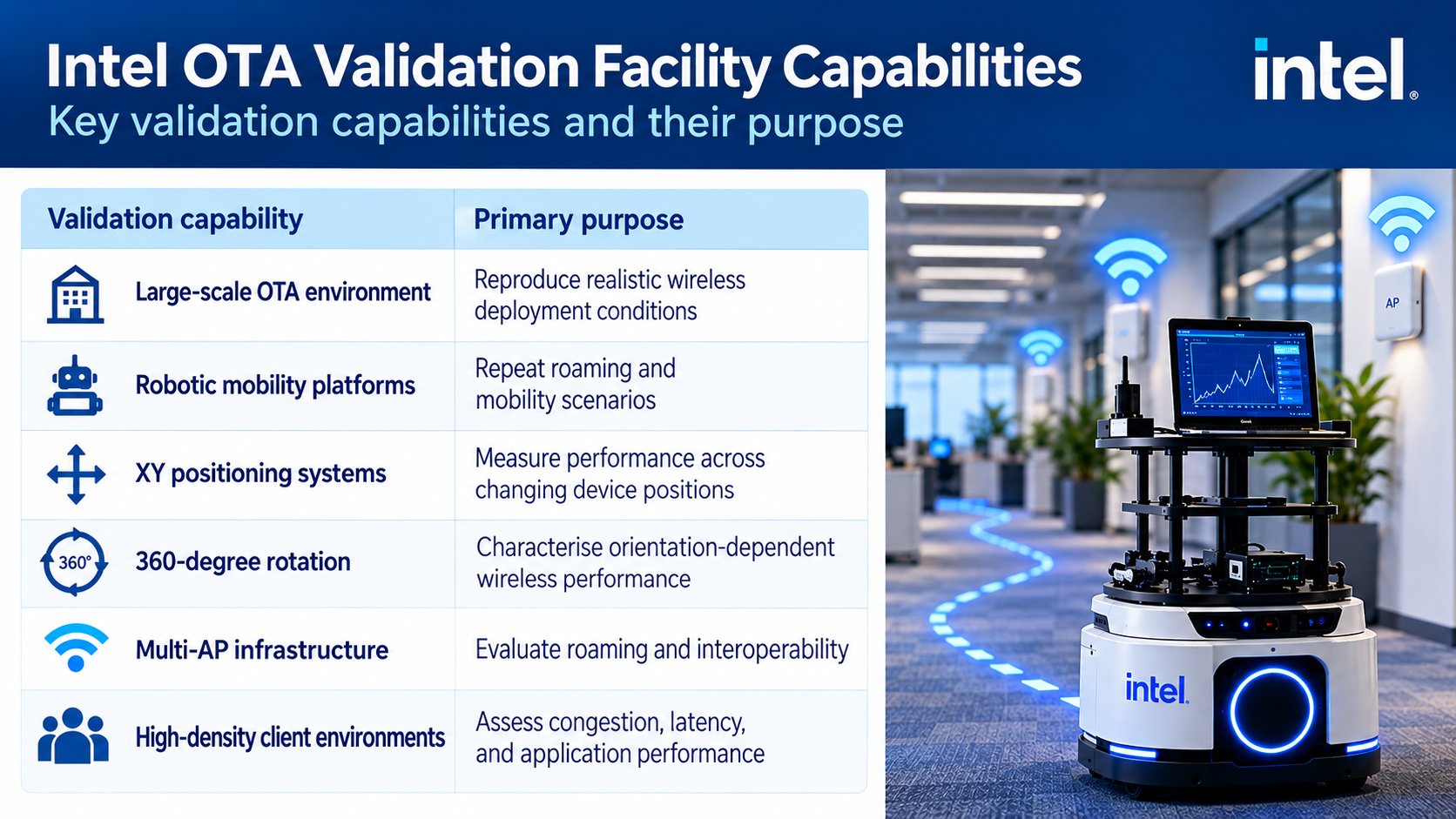
The facility supports continuous validation of wireless platforms, drivers, firmware, and new features, including regression testing following software changes. Importantly, the infrastructure allows engineers to compare different devices, configurations, and wireless generations under repeatable conditions. This creates a more reliable basis for understanding whether an observed performance improvement is attributable to a particular design change or technology.
3. Performance and range: Looking beyond peak throughput
Wi-Fi 7 introduced significant physical-layer performance improvements, including support for 320 MHz channels in the 6 GHz band and Multi-Link Operation. During the presentation, Mansour reported that Intel had measured throughput exceeding 4 Gbps using Wi-Fi 7 with 320 MHz channels in a real-world test environment. However, he emphasised that achieving high throughput close to an access point is no longer sufficient to characterise wireless platform quality.
Wireless clients operate at different distances, orientations, and signal levels, including non-line-of-sight conditions. Performance may vary substantially depending on antenna design, platform integration, and the surrounding environment. Intel’s validation methodology therefore evaluates performance across a wider range of physical conditions. Automated XY positioning systems move devices through defined measurement locations, while rotational platforms evaluate performance across a full 360 degrees.
The resulting measurements can be used to construct performance heat maps and identify areas where wireless performance degrades. Intel uses these techniques to characterise operation across the 2.4 GHz, 5 GHz, and 6 GHz bands, including advanced Wi-Fi 7 capabilities. The presentation included examples comparing laptop performance at different orientations, illustrating that devices with nominally similar wireless capabilities can produce materially different results.
It also presented throughput comparisons between Wi-Fi 7 and Wi-Fi 6 at different distances, demonstrating the value of examining performance throughout the coverage area rather than at a single favourable location. These measurements provide engineering input for antenna optimisation, platform configuration, and driver development.
Example: Intel’s Wi-Fi 7 performance measurements
The following values are taken from the chart on page 4 of Intel’s presentation. They represent selected measured receive-throughput results, not universal performance guarantees.
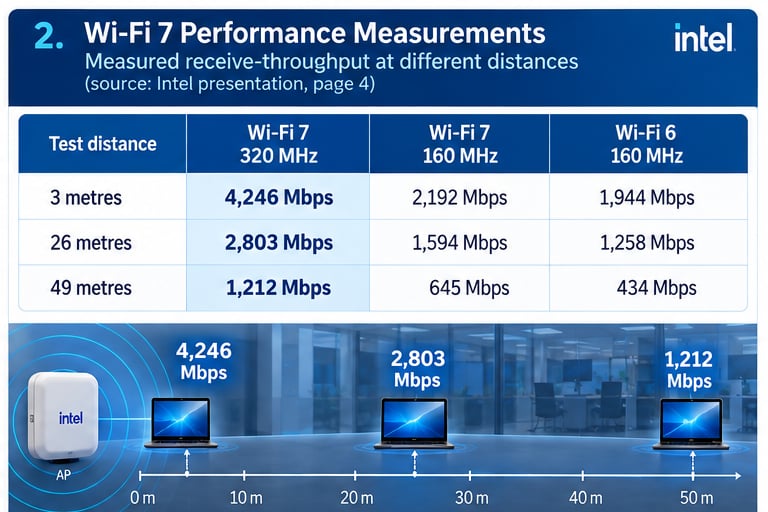
The measurements illustrate how a wider channel can provide substantial throughput advantages under the tested conditions, while also showing how performance changes with distance. The broader engineering lesson is that comparisons between wireless platforms should account for the full operating environment, not merely the highest measured throughput.
4. Robotic roaming validation: Measuring the complete mobility experience
Roaming is one of the most challenging aspects of wireless validation because problems frequently occur during brief transitions between access points. A device may appear to maintain connectivity while an application experiences packet loss, increased latency, or a temporary interruption. Conventional roaming tests can simulate changing signal strengths through conducted RF connections and programmable attenuation. However, Mansour explained that such methods do not always reproduce actual over-the-air roaming behaviour accurately.
Intel addresses this limitation using robotic mobility platforms that move wireless devices through physical environments along predefined paths. Because the robot’s location and movement are controlled, engineers can repeat the same roaming scenario and compare the resulting measurements. The validation process includes several metrics:
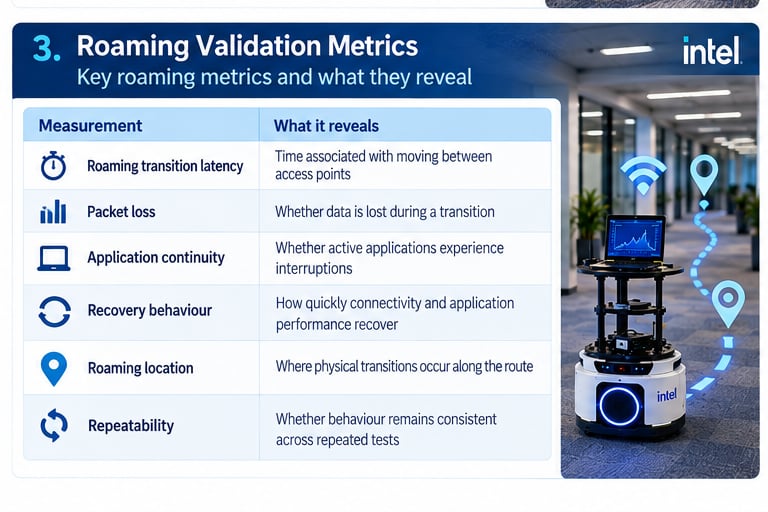
Crucially, Intel performs these measurements while devices execute real-world application workloads. These include video conferencing, voice, streaming, interactive applications, and other traffic sensitive to interruption or latency. This allows engineers to evaluate not only whether a client successfully associates with a new access point, but whether the transition maintains an acceptable user experience.
The approach also supports analysis of roaming predictability, helping identify whether transitions occur consistently under comparable conditions.
Using robots to validate Wi-Fi positioning
Intel’s robotic infrastructure also supports wireless ranging and indoor positioning validation. Because the robot’s physical location is known, its coordinates serve as ground-truth reference against which Wi-Fi-derived position or distance estimates are compared. The presentation included an example involving IEEE 802.11mc and 802.11az ranging, with measurements taken over a route of approximately 60 metres.
Comparing reported wireless measurements with the robot’s known position allows engineers to assess positioning accuracy and consistency. This extends the value of robotic testing beyond connectivity and roaming into emerging location-aware wireless applications.
5. High-density testing and multi-vendor interoperability
A further challenge in wireless validation is reproducing the behaviour of networks containing many simultaneously active devices. Even relatively small residential networks may support numerous connected clients, while enterprise environments can involve dozens of devices competing for wireless resources. Intel’s facility includes high-density test environments with large numbers of Wi-Fi and Bluetooth devices.
This is particularly relevant because many Intel wireless solutions integrate Wi-Fi and Bluetooth capabilities within shared connectivity hardware. The facility allows engineers to evaluate the interaction of multiple wireless devices and applications under congested conditions. Testing includes throughput, latency, quality of service, Multi-Link Operation, and application performance.
Interoperability is another major focus. Intel validates wireless platforms across access points from different manufacturers, different client platforms, operating systems, and infrastructure configurations. Mohammad Mansour specifically referenced the importance of testing across Windows, Linux, Apple, Android, and Chrome-based environments. This reflects a practical reality: Wireless behaviour is influenced not only by the radio chipset but also by operating-system software, device integration, and network infrastructure.
A feature that performs well with one access point or client configuration may behave differently elsewhere while large-scale interoperability testing helps engineers identify these differences before they become customer deployment problems.
Why MLO and 6 GHz require realistic validation
Multi-Link Operation and 6 GHz connectivity introduce additional opportunities for improving wireless performance. However, their practical benefits depend on network conditions, device capabilities, and the behaviour of other connected clients. For example, an MLO-capable device may deliver excellent results under favourable conditions, but its performance must also be understood when multiple devices compete for airtime or when link conditions change. Intel’s high-density infrastructure provides a means of evaluating such behaviour under realistic conditions rather than relying exclusively on isolated feature testing.
6. Wi-Fi 8: A new emphasis on reliability and predictable performance
The final part of Intel’s presentation connected its validation methodology with the objectives of Wi-Fi 8. Wi-Fi 8, based on the emerging IEEE 802.11bn Ultra High Reliability initiative, represents an important change in wireless development priorities. Rather than focusing primarily on higher peak physical-layer rates, Wi-Fi 8 targets improvements in reliability, consistency, and performance under challenging deployment conditions. Mohammad Mansour identified three particularly relevant areas:
Performance at medium and long range: Improving connectivity and performance under weaker signal conditions and toward the edge of the coverage area.
Seamless mobility and roaming: Reducing interruptions, packet loss, and latency during transitions between access points.
High-density efficiency: Improving wireless behaviour when many clients share network resources in congested environments.
These objectives are closely aligned with the capabilities Intel has developed for its OTA validation facility. Automated range and orientation testing can characterise reliability across changing signal conditions. Robotic mobility platforms can measure the effects of roaming on packet loss, latency, and application continuity. High-density client environments can evaluate wireless efficiency and consistency when multiple devices compete for network resources. The important distinction is that Wi-Fi 8 improvements must ultimately be demonstrated through measurable changes in real-world behaviour.
A feature intended to improve reliability cannot be fully evaluated through peak throughput testing alone. It must be assessed under the conditions in which the improvement is expected to matter. Intel’s presentation described the facility as a foundation for future Wi-Fi 8 validation, rather than presenting completed certification results or definitive performance claims for Wi-Fi 8 products.
7. Industry implications: Wireless validation is becoming more application-oriented
Intel’s approach illustrates a broader development in wireless engineering. As Wi-Fi technology becomes more capable, performance validation must also become more sophisticated. Peak throughput, signal strength, and conventional RF measurements remain important, but they do not fully describe the experience delivered to users and applications. For device manufacturers, this creates a need for repeatable validation of complete wireless platforms, including antennas, drivers, firmware, and host-system integration.
For access point vendors, it reinforces the importance of interoperability and performance under realistic client densities and mobility conditions. For enterprise network operators and service providers, it highlights the value of evaluating application continuity, roaming behaviour, and performance consistency rather than relying exclusively on headline wireless specifications. There is also an important development-cycle implication.
By reproducing customer scenarios before product release, engineers can identify problems earlier, validate corrective changes, and reduce the risk of issues appearing only after deployment. The growing importance of Wi-Fi 8 reliability objectives is likely to reinforce demand for these more realistic validation methodologies.
Conclusion: The next generation of Wi-Fi requires the next generation of testing
Intel’s presentation at WiFi NOW DVT Forum demonstrated how large-scale over-the-air testing, robotic mobility platforms, automated positioning, and high-density interoperability environments provide a more complete understanding of wireless performance. The company’s 21,000-square-foot validation facility bridges the gap between conventional laboratory measurements and the conditions experienced by real users.
Its testing methodology is particularly relevant as the industry moves toward Wi-Fi 8, where the central objectives increasingly concern reliability, predictable latency, roaming continuity, and consistent performance across changing network conditions. The fundamental message is clear: The quality of a wireless platform cannot be determined by its peak data rate alone. It must be measured by how reliably the platform performs across the full range of conditions encountered in real deployments.
Source: Mohammad Mansour, Engineering Manager and Group Lead, Intel Wireless Connectivity Solutions, “Testing Next-Generation Wireless Chipsets,” WiFi NOW DVT Forum 2026. Based on the Intel presentation and session transcript.