
Enterprise Wi-Fi networks are becoming increasingly complex, but the teams responsible for managing them are not growing at the same rate. At the WiFi NOW DVT Forum, Wyebot explained why traditional infrastructure monitoring is no longer sufficient to assure a reliable user experience, and how continuous synthetic testing, independent visibility, and intelligent automation can help enterprises manage Wi-Fi at scale. This report is based on a presentation by Wyebot CEO Anil Gupta at WiFi NOW DVT Forum 2026.
Enterprise Wi-Fi has become a systems problem
Enterprise Wi-Fi has evolved from a relatively straightforward connectivity technology into a complex system supporting an expanding range of devices, applications, and operational environments. Today’s networks must accommodate laptops, smartphones, IoT devices, industrial equipment, and specialised wireless clients. They must also support increasingly demanding applications, including real-time voice, video conferencing, and business-critical cloud services.
Watch the full video presentation & access DVT Forum 2026 presentation materials here.
At the same time, the introduction of Wi-Fi 6, Wi-Fi 7, 6 GHz spectrum, Multi-Link Operation (MLO), and increasingly sophisticated roaming mechanisms has added new dimensions to network management.Enterprise networks are also becoming more geographically distributed. A single IT organisation may be responsible for Wi-Fi across hundreds or thousands of locations, including campuses, branch offices, warehouses, and remote facilities. According to Wyebot, these developments have fundamentally changed the challenge facing enterprise network administrators.
The central question is no longer simply whether access points and controllers are operating correctly. It is whether users can consistently access the applications and services they need. The distinction is important because infrastructure health and user experience are not necessarily the same thing.
The scale mismatch: More complexity, but very few Wi-Fi experts
One of the central arguments in Wyebot’s DVT Forum presentation was that enterprise Wi-Fi complexity is increasing much faster than the number of specialists available to manage it. Even large organisations may have only two or three dedicated Wi-Fi experts responsible for extensive wireless infrastructure.
These teams may oversee thousands of access points, tens of thousands of connected devices, and hundreds of geographically distributed sites. They are expected to diagnose connectivity problems, manage configurations, respond to complaints, and maintain consistent performance across the entire environment. Traditional troubleshooting methods are difficult to scale under these conditions.
Sending an engineer to a location with a handheld testing device may provide valuable information about the network at a particular moment. However, it does not necessarily reveal intermittent problems or provide continuous visibility into changing conditions. Likewise, asking individual users to perform connectivity tests can produce inconsistent results because different devices, configurations, and testing conditions affect the measurements.
Wyebot’s argument is that enterprises cannot solve this operational challenge simply by adding more people. Instead, they need to extend the reach of their existing Wi-Fi expertise through automation. The objective is to absorb network complexity through automated systems rather than requiring administrators to manage every issue manually.
Why infrastructure monitoring alone is not enough
Traditional enterprise Wi-Fi management platforms provide extensive information about the state of the wireless infrastructure. Administrators can typically monitor access point availability, RF conditions, signal strength, client associations, channel utilisation, controller status, firmware, and configuration events.
These measurements are essential, but they do not necessarily establish whether a user is experiencing satisfactory connectivity. For example, an enterprise management platform might report that an access point is operational, signal strength is good, signal-to-noise ratio is acceptable, and channel utilisation is low.
Yet users connected to that same network may experience interrupted voice calls, frozen video, slow application response, or intermittent connectivity failures. The underlying causes might include packet loss, latency spikes, excessive retries, roaming delays, or problems elsewhere in the network.
These conditions may not be immediately apparent from infrastructure telemetry alone. Wyebot therefore argues that enterprise Wi-Fi assurance requires two complementary perspectives:
- Infrastructure perspective: What the access points, controllers, RF measurements, and management platforms report about network operation.
- User perspective: Whether clients can connect, remain connected, roam successfully, and use their applications with acceptable performance.
Combining these perspectives provides a more complete understanding of the wireless experience.
Four layers of enterprise Wi-Fi assurance
Wyebot describes the end-to-end Wi-Fi experience as four interconnected layers, beginning with the infrastructure and extending to the applications and services consumed by users (see image below).
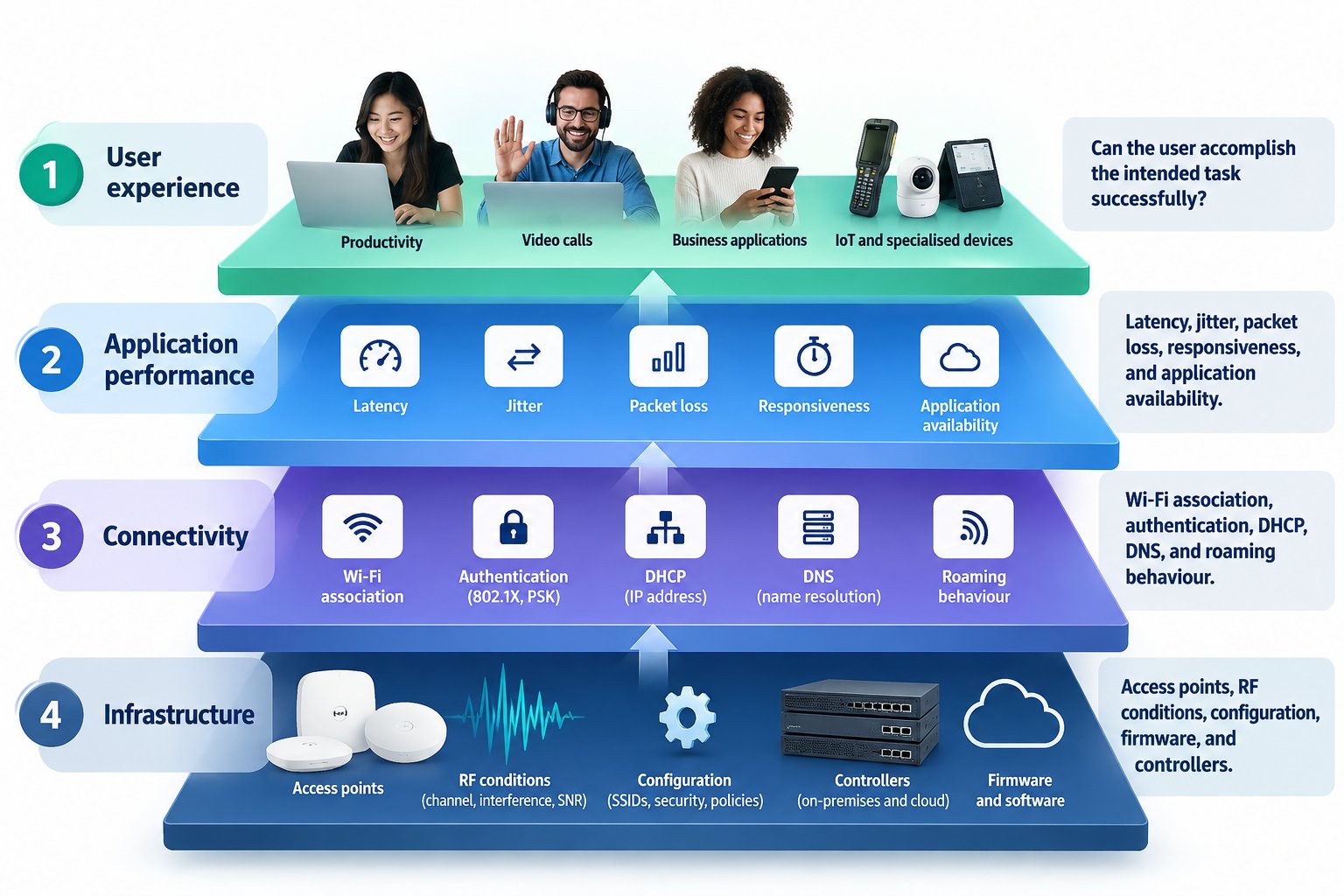
The infrastructure forms the foundation, but the ultimate measure of network performance is whether the user can successfully complete the intended task. For example, a device may associate successfully with an access point but subsequently encounter DHCP or DNS problems.
Alternatively, connectivity may be established correctly while application performance suffers from intermittent packet loss or latency. Understanding where a problem occurs requires visibility across the entire experience, rather than a single part of the network.
Independent synthetic testing adds another observation point
A key element of Wyebot’s approach is the use of independent observation points to measure network performance from a perspective that complements infrastructure monitoring. These observation points can include dedicated wireless sensors or software agents running on client devices. Dedicated sensors can act as synthetic users, continuously performing network tests without depending on employees to report problems or manually initiate troubleshooting. The tests discussed in Wyebot’s presentation include:
- Wi-Fi connectivity and association testing.
- Authentication and network access verification.
- DHCP and DNS performance testing.
- Application connectivity and responsiveness.
- Network throughput and iPerf testing.
- Continuous RF measurement and analysis.
- Latency, packet loss, and other performance measurements.
This approach is particularly useful for identifying intermittent issues that may otherwise go unnoticed until users submit complaints. It also provides a consistent measurement reference. Rather than comparing tests performed on different employee laptops or smartphones, administrators can use dedicated monitoring devices to establish repeatable measurements over time.
It also provides a consistent measurement reference. Rather than comparing tests performed on different employee laptops or smartphones, administrators can use dedicated monitoring devices to establish repeatable measurements over time.
Wyebot emphasises three important properties of this approach: independence, vendor neutrality, and continuity. Independent testing provides an additional perspective on network performance. Vendor neutrality allows the assurance system to operate across environments containing equipment from different infrastructure suppliers. Continuous monitoring helps identify problems that occur outside normal troubleshooting windows. Importantly, this independent observation point is intended to complement existing enterprise Wi-Fi management systems, not replace them.
From monitoring to intelligent automation
Collecting more network information is useful only if the information can be translated into meaningful operational decisions. Wyebot describes a five-stage process for moving from network observation to automated assurance (see image below):
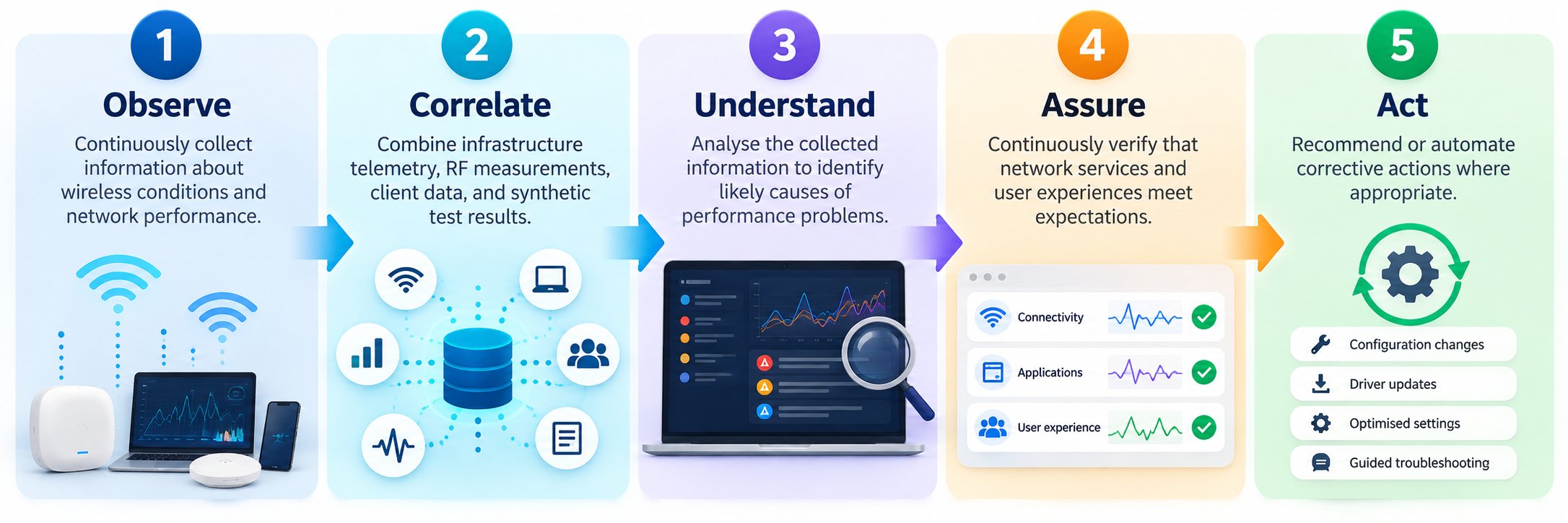
The correlation stage is especially important because individual measurements may not explain why a problem is occurring. For example, an application slowdown could be caused by Wi-Fi interference, excessive retries, roaming behaviour, a network service problem, or conditions beyond the wireless infrastructure.
By combining information from multiple sources, automated analysis can help narrow down the possible causes and identify appropriate corrective actions. These actions might include changes to network configurations, adjustments to device settings, driver updates, or guided troubleshooting workflows. Wyebot also points to the growing role of AI in analysing network telemetry and supporting automated root-cause analysis.
However, the presentation emphasised that AI depends on the quality and completeness of the information available to it. Without sufficient visibility into both infrastructure behaviour and user experience, even sophisticated automation systems may struggle to identify the actual cause of connectivity problems. Automation can only act on what it can observe.
Why operational simplicity is essential
Automation and extensive monitoring can themselves introduce additional operational complexity. Deploying sensors, configuring data collection, integrating management systems, and maintaining monitoring infrastructure may create new workloads for already stretched IT teams. Wyebot argues that this is why simplicity must be treated as a fundamental design requirement rather than an optional feature.
The company identifies three principles for scalable Wi-Fi assurance:
- Plug-and-play deployment: Monitoring systems should be straightforward to install and configure, ideally supporting zero-touch deployment without requiring extensive specialist involvement.
- Easy operation: Automated analysis should make complex network information accessible to IT staff who may not have advanced Wi-Fi engineering qualifications.
- Easy scaling: Organisations should be able to extend a consistent monitoring and assurance model across large numbers of locations without proportionally increasing operational effort.
This is particularly relevant to distributed enterprises with hundreds or thousands of sites. A solution that requires extensive manual configuration or expert intervention at every location may be technically capable but operationally difficult to scale. Wyebot’s position is that the underlying technical complexity should be handled by the assurance platform, allowing IT teams to concentrate on maintaining service quality and resolving the issues that require human attention.
The next stage: Combining infrastructure intelligence with user experience
Enterprise Wi-Fi management has evolved through several generations of operational tools, from command-line interfaces and SNMP-based monitoring to graphical dashboards, cloud management, and increasingly AI-assisted operations.
Wyebot expects this evolution to continue towards more automated and potentially agentic approaches to network management. However, the company argues that the success of these systems will depend on combining four elements: infrastructure visibility, user-experience measurements, intelligent automation, and operational simplicity.
Infrastructure management systems provide valuable information about the condition and operation of the network. Independent monitoring adds the perspective of the user and the applications running across that network. Automation can then correlate these sources, identify potential problems, continuously verify service quality, and support corrective action.
For enterprises, the potential benefit is a shift away from predominantly reactive troubleshooting towards continuous, proactive assurance. The broader message from Wyebot’s DVT Forum presentation is that managing enterprise Wi-Fi at scale is no longer simply a question of deploying better infrastructure or hiring more wireless specialists.
It requires an operational model capable of translating increasingly complex network behaviour into reliable user experiences, without transferring that complexity to the people responsible for keeping the network running. The goal is not more people managing more complexity. It is intelligent automation that makes enterprise Wi-Fi simpler to operate.
This Resource Centre article is based on Wyebot’s presentation “When Wi-Fi Complexity Grows Faster Than Your Team: How Automation, Complete Visibility, and Simplicity Are Changing Enterprise Wi-Fi Assurance,” delivered at the WiFi NOW DVT Forum on September 29, 2026, together with the accompanying presentation transcript.
Further information: Wyebot official website
/Claus.