By Claus Hetting, WiFi NOW CEO & Chairman
Enterprise Wi-Fi networks are becoming increasingly complex to manage, particularly for organisations operating hundreds or thousands of sites. At WiFi NOW’s DVT Forum Online, Konstantin Khitrik, Chief Revenue Officer and co-founder of SIDOS, explained how simplified field measurements, remote troubleshooting, and AI-calibrated digital twins can help enterprises improve Wi-Fi service quality while reducing the cost and complexity of network validation.
Why good Wi-Fi coverage doesn’t necessarily mean good service
One of the most persistent misconceptions in enterprise Wi-Fi is that good signal coverage automatically translates into good connectivity performance. According to Sidos, this assumption overlooks many of the factors that determine the actual user experience.
Watch the full video presentation & access DVT Forum 2026 presentation materials here.
A Wi-Fi network can show excellent signal strength across an entire building while still suffering from poor performance. Interference, channel contention, client behaviour, network configuration, and environmental conditions can all affect service quality independently of received signal strength.
Another common misconception is that adding more access points will necessarily improve performance. Because Wi-Fi operates using shared spectrum and contention-based access, deploying additional APs without careful channel and power planning can actually reduce usable capacity. Similarly, a predictive Wi-Fi design, however sophisticated, cannot guarantee that the installed network will perform as expected.
Building materials, wall attenuation, reflections, and changing physical environments can introduce significant differences between simulated and actual RF conditions. These differences become particularly important in warehouses, manufacturing facilities, and other industrial environments where equipment, shelving, inventory, and moving machinery can affect propagation. Khitrik argued that these challenges make real-world validation an essential component of enterprise Wi-Fi engineering.
The three essential elements: Design, monitoring, and field validation
Sidos identifies three complementary disciplines required to maintain reliable enterprise Wi-Fi connectivity:
- Network design: Predicting coverage and performance before deploying or modifying a network, including modelling AP placement, transmit power, and building characteristics.
- Network monitoring: Using controller telemetry and other network data sources to understand network conditions, identify problems, and monitor ongoing performance.
- Field validation: Taking actual measurements at the locations where users and devices operate to verify that the network meets its requirements.
While AI and automation are making network design and monitoring increasingly efficient, Konstantin Khitrik emphasised that field measurements remain indispensable. Controller telemetry can provide valuable information about APs and connected devices, but it cannot necessarily reproduce the exact RF conditions experienced by a client at a particular location.
This is especially relevant for industrial applications involving autonomous mobile robots, warehouse scanners, and other devices that depend on reliable wireless connectivity. A robot that loses connectivity at a particular point in a warehouse may be experiencing a problem that cannot be fully diagnosed using centralised network data alone. Understanding the cause may require measuring the actual RF environment at that location.
The enterprise challenge: Thousands of sites, limited Wi-Fi expertise
The difficulty for large enterprises is scaling this validation process across distributed networks. Konstantin Khitrik described an example of an enterprise team consisting of approximately eight people responsible for managing 3,000 sites globally. Traditional site surveys can be expensive and time-consuming. According to Konstantin Khitrik, conventional surveys typically cost between $2,500 and $8,000 per building, depending on geographical location and building complexity.
For an organisation operating thousands of sites, comprehensive periodic surveys can therefore become prohibitively expensive. As a result, many enterprises only conduct surveys when there is a compelling reason, such as a network upgrade, a major environmental change, or a service problem.
SIDOS argues that this reactive approach creates an opportunity for a different operating model: Enabling non-specialist personnel to collect consistent, structured Wi-Fi measurements locally while qualified wireless engineers analyse the results remotely. The objective is not to replace Wi-Fi experts, but to allow their expertise to be applied across a much larger number of sites.
SIDOS Deep Survey: The expert stays, the measurement device travels
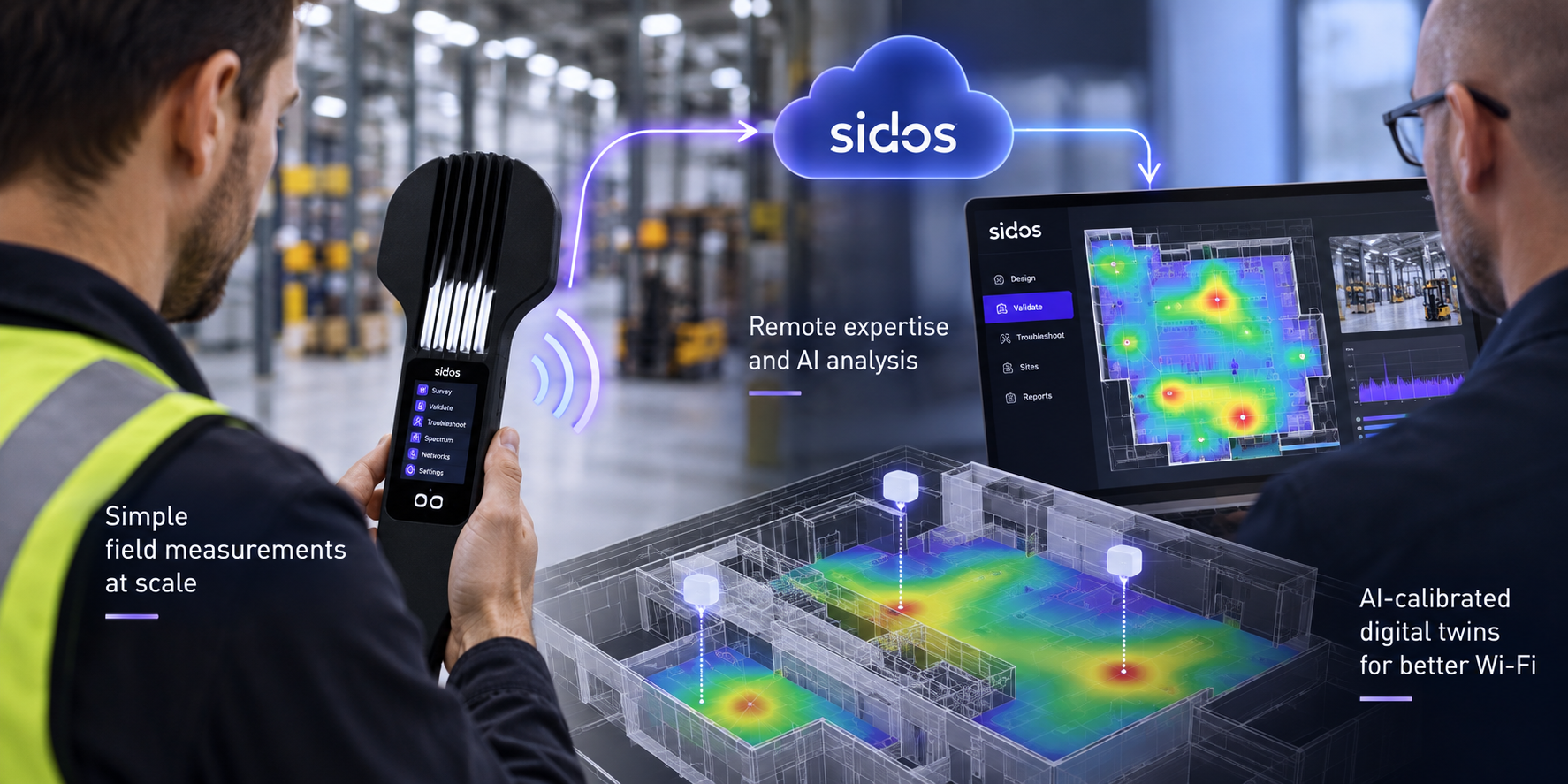
At the centre of SIDOS’ approach is its Wave handheld measurement device, combined with a guided workflow called Deep Survey. Rather than requiring a Wi-Fi specialist to travel to a site and perform a conventional walk-through survey, the system allows the expert to define specific measurement locations and requirements remotely. The workflow is straightforward:
- A Wi-Fi expert identifies the locations where measurements are needed and creates a predefined measurement plan.
- A local employee receives the Sidos Wave device and follows the guided instructions.
- At each designated location, the employee initiates a measurement lasting approximately ten seconds.
- The collected data is uploaded to Sidos Cloud, where the expert can review the measurements and diagnose potential problems.
- The expert determines whether the problem can be resolved remotely or whether a more comprehensive on-site investigation is required.
According to Konstantin Khitrik, the process can be carried out by employees without specialist Wi-Fi training, including office managers or other local personnel. The device itself runs an ecosystem of micro-applications designed to automate data collection and provide consistent measurements.
SIDOS says the advantage of using dedicated measurement hardware rather than ordinary smartphones is the ability to capture RF information quickly, accurately, and consistently. The company also supports remote interaction with the Wave device, allowing an expert to examine results and assist with troubleshooting without physically visiting the location.
This model can significantly reduce the need for specialist travel and makes targeted validation practical across large numbers of distributed enterprise sites.
Beyond signal strength: Automated validation of network configuration
An important part of the Deep Survey approach is that measurements are not limited to RF signal levels. The system can also check network characteristics and configuration parameters against predefined requirements.
For example, an organisation may specify that a particular network must operate in the 5 GHz band using 40 MHz channels. The validation workflow can check observed network parameters against these requirements and report whether the checks pass or fail.
Other checks can identify potential issues involving authentication modes, transmit power, channel usage, and related network settings. Konstantin Khitrik described situations in which Sidos measurements revealed configuration inconsistencies that had escaped the attention of centralised network management teams.
In one example illustrated in the presentation, a room showed acceptable received signal strength and passed several radio-related checks, but failed an authentication-mode check. The significance is that a network can deliver excellent RF coverage while still failing to meet its intended operational or security requirements. Automating these checks allows enterprises to apply consistent validation criteria across multiple locations, even when the measurements are collected by non-specialist personnel.
AI-calibrated digital twins: Improving the accuracy of Wi-Fi design
The second major element of the Sidos proposition is the use of AI-calibrated digital twins. Conventional predictive Wi-Fi design relies on modelling the physical environment, including walls, floors, and other structures that influence radio propagation.
However, accurately estimating the RF attenuation of building materials is challenging. Two apparently similar walls may produce different signal losses because of differences in their construction or the materials behind them. SIDOS uses AI to detect walls from building plans and combines this information with real-world signal measurements to calibrate the propagation model.
The company describes the resulting model as a digital twin of the building. Importantly, this is not simply a three-dimensional visual representation. It is a continuously refined digital model incorporating information about the building and its wireless environment. Each additional set of field measurements can contribute to improving the model’s representation of actual RF conditions.
For example, measurements can be used to estimate wall attenuation more accurately, reducing uncertainty in subsequent coverage predictions. The resulting calibrated model can then be reused when planning network changes, including AP upgrades or equipment replacements.
In the presentation, SIDOS demonstrated how a calibrated building model could be used to predict 5 GHz coverage when replacing existing APs with a different model while retaining their physical locations. After the upgrade, new field measurements can be taken to validate the actual result. The approach therefore creates a feedback loop between predictive design and real-world measurements, allowing network models to become more representative of the installed environment over time.
KonstantinKhitrik cautioned that no predictive design tool can perfectly reproduce real-world conditions in every environment, particularly in industrial facilities with frequently changing layouts and equipment. The objective is to reduce the margin of error, rather than eliminate the need for physical validation.
From reactive troubleshooting to proactive service assurance
The broader implication of Sidos’ approach is a potential shift in how enterprises manage Wi-Fi service quality. Traditional site surveys are frequently commissioned after a problem has occurred or when an infrastructure change is planned. By reducing the cost and complexity of collecting field measurements, Sidos aims to make more frequent and proactive validation economically practical.
This could be particularly valuable in environments where physical conditions change regularly.A warehouse, for example, may experience significant changes in shelving arrangements, inventory levels, and equipment movement during seasonal demand peaks. Such changes can alter the RF environment even when the wireless infrastructure remains unchanged.
Periodic validation could help identify potential service issues before they result in operational disruption. For large enterprises, the combination of guided measurements, remote engineering expertise, and AI-assisted analysis could also make it easier to maintain consistent wireless performance standards across geographically distributed facilities.
The underlying principle is that Wi-Fi service assurance should be based not only on what network infrastructure reports, but also on what can actually be measured at the point of use.
AI will augment Wi-Fi expertise, not replace it
Konstantin Khitrik’s central message was that AI and automation should remove repetitive tasks from wireless engineering workflows rather than replace the engineers themselves. AI can accelerate network design, assist with identifying building characteristics, calibrate propagation models, and automate the analysis of measurement data.
Similarly, guided measurement workflows can eliminate much of the need for specialists to perform routine data collection in person. But expert knowledge remains necessary to determine what should be measured, interpret results, identify root causes, and decide how network problems should be resolved.
For enterprises operating large distributed networks, the opportunity is to combine centralised wireless expertise with scalable local data collection. The result, SIDOS argues, is a more efficient approach to network validation and troubleshooting that can help organisations improve Wi-Fi service quality without proportionally increasing their specialist engineering resources.
/Claus.