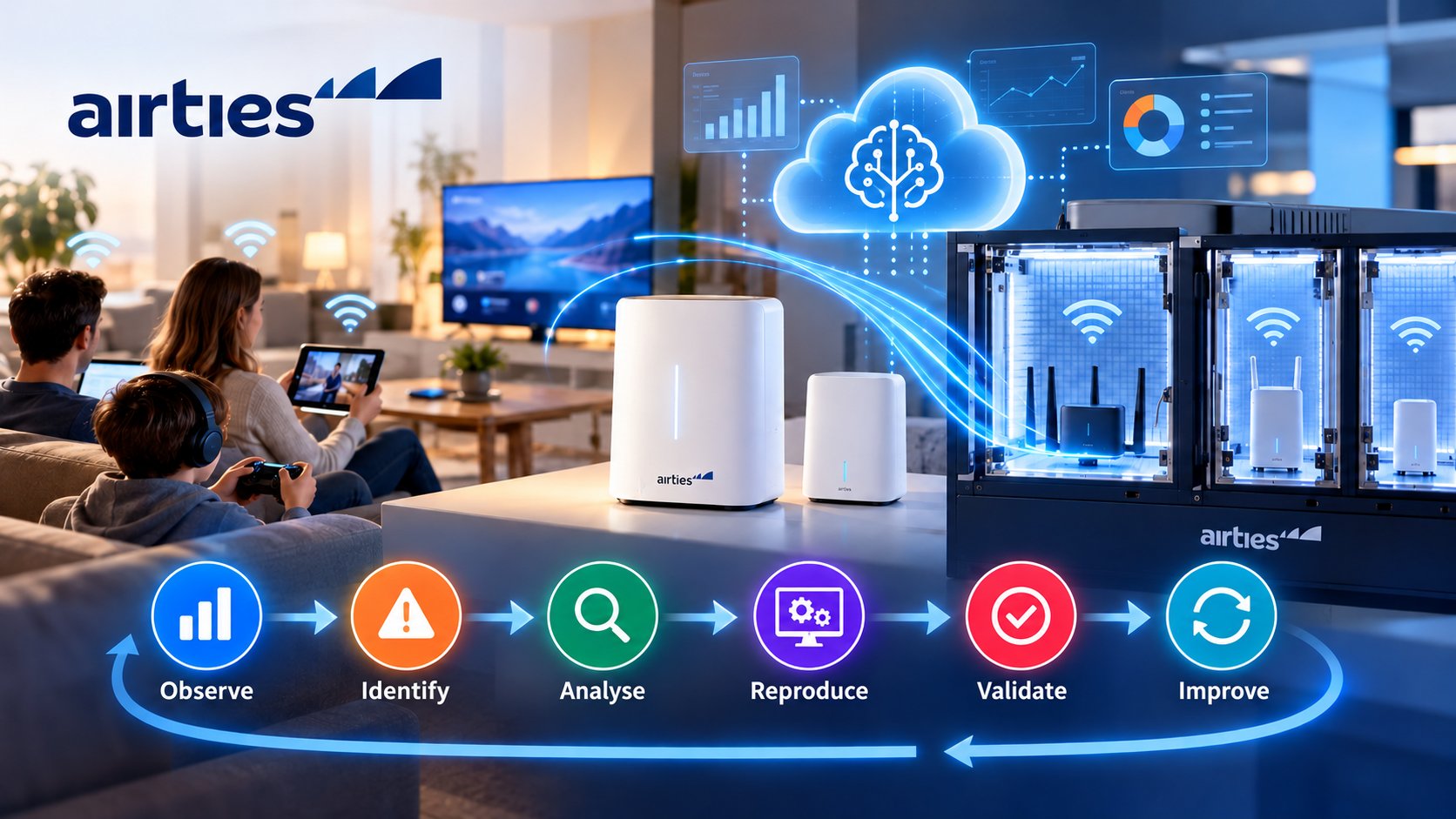
How Airties Orbit, Nova, and Aura are bringing continuous validation, application-level experience testing, and field intelligence together to improve residential Wi-Fi quality. This report is based on Arties’ presentation at DVT Forum 2026 accessible for viewing here.
Traditional Wi-Fi testing has become increasingly sophisticated, yet consumers continue to experience connectivity problems. Even when products meet RF performance targets, pass interoperability certification, and deliver excellent throughput under laboratory conditions, they may still fail to provide a consistently good user experience in the home.
According to Airties, addressing this problem requires a fundamental change in how Wi-Fi products are developed, validated, deployed, and optimised. Rather than treating testing as a final step before product launch, service providers and equipment manufacturers need continuous, end-to-end validation that measures the actual experience delivered to users.
Watch Mujdat Pakkan’s full presentation video here.
At the WiFi NOW DVT Forum, Mujdat Pakkan, EVP of Customer and Partner Engineering at Airties, presented the company’s approach to this challenge. The strategy combines three complementary capabilities: Airties Orbit for validating telemetry and EasyMesh implementations, Airties Nova for automated user experience testing, and Airties Aura for AI-driven analysis and future optimisation. The longer-term objective is to create a continuous feedback loop in which problems identified in operational Wi-Fi networks automatically inform the next generation of laboratory tests.
1. Why conventional Wi-Fi testing is no longer sufficient
The wireless industry has developed extensive tools and procedures for validating Wi-Fi equipment. These include RF performance measurements, maximum throughput testing, rate-versus-range measurements, stress testing, interoperability certification, and EasyMesh compliance testing. These tests are essential, but they do not necessarily establish whether a product will deliver a satisfactory user experience in a real home.
A gateway may demonstrate excellent throughput in a controlled laboratory environment while delivering inconsistent performance when multiple devices, applications, and mesh nodes compete for network resources. The problem becomes more complex as residential Wi-Fi environments evolve.
Airties identifies three major drivers of increasing test complexity:
Device and application fragmentation
Residential networks contain increasingly diverse combinations of smartphones, tablets, computers, televisions, gaming devices, and IoT products. These devices use different chipsets, drivers, software versions, and Wi-Fi capabilities. Applications also impose different performance requirements. Video streaming depends on sustained delivery and buffering performance, while gaming and real-time collaboration are particularly sensitive to latency, delay variation, and interruptions.
Evolving Wi-Fi standards
The transition from Wi-Fi 6 to Wi-Fi 7, and eventually Wi-Fi 8, introduces additional complexity. Operators must support mixed-generation networks containing gateways, extenders, and client devices with different capabilities. A Wi-Fi 7 gateway may, for example, operate alongside Wi-Fi 6 extenders and legacy devices. Such combinations of radio configurations and client behaviours require extensive compatibility testing.
Frequent software and firmware updates
Chipset vendors, equipment manufacturers, and software developers regularly release new drivers, firmware versions, and features. Each change creates the possibility of performance regressions, interoperability problems, or unexpected application behaviour. For service providers, the challenge is therefore not simply to certify a gateway before deployment. It is to ensure that successive software releases continue to deliver acceptable performance throughout the product lifecycle.
2. Continuous testing throughout the Wi-Fi product lifecycle
Airties proposes a continuous validation approach covering the complete Wi-Fi product lifecycle. The process begins with requirements and design, continues through development, integration, certification, and production, and extends into deployment, operations, and ongoing optimisation. Crucially, the lifecycle must operate as a closed loop rather than a sequence that ends when equipment reaches customers. Field experience should inform subsequent development and testing activities.
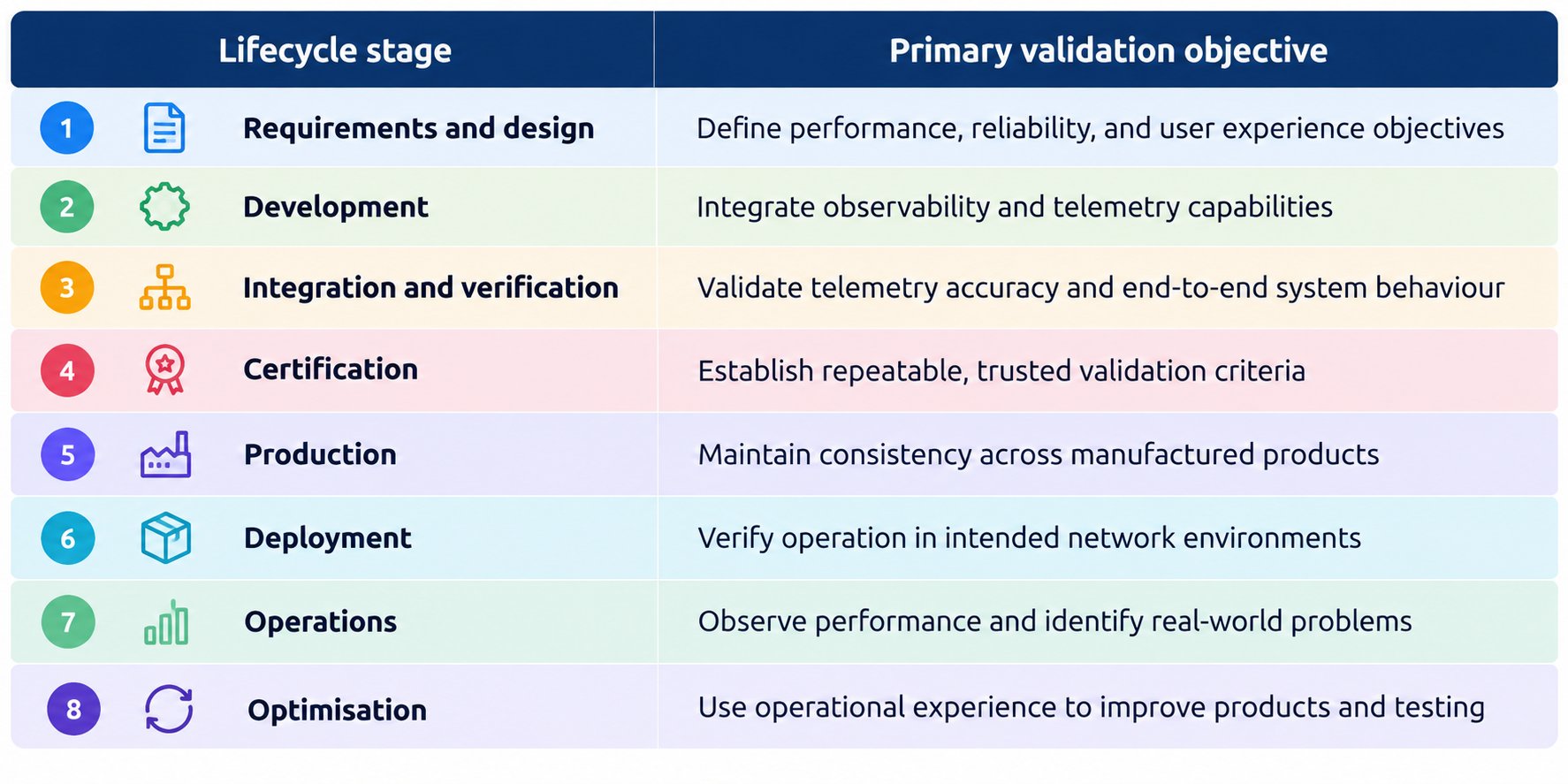
The expected benefits include fewer defects, faster product launches, reduced rework, more consistent performance, and improved product quality. A central principle of this approach is that reliable optimisation depends on reliable observability. Before an operator can use telemetry to improve Wi-Fi performance, it must establish that the information collected from devices accurately reflects their behaviour.
3. Airties Orbit: Validating the foundations of Wi-Fi observability
Airties Orbit addresses a fundamental problem in telemetry-driven network management: How can an operator be certain that the information reported by a Wi-Fi gateway or extender is accurate? Wi-Fi optimisation systems depend on data collected from device drivers, platform software, EasyMesh agents and controllers, and ultimately cloud-based management platforms. Errors anywhere in this chain can compromise the decisions made by the optimisation system.
For example, a device may report incorrect information about interference, client associations, radio conditions, or other network events. Even if the cloud analytics platform processes the information correctly, the resulting optimisation decisions may be based on inaccurate measurements. Airties Orbit is designed to verify the integrity of this telemetry chain.
Orbit is an automated EasyMesh data verification platform for customer premises equipment (CPE), including residential gateways and Wi-Fi extenders. It uses configurable test chambers and real radios to create controlled wireless conditions and validate device behaviour. The platform tests whether devices generate the correct information under different operating conditions, including interference, association and disassociation events, radar detection, and different wireless configurations. It also verifies that information is processed correctly through the EasyMesh agent and controller architecture.
Orbit capabilities
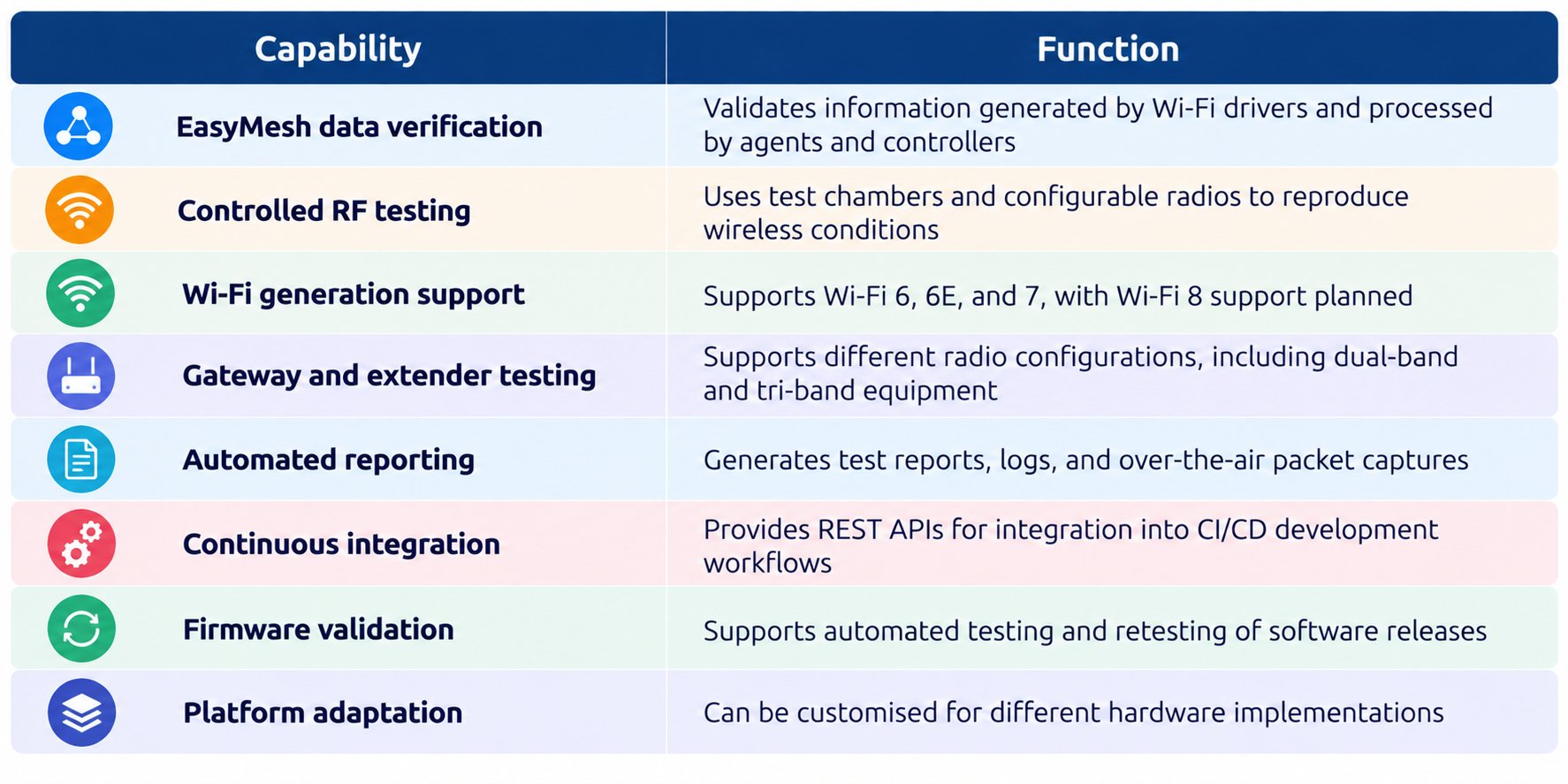
According to Airties, Orbit is used by major chipset vendors and equipment manufacturers to validate EasyMesh implementations. The company also identifies the prpl Foundation and RDK ecosystem as users of the platform for EasyMesh-related testing. An important advantage is the ability to incorporate Orbit into automated development workflows.
When a new firmware version becomes available, the platform can load the software, execute the relevant tests, and generate results for engineering teams. This allows telemetry validation to become part of continuous software development rather than a separate, occasional laboratory activity. For operators implementing cloud-based Wi-Fi management and optimisation, the significance is considerable: Accurate field intelligence begins with validating the data generated by the CPE.
4. Airties Nova: Testing the actual Wi-Fi user experience
While Orbit focuses on the accuracy of telemetry and EasyMesh implementations, Airties Nova addresses a different question: Does the complete Wi-Fi system deliver a satisfactory experience for the applications and devices customers actually use? Airties developed Nova by drawing on its experience operating residential Wi-Fi test environments.
The company previously used dedicated test houses in several countries, including the United States, United Kingdom, and Turkey. These environments incorporated real client devices and automated systems to reproduce roaming, steering, and other residential networking scenarios. Although valuable, physical test houses are expensive and difficult to scale. Nova packages much of this testing expertise into a modular, automated laboratory platform that service providers can deploy within their own facilities.
Testing real devices and mesh networks
Nova combines automated test software with configurable hardware chambers. The platform can test a single gateway or multi-node mesh configurations, including a gateway with two extenders. Different mesh topologies can be reproduced, including star and daisy-chain configurations. An important feature is its support for real client devices alongside virtual stations.
According to Mujdat Pakkan, Nova can accommodate up to six real client devices within its test environment. These may include smartphones, tablets, laptops, and other Wi-Fi equipment. This matters because simulated traffic alone cannot reproduce every aspect of real device behaviour. Client implementations differ in their roaming decisions, power-saving behaviour, radio capabilities, and interactions with applications. Testing with real clients allows operators to identify problems that may otherwise remain undetected.
Application-level quality of experience
A particularly important element of Nova is its ability to evaluate the performance of actual applications rather than relying exclusively on network-level measurements. The platform includes test suites covering streaming, gaming, collaboration, and mixed application usage. Measurements can include:
- Throughput and available bandwidth
- Video buffering and playback resolution
- Application latency and delay
- Webpage loading performance
- Roaming behaviour and connectivity stability
- Performance under interference
- Airtime utilisation
- Device CPU and memory utilisation
Nova can collect application experience measurements and platform stability information during the same test execution. This makes it possible to evaluate whether a gateway or mesh system continues to perform reliably while supporting demanding user applications.
The distinction is important: A system may deliver acceptable aggregate throughput but still produce buffering during video playback, interruptions during conferencing, or inconsistent gaming latency. Nova is designed to identify these application-level problems before equipment or software is deployed to customers.
5. Automated test suites based on product lifecycle events
Another important feature of Nova is its organisation of tests around specific lifecycle events. Rather than requiring operators to run the same comprehensive test programme after every change, the platform allows different test suites to be associated with relevant triggers. These triggers may include the introduction of a new device, a firmware upgrade, a feature release, changes to network configuration, or reports of deteriorating application performance.
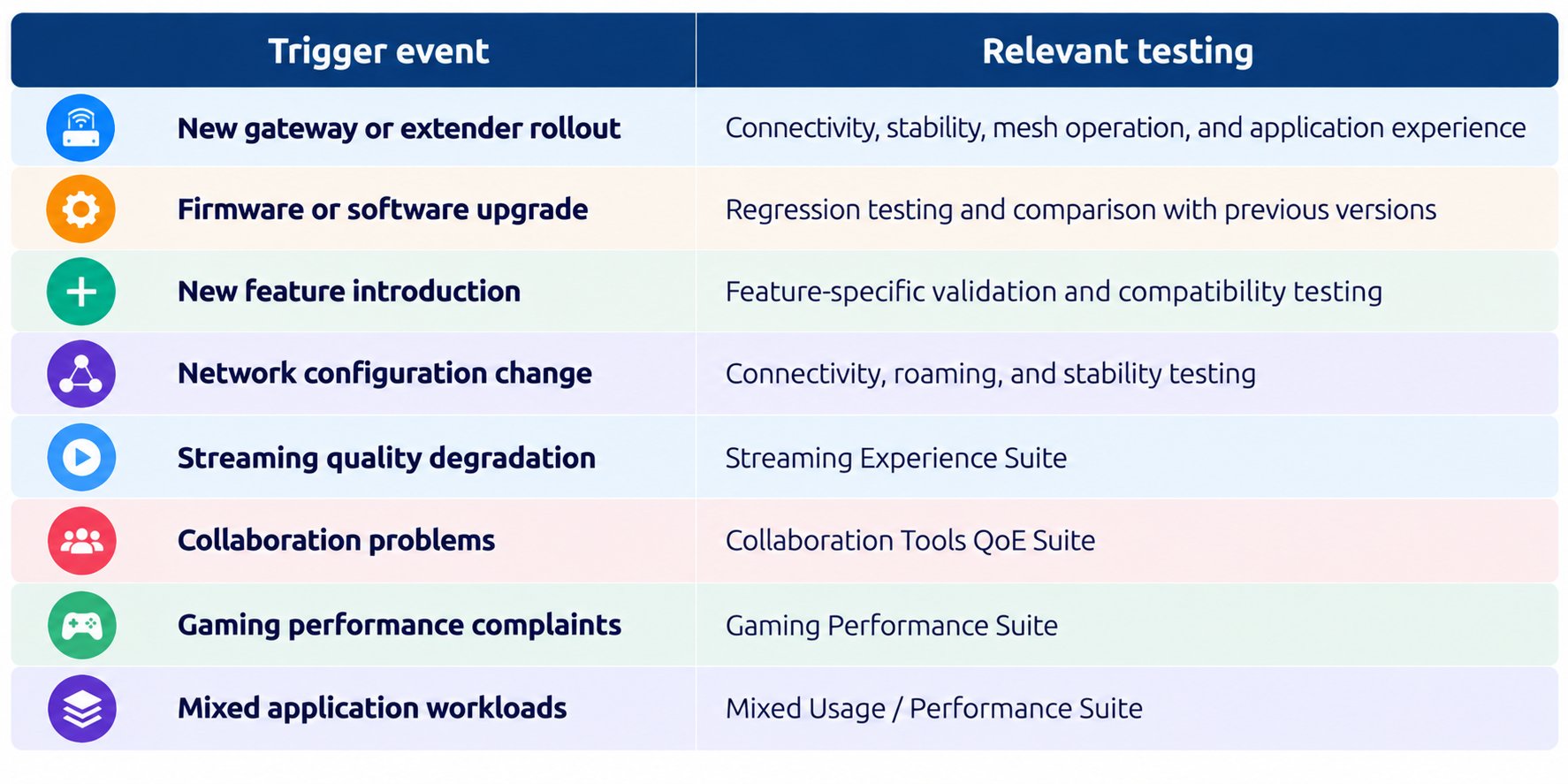
Nova provides predefined test suites that operators can select and execute according to their requirements. Airties also maintains and updates these suites as technologies, client devices, and software implementations evolve. Operators can introduce additional tests through the platform’s APIs. This approach reduces the need for each service provider to develop and maintain its own complete test automation framework.
Integration with software development workflows
Like Orbit, Nova supports integration with continuous integration and continuous deployment systems. For example, a new firmware release can be retrieved from a software repository, installed on a device under test, and subjected to automated regression testing. The resulting reports can help determine whether the release improves performance, introduces regressions, or requires additional investigation. This is particularly relevant as residential gateways increasingly become software-defined platforms receiving frequent updates throughout their operational lifetime.
6. Turning test results into actionable engineering decisions
Generating large quantities of test data is useful only if engineering teams can interpret the results and make decisions. Nova therefore includes reporting, comparison, benchmarking, and analysis capabilities intended to translate test results into practical recommendations. The platform maintains historical results associated with specific devices, configurations, and firmware versions. This allows operators to compare performance across successive software releases or different equipment platforms.
For example, an operator could compare the streaming and conferencing performance of two firmware versions on the same gateway. Alternatively, the operator could benchmark gateways supplied by different OEMs using the same test conditions and application scenarios. Nova also uses AI to generate insights from test results. According to Mujdat Pakkan, these insights may recommend additional testing, investigation of particular client devices, or evaluation of alternative driver versions.
In some cases, the results may indicate that a software release should not proceed to deployment until identified problems have been resolved. This introduces an important distinction between simply reporting a failed test and providing information that supports an engineering or deployment decision.
7. Airties Aura: Connecting field intelligence with laboratory testing
The next stage of Airties’ strategy involves integrating its agentic AI technology – Airties Aura – with Nova. Airties has identified the integration of Aura into Nova as an upcoming development. The longer-term ambition goes beyond providing additional analysis of laboratory test results. Airties wants to use operational experience from deployed Wi-Fi networks to improve the tests performed in the laboratory automatically.
The concept is to create a feedback loop connecting field observability, AI-driven analysis, and product validation. Consider a situation in which an operator identifies a recurring streaming problem affecting a particular combination of gateway firmware and client device.In a conventional development process, engineers would investigate the problem, attempt to reproduce it, develop a correction, and manually update the relevant test procedures.
A more automated approach could use field intelligence to identify the conditions associated with the failure and help generate or refine laboratory test cases. Those tests could then become part of the regression testing programme for subsequent firmware releases. Over time, the test environment would become better aligned with problems actually encountered by customers.
The proposed closed-loop process
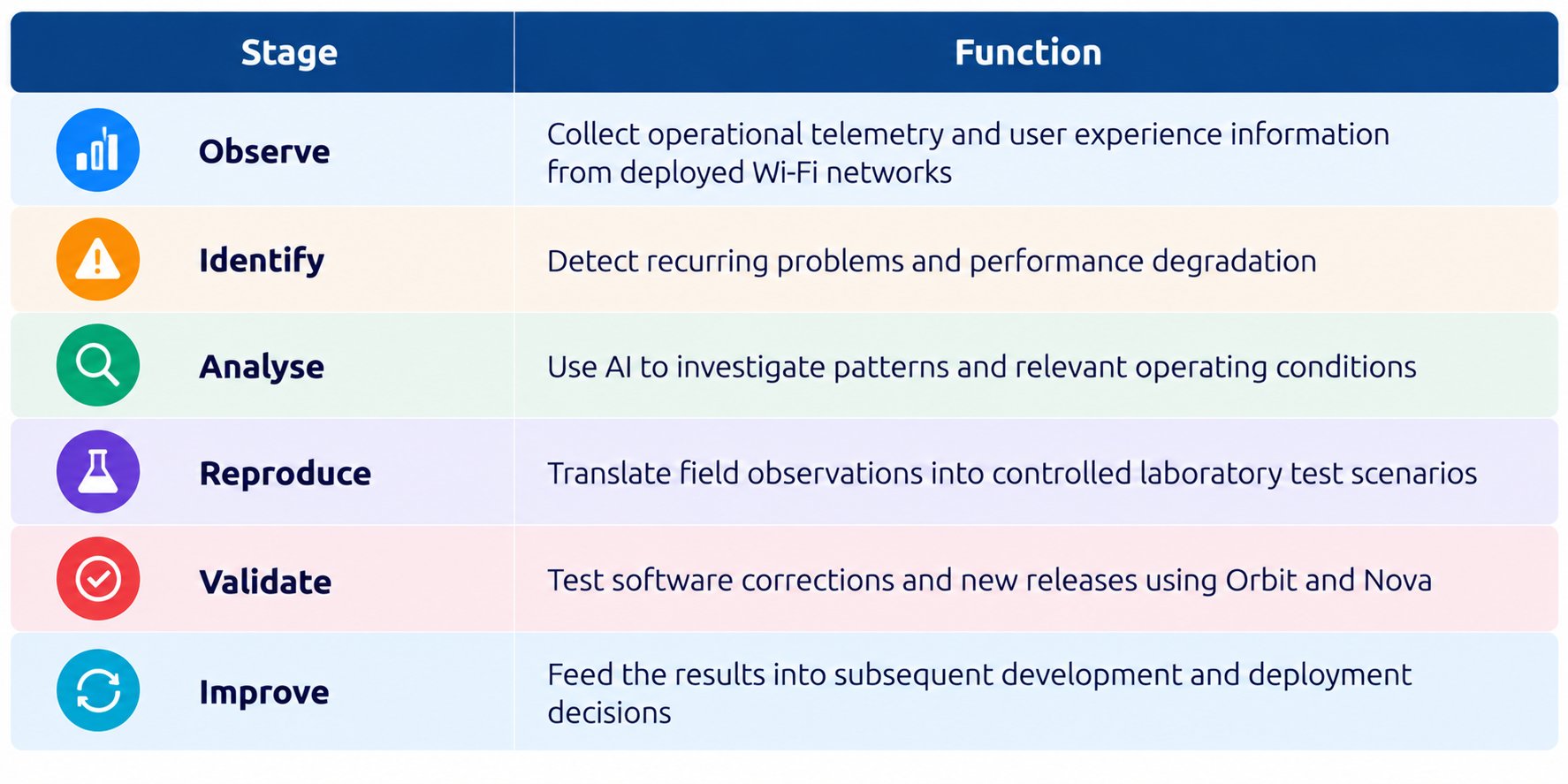
The proposed architecture connects Airties’ cloud-based field observability and optimisation capabilities with its laboratory validation platforms. Airties describes this as the next frontier in continuous Wi-Fi testing. Mujdat Pakkan indicated that the company was targeting further development of these capabilities in early 2027. This field-to-lab automation should be regarded as a roadmap objective rather than a fully deployed capability today. Its potential significance is nevertheless substantial.
If successfully implemented, it could reduce the time required to identify, reproduce, and resolve recurring Wi-Fi experience problems. It could also help operators prioritise testing based on actual customer experience rather than relying exclusively on predefined engineering assumptions.
8. Why this matters for service providers
Residential Wi-Fi has become one of the most important factors influencing how consumers perceive the quality of their broadband service. Customers generally do not distinguish between problems originating in the access network, gateway software, wireless interference, client devices, or individual applications. They experience these issues simply as poor broadband performance.
For service providers, improving Wi-Fi quality therefore requires more than selecting equipment with strong RF specifications. It requires a process that continuously validates how complete residential networking systems behave under realistic conditions. Airties’ approach addresses three related requirements.
First, establish trust in the data. Telemetry-driven optimisation depends on accurate information from devices and software platforms. Orbit is designed to validate this foundation.
Second, test the experience rather than only the network. Nova extends validation to real clients, mesh configurations, and application performance.
Third, connect operational experience with product development. The planned integration of Aura aims to use field intelligence to improve testing and accelerate subsequent optimisation.
Together, these capabilities represent a shift from isolated testing activities towards a continuous quality assurance process spanning development, deployment, and operations. For operators managing large fleets of residential gateways and extenders, this approach could improve release quality, reduce troubleshooting effort, and help prevent software regressions from affecting customers. The commercial value will ultimately depend on how effectively the approach translates into fewer customer complaints, improved service reliability, and lower operational costs.
9. From Wi-Fi certification to continuous experience assurance
Wi-Fi certification, RF performance testing, and interoperability validation remain essential elements of product development. But they address only part of the challenge of delivering reliable residential connectivity. The growing diversity of clients, applications, Wi-Fi generations, and software configurations means that operators must validate complete systems repeatedly throughout their operational lifetime.
Airties’ Orbit and Nova platforms address different but complementary aspects of this challenge. Orbit validates the telemetry and EasyMesh information required for trustworthy network observability and optimisation. Nova evaluates how complete Wi-Fi systems perform with real devices and applications under controlled, repeatable conditions. The planned integration of Aura introduces the possibility of using AI to connect these laboratory processes with experience gathered from operational networks.
The broader industry implication is clear: Wi-Fi quality assurance is evolving from a product certification activity into a continuous, experience-driven engineering discipline. The ultimate objective is not simply to establish that a Wi-Fi product works correctly at launch, but to ensure that it continues to deliver a reliable experience as devices, applications, and software evolve.
About Airties:
Airties is a provider of managed Wi-Fi software, cloud-based connectivity experience management, and Wi-Fi testing solutions for broadband service providers. The company reports that Airties Cloud has managed more than 50 million households to date and that its technologies have been integrated with more than 130 CPE platforms. Its testing portfolio includes Airties Orbit for EasyMesh data verification and Airties Nova for end-to-end user experience testing. Airties also develops Aura, an agentic AI technology intended to support connectivity experience management and further automation.
Source:
This report is based on the presentation “User Experience Testing and Validation” delivered by Mujdat Pakkan, EVP of Customer and Partner Engineering at Airties, at the WiFi NOW DVT Forum on October 1, 2026, together with the accompanying presentation transcript.