
This feature article is based on a Tech Watch video interview with Morse Micro’s Andy MacFarlane, VP Marketing, available here.
Artificial intelligence is moving into cameras, robots, sensors, vehicles, farms, and industrial equipment. But intelligence at the edge creates a connectivity problem: Devices need to exchange richer data over meaningful distances without becoming dependent on mains power.
Morse Micro says Wi‑Fi HaLow occupies an unusually useful middle ground – delivering more bandwidth than conventional low-power IoT technologies, much greater reach than standard Wi‑Fi, and low enough power consumption for battery- and solar-powered devices.
Artificial intelligence is moving out of centralised clouds and into the physical world. Cameras are analysing images locally, robots are making autonomous decisions, and sensors are processing increasingly complex data before sending selected information to other devices or the cloud.
The trend is often described as edge AI or physical AI. Andy McFarlane, VP Marketing at Wi‑Fi HaLow chipset specialist Morse Micro, prefers the term “untethered intelligence” because it captures one of the most important challenges associated with intelligence at the edge. “The most powerful intelligence ever built can’t ever be too far away from a wall socket,” Andy McFarlane says. “We need to untether the intelligence.”
 The intelligence itself is only one part of the system. An intelligent edge device also needs a wireless connection capable of transporting its sensor data, decisions, images, video clips, and software updates. This creates a three-way engineering challenge. The wireless link needs sufficient bandwidth for the application, stable connectivity over the required distance, and sufficiently low power consumption to preserve battery life or make solar-powered operation practical.
Existing wireless technologies generally optimise strongly for one or two of these attributes. Standard Wi‑Fi delivers abundant throughput but is not designed primarily for long-range coverage. LoRaWAN provides excellent range at very low power but is intended for relatively small amounts of data. Cellular technologies can combine long range with useful bandwidth, but power consumption and recurring connectivity costs can become constraints.
Wi‑Fi HaLow – based on the IEEE 802.11ah standard and operating in sub-1 GHz spectrum – is designed to occupy the space between these categories. Morse Micro’s central proposition is that this middle ground is becoming substantially more valuable as edge devices graduate from transmitting simple telemetry to handling richer and more actionable data.
How much data does an intelligent device need?
Not every intelligent device needs to transmit a video stream. An industrial vibration sensor can communicate a useful event in a few tens of bytes, while a camera, robot, or drone may need to send images, short video clips, feature embeddings, diagnostic files, or over-the-air software and model updates.
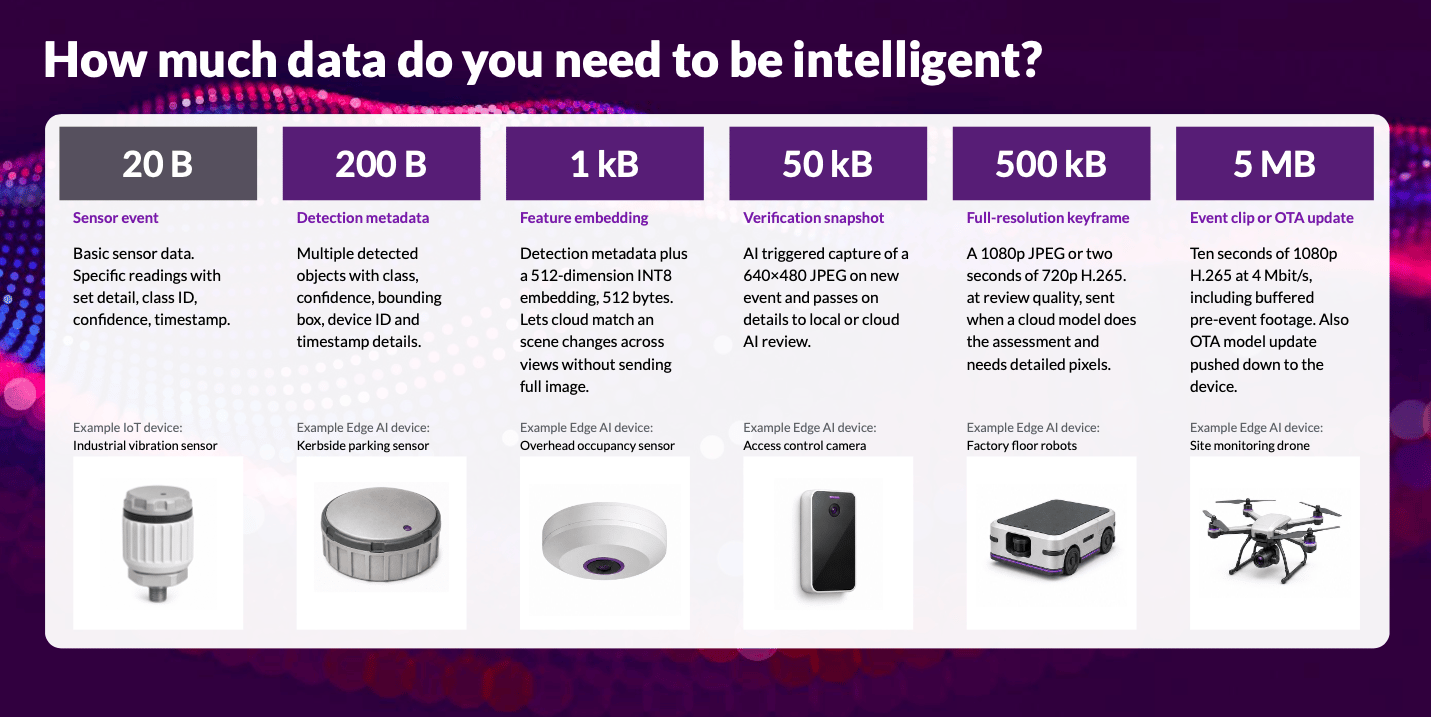
The correct connectivity technology therefore depends heavily on the payload. Morse Micro illustrates the progression with six representative payload sizes:
- A 20-byte message could contain a basic sensor reading together with a class identifier, confidence level, and timestamp. An industrial vibration sensor is one example.
- A 200-byte message could carry detection metadata for multiple objects, including classifications, confidence levels, bounding boxes, device information, and timestamps. A kerbside parking sensor could generate this type of data.
- A 1-kilobyte message could contain detection metadata together with a compact feature embedding. An overhead occupancy sensor could use this information to enable another system to compare changes between scenes without transmitting a complete image.
- A 50-kilobyte payload could contain an AI-triggered verification image, such as a 640 × 480 JPEG from an access-control camera.
- A 500-kilobyte payload could represent a full-resolution image or a short section of review-quality video from a factory-floor robot or security camera.
- A 5-megabyte payload could contain an event clip, buffered pre-event footage, or an over-the-air model or firmware update for a drone, robot, or camera.
The difference between these payloads is fundamental. Many traditional low-power IoT technologies are excellent at transmitting small sensor events but become impractical as the amount of data grows. Airtime increases, energy consumption accumulates, and application latency can become unacceptable. Conversely, selecting conventional Wi‑Fi simply because a device occasionally needs to transfer a large file can impose a range or infrastructure penalty.
This is the application space Morse Micro believes Wi‑Fi HaLow is particularly well suited to address.
Morse Micro compares energy use by packet size
To illustrate the trade-offs, Morse Micro conducted a data-sheet comparison of the calculated energy and airtime required to transmit payloads ranging from 200 bytes to 5 megabytes.
The comparison includes Wi‑Fi HaLow, sub-1 GHz Zigbee, LoRaWAN using spreading factor 7, LoRa Plus using FLRC, and NB-IoT. The energy calculation is based on the current, voltage, transmission time, and preparation overhead specified in relevant data sheets. The results vary significantly with payload size.
For a 200-byte transmission, Morse Micro calculates that Wi‑Fi HaLow requires 650 microjoules and 320 microseconds of transmit airtime. LoRa Plus FLRC uses less energy for this very small payload – 247 microjoules – but requires 655 microseconds. The position changes as the payload grows.
For a 50-kilobyte transfer, Morse Micro calculates energy consumption of 4.6 millijoules and airtime of 11.2 milliseconds for Wi‑Fi HaLow. The corresponding figures for LoRa Plus FLRC are 60 millijoules and 161.7 milliseconds. At 500 kilobytes, the calculated figures are 40.8 millijoules and 111.4 milliseconds for Wi‑Fi HaLow, compared with 600 millijoules and 1.62 seconds for LoRa Plus FLRC.
For a 5-megabyte transfer, Morse Micro calculates that Wi‑Fi HaLow requires 404 millijoules and 1.11 seconds of airtime. LoRa Plus FLRC requires 6 joules and 16.17 seconds. In other words, Morse Micro’s analysis suggests that Wi‑Fi HaLow uses approximately one-tenth to one-fifteenth of the energy required by LoRa Plus FLRC for the larger payloads included in the comparison.
The figures should be understood for what they are: A vendor-generated data-sheet analysis rather than an independent, controlled benchmark of complete devices under identical radio conditions. Real-world energy consumption will depend on implementation details, link quality, retransmissions, device architecture, traffic patterns, and application behaviour. Nevertheless, the comparison highlights an important principle: The technology with the lowest instantaneous radio power does not necessarily use the least total energy to complete a transaction.
Why airtime can matter as much as radio power
Low power is sometimes treated as an inherent property of a wireless technology. For real devices, however, energy consumed per completed transaction is often the more revealing measure.
A highly efficient narrowband radio may need to remain active for seconds or even minutes while transmitting a large payload. A faster wireless link may draw more instantaneous power but complete the transfer quickly, return to sleep, and consume less total energy. This does not make Wi‑Fi HaLow a replacement for LoRaWAN, Zigbee, Bluetooth, or cellular IoT. Each technology addresses different requirements involving range, topology, device cost, spectrum, mobility, data rates, and infrastructure.
LoRaWAN, for example, remains exceptionally well suited to very small and infrequent messages transmitted over long distances. Wi‑Fi HaLow is unlikely to be the correct solution simply for sending a few bytes from a remote meter several times per day. But the balance changes when devices begin transmitting images, feature embeddings, diagnostic data, video clips, or software updates. In these cases, airtime becomes a central part of the energy budget.
Product designers should therefore avoid selecting a wireless technology solely because it has a general reputation for being low power. Packet size, reporting frequency, retry behaviour, link margin, wake-up overhead, security processing, and firmware-update requirements must all be considered.
Edge AI expands the addressable market for Wi‑Fi HaLow
The first generation of IoT was dominated by compact measurements and infrequent status messages. The next generation adds machine vision, local inference, richer sensing, remote diagnostics, and AI models that need to be updated over the air.
These applications do not always need the hundreds of megabits or gigabits delivered by conventional Wi‑Fi, but many require considerably more throughput than traditional low-power wide-area networks were designed to provide. That is the opportunity for Wi‑Fi HaLow.
Morse Micro identifies security and access-control cameras, autonomous mobile robots, predictive-maintenance systems, water-quality monitors, environmental sensors, livestock monitoring, assisted-living systems, crop monitoring, and small autonomous agricultural vehicles as promising use cases.
The common requirement is not simply “AI at the edge.” It is useful intelligence deployed in locations where Ethernet and mains power are inconvenient, expensive, or impossible. Andy McFarlane cites the example of small electrically powered autonomous tractors capable of operating between rows of vines. Such machines may need to process information locally while maintaining a reliable connection across a vineyard. Their connectivity requirements extend well beyond a simple sensor reading, but conventional Wi‑Fi coverage and cellular power consumption may not be ideal.
Security cameras are an especially visible example: Conventional home Wi‑Fi coverage often determines where an outdoor camera can be installed. A sub-1 GHz link can instead allow the camera to be placed where the security requirement exists – at a gate, perimeter, outbuilding, or the end of a long driveway.
The emergence of a Blink consumer camera system based on IEEE 802.11ah provides tangible evidence that the technology is beginning to move beyond specialist and experimental deployments.
Hundreds of metres may be the practical sweet spot
Wi‑Fi HaLow is not intended to reproduce the multi-kilometre range of the lowest-rate LPWAN technologies. Its commercially useful proposition may instead be stable connectivity over hundreds of metres while retaining megabit-class throughput. That range is enough to cover a large number of homes, campuses, farms, warehouses, factories, yards, and municipal sites – potentially from a single access point and without deploying a dense network of repeaters.
“I think what you call good range – not many kilometres, but perhaps between 100 and 700 or 800 metres – is the sweet spot for an enormous number of use cases,” said Claus Hetting during the Tech Watch interview. Andy McFarlane agrees, noting that more than 100 metres of coverage from an access point would be sufficient to cover the great majority of residential properties in the US. The commercial benefit is not only coverage but the possibility of avoiding outdoor repeaters, mesh nodes, or multiple access points.
Morse Micro positions its technology as capable of reaching approximately one kilometre under favourable conditions, while delivering throughput in the tens of megabits per second over shorter distances. Actual performance will depend on regional spectrum regulations, channel width, modulation, antenna design, installation height, interference, obstructions, and the overall link budget.
The engineering value of Wi‑Fi HaLow is therefore not a single headline range figure. It is the ability to trade throughput for robustness and distance within the same Wi‑Fi-derived system.
What product designers need to test
Morse Micro’s data-sheet comparison presents a useful hypothesis, but product decisions should ultimately be based on measurements of complete devices using representative workloads.
Developers should test energy consumption per completed transaction across the expected distribution of packet sizes. Measurements should include association and wake-up behaviour, encryption overhead, retransmissions, link adaptation, idle listening, application acknowledgements, and the power consumed by the processor, sensor, camera, and memory. Exceptional traffic should also be modelled.
A device that normally sends 200-byte events may occasionally need to upload a diagnostic image or download a multi-megabyte firmware package. These relatively rare transfers can have a disproportionate effect on battery life and operational reliability. Wi‑Fi HaLow’s ability to handle both small telemetry messages and occasional bursts of richer data over the same connection may prove as important as its performance at any single payload size.
WiFi NOW’s take: The AI boom has given Wi‑Fi HaLow a clearer commercial role. The technology’s strongest proposition is no longer simply “long-range Wi‑Fi,” and it should not be evaluated only against the headline speeds of conventional Wi‑Fi or the maximum-distance claims of LPWAN technologies.
Wi‑Fi HaLow is increasingly becoming the connectivity layer for a class of devices that need meaningful bandwidth, meaningful range, and meaningful battery life at the same time. Morse Micro’s energy figures are vendor-generated and should be validated in real products under representative radio conditions. Even so, the underlying argument is compelling: As payloads grow, airtime becomes energy, and technologies designed around tiny messages can lose their traditional low-power advantage.
If intelligence continues to spread into cameras, robots, farms, industrial assets, and autonomous machines, Wi‑Fi HaLow may find that the market has finally caught up with the standard.