The demand for private wireless security cameras is on the rise – and now Blink (owned by Amazon) is delivering precisely what plenty of homeowners are looking for: A wireless camera system that should easily be able to cover your property with up to 10 times the usual Wi-Fi range. The new Blink system uses proprietary IEEE 802.11ah technology, the standard that forms the basis for Wi-Fi HaLow.
Wi-Fi HaLow – which is based on the IEEE 802.11ah wireless connectivity standard – has been the obvious solution for extended-range wireless home networks for years. Now Amazon-owned Blink is validating the utility and value of sub-GHz unlicensed wireless with a new extended-range wireless security camera system dubbed Blink XR+ (available on Amazon US here).
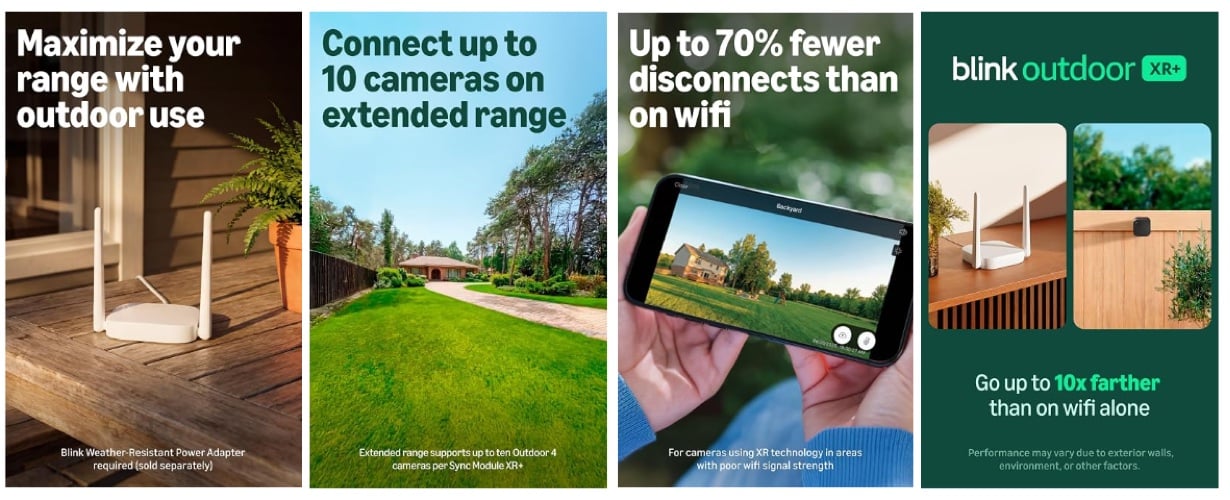
The system consists of a Sync Module XR+ router capable of connecting to up to ten Blink Outdoor 4 cameras at distances of up to 2,700 feet (about 800 meters), Blink says. For additional convenience and range, it is possible to install the router outdoors when used with Blink’s weather-resistant power adaptor. The new security camera system is a significant step up from consumer-grade 2.4 GHz Wi-Fi systems, which typically deliver only one-tenth of Blink XR+’s range. Regular Wi-Fi also has difficulty penetrating through walls when compared with IEEE 802.11ah, which operates in the sub-GHz band.
Blink says the system’s extended range delivers up to 70% fewer disconnects compared with regular Wi-Fi as well as “up to 20% quicker access to live view.” The XR+ technology operates in the unlicensed 900 MHz band, keeping camera links away from interference generated by conventional Wi-Fi devices in the 2.4 GHz band. The new Blink cameras are also remarkably power efficient: The battery on a Blink Outdoor 4 camera can last for up to two years – and the system works with Alexa, Blink says.
Not Wi-Fi HaLow but closely related
The wireless technology used by Blink XR+ is not certified Wi-Fi HaLow but rather Blink’s proprietary XR+ technology based on IEEE 802.11ah. Blink’s implementation therefore appears closely related (at the PHY/MAC level) to Wi-Fi HaLow, although it is not marketed or certified as such. A formal Wi-Fi HaLow designation would require certification by the Wi-Fi Alliance.
More and more equipment vendors are recognising the value of 802.11ah sub-GHz technology, although this – as far as we know – is the first time a company of the size and significance of Blink is embracing the technology. Some see the unlicensed sub-GHz band as a natural fourth lane for Wi-Fi systems, alongside 2.4 GHz, 5 GHz, and 6 GHz. The four together arguably support all the forms of connectivity needed for the home – from high-speed and high-capacity indoors to high-quality video and connectivity for IoT devices at the edge of your property.
The fact that Blink uses IEEE 802.11ah-based connectivity for the new system was discovered in an FCC radio test report referencing ‘general specs 802.11ah’ as well as the use of an ‘802.11ah stamped metal antenna’ (the report can be found here; see page 4). At this time, it is unknown who is providing Blink with the 802.11ah-capable chipsets needed for the new product. Amazon acquired Blink – a maker of smart home cameras and doorbells – in 2017.
WiFi NOW’s Take: Blink XR+ is significant not because Amazon has launched another security camera system, but because of the technology it has chosen to solve a very real connectivity problem. Conventional 2.4 GHz Wi-Fi was never designed to deliver low-power connectivity hundreds of metres across a property, through exterior walls, and into gardens, driveways, gates, and outbuildings. IEEE 802.11ah was.
It is particularly noteworthy that a company of Amazon’s scale has selected 802.11ah-based technology even without adopting the Wi-Fi HaLow certification and branding. In our view, this validates the fundamental proposition behind Wi-Fi HaLow: Sub-GHz connectivity fills a genuine gap in the Wi-Fi family that 2.4, 5, and 6 GHz cannot efficiently address.
Security cameras are an obvious use case, but they are unlikely to be the last. Sensors, access control, smart-home devices, outdoor IoT, and other low-power endpoints could all benefit from the same combination of range, penetration, and power efficiency. Blink XR+ may be proprietary, but its arrival is another strong indication that the market for 802.11ah-class connectivity is becoming very real.
/Claus.