
By Claus Hetting, WiFi NOW CEO & Chairman
Modern enterprise networks have become the digital nervous system of organisations. They connect employees, AI applications, industrial automation, healthcare equipment, logistics systems, security infrastructure and countless IoT devices that increasingly define how businesses operate. According to Cisco Senior Technical Leader Pelin Salem, the wireless infrastructure supporting these environments is now becoming a strategic competitive asset—and Europe’s decisions on the future of the upper 6 GHz band will help determine how quickly enterprises can embrace the next generation of digital innovation.
Speaking during a recent WiFi NOW webinar on European 6 GHz regulation, Pelin Salem argued that spectrum policy is no longer simply a technical discussion about radio frequencies. Instead, it has become an infrastructure decision with direct implications for artificial intelligence, healthcare, industrial automation and enterprise competitiveness. Her central message was clear and precise:
“Enterprise innovation follows infrastructure capability.”
The enterprise has become wireless-first
For many years enterprise Wi-Fi was viewed primarily as a convenience technology, providing connectivity for laptops, smartphones and meeting rooms. According to Salem, that picture has changed fundamentally. Today’s enterprise networks support a much broader range of applications, including:
- AI edge computing
- Industrial automation
- Robotics
- Building management systems
- Security cameras
- IoT sensors
- Badge access systems
- AR and VR devices
- Mission-critical communications
- High-density collaboration environments
As a result, enterprise wireless networks are expected to deliver far more than best-effort connectivity. They must provide predictable latency, reliable performance, secure segmentation and continuous availability across increasingly complex environments.
For Cisco, this changing role of Wi-Fi explains why future spectrum decisions matter.
Why upper 6 GHz changes the equation
According to Cisco, the importance of the upper 6 GHz band lies not simply in providing more spectrum, but in providing the right kind of spectrum.
Wide contiguous channels enable the capabilities introduced with Wi-Fi 7, including 320 MHz channels, Multi-Link Operation (MLO) and significantly lower latency. These capabilities become increasingly important as enterprises begin deploying AI-assisted applications, immersive collaboration, digital twins and industrial automation systems.
Pelin Salem also noted that Europe’s Gigabit connectivity ambitions are technology-neutral. The objective is to deliver high-performance connectivity regardless of access technology, while recognising that Wi-Fi carries the overwhelming majority of indoor traffic. In many enterprise environments, Wi-Fi-first architectures also provide lower capital and operational costs than indoor cellular alternatives.
Healthcare demonstrates the real value of 6 GHz
One of the strongest examples presented during the webinar came from healthcare. Cisco highlighted a Wi-Fi Alliance trial conducted at Thailand’s Ramathibodi Hospital, where the full 1,200 MHz available in the 6 GHz band was used to support AR and VR surgical training.
The demonstration compared applications using the full 6 GHz allocation with narrower spectrum configurations. Using the complete band delivered substantially more stable throughput and lower latency, allowing high-quality remote instruction and immersive surgical education.
The significance extends well beyond healthcare. As Pelin Salem explained, these applications are not simply about faster internet connections. They enable entirely new professional workflows that depend upon predictable wireless performance. Healthcare therefore illustrates how spectrum policy can directly influence innovation in critical public services.
Enterprise Wi-Fi extends beyond office walls
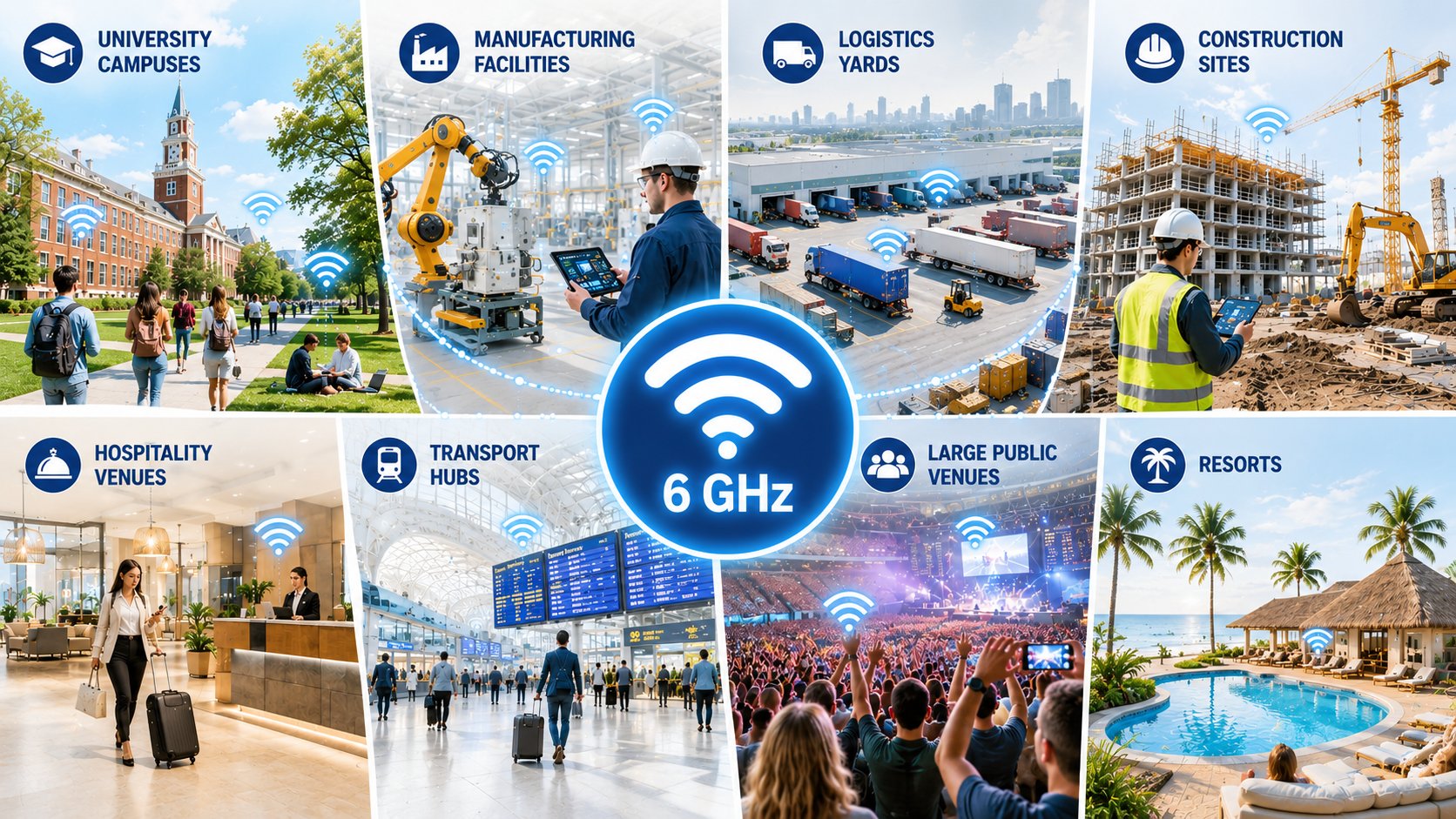
Cisco also challenged one common assumption in regulatory discussions: that enterprise Wi-Fi is primarily an indoor technology. Many business environments extend well beyond traditional offices. Examples include:
- University campuses
- Manufacturing facilities
- Logistics yards
- Construction sites
- Hospitality venues
- Transport hubs Large public venues
- Resorts
These environments require seamless wireless coverage across indoor and outdoor spaces, often supporting mobile workers and operational systems moving continuously between both. According to Cisco, low-power indoor operation alone cannot address all of these deployment scenarios. Higher-power outdoor Wi-Fi becomes increasingly important as enterprise operations become more connected and mobile.
AFC enables coexistence rather than conflict
Cisco’s presentation devoted considerable attention to Automated Frequency Coordination (AFC), which the company views as an enabling technology for spectrum sharing. Rather than statically excluding Wi-Fi from parts of the spectrum, AFC allows standard-power access points to query an authorised cloud database that determines appropriate frequencies and transmit power for a specific location while protecting incumbent licensed users.
Cisco argues that this transforms coexistence from static spectrum exclusion into dynamic spectrum coordination. Instead of asking whether Wi-Fi or licensed services should receive access to a particular band, AFC allows both to coexist under carefully controlled operating conditions.
Levi’s Stadium provides operational proof
Cisco also pointed to Levi’s Stadium in Santa Clara, California, as a practical example of this approach. The stadium’s Wi-Fi 7 deployment combines:
- Wi-Fi 7
- 6 GHz spectrum
- Standard Power operation
- Automated Frequency Coordination
- Hyper-directional access points
– to support one of the world’s most demanding wireless environments.
Beyond fan connectivity, the network supports security operations, media workflows, point-of-sale systems, stadium staff communications and increasingly high uplink traffic generated by spectators themselves. For Cisco, deployments such as Levi’s Stadium demonstrate that AFC has moved beyond theory and become a practical operational technology capable of supporting high-density enterprise environments while protecting incumbent spectrum users.
AI raises the stakes
Looking ahead, Cisco believes artificial intelligence significantly increases the importance of wireless infrastructure. While much public discussion focuses on cloud-based AI, Salem noted that AI workloads are increasingly moving towards the network edge.
Connected cameras, industrial robots, XR devices, autonomous systems and distributed sensors all require reliable, low-latency local wireless connectivity. As these applications mature, wireless performance increasingly becomes a limiting factor in digital transformation. From this perspective, spectrum availability is closely linked to the pace at which enterprises can deploy AI-enabled services.
A question of competitiveness
Cisco stopped short of arguing that regulators should favour Wi-Fi over mobile technologies. Instead, Pelin Salem repeatedly emphasised coexistence.
“The goal is not choosing Wi-Fi over incumbents,” she said during the webinar. “The goal is designing coexistence that enables both.” Nevertheless, she argued that regulatory decisions made today will influence where advanced enterprise deployments emerge first.
If access to suitable wireless infrastructure is constrained, enterprises are unlikely to abandon AI, automation or digital transformation initiatives. Instead, those deployments may simply occur more quickly in regions where the necessary infrastructure is available.
WiFi NOW Perspective: Cisco’s presentation deliberately focused on enterprise outcomes rather than spectrum politics. That makes its message particularly relevant beyond the regulatory debate itself.
Whether discussing AI, healthcare, logistics or stadium connectivity, the underlying theme remained remarkably consistent: Wireless infrastructure increasingly determines what organisations can build and deploy. As enterprise applications become more demanding, decisions about spectrum allocation become decisions about innovation capacity.
Regardless of how European regulators ultimately decide the future of upper 6 GHz, Cisco’s central observation is difficult to ignore. Enterprise wireless networks are no longer simply providing connectivity—they have become foundational infrastructure for digital transformation. The question facing policymakers is therefore not only how to manage spectrum efficiently, but how today’s regulatory choices will influence tomorrow’s enterprise innovation.
Editorial note: This article is based on Cisco Senior Technical Leader Pelin Salem’s presentation during a WiFi NOW webinar on European 6 GHz regulation, together with Cisco presentation materials. The WiFi NOW Perspective represents WiFi NOW’s independent editorial analysis.