
By Claus Hetting, Wi-Fi NOW CEO & Chairman
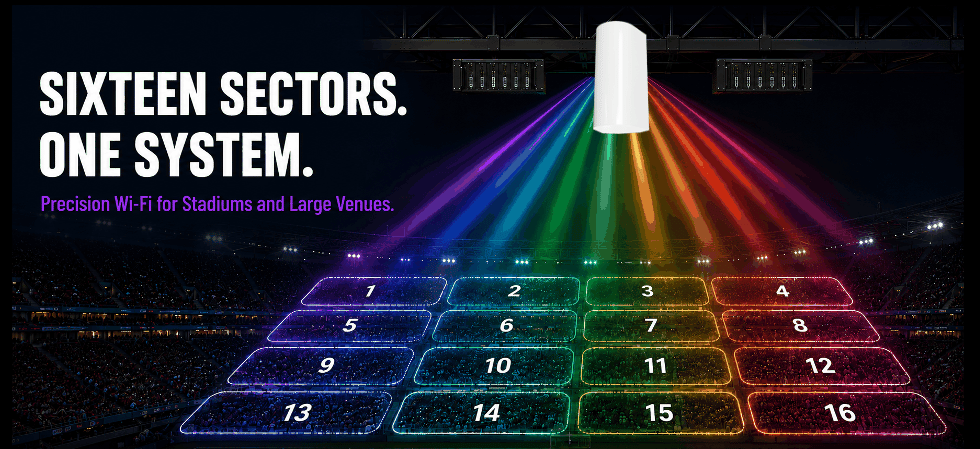
A new lens-based antenna architecture creates 16 independently served RF sectors from a single stadium mounting point. Extreme Networks says the design could reduce installation and maintenance complexity without displacing under-seat or conventional directional Wi-Fi.
KEY TAKEAWAYS:
- Extreme Multi-Beam Wireless creates 16 independently served RF sectors from one MatSing lens antenna location.
- The system uses 16 AP5022FX Wi-Fi 7 access points—one for each sector—so it reduces mounting locations rather than radio capacity.
- Extreme says the focused beams can reach 150 feet or more, extending overhead coverage beyond typical directional-antenna distances.
- The design is intended to complement under-seat, directional, and conventional indoor access points in a hybrid stadium network.
- The first installation is underway at the Tennessee Titans’ new stadium, says Extreme Networks.
A third option for the stadium bowl
Wi-Fi was never designed with a packed 70,000-seat stadium bowl in mind. Tens of thousands of unmanaged devices arrive at once, human bodies reshape the RF environment, and every fan expects fast, frictionless connectivity for messaging, video, mobile ordering, ticketing, and other venue services.
Extreme Networks has spent more than a decade engineering networks for this unusually difficult environment. Now the company is adding a new option to its stadium design toolkit: Extreme Multi-Beam Wireless, developed with antenna specialist MatSing.
The system combines Extreme Wi-Fi 7 access points with MatSing’s patented dielectric lens technology to create 16 separate RF sectors from one physical antenna location. According to David Coleman, Director of Wireless Networking at Extreme Networks, the first deployment is being installed at the Tennessee Titans’ new stadium, with several more projects in the pipeline.
The important point is that Extreme is not presenting multi-beam wireless as a universal replacement for existing stadium designs. David Coleman describes it as a third tool that can be used alongside under-seat access points and conventional directional antennas, depending on the geometry and operational requirements of each venue.
Why stadium Wi-Fi requires more than one design
The traditional under-seat approach places weatherised access points as close as possible to the fans. Short RF paths produce strong signal-to-noise ratios, while each small cell may serve roughly 75 seats. The crowd itself absorbs RF energy and helps contain each cell, enabling tight channel reuse across the seating bowl.
Under-seat Wi-Fi remains highly effective for capacity, David Coleman says, but it has practical limitations. Retrofitting cable and conduit into concrete can be expensive, retractable seating complicates installation and maintenance, and access points beneath the seats cannot adequately cover a playing field or temporary concert seating.
Conventional directional Wi-Fi solves a different set of problems. An overhead access point can direct a focused beam into a seating section, onto the field, or across other areas that cannot be reached from below. Extreme’s AP5060D, for example, offers selectable 20-degree and 70-degree beamwidths for different mounting distances and coverage geometries.
The trade-off is that a longer RF path typically delivers a lower signal-to-noise ratio at the client than an access point positioned one or two metres away. Directional cells are also larger, reducing the scope for frequency reuse, and they depend on clear sight lines. Large cells can create additional contention and hidden-node problems when clients at opposite ends of a section cannot hear one another.
This is why Extreme advocates a hybrid design. Under-seat access points can deliver dense, tightly contained cells in the bowl; directional units can cover the field, floor seating, and awkward sections; and conventional indoor access points can serve concourses, suites, concession areas, and back-of-house spaces. The right mix varies from one stadium to another.
How the multi-beam system works
At the centre of the new design is a spherical MatSing antenna inspired by the electromagnetic principles of a Luneburg lens. A Luneburg lens focuses radio energy in much the same way that an optical lens focuses light. MatSing’s implementation uses its own patented dielectric meta-material technology and multiple feed elements to form several high-gain beams pointing in different directions.
In Extreme’s architecture, one lens antenna creates 16 independent coverage sectors. Two chassis each house eight AP5022FX Wi-Fi 7 access points, for a total of 16 APs. Each access point drives one sector through external antenna connectors, so each beam remains an independently served RF cell rather than one broad signal divided across the stadium.
The AP5022FX is designed for external antenna systems and includes three 4×4:4 radios plus a dedicated tri-band sensor. It also provides two 10 GbE ports and external RF connectors supporting several radio configurations. Extreme says its initial indoor US implementation will deliver both 5 GHz and 6 GHz coverage.
The focused lens design also extends the useful reach of overhead coverage. Coleman says conventional directional stadium antennas typically operate across roughly 70 to 120 feet, while the multi-beam system can reach 150 feet or more, opening additional mounting positions high above the seating bowl.
The business case is fewer mounting points – not fewer radios
For venue operators, the most immediate benefit may be physical simplification. A conventional 480-AP design can involve as many as 480 individual mounting locations. Grouping 16 independently operating AP sectors behind each lens could reduce that example to 30 multi-beam antenna mounting points.
That calculation does not mean 480 AP radios are replaced by 30. The system still uses one AP for each RF sector. What changes is the number of antenna locations distributed around the venue, with the potential to reduce overhead mounting work, cable-routing complexity, lift or rope access, and the recurring cost of maintaining equipment in difficult-to-reach positions.
The value will depend on the venue. Multi-beam antennas will not eliminate the need for access points in suites, concourses, concession areas, or other spaces outside the bowl. Nor will they automatically be the best answer for every seating section. The strongest deployment model is therefore likely to remain hybrid, with multi-beam coverage used where its reach and mounting economics offer a clear advantage.
Six gigahertz and the role of standard power
The discussion also highlights a broader stadium Wi-Fi issue: ;aking 6 GHz coverage behave more like 5 GHz coverage. Low-power indoor operation can create a smaller 6 GHz coverage zone, complicating one-for-one access-point replacement and leaving uneven band availability at the edges of a cell.
Extreme is already using standard-power 6 GHz with Automated Frequency Coordination (AFC) in supported markets, including indoor large public venues, David Coleman says. He expects standard-power indoor operation to become more important in other enterprise environments where designers need greater 6 GHz reach. Regulatory availability remains country-specific, so this part of the architecture will vary by market.
Stadiums remain wireless technology’s proving ground
Extreme Multi-Beam Wireless is interesting not because it declares one stadium design obsolete, but because it expands the number of practical choices available to RF engineers. It can project multiple high-capacity cells from a high mounting position, reach sections that are difficult to serve conventionally, and potentially simplify the physical infrastructure required around the bowl.
Stadiums remain one of the hardest tests in Wi-Fi: enormous client density, rapidly changing RF conditions, unforgiving event schedules, and users who simply expect the network to work. Technologies proven in that setting often influence design thinking in arenas, convention centres, transport hubs, and other high-density public venues.
For Extreme, the new MatSing-based architecture is therefore both a specialised stadium product and a demonstration of a broader principle: better venue Wi-Fi comes from matching the RF tool to the problem, not insisting that every problem has the same solution.
Source note: Based on a Wi-Fi NOW Tech Watch interview with David Coleman of Extreme Networks and accompanying Extreme Networks presentation materials. Product capabilities and deployment statements are attributed to Extreme Networks.
Download David Coleman’s TechWatch presentation here.