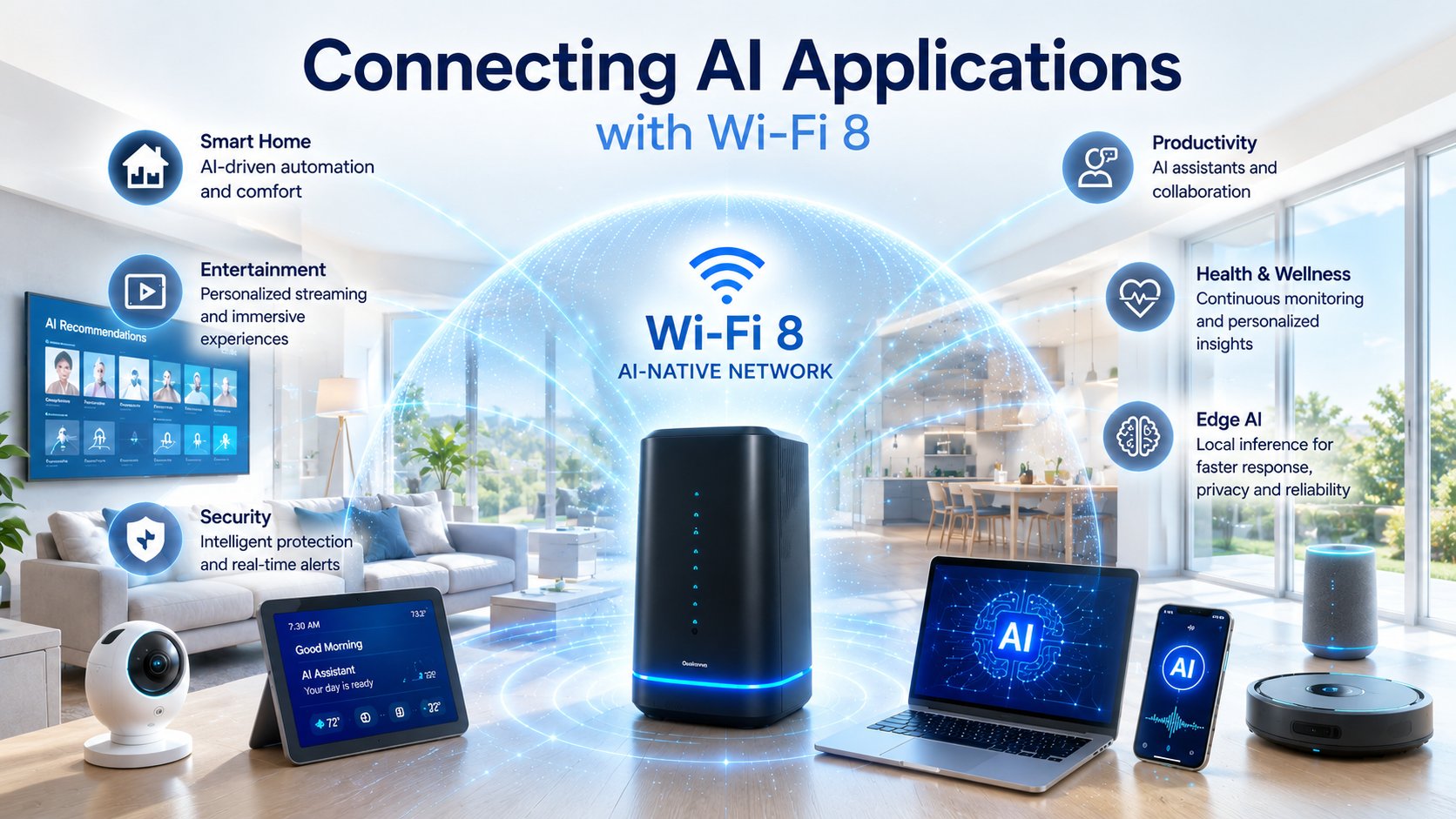

By Claus Hetting, WiFi NOW CEO & Chairman
Source: Based on Qualcomm Technologies’ presentation “Wi-Fi 8 and the New Networking Infrastructure for the AI Era” by Ganesh Swaminathan, VP & GM, Wireless Infrastructure and Networking, presented at Wi-Fi World Congress USA April 2026.
The wireless industry has spent more than two decades measuring progress in terms of faster Wi-Fi. According to Qualcomm, that era is coming to an end. Speaking at WiFi NOW Europe 2026, Ganesh Swaminathan, VP & GM of Wireless Infrastructure and Networking at Qualcomm Technologies, argued that Wi-Fi 8 represents something fundamentally different: the emergence of networking infrastructure designed specifically for the AI era.
The message aligns closely with one of the central themes emerging across the Wi-Fi industry today. AI is changing not only the applications running over wireless networks but also the requirements placed on the networks themselves.
AI changes everything—including the network
According to Qualcomm, AI is already reshaping homes, enterprises, and broadband infrastructure. Nearly one billion smart home devices are expected to ship annually, AI is becoming pervasive across enterprise workflows, and AI-generated traffic is forecast to account for roughly one-third of global network traffic over the coming years. The presentation cites rapid growth in both consumer and enterprise AI traffic as evidence that networking requirements are changing dramatically.
Ganesh Swaminathan argues that this evolution is about far more than increased bandwidth. AI systems increasingly rely on:
- Multimodal sensors
- Continuous data collection
- Edge inference
- Autonomous AI agents
- Persistent connectivity
Instead of devices periodically uploading information to the Cloud, future networks will support continuous exchanges between cloud services, edge AI, gateways, and connected devices. Ganesh Swaminathan said that networks are moving from supporting reactive applications towards enabling proactive, autonomous systems operating with minimal human intervention.
The gateway becomes an AI platform
One of Qualcomm’s most interesting observations is that broadband gateways are evolving far beyond their traditional role. Rather than acting simply as Wi-Fi routers, future gateways become:
- Edge AI compute platforms
- Network intelligence engines
- Orchestration points for connected devices
Real-time decision-making platforms
Because gateways already sit between broadband access and every connected device in the home, Qualcomm believes they are uniquely positioned to combine network visibility with local AI processing.
Instead of sending every decision to the cloud, more intelligence can remain inside the home—improving responsiveness, reducing cloud dependence, and helping preserve privacy through local processing. Qualcomm describes this as an “edge-to-cloud continuum,” where intelligence is distributed rather than centralised.
Wi-Fi 8 is about consistency—not peak speed
Perhaps Qualcomm’s strongest message concerns the changing priorities of Wi-Fi itself. Swaminathan emphasised that Wi-Fi 8 should not be viewed as another throughput upgrade. Instead, IEEE 802.11bn focuses on improving performance where users actually experience problems:
- Lower latency
- Lower packet loss
- Higher throughput under difficult signal conditions
- Better behaviour while roaming
- More predictable performance
The draft IEEE performance targets include up to:
- 25% lower latency (95th percentile)
- 25% less packet loss during access point transitions
- 25% higher throughput in challenging radio conditions
These are goals defined in the IEEE project authorisation rather than guaranteed end-user performance, but they clearly illustrate the direction of Wi-Fi 8 development.
Three pillars of AI-era networking
Qualcomm describes future networking infrastructure as resting on three equally important foundations.
- High-performance wireless connectivity: Wi-Fi remains responsible for delivering predictable wireless performance, particularly under congestion, mobility, and heavy device density.
- Broadband access: Qualcomm sees fibre and 5G Fixed Wireless Access (FWA) becoming the two dominant broadband technologies feeding AI-enabled homes and enterprises.
- Edge compute: Perhaps the newest element is compute capability built directly into networking infrastructure.
Instead of relying solely on general-purpose CPUs, Qualcomm envisions gateways combining dedicated networking acceleration with AI processing engines capable of supporting local inference, AI-assisted optimisation, and future agentic applications.
AI operating inside the network
Qualcomm also distinguishes between two different classes of AI operating at the network edge. The first is Network AI, which continuously monitors network conditions, analyses telemetry, optimises Quality of Experience (QoE), detects anomalies, and supports AIOps.
The second is Agentic AI, where gateways provide compute resources for AI applications themselves, allowing intelligent services to execute locally rather than depending entirely on cloud infrastructure. This distinction reflects a broader trend emerging across the industry: networks are no longer simply transporting AI traffic—they are beginning to participate directly in AI workloads.
An open software ecosystem
Qualcomm also highlighted the importance of software openness. Its latest infrastructure platforms support multiple broadband software environments, including OpenWrt, prpl, RDK, and OpenSync, alongside APIs for telemetry, QoS management, and containerised applications. The goal is to provide operators and developers with a unified silicon-to-cloud platform capable of supporting a wide range of deployment models.
WiFi NOW perspective: Qualcomm’s presentation illustrates how the conversation around Wi-Fi 8 has evolved. Early generations of Wi-Fi focused largely on delivering higher PHY rates and wider channels. Wi-Fi 8, by contrast, is increasingly framed as infrastructure for AI-driven connectivity.
Whether AI workloads ultimately become as pervasive as many forecasts suggest remains to be seen. However, one conclusion already appears clear: If homes and enterprises increasingly depend on autonomous devices, continuous sensing, edge inference, and real-time decision-making, network reliability, deterministic latency, and local intelligence will matter far more than another headline increase in maximum throughput.
In that sense, Qualcomm’s view captures what may become Wi-Fi 8’s defining characteristic. Rather than representing the next speed upgrade, Wi-Fi 8 may mark the point where wireless infrastructure itself becomes an active participant in the AI ecosystem rather than simply the network that connects it.